Solar Power Picks logo with sun, solar panel, and green energy icon

  • Home
  • Reviews
  • Best
    • Best portable power stations
    • Best Solar Panels
    • Best Solar Generators
  • Guides
    • Portable Power Stations Guides
    • Solar Panels Guides
    • Solar Generators Guides
  • Comparisons
    • Portable Power Stations Comparisons
    • Solar Panels Comparisons
    • Solar Generators Comparisons
  • Calculator
Home / Solar Generators / Best / Best Budget Solar Generator: Cheap Kits Worth Buying 2026

Best Budget Solar Generator: Cheap Kits Worth Buying 2026

OUR PICKS

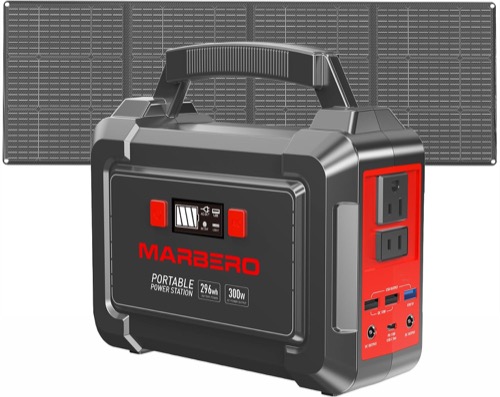
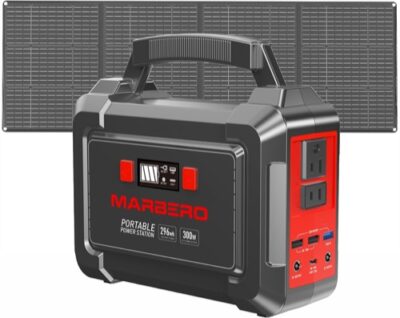
Marbero 296Wh Solar Generator Review: A Cheap, 5-Pound Camping Kit That Knows Its Limits

Best Ultra-Budget

Marbero 296Wh Solar Generator Review: A Cheap, 5-Pound Camping Kit That Knows Its Limits

Check price at Amazon Jump to details
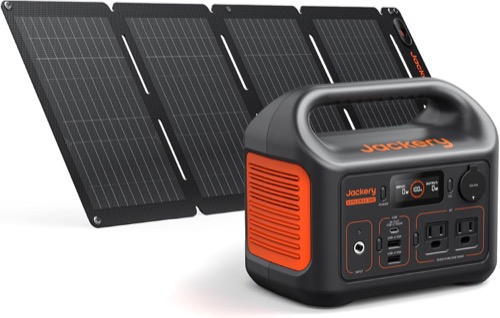
Jackery Solar Generator 300 Review: A 7.5-Pound 292Wh Kit for Fans, Phones, and Weekend Camping

Best Budget Brand-Name

Jackery Solar Generator 300 Review: A 7.5-Pound 292Wh Kit for Fans, Phones, and Weekend Camping

Check price at Amazon Jump to details
GRECELL 500W Solar Generator Review: A Budget 519Wh Kit With Its Own 100W Panel

Best Value Overall

GRECELL 500W Solar Generator Review: A Budget 519Wh Kit With Its Own 100W Panel

Check price at Amazon Jump to details
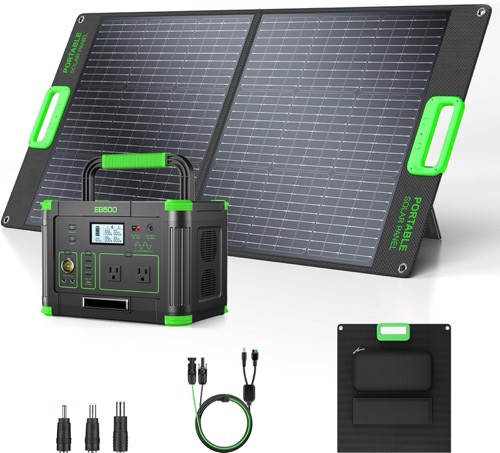
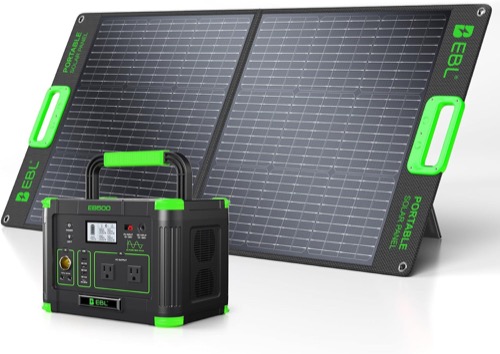
EBL 500W Solar Generator Review: A Light 519Wh Kit Built for CPAPs, Coolers, and Quiet Backup

Best 500W Value

EBL 500W Solar Generator Review: A Light 519Wh Kit Built for CPAPs, Coolers, and Quiet Backup

Check price at Amazon Jump to details
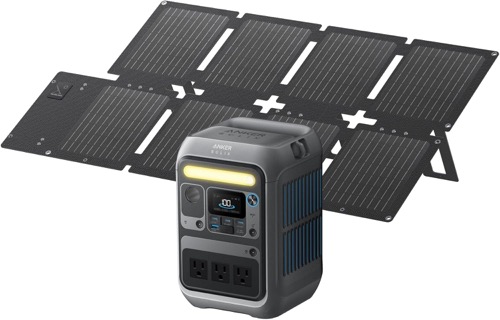
Anker SOLIX C300 Review: A Pocket-Sized 288Wh Kit With Its Own 60W Panel

Best Premium-Budget

Anker SOLIX C300 Review: A Pocket-Sized 288Wh Kit With Its Own 60W Panel

Check price at Amazon Jump to details

A budget solar generator is an exercise in what you’re willing to give up. Drop below $350 and something has to yield — usually battery chemistry, capacity, the bundled panel, or the warranty behind it. The trick isn’t finding the cheapest kit; it’s finding the one that cuts corners you don’t care about while keeping the parts you do. A $170 lunchbox that charges phones and runs a CPAP is a smart buy for the right person and a disappointment for the wrong one.

The five kits below are the cheap solar generators we’d actually spend our own money on. They run from the $170 MARBERO 296Wh up to the $390 EBL 500W, and every one ships as a panel-and-station kit so you get a working solar setup out of the box. None of them will run a house or a full-size fridge for long. All of them will keep your devices, lights, and essentials alive on a camping trip or through a short outage — which is exactly the job most budget buyers are shopping for.

What follows is an honest map of the trade-offs. Use the quick picks and comparison table above to see the lineup at a glance, then read on for how we chose, what genuinely suffers under $350, and when a cheap solar generator is the right call versus when you should spend more.

How We Chose These Budget Solar Generators

Ranking budget kits is different from ranking flagships. Headline watt-hours matter less than whether the corners a manufacturer cut to hit the price are the ones you can live with. We weighted five things, in the order that decides real value at this tier.

Criterion Why It Matters Weight
Price-to-capacity Watt-hours per dollar is the core of a budget buy — how much usable energy you actually get for the money High
Battery chemistry & cycle life Li-ion is cheaper but ages faster; LiFePO4 costs more up front and lasts years longer under repeat use High
Real usable output Continuous watts decide what runs at all, and usable Wh after inverter losses set true runtime High
Included panel’s real output A 40-60W kit panel is a trickle-charger; a genuine 100W panel refills the battery in a usable time Medium
Warranty & support Budget brands vary from 12-month cover to 5 years; thin support is a hidden cost of a cheap unit Medium

Two of those need a word on how we read them. On usable output, we treat rated capacity as a best case: at roughly 85 percent AC efficiency, a 519Wh unit like the GRECELL 500W delivers about 440Wh through the outlets, and a 296Wh MARBERO around 250Wh. On the included panel, we’re blunt that a 40W or 60W panel refills these batteries over most of a sunny day, not in an hour — which is why the 100W-panel kits score better even when the battery is the same size.

Worth knowing: At this price the panel is where corners hide. Two of our five picks include a real 100W panel; the rest ship a 40W or 60W panel that’s better thought of as maintenance power than primary recharge.

What to Expect (and What to Give Up) Under $350

Every budget solar generator makes the same handful of compromises. Knowing which ones are dealbreakers for your use is the whole game.

Li-ion vs LiFePO4 and Lifespan

This is the biggest divide in the lineup. Standard lithium-ion (Li-ion) is cheaper and lighter, which is how the MARBERO, GRECELL, and EBL hit their prices — but it’s rated for fewer cycles and ages faster. MARBERO quotes about 1,000 cycles to 90 percent capacity. LiFePO4 (LFP) costs more up front and is what earns the Jackery Explorer 300 its 4,000-cycle rating to 70 percent, and the Anker SOLIX C300 its 3,000 cycles. If you’ll cycle the battery weekly, an LFP unit keeps most of its capacity years longer; if you’ll use it a few times a year, Li-ion is the cheaper, sensible call.

Real Capacity and Runtime at This Price

These are small batteries, and their honest numbers are smaller still. The picks here span 288Wh to 519Wh, and after inverter losses you keep roughly 85 percent of that at the outlets. In practice, that’s a CPAP through the night, a phone charged a dozen times, a laptop refilled several times, and lights or a fan for an evening. It is not a full-size fridge for more than a few hours, and it is not a microwave or a heater at all. Owners consistently report exactly this: great for small devices, silent through an outage, and quick to disappoint if you plug in something over its rating.

Inverter Limits

Continuous output is the hard ceiling. The MARBERO, Jackery 300, and Anker C300 deliver 300W continuous (600W surge); the GRECELL and EBL step up to 500W (1000W surge). All five use pure sine wave inverters, so they’re safe for sensitive electronics and CPAP machines — but the watt limit is real. A 500W unit won’t run a 1,200W kettle or a 1,500W heater no matter how the box is marketed. Add up the wattage of everything you’ll run at once and keep it comfortably under the rating.

The Included Panel’s Real Output

The kit panel is the corner most often cut. The MARBERO and Anker C300 bundle a 60W panel and the Jackery 300 just a 40W one, so a full solar refill takes most of a sunny day and real-world output lands below the rating once you account for sun angle and heat — Anker owners report around 40W from the 60W panel in good sun. The GRECELL and EBL include a genuine 100W panel (23.5 percent efficiency), which refills their 519Wh batteries noticeably faster. If solar is your primary recharge plan rather than an occasional top-up, buy more panel than any of these kits include.

Warranty and Support

Support is the invisible cost of going cheap. MARBERO backs its kit with a 12-month warranty; Jackery and GRECELL sit in the middle; Anker leads the tier with a 5-year power station warranty and the most polished app and service reputation. Budget brands also carry more quality-control variance — you’ll find the occasional dead-on-arrival unit or faulty panel in owner reviews across this class — so buying from a seller with easy returns is part of buying smart at this price.

Reality check: The EBL 500W is our one pick just over the $350 line, at $390. It buys you a slightly better-finished 100W bifold panel and the highest owner ratings in the group — a fair step-up if the GRECELL’s value isn’t quite enough.

Is a Cheap Solar Generator Worth It?

For light, occasional, or backup use, a budget solar generator is genuinely worth it. If you’re charging phones and laptops, running a CPAP overnight, keeping camp lights and a fan going, or covering a router and essentials through a short outage, a $170 to $390 kit does the job silently and pays for itself the first time the grid drops. Buy Li-ion if you’ll use it a handful of times a year, LFP if you’ll cycle it often, and match the inverter watts to the biggest thing you’ll plug in.

Spend more when the job outgrows the tier. The moment you need to run a full-size fridge for a full outage, power tools, or anything over 500W, a budget unit stops being a bargain and starts being the wrong tool. That’s when it’s worth stepping up — for the full lineup and the sizing math, start at our best solar generators hub, which ranks everything from these budget kits up to whole-house systems.

Buying note: A cheap solar generator that fits your loads beats an expensive one that sits on a shelf. Size to what you actually run — then buy the smallest kit that clears it comfortably.

Related Picks and Guides

If a budget kit is close but not quite the fit, these focused shortlists and tools will steer you to the right one.

  • Best portable solar generator — the lightest grab-and-go kits for phones, laptops, and CPAP, where some of these budget picks also compete.
  • Best solar generator for camping — runtime math and lightweight kits for tents, car camping, and weekend trips.
  • Solar generator size calculator — estimate the right watt-hour class for your devices, trip length, and recharge plan before you spend.

The short version of sizing: list every device you’ll run, multiply each one’s watts by the hours you need it, add roughly 15 percent for inverter losses, then check that your single biggest device fits under the station’s continuous rating. Work from your loads and your recharge plan, and the cheapest kit that clears both is the budget solar generator worth buying.

Best Ultra-Budget

Marbero 296Wh Solar Generator Review: A Cheap, 5-Pound Camping Kit That Knows Its Limits

Marbero 296Wh Solar Generator Review: A Cheap, 5-Pound Camping Kit That Knows Its Limits

Get it now:

Check latest price

What to know

  • Li-ion chemistry rated for about 1,000 cycles to 90% capacity — best for occasional use, not weekly cycling.
  • 5.73-lb station plus a 3.08-lb folding panel; the whole kit fits in a laptop bag.
  • Eight ports, including USB-C PD, three USB-A, two 12V DC, and two AC outlets, plus an LED flashlight with SOS.
  • The 60W panel is a slow trickle-charger; the wall adapter fills it in about 7 hours.

Best if

  • You want the lowest-priced kit still worth owning
  • You mainly charge phones, a laptop, and a CPAP
  • Ultra-light, packable power is the priority

Skip if

  • You'll cycle the battery weekly and need long life
  • You need more than 300W of continuous output
  • You want more than a 12-month warranty
This is the cheapest kit in the guide that we'd still hand to a friend. At $170 you get a 296Wh Li-ion station, a 300W pure sine inverter, and a 60W panel — a complete solar setup weighing just 5.73 lbs that slips into a backpack or car trunk. Nothing here is class-leading, and the Li-ion pack won't age like LFP, but for a first camping power source or a light-duty blackout backup you won't fret over, it's the honest bargain of the bunch.
  • Capacity: 296Wh Li-ion (~1,000 cycles to 90%)
  • Output: 300W continuous / 600W surge (pure sine)
  • Solar input: 60W panel included (IP65, ~23% efficiency)
  • Weight: 5.73 lbs station; 8 ports; 12-month warranty
  • Price: $170
Best Budget Brand-Name

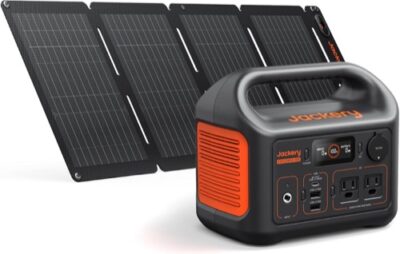
Jackery Solar Generator 300 Review: A 7.5-Pound 292Wh Kit for Fans, Phones, and Weekend Camping

Jackery Solar Generator 300 Review: A 7.5-Pound 292Wh Kit for Fans, Phones, and Weekend Camping

Get it now:

Check latest price

What to know

  • LiFePO4 chemistry: 4,000+ cycles to 70%, an 11-year-plus service life at this price.
  • 7.5 lbs — the lightest kit in the lineup, lunchbox-sized for van life and festivals.
  • 100W USB-C PD output is unusually strong for a 292Wh unit.
  • The 40W panel reaches 80% in about 7.5 hours; a 100W panel would do it in ~2.8 hours if you upgrade.

Best if

  • You want long-life LFP power at a budget price
  • Weight and packability are top priorities
  • You value a trusted brand and a strong USB-C port

Skip if

  • You need to run anything over 300W
  • You want fast solar recharge from the bundled panel
  • You want app control or the most capacity per dollar
The cheapest way onto the Jackery LiFePO4 ladder, and the pick when longevity matters more than saving another fifty dollars. At $279 you trade the Li-ion of the ultra-budget kits for a 292Wh LFP pack rated at 4,000 cycles — well over a decade of use — inside the lightest station here at 7.5 lbs. A genuinely strong 100W USB-C PD port punches above the price, though the bundled 40W panel is strictly a top-up.
  • Capacity: 292Wh LiFePO4 (4,000+ cycles to 70%)
  • Output: 300W continuous / 600W surge (pure sine)
  • Solar input: 40W panel included; 100W USB-C PD output
  • Weight: 7.5 lbs; 6 ports; 2 AC outlets
  • Price: $279
Best Value Overall

GRECELL 500W Solar Generator Review: A Budget 519Wh Kit With Its Own 100W Panel

GRECELL 500W Solar Generator Review: A Budget 519Wh Kit With Its Own 100W Panel

Get it now:

Check latest price

What to know

  • 519Wh and a 100W panel for ~$290 is the strongest capacity-and-panel-per-dollar here.
  • Li-ion (not LiFePO4) — cheaper and lighter, but fewer cycles, so best for occasional use.
  • Ten ports, including a 60W USB-C PD and a built-in wireless charging pad.
  • The real 100W monocrystalline panel (23.5% efficiency) refills it faster than the small kit panels above.

Best if

  • You want the most Wh and panel per dollar
  • You value lots of ports and a wireless pad
  • You want a real 100W panel at a budget price

Skip if

  • You'll cycle the battery weekly and need LFP life
  • You depend on it for all-night critical CPAP runtime
  • You need more than 500W of continuous output
This is the best pure value in the guide: the most capacity-and-panel per dollar at any price here. For about $290 you get 519Wh, a real 500W pure sine inverter, and — crucially — a genuine 100W panel rather than the 40-60W trickle-chargers on the cheaper kits. Ten ports and a built-in wireless pad add convenience the price doesn't suggest. The catch is chemistry: it's Li-ion, so it's the value pick for occasional use, not daily cycling.
  • Capacity: 519Wh Li-ion (smart BMS protections)
  • Output: 500W continuous / 1000W surge (pure sine)
  • Solar input: 100W panel included (23.5% efficiency)
  • Ports: 10 total, incl. 60W USB-C PD and wireless pad
  • Price: $290
Best 500W Value

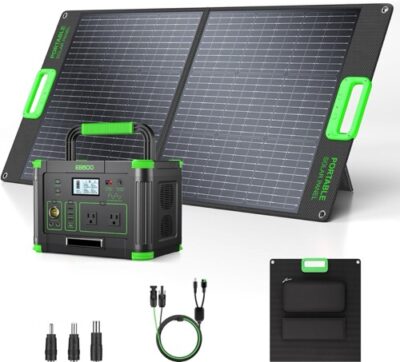
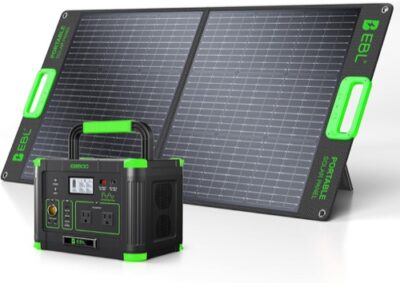
EBL 500W Solar Generator Review: A Light 519Wh Kit Built for CPAPs, Coolers, and Quiet Backup

EBL 500W Solar Generator Review: A Light 519Wh Kit Built for CPAPs, Coolers, and Quiet Backup

Get it now:

Check latest price

What to know

  • 519Wh Li-ion with a full solar recharge in 6-9 hours from the included 100W panel.
  • The 100W bifold panel adds dual kickstands, mounting grommets, and a wide adapter set for easy setup.
  • Ten devices at once: 2 AC (120V/500W), 3 USB-A QC3.0, 1 USB-C PD 60W, 12V DC and car ports, plus a wireless pad.
  • 14.1 lbs with an LED flashlight; highest owner rating here but from a small review base so far.

Best if

  • You want a well-finished 100W panel with the 500W station
  • Easy panel setup and lots of ports matter to you
  • You'll pay a small premium for higher owner ratings

Skip if

  • You want to spend the least (see the GRECELL)
  • You'll cycle it weekly and need LiFePO4 longevity
  • You need more than 500W of continuous output
The GRECELL's closest rival, and the pick if you'll pay a little more for a better-finished panel and the highest owner ratings in the group. At $390 it's our one pick just over the budget line, but you get the same 519Wh Li-ion capacity, a 500W pure sine inverter, and a 100W bifold panel with built-in kickstands and grommets that's genuinely easy to set up. A small early-review count is the only reason it isn't our outright value winner.
  • Capacity: 519Wh Li-ion (smart BMS protections)
  • Output: 500W continuous / 1000W surge (pure sine)
  • Solar input: 100W bifold panel included (20V, 23.5% efficiency)
  • Weight: 14.1 lbs; 10 ports; 6-9 hr solar full charge
  • Price: $390
Best Premium-Budget

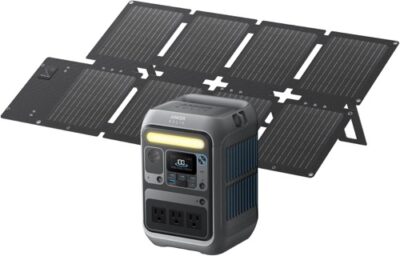
Anker SOLIX C300 Review: A Pocket-Sized 288Wh Kit With Its Own 60W Panel

Anker SOLIX C300 Review: A Pocket-Sized 288Wh Kit With Its Own 60W Panel

Get it now:

Check latest price

What to know

  • LiFePO4 chemistry (3,000 cycles) plus a 5-year warranty — the strongest longevity and support here.
  • 140W two-way USB-C recharges the unit about as fast as it charges a laptop; 0-80% from the wall in ~50 minutes.
  • Anker app connects instantly over Bluetooth or Wi-Fi for status, the light bar, and battery temperature.
  • 25dB near-silent operation; the 60W panel is a top-up, and it isn't compatible with Anker's larger PS-series panels.

Best if

  • You want the most refined, longest-supported budget kit
  • You lean on USB-C and fast two-way charging
  • App control and a 5-year warranty matter to you

Skip if

  • You want the cheapest entry point (see the MARBERO)
  • You need to run a full-size fridge or power tools
  • You want big solar intake for multi-day off-grid use
The most polished kit in the budget tier, and the one to buy when a slightly higher price buys real peace of mind. At $330 the C300 pairs a 288Wh LiFePO4 pack with Anker's best-in-class app, 140W two-way USB-C charging, a soft light bar, near-silent 25dB operation, and a class-leading 5-year warranty. It won't run a fridge, but as a refined, carry-anywhere power source that recharges as fast as it charges your laptop, nothing else here matches its finish.
  • Capacity: 288Wh LiFePO4 (3,000 cycles)
  • Output: 300W continuous / 600W surge (pure sine)
  • Solar input: 60W panel included
  • Ports: 8 total, incl. 2x 140W USB-C; 25dB; 5-yr warranty
  • Price: $330

Product Comparison

Feature Marbero 296Wh Solar Generator Review: A Cheap, 5-Pound Camping Kit That Knows Its Limits Jackery Solar Generator 300 Review: A 7.5-Pound 292Wh Kit for Fans, Phones, and Weekend Camping GRECELL 500W Solar Generator Review: A Budget 519Wh Kit With Its Own 100W Panel EBL 500W Solar Generator Review: A Light 519Wh Kit Built for CPAPs, Coolers, and Quiet Backup Anker SOLIX C300 Review: A Pocket-Sized 288Wh Kit With Its Own 60W Panel
Product Image
Marbero 296Wh Solar Generator Review: A Cheap, 5-Pound Camping Kit That Knows Its Limits
Jackery Solar Generator 300 Review: A 7.5-Pound 292Wh Kit for Fans, Phones, and Weekend Camping
GRECELL 500W Solar Generator Review: A Budget 519Wh Kit With Its Own 100W Panel
EBL 500W Solar Generator Review: A Light 519Wh Kit Built for CPAPs, Coolers, and Quiet Backup
Anker SOLIX C300 Review: A Pocket-Sized 288Wh Kit With Its Own 60W Panel
Price $169.99 $279 $289.98 $389.99 $329.98
Rating
4.2 / 5
4.3 / 5
4.4 / 5
4.8 / 5
4.6 / 5
Category Solar Generators Solar Generators Solar Generators Solar Generators Solar Generators
Brand MARBERO Jackery GRECELL EBL Anker
Model / SKU 296Wh Solar Generator + 60W Panel Kit (station M188SL60; ASIN: B0FG7MTQTH) Solar Generator 300 + 40W Panel Kit (Explorer 300; ASIN: B0G429L5B4) 500W Portable Power Station + 100W Solar Panel Kit (ASIN: B0GYP8PS1L) 500W Portable Power Station + 100W Solar Panel Kit (ASIN: B0GG9GX8CN) SOLIX C300 + 60W Solar Panel Kit (ASIN: B0DBLJRRPW)
Product type Budget solar generator kit — portable power station + 60W folding solar panel Solar generator kit — portable power station + 40W solar panel Solar generator kit — portable power station + 100W solar panel Solar generator kit — portable power station + 100W solar panel Solar generator kit — compact portable power station + 60W solar panel
Battery capacity 296 Wh 292 Wh 519.48 Wh 519.48 Wh (140,400 mAh) 288 Wh
Battery chemistry Lithium-ion (Li-ion) (~90% capacity after 1,000 cycles; not LiFePO4) LiFePO4 (LFP) (rated 4,000+ cycles to 70% capacity) Lithium-ion (listing states "lithium battery" with a smart BMS; no LiFePO4 claim) Lithium-ion (Li-ion) LiFePO4 (LFP) (rated 3,000 cycles; smart temperature control, impact resistant)
Continuous AC output 300 W (pure sine wave; rated continuous — capacity limits sustained high draw) 300 W (pure sine wave) 500 W (pure sine wave) 500 W (pure sine wave) 300 W (pure sine wave)
Surge / peak output 600 W 600 W 1000 W 1000 W 600 W
Solar input 60 W (bundled IP65 folding panel; up to 23% cell efficiency claimed; real input runs lower) 40 W (bundled Air panel; ~80% in ~7.5 hr good sun) Up to 100 W (bundled monocrystalline panel; ~18V, up to 23.5% cell efficiency) 100 W max (20V; bundled monocrystalline panel, up to 23.5% cell efficiency) 60 W (bundled foldable panel; owners cite IP68 water resistance)
Wall (AC) recharge ~7 hours from the 19V DC adapter Included AC adapter (fastest path; recharge time not specified by brand) Not specified by listing A few hours with the included AC adapter 80% in about 50 minutes (full charge shortly after)
Car recharge Yes — via the included cigarette-lighter (12V) cable N/A N/A N/A N/A
Solar recharge ~7.5 hours in strong sun (owner-measured) (longer in weak or cloudy conditions) ~80% in ~7.5 hr from the 40W panel (~2.8 hr with a 100W panel, sold separately) Roughly a full sunny day from the 100W panel (real input often ~60-70W; 100W input cap) ~6-9 hours full charge in good sun (real input varies with angle and cloud cover) Most of the pack over a good sunny day (owners measured ~40W in full sun; ~5-15W heavily overcast)
AC outlets 2 (110V pure sine wave; one 2-prong, one 3-prong) 2 (pure sine wave) 2 (pure sine wave, 500W) 2 (120V, 500W total, pure sine wave) 3 (pure sine wave; 300W total)
USB-C ports 1 (PD 18W) 1 (100W PD) 1 (60W PD max) 1 (PD, 20V/3A, 60W max) 3 (2× 140W two-way fast charge, 1× 15W)
USB-A ports 3 (2x QC3.0 18W, 1x QC3.0 15W) 2 3 (QC3.0, 18W each) 3 (QC3.0, 18W max each) 1 (12W)
12V DC ports 2 (for car coolers, LED strips) 1 (120W car port) N/A N/A 1 (car socket, 120W)
Built-in light Yes — LED flashlight with SOS mode N/A N/A LED flashlight (steady, strobe, SOS modes) Yes — soft, diffused front light bar (app- and button-controlled)
Display LCD status screen (owners note it is dim and hard to read in bright daylight) N/A Built-in information window (charge level and load) N/A N/A
Protection Built-in BMS (overcharge, overheat, short-circuit protection) N/A N/A N/A N/A
Station weight 5.73 lb (9.09 x 4.01 x 8.38 in) N/A N/A N/A N/A
Panel weight 3.08 lb (folds to 10.15 x 13.93 x 1.18 in; unfolds to 13.93 x 40.7 in) N/A N/A N/A N/A
Panel waterproofing IP65 (light rain, dust; do not submerge) N/A N/A N/A N/A
Warranty 12 months (plus Amazon-message customer service) Manufacturer warranty (per Jackery; register to confirm term) Not specified by listing N/A 5 years
What's in the box 1x M188SL60 power station, 1x 60W solar panel, 1x power adapter, 1x cigarette-lighter adapter, 1x user manual 1× Explorer 300 station, 1× 40W Air solar panel, 1× AC adapter, 1× car charger cable, 1× user guide 1× 500W / 519.48Wh power station, 1× 100W monocrystalline solar panel, adapters and connectors, charging cables, user manual 1× EBL 500W power station, 1× 100W folding solar panel with adapter cables, charging accessories, user manual 1× SOLIX C300 station, 1× 60W solar panel, XT-60 to DC7909 charging cable, solar-to-XT60 charging cable, extension cable, AC charging cable, safety manual, warranty info (station and panel ship separately)
Best for Cheap, light backup for phones, laptops, small fans, lights, CPAP-class low-draw gear, and short-run small appliances while camping, in an RV, or during outages — based on actual customer usage Vanlife, tent camping, travel, CPAP, and blackout backup — quiet, light, budget power for phones, fans, lights, and small electronics — based on actual customer usage Camping, travel, RV trips, and small-device emergency backup — phones, laptops, fans, a CPAP, and a mini-fridge — based on actual customer usage Camping, road trips, fishing, CPAP backup, and short home outages — light, quiet, fumeless sub-500W power with a solar panel already included — based on actual customer usage Travel, remote work, camping, and emergency backup for phones, laptops, and small devices — quiet, light power with a solar panel already included — based on actual customer usage
Buy Now View Deal View Deal View Deal View Deal View Deal

Which Budget Solar Generator Should You Buy?

The best budget solar generator is the cheapest kit that still covers your real loads without cutting a corner you'll regret. For most people that's the GRECELL 500W ($290) — our Best Value Overall, with 519Wh, a genuine 500W inverter, and a real 100W panel for the money. If you want the same 500W class with a slightly better-finished panel and higher owner ratings, the EBL 500W ($390) is the Best 500W Value, just above our budget ceiling.

Spend less and accept less. The MARBERO 296Wh ($170) is our Best Ultra-Budget pick — a 5.73-lb Li-ion lunchbox for phones, a CPAP, and lights, with the shortest cycle life here. Willing to pay a little more for chemistry that lasts? The Jackery Explorer 300 ($279) is the Best Budget Brand-Name — LiFePO4 rated for 4,000 cycles and a strong 100W USB-C port — while the Anker SOLIX C300 ($330) is our Best Premium-Budget, adding app control, 140W two-way USB-C, and a 5-year warranty.

Under $350, you're choosing between more capacity per dollar (Li-ion) and a battery that lasts years longer (LiFePO4). Pick by how often you'll cycle it: occasional trips and blackouts favor value, weekly use favors LFP. If your loads climb past 500W or a full-size fridge, don't stretch a budget unit — step up to the portable or full solar generator shortlists instead.

---

Frequently Asked Questions

Are cheap solar generators worth it?

Yes — for the right job, and if you buy with your eyes open. A budget solar generator earns its price when you're charging phones, a laptop, camp lights, and a CPAP, or keeping essentials alive through a short outage. Every pick here ships as a kit, so you get a working solar setup out of the box for $170 to $390. Where cheap units disappoint is when you expect too much: a 296Wh to 519Wh battery won't run a full-size fridge for long, the bundled 40W to 100W panel refills slowly, and the Li-ion packs in the value picks age faster than the LiFePO4 units. Buy for light, occasional, or backup use and a cheap solar generator pays for itself the first time the power goes out.

What is the best budget solar generator?

For most buyers it's the GRECELL 500W at about $290 — our Best Value Overall. You get 519Wh of capacity, a real 500W pure sine inverter, ten ports with a built-in wireless pad, and a genuine 100W panel, which is the strongest capacity-and-panel-per-dollar combination here. If longevity matters more than price, the Jackery Explorer 300 ($279) uses LiFePO4 chemistry rated for 4,000 cycles instead of Li-ion, and the Anker SOLIX C300 ($330) adds app control and a 5-year warranty. To spend the absolute minimum, the MARBERO 296Wh ($170) is the cheapest kit here still worth owning.

Why do budget solar generators use Li-ion instead of LiFePO4?

Cost and weight. Standard lithium-ion (Li-ion NMC) cells are cheaper to produce and lighter for the same capacity, which is how the MARBERO 296Wh, GRECELL 500W, and EBL 500W hit their prices. The trade-off is cycle life: MARBERO rates its pack for about 1,000 cycles to 90% capacity, while a LiFePO4 (LFP) unit like the Jackery Explorer 300 is rated for roughly 4,000 cycles to 70% and the Anker SOLIX C300 for 3,000. If you'll charge and drain the battery weekly, LFP keeps most of its capacity years longer and is the better value over time. For occasional camping and emergency use, a Li-ion pack is fine and saves you money up front.

What can a budget solar generator actually run?

Small electronics and low-wattage devices, not major appliances. The picks here deliver 300W to 500W of continuous output, so they comfortably run phones, tablets, laptops, cameras, routers, fans, LED lights, and a CPAP, plus small items like a mini cooler or a bottle warmer. Real runtime depends on capacity: after inverter losses you get roughly 250Wh usable from a 296Wh unit and about 440Wh from a 519Wh unit, enough for a CPAP overnight or a phone charged many times over. What they cannot do is run a full-size refrigerator for long, a microwave, a space heater, or anything above their 300-500W rating. Match the biggest device you'll plug in to the inverter watts first, then size capacity for how long you need it.

Can I recharge a budget solar generator with the included panel?

You can, but slowly — the bundled panel is the corner most cut at this price. The MARBERO and Anker C300 kits include a 60W panel and the Jackery 300 just a 40W panel, so a full solar refill takes most of a sunny day and real output usually lands below the rated wattage once you factor in sun angle, heat, and cloud. The GRECELL and EBL kits include a genuine 100W panel, which is why they refill noticeably faster. Treat solar on the small-panel kits as maintenance or top-up power rather than your primary recharge, and if solar is your main plan, budget for a larger panel than the kit provides.

What is the cheapest solar generator worth buying?

The MARBERO 296Wh at about $170 is the cheapest kit here we'd still recommend. For that price you get a 296Wh Li-ion power station, a 300W pure sine inverter, eight ports, an LED flashlight with SOS, and a 60W solar panel — a complete, genuinely portable setup at 5.73 lbs. The honest caveats are its shorter Li-ion cycle life, a small 60W panel that charges slowly, and a 12-month warranty rather than the multi-year coverage on pricier picks. For a light-duty backup or a first camping power source you won't cry over, it's the best true bargain. Spend $100 more only if you want LiFePO4 longevity or app control.

×

About Solar Power Picks

Portable Solar Power, Backup Power, and Off-Grid Gear Guides

Your trusted source for honest, in-depth product reviews and comparisons.

Quick Links

  • Best Picks
  • Reviews
  • Guides
  • Comparisons
  • Calculator
  • Privacy policy
  • Favorites

Categories

  • Portable Power Stations
  • Solar Generators
  • Solar Panels

© 2026 Solar Power Picks. All Rights Reserved.

We may earn a commission when you purchase through links on our site. Learn more