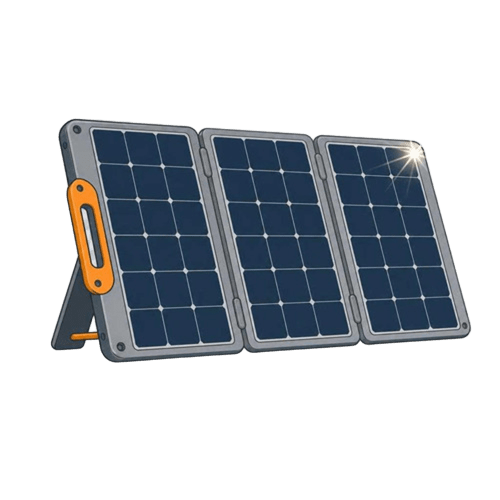
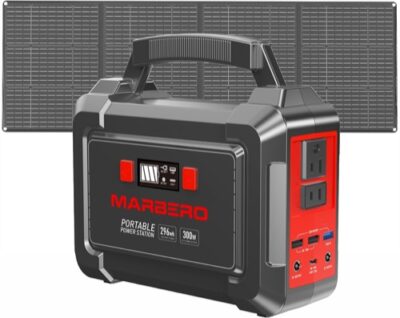
Marbero 296Wh Solar Generator Review: A Cheap, 5-Pound Camping Kit That Knows Its Limits
At a Glance
KEY FEATURES
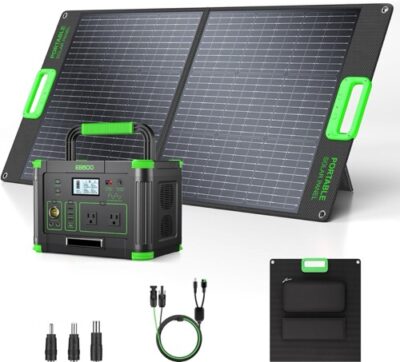
- Exact kit: MARBERO M188 with 60W foldable solar panel.
- Battery/output: 296Wh NCM, 300W continuous AC, 330W surge.
- Solar: 60W included; one owner describes about 7.5 hours in strong sun.
- Evidence caution: One owner waveform description conflicts with exact primary documentation.
- Best fit: Price-sensitive small-device camping and communications backup.
PROS
- Light station and panel make the complete kit easy to carry.
- 296Wh is useful for electronics, radios, lights, fans, and laptops.
- 60W panel can replenish a modest daily device budget.
- Low price can make solar backup accessible for narrow missions.
CONS
- 300W continuous and 330W surge exclude many appliance loads.
- NCM chemistry and limited cycle-life detail trail current LFP competitors.
- One waveform report conflicts with primary documentation.
- Dim-display and isolated early-failure reports demand prompt testing.
Budget pick for small devices
Exact documentation plus 96 usable qualitative owner records. Score rewards portability and mission-fit value while accounting for limited output, NCM chemistry, display/failure narratives, and a waveform source conflict.
Exact primary material identifies the M188 AC output as pure sine wave, while one supplied owner report calls the delivered output modified sine wave. That single account does not override the documentation, but buyers of waveform-sensitive equipment should verify the delivered revision and output before relying on it.
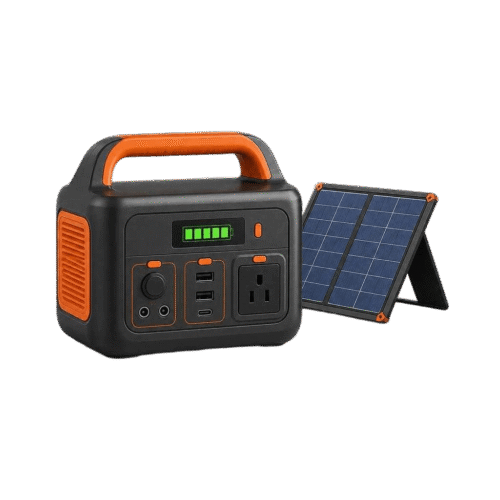
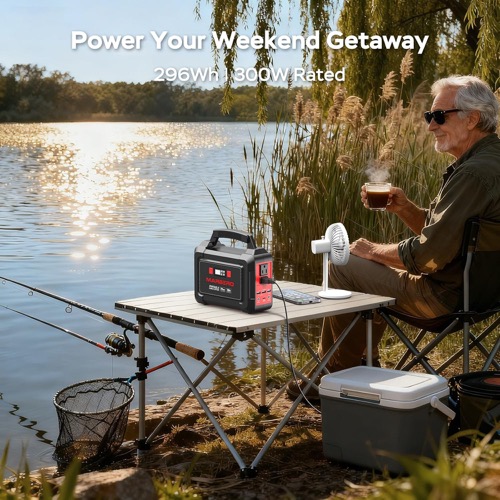
The MARBERO M188 kit is an expectation-management product. It combines a lightweight 296Wh NCM station, 300W continuous AC output, 330W surge, and a 60W foldable panel. The package is suited to radios, phones, laptops, cameras, lights, fans, small televisions, and short emergency tasks. It is not a low-cost substitute for a 1kWh refrigerator or cooking system.
Ninety-six usable owner records provide strong qualitative context for camping, communications, lighting, device charging, portability, and small-load backup. They also include dim-display complaints, early failures, solar and charging variability, and the waveform conflict. One exact owner describes about 7.5 hours of strong sun for solar recovery. That is a case study, not a guaranteed full-charge time.
Spend the battery here
Radio, router, phone, camera, laptop, LED light, USB fan, small display, and brief low-power AC tasks.
Do not spend it here
Heating, cooking, full-size refrigeration, high-start motors, or any critical device whose waveform requirement is unresolved.
A 296Wh battery needs a written priority list. Use native USB or DC paths where safely compatible to reduce conversion overhead. Protect an emergency communications reserve. Test the display in daylight and darkness because poor legibility can make state-of-charge management difficult. Do not wait for an outage to learn the button sequence or output timeout.
| Acceptance test | Why M188 needs it | Record |
|---|---|---|
| Waveform-sensitive load | Primary and one owner source conflict | Exact revision, device behavior, and qualified measurement if required |
| Display | Owner complaints mention dim readability | Charge percentage and icons in sun and at night |
| 60W solar | All-day recharge depends on setup | Stable watts and total watt-hours across the solar window |
| Early-life cycling | Isolated early failures appear in the record | AC charge, solar charge, full discharge segment, and all outputs |
The 60W panel is proportionate to a small travel kit, but not fast. A 7.5-hour strong-sun owner account is plausible context; shade, heat, angle, cable loss, battery taper, and active loads can extend it. Reposition the panel and compare daily harvest against daily device demand. If the load list consumes more than the sun replaces, use wall/car charging or buy a larger documented system.
The M188 Expectation Budget
| Spec | Value |
|---|---|
| Battery Capacity | 296 Wh lithium-ion (Li-ion) |
| Continuous AC Output | 300 W (pure sine wave) |
| Surge / Peak | 600 W |
| Solar Input | 60 W (bundled folding IP65 panel) |
| Wall Recharge | ~7 hr (19V DC adapter) |
| Ports | 2 AC, 1 USB-C (18W), 3 USB-A, 2 12V DC |
| Extras | Built-in LED flashlight with SOS mode |
| Weight | 5.73 lb (station), 3.08 lb (panel) |
| Warranty | 12 months |
| Best For | Camping, small-device backup, outages |
Small-Load Verdict Before the Feature List
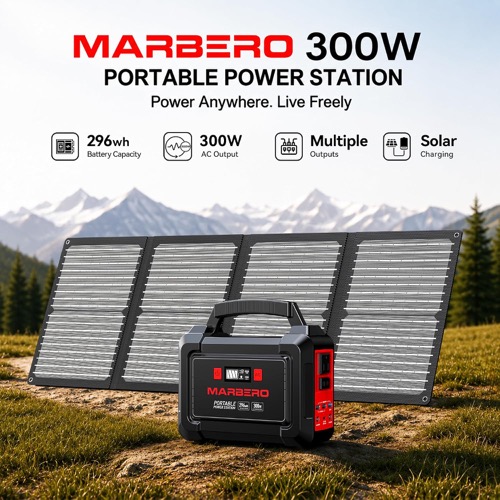
If you want cheap, genuinely portable power for small devices, this Marbero 296Wh solar generator review lands on a qualified yes. The kit is light — a 5.7 lb station and a 3.1 lb folding panel that both fit in a laptop bag — and the exact documentation identifies a 300W pure-sine inverter, although one owner report conflicts with that waveform description, running a TV, a bass amp, or a small fan cleanly. Eight ports let you charge two phones, a watch, and a laptop at once. Just size your expectations to the 296Wh tank: it’s built for phones, laptops, lights, and short-run small appliances, not fridges or air conditioners. Buy it as a light camping and emergency companion and it delivers well above its price. Buy it hoping to power a household and you’ll be disappointed.
Carry Weight, Display Legibility, and Cable Inventory
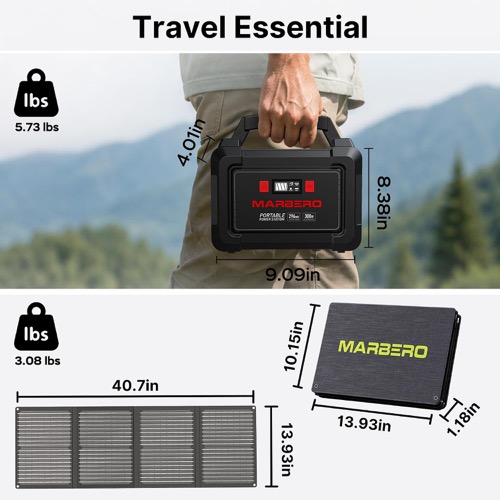
The first thing owners notice is how little there is to carry. The station weighs about 5.73 lbs and measures roughly 9 by 4 by 8 inches — small enough that one buyer called it “smaller size wise than expected,” which in this category is praise. The folded panel adds another 3.08 lbs and packs down to about the footprint of a large laptop, so the whole kit slides into a camping backpack or an old laptop bag. The shell gets described as solid, impact-resistant material, and the built-in LED flashlight with an SOS mode earns repeated mention as a genuinely useful extra for nighttime camping and blackouts.
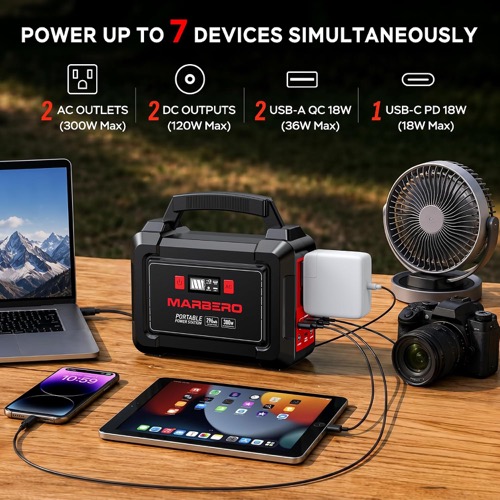
Port selection is the standout for the price. You get one USB-C PD 18W port, three USB-A ports (two 18W and one 15W QC3.0), two 12V DC ports for car coolers or LED strips, and two 110V AC outlets — a 2-prong and a 3-prong. That’s eight outputs, enough that owners keep two phones, a smartwatch, and a laptop going without swapping cables, and one topped two phones and a watch while inflating an air mattress twice on half a charge. The AC is pure sine wave, not a modified-sine shortcut, so a bass amp runs “with no issue” and a TV behaves normally.
The build isn’t flawless. The most common complaint is the display: several owners find it dim and hard to read in bright daylight, with one calling it “mirrored” and nearly invisible “unless in a certain amount of darkness.” It’s readable indoors and at night, but checking your charge level outside in full sun can mean cupping a hand over the screen. And the chemistry is the budget tell — this is lithium-ion, rated for about 90% capacity after 1,000 cycles, not the 3,000-to-4,000-cycle LiFePO4 you’d find in a pricier station.
Spend 296Wh on Radios, Lights, Laptops, and Fans
Start with the honest usable number. After inverter and conversion losses, a 296Wh lithium-ion pack delivers roughly 252 watt-hours to your devices — call it 296 times 0.85. That figure, not the nameplate, is what your runtime math should use, and at this size the difference matters.
From there the story splits cleanly. The 300W inverter decides what you can plug in; the small 296Wh pack decides how long it lasts. Push a load near 300W and you’ll empty the battery in well under an hour. Stay under about 100W — phones, a laptop, a small fan, lights, a CPAP — and it stretches into hours or a full night. That’s exactly what owners report: one ran a tower fan, a laptop, a phone, and a 100W lamp together and got about 7.5 hours before it died, while another warns that powering a device that’s actively working “will drain the battery fast.”
| Device (typical draw) | Estimated Runtime | Owner-Grounded Note |
|---|---|---|
| Near-max AC load (~300 W) | ~0.7 hr | Inverter delivers it; 296Wh empties fast |
| Mixed load (~100 W avg) | ~2.5 hr | Owner ran fan + laptop + phone + lamp ~7.5 hr lighter |
| 60W mini car fridge (~30 W avg) | ~7-8 hr | Cycling keeps average draw low |
| CPAP, no humidifier (~35 W) | ~6-7 hr | Roughly one night of use |
| 13-inch laptop (~60 Wh) | ~4 charges | Matches Marbero’s own claim |
| iPhone 15 (~14 Wh) | ~12-15 charges | Matches Marbero’s own claim |
| 10W LED camping light | ~20 hr | Matches Marbero’s own claim |
Callout — The 300W pure sine inverter decides what you can plug in; the 296Wh pack decides how long it runs. Owners power a TV, a bass amp, and a heat gun in bursts — the inverter handles the load, but the small battery sets the clock. Keep loads under about 100W and you’ll get the long, satisfying runtimes; run anything near 300W and plan in minutes, not hours.
These are estimates. Your real numbers shift with the device’s actual draw, the starting charge, and temperature — and remember the owner caution that charging a device while it’s actively in use pulls the pack down noticeably faster.
A Seven-and-a-Half-Hour Owner Solar Day in Context
The kit’s best feature is that it doesn’t leave you tethered to a wall outlet. There are three ways to refill it: the 19V DC adapter, which recharges the station in about 7 hours; the included cigarette-lighter cable, which tops it up from a car’s 12V socket; and the folding 60W panel for off-grid days. One owner during a power outage simply ran the car for half an hour to claw back useful charge, which captures how the recharge options complement each other.
The solar side is real but modest, and worth clear expectations. Marbero rates the panel at 60W with up to 23% cell efficiency and an IP65 rating for light rain and dust, and it folds down small enough to slip into a laptop bag. In strong sun it works: one owner in the Palm Desert in midsummer fully recharged the station from the panel in about 7.5 hours. In weaker conditions the reality is softer — another buyer felt it performed like “a 30W panel,” getting only “2 or 3 bars depending on the weather,” and one owner’s panel stopped charging within a few weeks and became “a dud.”
The takeaway is to treat solar as a top-up, not a fast refill. Sixty watts is a small input, real-world output always runs below the rating, and a full solar recharge realistically eats most of a sunny day. The wall adapter’s roughly 7-hour charge is your dependable primary method; the panel is the bonus that keeps you going when there’s no outlet in sight. Given the isolated panel failure, test both halves of the kit early in the return window.
Callout — The smartest way to use this kit off-grid is to keep the panel aimed at the sun during the day and lean on the wall or car charger when you can. The 60W panel refills the 296Wh pack over a good solar day, but it won’t outrun a load you’re running at the same time — so charge it up before you need it, not while you’re draining it.
Waveform Conflict, Dim Display, and Early-Failure Checks
No sub-$200 kit is free of compromises, and it’s fair to name Marbero’s. The chemistry is the big one: this is lithium-ion, not LiFePO4. Marbero’s own 1,000-cycle rating is fine for weekend and emergency use, but a LiFePO4 station lasts three to four times as long under daily cycling, so heavy repeat users will feel the difference over the years. Related is the warranty — 12 months, against the 5 years common on premium LFP kits.
The display is the day-to-day annoyance. Its poor daylight visibility means the one piece of information you most want outdoors, remaining charge, is the hardest to read in the sun. One owner also found the unit “not exactly user friendly” at first, so budget a few minutes to learn its buttons rather than expecting a polished, premium interface. And several owners, even happy ones, wish the charging were faster; a multi-hour wall refill is not a quick turnaround.
None of these are dealbreakers at the price, but they’re the difference between this kit and one that costs two or three times as much. You’re trading longevity, screen quality, and charging speed for weight, ports, and a very low sticker price.
M188 Mission Envelope
| Use Case | Fit | Why |
|---|---|---|
| Camping / backpacking | Strong fit | 5.7 lb station, small folding panel |
| Phone, laptop, tablet charging | Strong fit | Eight ports; 12-15 phone charges |
| Small-device outage backup | Strong fit | Holds charge in storage; SOS light |
| CPAP / low-draw overnight gear | Solid fit | ~6-7 hr on a humidifier-free CPAP |
| Small appliances, short bursts | Solid fit | 300W pure sine runs a TV, amp, fan |
| Off-grid top-ups | Borderline | 60W solar is slow; treat as a top-up |
| Running a full-size fridge | Not ideal | 296Wh drains fast under real loads |
| Air conditioners / high-draw tools | Not recommended | Beyond a 296Wh, 300W kit’s ceiling |
| Daily heavy cycling for years | Not recommended | Li-ion ~1,000 cycles, not LiFePO4 |
Buy it when you want:
- A cheap, genuinely light kit for phones, laptops, lights, and small gear
- A real 300W pure sine inverter and eight ports for the price
- Three ways to recharge, including a panel that’s actually in the box
- A grab-and-go camping and small-outage backup, not a house battery
Look elsewhere if you need:
- Hours of runtime on a fridge, AC unit, or heavy continuous load
- LiFePO4 longevity for daily cycling over many years
- Fast recharging or a screen that’s easy to read in bright sun
- A long warranty to match a premium-tier station
MARBERO 60W Kit: Price-First Final Decision
For campers, road-trippers, and anyone assembling a small-device emergency kit on a budget, this Marbero 296Wh solar generator review comes down in favor — with the size caveat front and center. The station is easy to recommend for what it is: light, cheap, well-connected with eight ports, and backed by a clean 300W pure sine inverter that runs a TV, a small amp, or a fan without complaint. Owners lean on it happily through camping trips, road trips, and multi-day outages, and one has three trouble-free years on the clock. The included 60W panel and the wall and car charging make it a true, self-contained little power kit rather than a battery you have to build out.
The trade-offs are honest and worth respecting. The 296Wh pack drains fast under any real AC load, the chemistry is lithium-ion with a ~1,000-cycle life rather than long-lived LiFePO4, the display is hard to read in daylight, and solar recharging is slow enough that you’ll rely on the wall adapter. So the if/then is simple: if you want a light, low-cost companion for phones, laptops, lights, and short-run small appliances while camping or riding out a blackout, the Marbero 296Wh solar generator is an easy yes. If you’re hoping to power a fridge, an AC unit, or a household, spend more and step up to a larger LiFePO4 station before you buy.
Pros & Cons Analysis
Based on documented specifications and owner feedback
Pros
- The kit is genuinely portable — Low combined weight increases the chance that both station and panel are carried and deployed on short trips.
- Small-load evidence is extensive — Supplied accounts cover radios, lighting, fans, phones, laptops, cameras, television, and camping scenarios.
- Solar is appropriately sized for light demand — A 60W module can replace a modest device budget without the bulk of a large panel.
- Port diversity supports efficient paths — Using native USB/DC where appropriate can conserve more of a small battery than running AC adapters.
- Value is mission-specific — Buyers who need limited energy can avoid paying for inverter and battery capacity they will not use.
Cons
- Waveform uncertainty matters for sensitive loads — One owner conflicts with exact pure-sine documentation, so delivered revision and device compatibility should be verified.
- Energy disappears quickly under AC load — A device can remain below 300W yet consume most of 296Wh in a short period.
- Solar remains weather-bound — A 7.5-hour strong-sun account cannot be generalized to cloud, shade, heat, winter, or active-load conditions.
- Display readability affects management — A dim screen can make reserve and fault interpretation harder in bright daylight.
- Early-life testing is essential — Isolated failures make return-window cycling, port tests, and documentation more valuable than leaving the kit boxed.
A Useful Low-Cost Device Kit With No Room for Inflated Expectations
The M188 and 60W panel are credible for light, small-device missions and buyers who prize carry weight and price. Avoid appliance-class expectations, verify waveform-sensitive loads, and complete early-life charging, display, and output tests.
Frequently Asked Questions
Is the MARBERO M188 pure sine wave?
Exact primary documentation says pure sine wave, but one supplied owner report conflicts. For waveform-sensitive equipment, verify the delivered revision and obtain qualified measurement or manufacturer confirmation.
How long does the 60W panel take to charge it?
One owner reports about 7.5 hours of strong sun. Actual recovery depends on sun, angle, shade, heat, cable loss, battery state, and concurrent loads.
Can it run a refrigerator?
Its 300W/330W output and 296Wh battery make full-size refrigeration a poor default mission. A small cooler may work only after startup and duty-cycle measurement.
Can it run a laptop?
Usually when the laptop's required power is within a supported output. Use a compatible direct USB path where possible and include the laptop's total daily watt-hours.
Why does display brightness matter?
A hard-to-read display can hide reserve, input, output, or fault state. Test it in daylight and darkness before relying on the kit.
What early tests should I run?
Verify exact labels, AC and solar charging, every port family, the highest planned load, display readability, a partial discharge/recharge cycle, and the documented warranty contact.
Technical Specifications
| Brand | MARBERO |
|---|---|
| Kit model / SKU / ASIN | M188 + 60W panel bundle (bundle model M188SL60; ASIN B0FG7MTQTH) |
| Power-station model | MARBERO M188 |
| Included solar-panel model and quantity | 1 × MARBERO 60W foldable panel |
| Battery capacity | 296Wh |
| Battery chemistry | Lithium-ion; not LiFePO4 |
| Cycle-life rating | 1,000 cycles to about 90% capacity in the exact bundle documentation |
| Expandable capacity | No expansion-battery port |
| Continuous AC output | 300W |
| Surge / peak output | 330W |
| AC voltage, frequency, and waveform | 110V, 60Hz, pure sine wave |
| AC outlets and high-current / RV / 240V outputs | 2 × AC; no high-current RV or 240V output |
| USB and DC outputs | 2 × USB-A QC 18W, 1 × USB-A 15W, 1 × USB-C 18W, 2 × DC outputs |
| Maximum station solar input | Station maximum is not published for the exact M188 bundle; included panel is 60W |
| PV input voltage/current range and connector | 18–24V DC input through the bundled DC adapter path; maximum current is not published |
| Included panel rated power | 60W |
| Panel Voc / Vmp / Isc / Imp | 18–24V DC panel output; exact Voc, Vmp, Isc, and Imp are not published for the bundled revision |
| Panel construction and cell type | Foldable monocrystalline panel in an Oxford-cloth body; 23% published cell efficiency |
| Panel weather rating | IP65 panel |
| Panel dimensions and weight, folded / deployed | Folded 10.15 × 13.93 × 1.18 in; deployed 13.93 × 40.7 in; 3.08 lb |
| Solar recharge estimate with included panel | Owner-measured about 7.5 hours in strong sun; manufacturer does not publish an exact full-charge time |
| Maximum AC input and AC recharge time | Included 19V adapter; about 7 hours to full |
| Car, alternator, and other charging methods | 12V vehicle charging through the included cigarette-lighter cable |
| UPS / EPS support and transfer time | No documented UPS/EPS transfer-time rating |
| App and connectivity | No app or wireless connectivity |
| Station dimensions, weight, operating limits, and weather rating | 9.09 × 4.01 × 8.38 in; 5.73 lb; operating limits and IP rating are not published for the exact station |
| Station and panel warranties | 12-month bundle warranty |
| Included in the box | M188 station, 60W foldable panel, AC adapter, 12V car cable, user manual |