Renogy Wanderer 10A Review: Budget PWM with Useful Controls
At a Glance
KEY FEATURES
- Output: 10A PWM charging with 12V/24V recognition for non-lithium batteries.
- PV limits: 50V Voc; 130W @ 12V or 260W @ 24V.
- Battery support: Lead-acid and lithium selection with adjustable lithium voltage.
- Monitoring: Backlit LCD; optional BT-1 module through RS232.
- Best fit: Small, price-sensitive lighting, shed, fence, and maintenance systems.
PROS
- Local LCD and programmable load modes suit small sheds, lights, gates, and maintainers.
- Recognizable documentation and support channels distinguish it from anonymous PWM units.
- Low cost is rational when the array is voltage-matched and comfortably below 10A.
CONS
- PWM conversion and a 10A ceiling leave little room for array growth.
- Owner reports include display, voltage-detection, terminal, and early-failure concerns.
- Bluetooth may require an accessory and does not equal deep historical monitoring.
Editor's Choice
Editorial assessment based on exact-model documentation and qualitative exact-ASIN owner evidence; no first-party bench test or population-rate claim
Will the Renogy Wanderer 10A Fit Your Solar Array?
Estimate required charging current and check it against the documented limits for Renogy Wanderer 10A.
Solar Charge Controller Size Calculator
What size charge controller do I need?
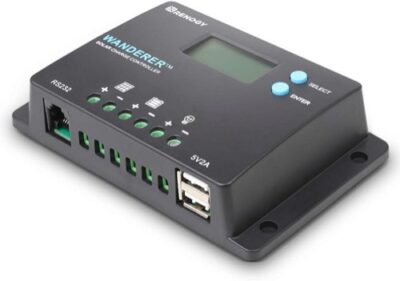
This Renogy Wanderer 10A review finds a sensible budget controller for genuinely small solar systems. It combines a 10A PWM design with a backlit LCD, programmable DC load output, USB power, documented 12V/24V limits, and optional Bluetooth through the RS232 port.
The low price does not erase its constraints. PWM topology requires appropriate panel-to-battery matching, terminals accept only up to 12 AWG, and adding the BT-1 module can push total cost toward small MPPT controllers with Bluetooth included. owner reports also include two early failures alongside several multi-year success stories.
| Best For | Main Strength | Main Limitation | Evidence Confidence |
|---|---|---|---|
| Small shed, fence, lighting, RV, and maintenance-charging systems | Low cost with LCD and flexible load modes | PWM conversion, 10A ceiling, and small terminals | High for specifications; medium for durability |
The Wanderer's Best Defense Is a Small, Defined Job
Good fit when the panel, battery, and controlled DC loads remain comfortably below 10A.
The load modes can automate dusk operation after commissioning.
Verify the exact revision, profile voltages, and low-temperature strategy.
Weak fit when PWM loss or the 10A ceiling will trigger an early replacement.
The expanded owner material reinforces a balanced view of the Renogy Wanderer 10A. Many accounts describe years of simple service in sheds, lights, fans, maintainers, and small batteries. Others report display faults, incorrect voltage behavior, melted hardware, or support friction. These anecdotes do not provide a failure rate, but they make conservative loading and an early supervised test more important than the controller’s low price.
The Wanderer earns its place when the job is deliberately small. PWM architecture is acceptable when panel and battery voltage are closely matched and the energy penalty does not justify MPPT. The 10A charge ceiling, terminal dimensions, load-output behavior, and idle draw must all fit the same design. Removing conductor strands to force a large cable into a small terminal is not an acceptable solution.
Commission with the battery connected in the manual-required sequence, confirm detected system voltage, and compare the display with a multimeter. Exercise the load timer across sunset and sunrise. If Bluetooth is part of the purchase, verify whether the required module is included and whether the desired history is actually available. Finally, inspect terminal temperature during strong sun and repeat the battery-voltage check after several days.
Buy the Wanderer because a recognizable manual, local screen, and programmable small-load output improve a modest PWM system. Do not buy it as a cheap substitute for an MPPT controller on a voltage-mismatched or expanding array.
A 10A PWM Controller, Not a Small MPPT
Renogy specifies 130W maximum PV input for a 12V battery or 260W for 24V, with 50V maximum PV Voc and 10A rated charge current. Non-lithium system voltage is recognized automatically. These numbers still require an array check: maximum panel current, cold-corrected Voc, and controller output are separate boundaries.
PWM connects the panel toward battery voltage during charging. A high-voltage panel or long series string will not be converted into extra battery current as an MPPT controller would. For a small 12V-class panel and battery, that simplicity can be perfectly reasonable; for limited roof area or variable shade, MPPT may recover more useful energy.
| Design Point | Documented Value | Practical Effect |
|---|---|---|
| Rated charge current | 10A | Limits battery-side charging and array current planning |
| Maximum PV Voc | 50V | String voltage must stay below this after cold correction |
| Maximum PV power at 12V | 130W | Fits a modest 12V-class panel system |
| Maximum PV power at 24V | 260W | Supports more power at higher battery voltage |
| Maximum terminal size | 12 AWG | Can constrain long-run or low-drop cable design |
One long-term owner used the Wanderer with a 50W panel and 10Ah LiFePO4 battery in a shed for several years. Another used multiple units across lead-acid and RV lithium systems for roughly two years without problems. These are credible use examples, not proof that every unit lasts that long.
LCD, USB, and Programmable Load Modes
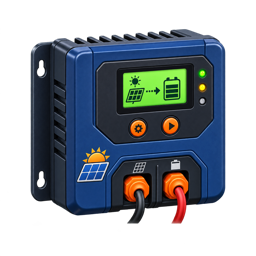
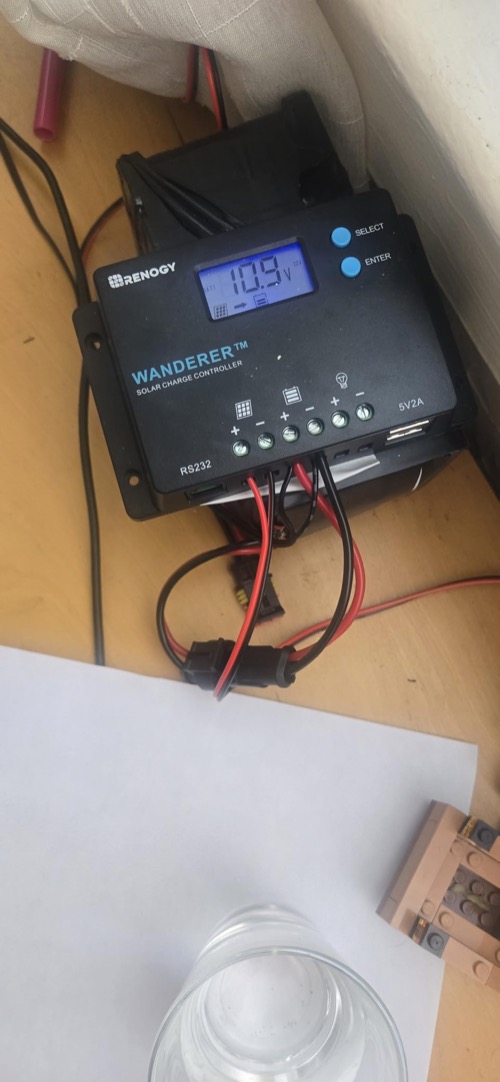
The backlit LCD is unusually useful at this price. It reports panel and battery information, current, charge state, load status, and error codes. Two buttons handle battery selection and operating modes, so the manual remains important when interpreting the abbreviated timer codes.
The 10A load output supports automatic, timer, manual, test, and always-on behavior. One owner used it to switch patio lights on at dusk for four hours; another used the controller in a small shed with LED lighting and ventilation. These are appropriate low-power applications.
The load terminals are not an inverter connection. High-surge appliances, heaters, and motors can exceed the controller’s protection behavior even when their nominal current looks modest. One owner reported unstable load cycling with a diesel heater, which illustrates why inrush and controller mode matter.
The 5V/2A USB output is convenient for small devices. A detailed owner noted that enabling the load also enabled USB circuitry and increased idle consumption. That matters more in a very small battery system than in a large bank.
Battery Profiles and Optional Bluetooth
The current Wanderer supports sealed/AGM, gel, flooded, and lithium selection, with adjustable lithium charging voltage. The exact value must match the battery maker’s documentation. Renogy publishes lead-acid temperature compensation but no controller-managed lithium low-temperature cutoff.
An optional BT-1 module connects through RS232 to Renogy DC Home. It enables live status and setting changes, but supplied evidence indicates that this combination does not provide the same historical logging depth as VictronConnect. Check the exact bundle because the controller-only listing does not include Bluetooth.
The combined controller-and-module price deserves comparison with a small MPPT unit that includes Bluetooth. The Wanderer is strongest as a simple controller; accessory spending can weaken its value case.
Terminals, Mounting, and Environmental Limits
The compact enclosure measures 119 × 75 × 27.5 mm and weighs about 122g. It accepts up to 12 AWG cable. One owner said 12-gauge conductors fit without trouble, while another found larger Renogy solar cable too large and described loose connections after removing strands.
Never trim conductor strands to force a cable into a terminal. That reduces cross-section and can create a poor connection. If voltage-drop calculations call for a larger conductor, redesign the run or use an appropriate protected distribution method that terminates within the controller’s documented capacity.
Renogy publishes an operating range of -25°C to 45°C but no ingress rating. Install the controller in a dry, ventilated, protected location. It is not a substitute for the IP67 Voyager in an exposed portable or marine position.
Reliability Signals Need an Acceptance Test
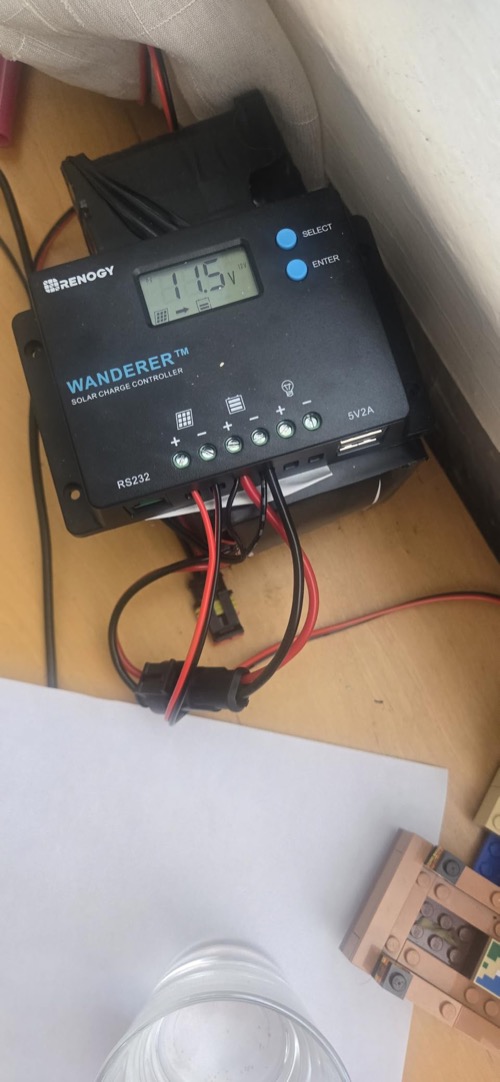
Negative reports include one controller showing repeated error codes within weeks, one display failing in under a year after limited use, and one problematic high-inrush load interaction. These reports are too few and too different to establish a single recurring defect. They do justify a more cautious reliability rating than the positive reviews alone would suggest.
| Owner-Evidence Theme | supplied Detail | Editorial Interpretation |
|---|---|---|
| Multi-year small-system use | One 50W shed system reportedly ran for years; another owner used four 10A units for roughly two years | Useful longevity examples, but does not predict reliability across all units |
| Better documentation than anonymous PWM units | A buyer contrasted the Renogy with two inaccurate controllers that failed quickly | Documentation and support are meaningful buying factors at this price |
| Small terminals divide opinion | One owner fitted 12 AWG easily; another said larger Renogy cable would not fit securely | Use the published 12 AWG maximum and design the cable run before purchase |
| Early electrical or display failures | Two independent one-star reports described different early failures | A real caution signal, but not evidence of one repeated root cause |
| Load-output trouble with a diesel heater | One owner reported cycling and apparent short-circuit behavior at startup | A specific surge-load warning, not a general charging failure |
Reliability interpretation — The owner record supports both sides of the decision: several owners describe years of ordinary small-system service, while two describe early failures. A responsible verdict preserves that uncertainty instead of averaging the stories into “reliable.”
Four Systems That Reveal Whether 10A Is Enough
A 50W shed system is almost the ideal Wanderer use case. One owner paired a 12V-class panel with a 10Ah LiFePO4 battery, LED lights, and ventilation. The array was modest, the loads were understandable, and future expansion eventually prompted an MPPT upgrade rather than forcing the PWM controller to do a job outside its size class.
A dusk-to-timer lighting system is another good match. The controller can turn its load output on after solar input falls and then switch it off after a programmed interval. One patio-light owner used a four-hour setting successfully. The important electrical detail is that the inverter or high-power lighting circuit should not be assumed safe on the controller’s 10A output merely because the timer feature is convenient.
A small solar suitcase can fit, but exposure changes the answer. The Wanderer has been sold in changing revisions and the evidence package does not establish it as equivalent to Renogy’s sealed Voyager. If rain, spray, or frequent outdoor handling is expected, a controller with an exact documented ingress rating is the more defensible choice.
An expandable RV roof is the weakest fit. At 12V, the published 130W PV guidance and 10A charge ceiling leave little room for panel growth. Paying for the BT-1 module also changes the comparison: a small MPPT controller with Bluetooth and history included may deliver more useful capability for similar total cost.
| Use Case | Wanderer 10A Fit | Why | Upgrade Trigger |
|---|---|---|---|
| 50–100W shed, fence, or maintenance system | Strong | Panel voltage and current can be matched closely to a 12V bank | More panels, long cable run, or need for richer history |
| Timed low-power lighting | Strong | Built-in dusk/timer modes avoid a separate simple controller | Load surge or continuous current approaches the output limit |
| Portable outdoor suitcase | Conditional | Compact and inexpensive, but environmental protection must be verified | Frequent rain/spray exposure favors a sealed Voyager-type unit |
| Growing RV roof array | Weak | 130W-at-12V and 10A ceilings arrive quickly | Move to correctly sized MPPT before buying accessories |
| High-voltage residential-style panel | Weak | PWM cannot turn excess panel voltage into proportional charge current | MPPT matched to the panel’s cold Voc and Isc |
Topology warning — A 200W panel does not become a sensible Wanderer pairing just because its Voc is under 50V. With PWM, panel voltage, operating current, battery voltage, and the controller’s 10A limit must be considered together; unused voltage is not converted the way it is by MPPT.
The Hidden Cost of Bluetooth on a Budget Controller
The base controller’s LCD already shows the essentials locally, which is part of its value. Bluetooth requires the separately sold BT-1 module. A detailed owner reported live monitoring and setting changes but no historical data logging for this combination. Buyers who need day-by-day harvest history should verify current app and hardware behavior rather than assuming that “Bluetooth” guarantees analytics.
Accessory cost also changes the competitive set. The Wanderer makes financial sense as a low-cost PWM controller with a screen. Once a module, weather enclosure, distribution hardware, or a near-term controller upgrade is added, the lowest purchase price may no longer produce the lowest system cost.
This distinction matters for search intent. Someone wanting a simple voltage display beside a shed battery may get more value from the Wanderer than from an app-only MPPT. Someone wanting remote history and future panel expansion is buying toward a different requirement, even if both products are called 10A or 15A charge controllers.
| Monitoring Requirement | Wanderer Alone | Wanderer + BT-1 | When to Compare Another Controller |
|---|---|---|---|
| Read voltage/current at the installation | LCD provides local readings | Also visible in the app | No need to add Bluetooth solely for this |
| Change settings without opening a cabinet | Use front buttons and manual codes | App can simplify access | Compare total bundle price with built-in Bluetooth models |
| Review prior-day harvest | Not provided by the local LCD | owner says this pairing lacks history | Choose hardware with documented historical logging |
| Internet monitoring away from the site | No | Bluetooth remains local-range communication | A gateway/cloud-capable ecosystem is required |
A Wanderer-Specific Installation Checklist
Start by confirming the exact hardware revision and manual. Marketplace copy changes, and the evidence reviewed for this article includes claims that should not be transferred automatically to every older Wanderer bearing a similar name. Record the model label before adopting any voltage, ingress, self-consumption, or protection specification.
Then size the array and conductors as a system. Use the panel datasheet to calculate cold-corrected Voc and total current, keep within the voltage-specific watt guidance, and calculate voltage drop over the entire cable length. If the result calls for wire larger than the documented 12 AWG terminal capacity, redesign the run or use suitable protected distribution hardware; never remove strands to make it fit.
| Before Energizing | What to Verify | Why It Matters Here |
|---|---|---|
| Battery first | Correct polarity, system voltage, chemistry, and charge setting | The controller needs a stable battery reference and an appropriate profile |
| PV second | Corrected Voc, expected current, breaker/fuse plan | PWM suitability and the 10A ceiling cannot be inferred from panel watts alone |
| Load circuit | Continuous current, start-up surge, low-voltage behavior | Heater and other inrush loads can trip or cycle the controller output |
| Cable termination | Full conductor cross-section retained and firmly clamped | The 12 AWG ceiling is a real design constraint |
| Bluetooth decision | Required history and total accessory price | BT-1 adds convenience but may not add the logging buyers expect |
| Outdoor location | Exact revision’s environmental rating and enclosure | “RV” or “marine” marketing does not by itself prove exposed-weather suitability |
Installation stop point — If the cable calculation requires trimming strands, the design is not finished. Change the conductor run, controller location, distribution method, or controller model before energizing the circuit.
Alternatives That Solve Different Problems
Renogy’s Voyager 20A is the more relevant comparison for portable, wet-location use because its defining advantage is a sealed enclosure, not Bluetooth. The Rover 20A addresses a different limitation: it uses MPPT, doubles the charge-current class, and suits arrays where panel voltage should be converted rather than pulled toward battery voltage.
Victron’s SmartSolar 75/15 is another path when built-in Bluetooth, historical app data, and published PV-current limits matter more than an on-device LCD. Its higher initial price can be misleading if it avoids a separate Bluetooth purchase. Conversely, a buyer who only wants a local screen and a timer for one small 12V-class panel may reasonably prefer the cheaper Wanderer.
Anonymous PWM controllers can undercut every branded alternative. The strongest owner argument for the Renogy is not that PWM is technically superior—it is that the company supplies a recognizable model, manual, settings, and support channel. That benefit is valuable only if the electrical fit remains correct.
Renogy Wanderer 10A Review: Who Should Buy It?
Choose the Wanderer for a small, correctly matched PWM system where the LCD, timer-controlled load, and low purchase price are useful. It is a practical fit for lighting, ventilation, fences, sheds, and battery maintenance when 10A is genuinely enough.
Choose MPPT when the panel voltage is substantially above battery voltage, shade varies, roof area is limited, or expansion is likely. Choose the Voyager when the controller must tolerate weather, and choose larger terminals when cable design cannot stay within 12 AWG.
Pros & Cons Analysis
Based on documented specifications and owner feedback
Pros
- Low-cost documented option — Renogy publishes voltage, power, terminal, temperature, size, and warranty details.
- Useful local interface — The backlit LCD exposes voltage, current, charging state, load status, and errors.
- Programmable load behavior — Five modes support always-on, manual, test, and dusk/timer applications.
- Small-system owner success — Sampled users describe multi-year shed, RV, lighting, and battery-maintenance service.
- Optional app access — A compatible BT-1 module enables live DC Home monitoring and setting changes.
Cons
- PWM topology — It cannot convert excess panel voltage into additional battery charge current like MPPT.
- Small terminals — The 12 AWG maximum is restrictive, and one owner described poor fit with larger Renogy panel cable.
- Bluetooth is optional — Adding the BT-1 can erase much of the controller's price advantage.
- No historical logging — Sampled owner evidence indicates optional app monitoring is live rather than a full production-history tool.
- Mixed reliability sample — Two captured owners reported early display or controller failures, while others reported years of service.
Bottom Line: Good Value Only in the Right Size
Verdict: The Wanderer 10A is a better-supported budget PWM option than anonymous controllers, with useful local monitoring and load automation. Its value depends on keeping the system small and avoiding unnecessary accessory costs.
Best reason to buy: You need an inexpensive 10A controller with an LCD and timer-controlled DC load output.
Reason to pause: PWM conversion, small terminals, optional Bluetooth, and mixed durability evidence limit its appeal beyond basic projects. This Renogy Wanderer 10A review recommends it for narrowly defined small systems rather than future expansion.
Frequently Asked Questions
Is the Renogy Wanderer 10A MPPT?
No. It is a PWM controller, so panel voltage should be matched appropriately to the battery system rather than relying on MPPT voltage conversion.
What size solar array can it support?
Renogy publishes 130W for 12V or 260W for 24V, with a 10A controller rating and 50V maximum PV Voc. Array current and cold-corrected voltage still require checks.
Does it work with LiFePO4 batteries?
The current model supports lithium selection and adjustable charging voltage. Match that voltage to the exact battery manual and rely on the battery system for low-temperature protection unless another documented control is present.
Does the Wanderer 10A include Bluetooth?
Only the bundle variant includes the module. The controller has an RS232 port and otherwise requires a separately purchased compatible BT-1.
Can its load output power an inverter?
No. The 10A programmable output is intended for modest DC loads such as lighting or control circuits. Inverters belong on a correctly protected battery-side connection.
What is the largest wire that fits?
Renogy specifies up to 12 AWG. Do not trim conductor strands to force a larger cable into the terminal; redesign the run or use an approved distribution method.
Is it waterproof?
Renogy does not publish an ingress rating for this model. Install it in a dry, ventilated, protected location.
Is it cheaper than buying an MPPT controller?
The controller alone is inexpensive. If you add the optional Bluetooth module, compare the combined cost with small MPPT models that include Bluetooth and history before deciding.
Technical Specifications
| Brand | Renogy |
|---|---|
| Exact model / revision / ASIN | Wanderer 10A (RNG-CTRL-WND10; ASIN B07NPDWZJ7) |
| Controller type | PWM |
| Rated battery-side charge current | 10A |
| Supported battery-system voltage | 12V / 24V automatic recognition for non-lithium batteries |
| Battery chemistry and profile support | Sealed/AGM, gel, flooded, and lithium |
| Maximum PV open-circuit voltage (Voc) | 50V |
| Maximum PV short-circuit/input current (Isc) | 10A controller limit; verify array Isc and required margin |
| Maximum PV power by battery voltage | 130W @ 12V; 260W @ 24V |
| Minimum PV/start voltage requirement | Not published for the reviewed revision |
| Load output and low-voltage disconnect | 10A programmable DC load output with five operating modes |
| Grounding topology | Negative ground |
| Charging stages and custom voltage control | Four-stage PWM with battery-type selection and adjustable lithium voltage |
| Temperature sensing and lithium low-temperature behavior | -3mV/°C/2V lead-acid compensation; no lithium low-temp cutoff published |
| Display and local controls | Backlit LCD, two buttons, status indicators, and 5V/2A USB |
| App, communications, and data history | RS232; optional BT-1 module for Renogy DC Home |
| Maximum terminal conductor size | 12 AWG |
| Controller self-consumption | Less than 10mA |
| Published tracking/conversion efficiency | Not applicable; PWM controller |
| Cooling method and thermal derating | Not published for the reviewed revision |
| Electrical protections | Overcharge, over-discharge, overload, short-circuit, reverse-polarity, and reverse-current protection |
| Enclosure, ingress rating, and operating temperature | Ingress rating not published; -25°C to 45°C (-31°F to 113°F) |
| Certifications | CE and RoHS |
| Dimensions, weight, and included accessories | 119 × 75 × 27.5 mm; 122 g / 0.27 lb |
| Warranty | 2 years |