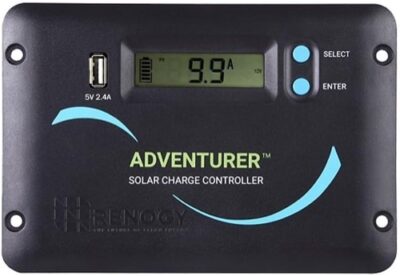
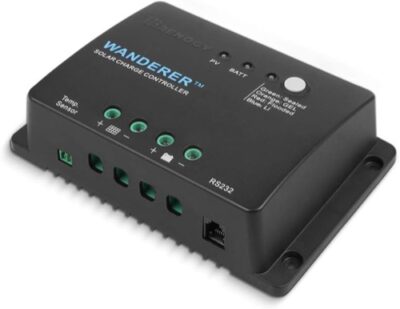
The best PWM solar charge controllers suit deliberately matched panel-and-battery systems. They are not simply cheaper MPPT controllers. These three choices separate a small utility array, an interior flush-mount display and a simple 12V charging path, with the exact model limits taking priority over a large faceplate number.
When PWM Is a Deliberate Choice
PWM is worth considering when the array is suitable for the battery architecture and the added conversion capability of MPPT is not needed to meet the project’s goals. Small charging jobs, an existing compatible panel and a preference for straightforward controls can make the simpler approach attractive.
The important qualifier is compatibility. A high panel operating voltage is not automatically useful to a PWM battery-charging system in the same way it can be to an appropriate MPPT design. Do not buy a controller first and assume any panel below its maximum voltage will be an efficient match.
If the project requires a different series-string arrangement or must extract more useful energy from a particular panel, compare the alternatives in the MPPT and PWM guide. The topology should follow the job, not a preference for the cheaper label.
Three Distinct Reasons to Choose These Models
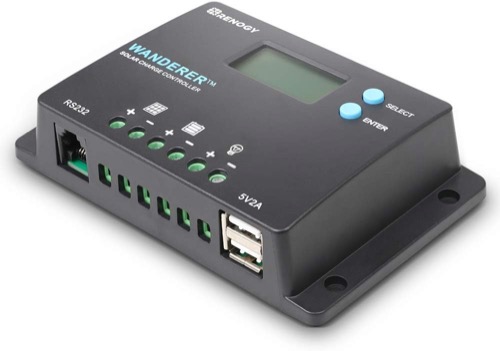
The Wanderer 10A is the small-system option. Its role is an array that fits a modest controller, not an attempt to make a low-cost unit serve a much larger job. Published input limits give the buyer something to compare against the panel documentation.
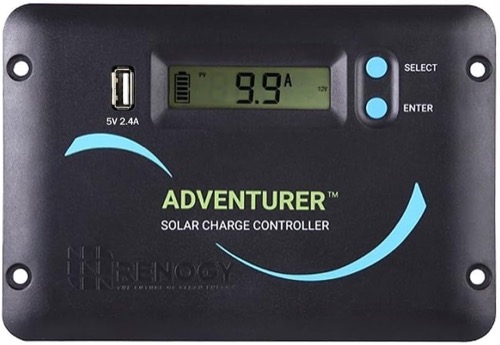
The Adventurer 30A is different because its flush-mount interface can be part of the installation layout. Buyers who want a visible wall display should evaluate the mounting cavity and wiring access alongside electrical fit. The interface is a reason to consider it, not a reason to overlook the array requirements.
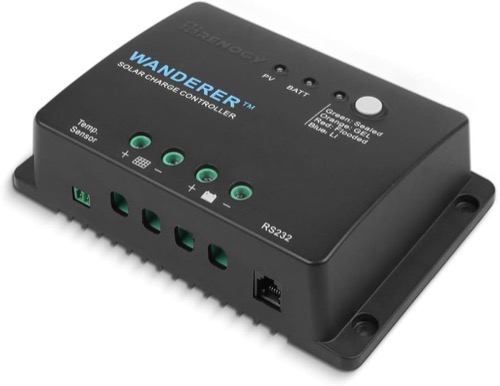
The Wanderer Li 30A is the straightforward 12V PWM alternative. Do not read the shared Wanderer name as proof that it has the same bank-voltage support or controls as the 10A version. A larger rating within a product family can still bring a narrower fit in another respect.
Match the Bank and Array Without Borrowing Limits
Use the exact model’s supported battery voltage and charging profiles. A controller that recognizes more than one lead-acid system voltage may have different requirements for lithium setup. The selected battery mode also needs to match the battery manufacturer’s permitted settings and temperature behavior.
For the array, check documented PV voltage, current and power restrictions. A PWM controller’s current label is not permission to ignore the panel’s short-circuit current or to connect a series string based only on its total watts. Conditions attached to a limit belong with that limit.
When an inexpensive model leaves essential input data unresolved, the low price does not resolve the uncertainty. That is why this page uses a shorter list rather than repeating a longer catalog of superficially similar controllers. No universal wiring or battery-setting recipe is implied.
| Installation preference | Useful starting point | Boundary to check first |
|---|---|---|
| A small utility charging job | A modest controller with clear input limits | The actual array and battery voltage |
| Controls visible on an interior wall | A flush-mount interface | Rear clearance and compatible panel architecture |
| A simple larger-current PWM path | An exact 12V charging model | Bank voltage and documented array restrictions |
Inspect the Controls Before Committing to the Mount
Consider how often you will look at the controller and what you need to change. A display that is useful on a workshop bench may be awkward near the floor or behind equipment. If there is no detailed local display, decide how charging behavior will be checked without assuming extra monitoring equipment is included.
Mounting depth and conductor access can be more important than the face dimensions. Leave the required space for connections and the manufacturer’s environmental conditions. A clean-looking front panel is not a complete installation plan if there is no practical access behind it.
Keep the selected model’s operating instructions available for commissioning. Similar cases and buttons do not guarantee identical menus or battery settings. The product review can explain the ownership tradeoff, but the delivered unit’s documentation controls its setup.
Count the Cost of the Whole Small System
For a small array, installation accessories can be a significant part of the total. Include suitable wiring, protective devices, mounting work and any required monitoring hardware. Compare a usable installed system rather than assuming a low controller price dominates the budget.
Avoid paying for a capacity number that solves no current problem. Equally, do not undersize a controller simply to stay within a price target. A replacement purchase, additional wiring work or a damaged battery can outweigh a small saving at checkout.
This comparison does not claim that any candidate is currently the cheapest. Prices and package contents change. The purpose of the shortlist is to identify documented options worth pricing after their electrical and mechanical fit has been established.
- Select the exact battery-voltage version.
- Compare panel data with each published input restriction.
- Check charging-profile support without assuming cold-charge protection.
- Plan access to controls and connections before choosing the mounting point.
Know When to Leave the PWM Shortlist
If a panel arrangement is a poor PWM match, changing the controller topology may be a better answer than adding more similarly mismatched panels. The right decision depends on the array, cable run, battery and energy requirement, not on whether PWM worked in somebody else’s smaller system.
The linked reviews and manufacturer limits support these research-led selections. No hands-on tests by Solar Power Picks are claimed. Owner evidence can highlight setup problems worth investigating, but cannot prove that every controller of a model will perform the same way.
Use the controller sizing guide if the project has moved beyond a small matched-voltage installation. Leaving this shortlist is the correct outcome when none of its three choices fits.