Choosing among the best MPPT solar charge controllers starts with system compatibility because “MPPT” describes conversion topology, not a universal fit. A controller can track a useful PV operating point and still be wrong for the array voltage, parallel-string current, battery bank, conductor size, mounting location, or monitoring requirements.
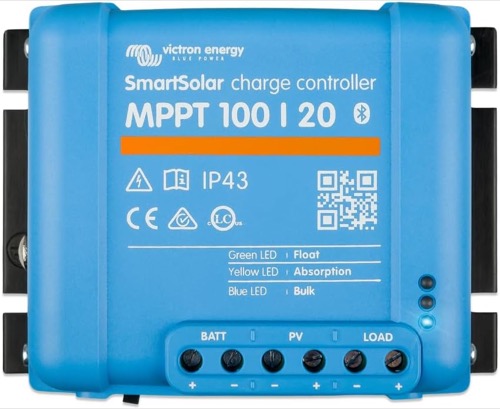
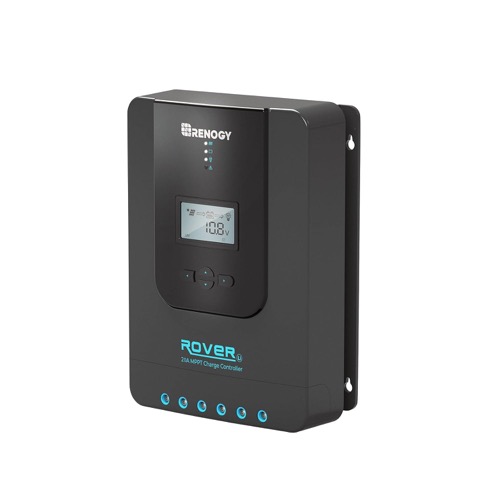
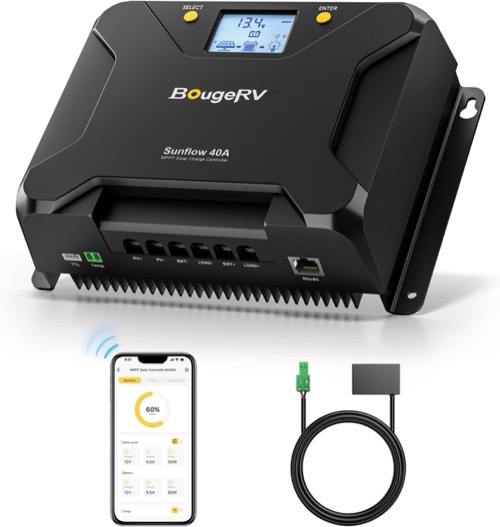
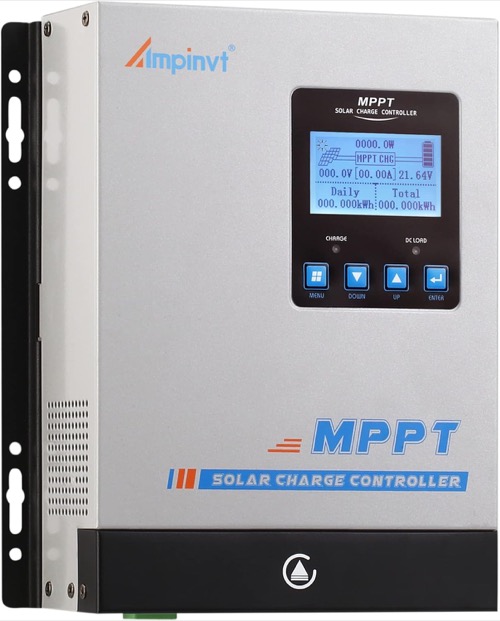
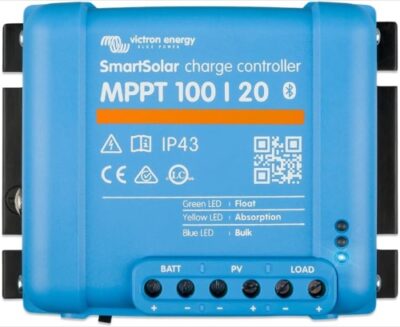
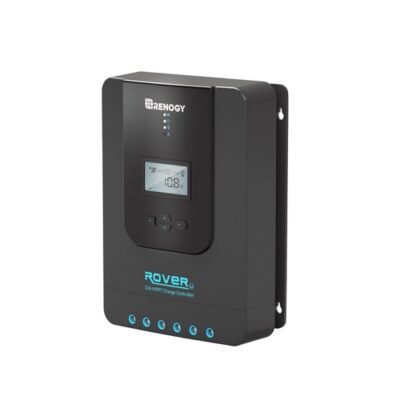
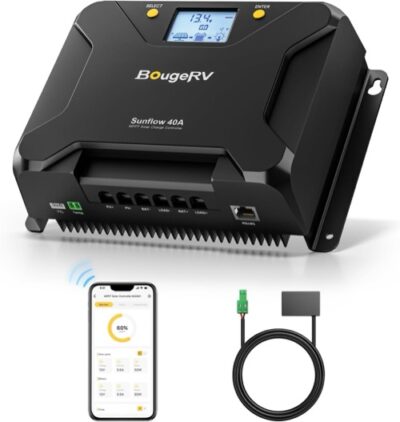
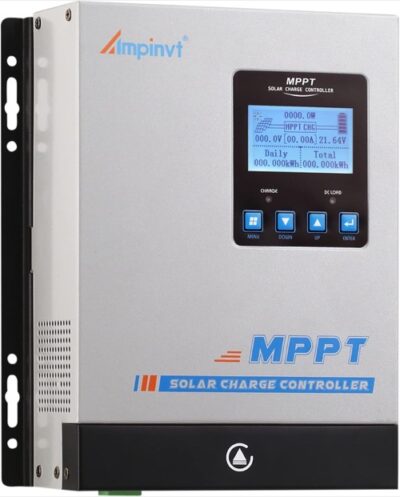
This shortlist deliberately covers different jobs. The Victron SmartSolar 100/20 emphasizes documentation and built-in Bluetooth; the Renogy Rover 20A combines a local screen with a programmable load output; the BougeRV Sunflow 40A targets higher-current 12V/24V systems; the AMPINVT 60A offers 150V and multi-voltage capacity at a lower price; and the Bateria Power SunRock 10A serves very small 12V installations. They should not be ranked by amperage alone.
How we evaluated — We normalized each exact model to the same specification schema, checked current manufacturer or listing material available in the research package, and synthesized 8–13 captured Amazon reviews per product. Solar Power Picks did not bench-test these controllers, so owner measurements are attributed and marketplace efficiency figures remain claims.
Estimate Output Before Ranking Hardware
Use the solar charge controller size calculator to estimate battery-side output from array watts and charging voltage. The result is only one filter for the best MPPT solar charge controllers: the final model must also accept cold-corrected series Voc, total array Isc, permitted PV watts at the chosen battery voltage, and the battery/BMS charge-current limit. A calculated 18A requirement does not make every 20A controller compatible.
First Decide Which MPPT Problem You Need to Solve
A small RV with 200W of PV does not benefit from paying for a 60A controller it cannot use. A 48V cabin with a long series string cannot use a compact 12V-only controller simply because its price and review average look attractive. Start by classifying the system, then eliminate every controller that fails a hard electrical boundary.
| System Question | Why It Changes the Choice | Models That Illustrate the Difference |
|---|---|---|
| Is the bank 12V, 24V, or 48V? | Battery voltage controls compatibility and the permitted PV-watt row | SunRock is 12V only; Sunflow is 12V/24V; Victron 100/20 and AMPINVT 60A reach 48V |
| How high can winter string Voc rise? | Exceeding absolute PV voltage can damage a controller | SunRock stops at 30V; Victron/Renogy small models use 100V-class inputs; AMPINVT reaches 150V |
| What is total array Isc? | Parallel strings add input current independently of output amperage | Victron publishes 20A Isc; several alternatives leave the reviewed value unresolved |
| Does the battery accept the full charge current? | A 60A controller can exceed a small bank’s permitted rate | Configuration or a smaller model may be required |
| Is local or phone-based control essential? | Hardware and accessory costs differ materially | Renogy supplies an LCD; Victron uses built-in Bluetooth; AMPINVT remote hardware is optional |
| Will the controller face weather? | Most MPPT units here still require protected mounting | IP34 or IP43 is not equivalent to a sealed outdoor controller |
The practical result is an elimination process rather than a beauty contest. Once incompatible products are removed, warranty, controls, owner patterns, and price can decide between the survivors.
The Five Candidates Occupy Different Electrical Classes
The product name often combines maximum PV voltage and charge current, but not always. Even when it does, those two numbers do not reveal maximum PV Isc, battery-voltage-specific power, terminal capacity, temperature behavior, or low-temperature lithium protection.
| Controller | Charge Output | Battery Systems | Reviewed PV Voltage | Reviewed PV Power |
|---|---|---|---|---|
| Victron SmartSolar 100/20 | 20A | 12V / 24V / 48V | 100V Voc | 290W / 580W / 1,160W |
| Renogy Rover 20A | 20A | 12V / 24V | 100V Voc | 260W / 520W |
| BougeRV Sunflow 40A | 40A | 12V / 24V | 100V absolute; lower protection thresholds | 600W / 1,200W |
| AMPINVT 60A | 60A | 12V / 24V / 48V automatic; 36V manual | 150V Voc | 900W / 1,700W / 2,700W / 3,400W |
| Bateria Power SunRock 10A | 10A | 12V | 30V; 15V–30V operating range stated | Not published in reviewed evidence |
This table is a filter, not a wiring plan. Every array still needs a cold-corrected Voc calculation and a current check. The BougeRV technical material describes protection near 95V despite a 100V absolute figure. The AMPINVT’s 150V label provides series-string flexibility, but its PV Isc was not present in the reviewed evidence. The SunRock’s narrow 15V–30V range demands especially careful panel matching.
Non-negotiable rule — Missing PV-current or power documentation is not an unlimited rating. Obtain the exact current manual or written manufacturer confirmation; if the design depends on an unknown boundary, choose a better-documented controller.
Best Documented Compact Choice: Victron SmartSolar 100/20
The SmartSolar 100/20 is the strongest all-round fit when the design stays within 20A. Victron publishes 100V maximum Voc, 20A maximum PV Isc, and separate power allowances for 12V, 24V, and 48V banks. Built-in Bluetooth and VE.Direct provide a mature configuration path, 30-day history, firmware updates, alarms, and ecosystem integration.
The tradeoffs are concrete. There is no numeric screen, the physical load output falls to only 1A on a 48V bank, and detailed remote internet monitoring requires more Victron hardware. Two captured owners described serious 48V load- or battery-disconnect events, so the load circuit should not be treated as a convenient inverter feed.
Choose it for documentation, compact passive cooling, phone-based commissioning, and a five-year warranty. Do not choose it merely for the blue enclosure if a local screen or higher current is essential.
Best Small Controller with Local Controls: Renogy Rover 20A
The Rover addresses buyers who want to see and change core settings at the controller. Its LCD and four-button interface work without a phone, while an optional BT-2 module adds app access. Renogy documents 100V Voc, 260W at 12V, 520W at 24V, an 8 AWG terminal maximum, IP32 protection, and a 20A programmable load output.
Compared with the Victron, the Rover gives up 48V battery support and built-in Bluetooth. The reviewed material also did not publish a PV Isc ceiling. Its lithium mode requires careful manual voltage selection, and the supplied temperature sensor should not be mistaken for a documented lithium cold-charge cutoff.
It is a sensible RV or cabin choice when 20A is enough, local control matters, and the controller will be mounted in a dry ventilated compartment. Include the BT-2 price only if the app is genuinely required.
Best Integrated 40A Value: BougeRV Sunflow
Sunflow doubles the output class while retaining a screen, built-in Bluetooth, and a 20A programmable load circuit. The 600W-at-12V and 1,200W-at-24V allowances suit larger RV, van, and cabin arrays, and the app is described as storing extended history.
Owner evidence is divided on interface quality. Several buyers liked the app; others reported short range, pairing failure, unclear menus, or revision-specific instructions. IP34 still requires protection, and the 18-month support period is short beside Victron’s five-year warranty.
Buy it when consolidated features and 40A output outweigh the interface and warranty compromises. Before final selection, confirm the exact product revision, app, temperature-sensing behavior, and missing PV Isc rule.
Best High-Voltage Budget Capacity: AMPINVT 60A
The AMPINVT APC190060 stands apart with 150V PV input, up to 60A charging, and support spanning 12V through 48V banks. Its published power table reaches 3,400W at 48V, and the front display provides operating and history information without forcing phone use. An external battery-temperature sensor is included in the documented feature set.
This is not the quiet or low-risk option. It uses fan cooling, remote monitoring requires an optional RS485/Wi-Fi path, no IP rating was supplied, and captured owner reports include noise, support, and durability concerns. Marketplace claims of greater than 99% tracking and 98% peak conversion were not independently corroborated.
The AMPINVT is most defensible in a ventilated, accessible installation managed by a technically confident owner who values voltage and current capacity over warranty clarity and ecosystem polish. Missing PV Isc and warranty details should be resolved before array purchase.
Best for a Tiny 12V Portable System: SunRock 10A
The Bateria Power SunRock is not a miniature substitute for every controller above. It is a compact 10A, 12V-only product with an LCD, local battery selection, and a narrow stated 15V–30V PV operating range. It supports common lead-acid types and LiFePO4 according to the reviewed material.
Its appeal is physical simplicity and portability, supported by customer setup photos. Its limits are equally important: no published PV Isc or watt allowance in the reviewed evidence, no communications, no formal weather rating, and no documented low-temperature lithium cutoff.
Choose it only for a small, protected, voltage-matched 12V project after obtaining the missing array rules. Anyone planning series expansion, remote monitoring, or a larger bank should move up to a better-documented electrical class.
Match the Winner to the Installation, Not the Award
| Buyer Scenario | Strongest Starting Point | Why | Immediate Alternative |
|---|---|---|---|
| Compact 12V/24V/48V system prioritizing documentation | Victron 100/20 | Complete Voc, Isc, power, app, enclosure, and warranty data | Rover 20A if a local LCD matters more |
| Small 12V/24V RV wanting a display and timed DC load | Renogy Rover 20A | Local interface and documented 20A load circuit | Victron for built-in Bluetooth and 48V path |
| 500W–1,200W 12V/24V array wanting app and screen | BougeRV Sunflow 40A | Integrated 40A feature set | Larger Rover/Victron class for different warranty or ecosystem needs |
| 48V bank with a higher-voltage string and tight budget | AMPINVT 60A | 150V and 60A headline capacity | Premium 150V model with better documentation and warranty |
| One small 12V portable panel and battery | SunRock 10A | Compact local controls | A documented 15A–20A model if expansion is plausible |
No table can decide without panel and battery data. A 48V-capable controller may still have an unsuitable load circuit. A 100V input may still fail a cold-climate series string. A 60A output may exceed the battery’s allowed charge current. Treat the “winner” as the product that survives the complete design review with the fewest compromises.
Battery Chemistry and Cold Charging Change the Ranking
Every candidate advertises or documents some lithium support, but that term has limited meaning by itself. The charge profile must match the battery maker’s absorption or boost voltage, current ceiling, float policy, and BMS behavior. Lead-acid equalization must not be accidentally applied to LiFePO4.
Cold charging deserves its own decision. A selectable lithium preset does not prove that the controller measures battery temperature and stops charge at the correct threshold. BougeRV advertises low-temperature behavior, but the exact sensing implementation should be confirmed. Victron can integrate compatible sensing, while several other candidates rely on the battery/BMS or leave the function undocumented.
Lithium check — Write down which component actually prevents cold charging. If the answer is only “the controller says lithium,” the protection strategy is incomplete.
Monitoring and Warranty Are System Costs
| Requirement | Victron 100/20 | Rover 20A | Sunflow 40A | AMPINVT 60A | SunRock 10A |
|---|---|---|---|---|---|
| Numeric local display | No | Yes | Yes | Yes | Yes |
| Bluetooth included | Yes | No; optional module | Yes | No; optional remote hardware | No |
| Historical data | VictronConnect | Depends on accessory/app | Listing describes extended app history | Front history; optional remote path | No documented history |
| Reviewed warranty | 5 years | 2 years | 18 months | Not published | Not published |
Compare the finished configuration rather than controller price alone. Add communication modules, displays, sensors, enclosures, cable adapters, and protection hardware. Also consider the cost of replacing a controller whose current or voltage class leaves no room for the next planned panel.
Final Pre-Purchase Checklist
- Record the exact model revision, not just brand and amperage.
- Calculate cold-corrected string Voc for the site’s lowest design temperature.
- Add parallel-string Isc and verify the manufacturer’s input-current rule.
- Use the PV-watt row for the actual battery voltage.
- Confirm the battery’s maximum charge current and every profile value.
- Identify the real low-temperature charging protection.
- Calculate conductor ampacity and voltage drop; confirm terminal fit without trimming strands.
- Size fuses, breakers, disconnects, and grounding from the exact manuals and applicable rules.
- Match the enclosure rating to the mounting location and ventilation.
- Price every required monitoring accessory and verify app/revision compatibility.
- Keep inverters and high-surge loads off small controller load terminals unless explicitly permitted.
Bottom Line: Best MPPT Solar Charge Controllers
The Victron SmartSolar 100/20 is the strongest documented compact all-rounder. The Renogy Rover 20A is better when an onboard screen and modest load automation matter. BougeRV’s Sunflow brings more current and built-in monitoring value to 12V/24V systems, while the AMPINVT 60A trades refinement and evidence confidence for 150V/60A capacity. The SunRock 10A belongs only in small, protected 12V projects.
The final choice should be the least expensive controller that passes every voltage, current, battery, environmental, installation, and monitoring requirement—with reasonable expansion margin. Any unresolved hard limit is a reason to pause, not a feature to infer.