
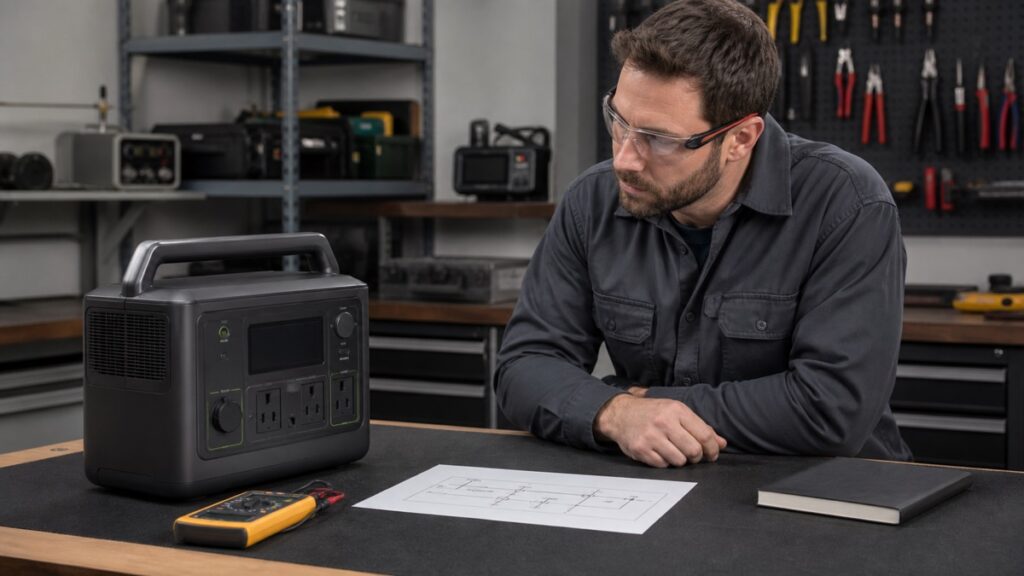
This draft must be reviewed by a qualified electrician or other appropriately qualified technical reviewer before publication. It explains decision boundaries and questions; it does not tell readers to add, remove, or improvise a neutral-ground bond.
Portable power station grounding questions cannot be answered safely from the words “floating neutral” alone. The answer changes with the exact station, regional manual, whether it is charging from grounded utility power, what device is connected, and whether the output remains direct cord-and-plug use or becomes part of an RV, transfer system, or building circuit. If the topology changes, stop and obtain product-specific guidance.
Ground Can Mean Four Different Things in One Conversation
A fault-current path associated with cords, plugs, receptacles, and exposed conductive parts.
A connection to earth within an electrical system. It is not interchangeable with every use of the word ground.
An intentional system connection whose correct location depends on the source and distribution topology.
A product connection whose allowed use must come from the exact manufacturer manual.
These functions interact but are not synonyms. A receptacle can have a ground contact while a portable source uses a floating neutral. A product can include an external grounding terminal without giving the owner permission to connect it arbitrarily. A fault-detecting device can reject a source without proving that the safe remedy is a generic bonding plug.
OSHA’s portable-generator fact sheet is useful for definitions: it distinguishes grounding from bonding and states that proper continuity or bonding verification requires correct equipment and a competent electrician. But a combustion generator fact sheet is not a universal wiring rule for battery power stations. The station’s exact manufacturer instructions, approved transfer equipment, local requirements, and qualified system design still control.
Identify the Connection Topology Before Taking Action
This decision tree never prescribes an electrical modification. It sorts the connection into ordinary documented use, manufacturer clarification, or qualified review. Select the real end use—not the use you hope an adapter will create.
A direct appliance path can remain within ordinary product instructions when the exact manual documents that use and nothing modifies the system. The result still does not certify a particular sensitive device. A transfer, building, RV, workshop, or fault-rejecting-device path contains more topology questions and should not be simplified into “bonded” versus “floating.”
The Exact Product Manual Controls the Answer
Manufacturer instructions vary. A current BLUETTI manual for one portable model says it is designed for portable use and typically does not require earth grounding, then provides different instructions when connected to grid power and tells users to consult a qualified electrician if uncertain. Another BLUETTI manual can describe use of an external grounding terminal under specific conditions. Those statements are not interchangeable across every BLUETTI product.
EcoFlow sells a model-specific Portable Power Station Grounding Adapter and lists exact compatible products and cable requirements. The existence of that accessory does not mean an arbitrary neutral-bonding plug is equivalent or that the adapter fits every DELTA model. EcoFlow’s instructions say to use the included communication cable and distinguish connection procedures by product.
| Manual evidence | What it can establish | What it cannot establish |
|---|---|---|
| Exact station grounding section | Manufacturer instructions for that model, region, and use | Rules for a different generation or topology |
| Exact manufacturer adapter page | Listed compatibility, cables, and intended use | Compatibility of generic adapters or improvised bonds |
| Transfer-system installation manual | Approved source connection and qualified-installation requirements | Permission to backfeed or bypass transfer equipment |
| Device ground-fault message | The device did not accept the observed source condition | The safe location or method for changing bonding |
Record manual title, revision, region, and page—not a forum summary. If the language is ambiguous, ask support a configuration-specific question in writing: exact station, charging state, exact connected equipment, all adapters, and whether any transfer/distribution equipment is present.
Cord-and-Plug Loads Are Not the Same as Building Wiring
Plugging an ordinary appliance directly into a station’s factory receptacle, as permitted by both manuals, keeps the source and load relationship comparatively simple. Connecting the station to a premises inlet, transfer switch, RV distribution system, or other wiring changes what equipment participates in grounding, neutral, overcurrent, and fault clearing.
- Factory station receptacle
- Intact appliance cord and plug
- Exact manuals allow the use
- No source/bond modification
- Building or RV distribution
- Transfer equipment or inlet
- Multiple sources or charging paths
- Neutral/bond location question
Crossing to the system-design side is a handoff, not a DIY tutorial. OSHA warns against connecting a portable generator directly to a structure without properly installed transfer equipment and says structure-transfer configurations require qualified installation. Again, battery systems require their own approved equipment and manuals, but the underlying boundary is useful: direct plug-in use and supplying premises wiring are not equivalent.
Do not energize building wiring through a receptacle, modified cord, or improvised adapter. Use only an approved transfer/home-backup configuration for the exact products and qualified installation where required.
Transfer Equipment Changes the Electrical System
A transfer device decides which source supplies the load and can also change whether neutral is switched or solidly connected. The correct bonding arrangement depends on the exact source and transfer design. That is why “my power station has a floating neutral—what plug should I add?” is the wrong starting question.
- Is the station explicitly approved as a source for this transfer product?
- Which conductors are switched, and what does the installation manual require?
- Where does the manufacturer define the system bonding point in each operating state?
- Can the station charge from utility power while supplying the transferred loads?
- How do GFCI/AFCI and other protective devices behave in both source states?
- Who is responsible for permits, inspection, commissioning, and labeling?
The reader should bring those questions to the transfer-equipment manufacturer and qualified electrician. This article intentionally does not answer them for an unnamed system.
EV and RV Faults Are Diagnostic Clues, Not Permission to Modify Bonding
EV supply equipment, RV surge protectors, and some appliances perform source checks. A red light or refusal to operate can indicate that the device does not accept the source condition it detects. It does not identify a universally safe remedy.
- Stop repeated connection attempts.
- Record exact error code and both model numbers.
- Confirm the device works on a known approved source if its manual permits that check.
- Ask both manufacturers whether the exact pairing and adapter are supported.
- Use only a listed, model-specific solution and its instructions.
- Escalate any bonding or distribution change to qualified electrical personnel.
Do not use a generic bonding plug merely because a forum reports that it clears an error. The station may later be connected to grounded utility charging, a transfer system, or another source, changing the topology. A modification that appears to make one device start can defeat protective behavior or create an objectionable current path elsewhere.
Stop When Any of These Conditions Appears
- The exact manual is missing, ambiguous, or describes a different region/generation.
- The plan touches a panel, inlet, transfer switch, RV distribution board, hardwired load, or multiple source.
- Someone proposes making, installing, removing, or relocating a neutral-ground bond.
- A GFCI, AFCI, EVSE, surge protector, or other protective device faults or trips.
- The station is simultaneously connected to utility charging and an output system whose topology is uncertain.
- A ground pin is missing, an adapter defeats a contact, a cord is modified, or backfeeding is proposed.
- Continuity or voltage testing would be needed to decide safety and the reader is not qualified/equipped.
- Local inspection, permit, transfer-equipment, or manufacturer approval requirements are unknown.
Stopping is not a failure. It identifies the point at which an article cannot safely substitute for product-specific system design.
Bring These Questions to the Manufacturer or Electrician
Ask for written answers that name the exact products. “Portable power stations are floating neutral” is too broad. The useful statement is closer to: “For model X, firmware Y, connected through approved accessory Z to transfer product Q while grid charging is disconnected/connected, what configuration does each manufacturer require?”
Editorial Hold: Qualified Review Required Before Publication
This page is intentionally prepared as a draft. Before publication, a qualified reviewer must verify the terminology, the boundary between generator guidance and battery-station instructions, the manufacturer examples, the decision-tree outcomes, and the absence of actionable bonding modifications.
Readers looking only for automatic transfer behavior should use the UPS-versus-EPS guide. Readers evaluating 120V and 240V circuits should use the dedicated voltage guide after publication. Neither page authorizes a grounding or building-wiring change.

Leave a Reply