Solar Power Picks logo with sun, solar panel, and green energy icon

  • Home
  • Reviews
  • Best
    • Best portable power stations
    • Best Solar Panels
    • Best Solar Generators
    • Best Solar Charge Controllers
    • Best Solar Batteries
  • Guides
    • Portable Power Stations Guides
    • Solar Panels Guides
    • Solar Generators Guides
    • Solar Charge Controllers Guides
    • Solar Batteries Guides
  • Comparisons
    • Portable Power Stations Comparisons
    • Solar Panels Comparisons
    • Solar Generators Comparisons
    • Solar Charge Controllers Comparisons
    • Solar Batteries Comparisons
  • Calculator
Home / Solar Charge Controllers / Best / Best PWM Solar Charge Controllers: 5 Practical Budget Picks

Best PWM Solar Charge Controllers: 5 Practical Budget Picks

OUR PICKS

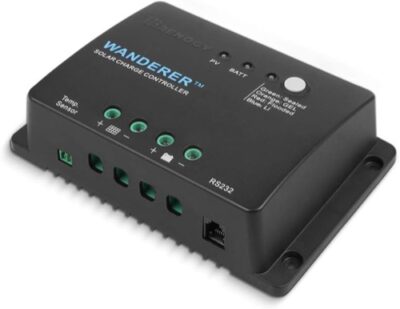
Renogy Wanderer 10A Review: Budget PWM with Useful Controls

Best Budget PWM

Renogy Wanderer 10A Review: Budget PWM with Useful Controls

Check price at Amazon Jump to details
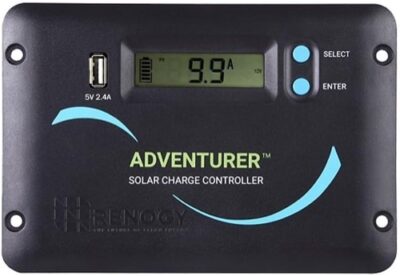
Renogy Adventurer Li 30A Review: The Flush-Mount RV Specialist

Best for Flush-Mount RV Panels

Renogy Adventurer Li 30A Review: The Flush-Mount RV Specialist

Check price at Amazon Jump to details
ECO-WORTHY 30A PWM Bluetooth Review: Cheap App Access, Uneven Evidence

Best with Bluetooth

ECO-WORTHY 30A PWM Bluetooth Review: Cheap App Access, Uneven Evidence

Check price at Amazon Jump to details
SOLPERK 10A Waterproof Review: Verify Polarity Before You Trust It

Best Weather-Resistant Value

SOLPERK 10A Waterproof Review: Verify Polarity Before You Trust It

Check price at Amazon Jump to details
EpRec 30A PWM Review: Revision Confusion Makes Battery Setup the Real Test

Best Ultra-Budget Lithium Option

EpRec 30A PWM Review: Revision Confusion Makes Battery Setup the Real Test

Check price at Amazon Jump to details

The best PWM solar charge controllers are not the models with the largest amp number; they are the ones whose panel voltage, battery profile, wiring, and environment match a deliberately small system. PWM remains a practical choice for voltage-matched arrays where simple controls or low cost matter more than extracting every possible watt.

The usual mistake is treating a 30A faceplate as a complete specification. It says nothing by itself about cold-corrected PV voltage, permitted array current, battery-voltage-specific watts, terminal capacity, or whether the controller can survive the mounting location.

We ranked these five exact models from published electrical data and their captured Amazon owner evidence. Solar Power Picks did not bench-test them, so owner measurements remain attributed and missing limits remain reasons to size conservatively.

PWM decision rule — Choose PWM because the array is voltage-matched and the system benefits from simplicity, not merely because the controller is cheaper than MPPT.

Start with the Five Electrical Profiles

The products separate into three roles: a documented small-system controller, a flush-mounted RV controller, and inexpensive feature-heavy units whose manuals leave more work to the buyer. SOLPERK adds weather resistance but removes lithium and numeric monitoring.

Product Article-Specific Badge Type / Rated Current Max PV Voc Battery System Best Fit
Renogy Wanderer 10A Best Documented Budget PWM PWM / 10A 50V 12V / 24V Small shed, fence, or lighting systems
Renogy Adventurer Li 30A Best Flush-Mount RV Controller PWM / 30A 50V 12V / 24V Permanent interior RV control panels
ECO-WORTHY 30A Bluetooth Best Low-Cost App Monitoring PWM / 30A 50V 12V / 24V Protected systems where built-in Bluetooth matters
SOLPERK 10A Waterproof Best Sealed SAE Maintainer PWM / 10A Not published 12V / 24V Outdoor lead-acid maintenance
EpRec 30A Best Experimental Ultra-Budget Pick PWM / 30A nominal Not published 12V / 24V Visible, noncritical hobby systems

This is an elimination table, not an approval to wire an array. The Wanderer and Adventurer publish useful power limits; ECO-WORTHY publishes 50V but not reviewed PV watts or input current; SOLPERK publishes watts but not Voc/Isc; and EpRec leaves all three PV boundaries unresolved.

How We Chose the Best PWM Solar Charge Controllers

Specification credibility came first. A lower-current model with published voltage, watts, terminals, and operating conditions scored above a nominal 30A unit whose documentation could not support safe use near its label. Next, we matched each controller to the reason a buyer might rationally select PWM: small-system economics, flush mounting, integrated app access, or a sealed enclosure.

Owner reports were used to identify installation friction and failure modes, not to invent reliability percentages. The evidence includes multi-year Wanderer service, an Adventurer voltage-offset allegation, ECO-WORTHY meter comparisons and heat reports, SOLPERK polarity/night-drain accounts, and EpRec revision confusion. No product received credit for hands-on testing by Solar Power Picks.

Criterion Why It Matters Weight
Voltage-matched array fit PWM cannot turn a large voltage surplus into proportional battery current High
Published PV boundaries Voc, Isc, and watts define what can be connected High
Battery/profile fit Lithium and lead-acid need different behavior High
Installation format Terminals, wall depth, fixed leads, and enclosure determine practical fit Medium
Monitoring LCD, app, and load modes help commissioning Medium
Owner evidence Repeated problems reveal risk that feature lists omit Medium

Evidence note — “30A” is not a quality score. In this roundup, missing PV limits reduce the defensible application even when the front panel shows a larger current rating.

Best Documented Budget PWM: Renogy Wanderer 10A

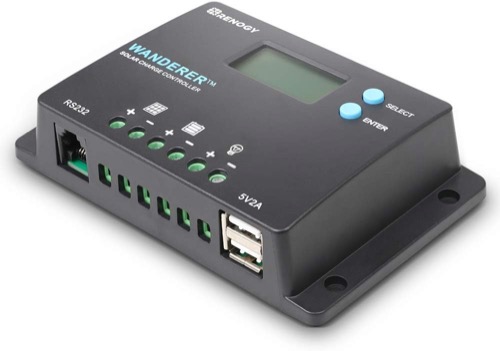
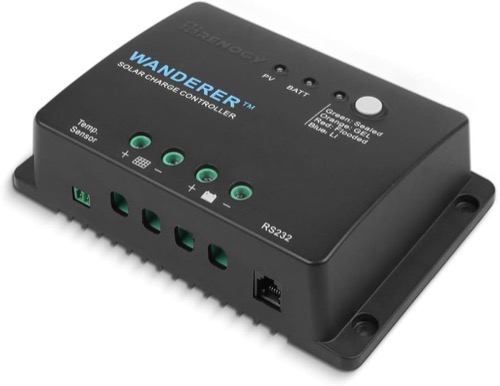
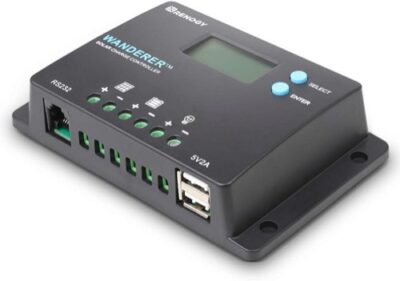
The Wanderer wins the small-system category because its limits are unusually usable for the price: 50V maximum PV Voc, 130W at 12V, 260W at 24V, a 10A load output, 12 AWG maximum terminals, LCD, USB, and several load-control modes. It supports common lead-acid profiles and lithium selection, while optional BT-1 adds local app access.

Its modest current is a virtue when the alternative is an unverifiable 30A claim. Captured owners describe years of service in 50W sheds, lighting, fences, and RV systems, although two also reported early display or electrical failures. The 12 AWG terminal ceiling and separately sold Bluetooth module should be designed and priced before purchase.

Skip it for a growing RV roof, a high-voltage module, or a long cable run that requires conductors too large for its terminals. It is the strongest choice here only when the system genuinely fits inside its small documented envelope.

Best Flush-Mount RV Controller: Renogy Adventurer Li 30A

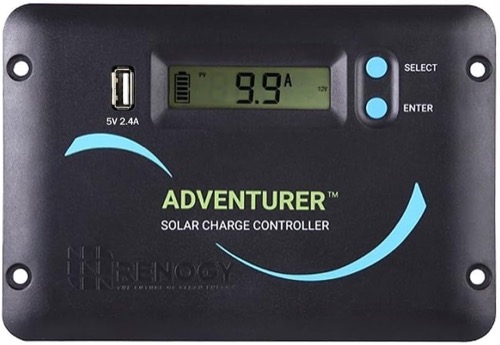
The Adventurer solves a physical problem the others do not. Its LCD and buttons sit in an RV wall, while the controller supports 30A, 400W at 12V or 800W at 24V, 50V maximum PV Voc, an 8 AWG terminal maximum, and an optional BT-1 module.

Measure the received hardware before cutting. One detailed owner needed roughly 1.75 inches of practical rear clearance once terminals, sensor plug, and cable bends were included, and another wanted a proper cutout template. A 4,000km road-trip report supports the format’s RV fit, but one owner also measured the display about 0.2V below several meters and believed actual charge voltage ran correspondingly high.

Choose it when a clean local control panel is the primary requirement and the roof array is suitable for PWM. Skip it when MPPT harvest, exposed mounting, or controller-managed lithium cold protection matters more than the flush face.

Best Low-Cost App Monitoring: ECO-WORTHY 30A Bluetooth

ECO-WORTHY combines LCD, USB, a programmable load output, battery presets, and built-in Bluetooth without requiring a separate dongle. The reviewed model supports 12V/24V operation, lead-acid and LiFePO4 selection, and a 50V PV ceiling.

The app is more than a marketing bullet when the controller sits inside a cabinet, but its data does not repair the specification gaps. Reviewed PV Isc, PV watts, terminal maximum, warranty, and a formal IP rating were unavailable. Owners also reported mixed app behavior, heat, early failure, and a variant that allegedly did not expose the expected Bluetooth function.

This is a conditional value pick for a modest protected system commissioned with independent measurements. It is not the 30A choice for a remote battery whose failure would be expensive.

Best Sealed SAE Maintainer: SOLPERK 10A Waterproof

SOLPERK offers IP67 enclosure protection, fixed SAE leads, automatic 12V/24V operation, and published limits of 150W at 12V or 300W at 24V. For a gate, UTV, trailer, or seasonal lead-acid battery, those features may matter more than app control.

The tradeoff is diagnostic depth. There is no numeric display, no communications, no programmable load output, and no documented lithium support. One apparent dead unit began working after the owner corrected SAE polarity; another buyer reported battery drain, and a repeat owner said a first unit began allowing nighttime discharge after about three years.

Verify every SAE connector with a meter and check reverse current after dark. The IP67 body also does not waterproof user-added connectors, fuse holders, battery posts, or extensions.

Best Experimental Ultra-Budget Pick: EpRec 30A

EpRec supplies an LCD, dual USB, adjustable PWM parameters, multiple battery selections, and a programmable load output at an extremely low price. That feature list makes it attractive for a bench, lighting experiment, or visible hobby system.

It ranks last because maximum PV Voc, PV Isc, PV watts, load-output current, terminal capacity, environmental rating, and warranty were not published in the supplied evidence. Captured owners also describe B1/B2/B3 revision confusion, a roughly 0.4V display overread, and a lithium-mode limitation involving a 24V LiFePO4 system.

A faceplate labeled 30A does not justify a 30A design. Keep the array small unless exact documentation is obtained, compare the display with a meter, and do not make this controller responsible for a remote or safety-relevant load.

Match Each Pick to a PWM-Sensible System

Product Suitable Array / Battery Context Best For Skip If Deciding Limit
Wanderer 10A One modest voltage-matched panel; supported 12V/24V battery Documented small systems Expansion or rich logging is planned 130W/260W, 10A, 12 AWG
Adventurer 30A RV roof within 50V and 400W/800W; protected wall cavity Flush local control Limited roof area favors MPPT Rear depth and actual battery voltage
ECO-WORTHY 30A Conservative 12V/24V array in a dry compartment Built-in app on a budget PV-current/watt documentation is required Missing Isc/watts/terminal data
SOLPERK 10A Outdoor lead-acid maintainer using verified SAE polarity Weather-exposed small charging Lithium or numeric monitoring is required Missing Voc/Isc and reverse-drain check
EpRec 30A Supervised, low-consequence hobby setup Lowest entry price Failure or uncertainty has real cost Most PV and installation limits unresolved

When PWM Is the Right Engineering Choice

Match Panel Operating Voltage to the Battery

PWM effectively pulls panel operation toward battery charging voltage during conduction. A “12V-class” module designed for 12V battery charging can therefore be a reasonable match. A high-voltage residential module may stay below the controller’s absolute Voc ceiling yet waste much of its voltage advantage because PWM does not perform the same voltage-to-current conversion as MPPT.

Use the panel datasheet, not the retail voltage label. Check cold-corrected Voc against the hard maximum and confirm hot-weather Vmp remains useful for charging. With SOLPERK and EpRec, missing voltage details are reasons to obtain the exact manual rather than assume compatibility from owner wattage alone.

Separate Output Current from Array Current

The controller’s rated amps normally describe maximum battery-side output. Array Isc is a different limit, especially when panels are paralleled. A 30A output name cannot fill an unpublished PV-current field.

The conservative response is not a homemade rule such as “stay below half the label.” Use manufacturer documentation for array Isc, protection, and any oversizing allowance. If that documentation does not exist, choose the Wanderer/Adventurer scale or a better-specified alternative instead of building to the unresolved edge.

Treat Lithium as a Complete Charging Strategy

Wanderer, Adventurer, ECO-WORTHY, and EpRec advertise or document lithium selections; SOLPERK is lead-acid only in the reviewed profile. A lithium button does not prove the charge voltage matches the exact battery, equalization is impossible, BMS recovery is handled correctly, or charging stops below freezing.

The reviewed controllers do not document a complete internal low-temperature LiFePO4 cutoff. Use a battery/BMS or other approved control that actually prevents cold charging. For lead-acid, confirm absorption, float, equalization, and temperature compensation rather than selecting a battery icon and walking away.

Battery check — Write down the component that enforces low-temperature charging protection. If the answer is only “the controller has lithium mode,” the design remains incomplete.

Count Monitoring and Mounting as Installed Cost

The two Renogy models require an optional Bluetooth module, while ECO-WORTHY includes Bluetooth and the other two have no app. Yet the Wanderer’s LCD may already satisfy a simple local system, and ECO-WORTHY’s lower purchase price may be offset by uncertain documentation or replacement cost.

Mounting also changes the budget. Adventurer needs a carefully planned wall cut and dry IP20 cavity. SOLPERK needs environmentally suitable connectors beyond its IP67 body. The indoor economy models need dry, ventilated, inspectable locations. Include enclosures, cable adapters, sensors, fuses, and labor before calling any pick cheap.

Preliminary PWM Sizing Examples

These hypothetical calculations estimate battery-side demand as array watts divided by target charging voltage. They do not calculate cold-corrected Voc and cannot replace exact manuals.

Scenario Array STC Watts Series Voc at STC Battery Bank Approx. Output Demand Still Must Verify
Shed maintainer 80W 22V 12V 80 ÷ 14.4 = 5.6A Cold Voc, array Isc, panel-to-battery voltage match
Small RV roof 300W 24V 12V 300 ÷ 14.4 = 20.8A Controller watts, wire/drop, battery charge limit
24V lighting bank 400W 44V 24V 400 ÷ 28.8 = 13.9A 50V cold headroom, PV Isc, load surge
Gate maintainer 40W 22V 12V 40 ÷ 14.4 = 2.8A Winter energy balance, overnight reverse current

Common PWM Buying Mistakes

  • Buying a 30A label before finding the model’s PV Voc, Isc, and watt limits.
  • Using a high-voltage panel because its Voc happens to remain below the absolute ceiling.
  • Comparing warm-day Vmp with maximum PV Voc instead of cold-correcting series Voc.
  • Assuming automatic battery voltage also means automatic chemistry selection.
  • Treating a lithium preset as low-temperature protection.
  • Running an inverter or high-inrush motor through a small programmable load output.
  • Trimming conductor strands to fit an undersized terminal.
  • Assuming the controller’s IP rating covers every connector and battery enclosure.

Bottom Line — Best PWM Solar Charge Controllers

Among the best PWM solar charge controllers, the Renogy Wanderer 10A is the strongest documented small-system value. It gives up output capacity but publishes the limits needed to decide whether a modest array fits. The Adventurer 30A is the better answer when a flush-mounted RV display is the project-defining requirement.

ECO-WORTHY earns a conditional place for built-in Bluetooth, while SOLPERK is the intentional outdoor lead-acid maintainer. EpRec belongs only in supervised, low-consequence use until its missing PV boundaries are resolved.

Before ordering, confirm cold-corrected array Voc, PV Isc, battery-voltage-specific watts, expected output current, battery profile, temperature strategy, conductor and terminal fit, load surge, enclosure, and the exact model manual. If panel voltage is substantially above battery voltage or roof space makes every watt valuable, this PWM list is the wrong endpoint—compare correctly sized MPPT models instead.

Best Budget PWM

Renogy Wanderer 10A Review: Budget PWM with Useful Controls

Renogy Wanderer 10A Review: Budget PWM with Useful Controls

Get it now:

Check latest price

What to know

  • Low-cost documented option
  • Useful local interface
  • Programmable load behavior
  • Small-system owner success

Best if

  • Low-cost documented option
  • Useful local interface
  • Programmable load behavior
  • Small-system owner success

Skip if

  • PWM topology
  • Small terminals
  • Bluetooth is optional
  • No historical logging

The Renogy Wanderer 10A is a low-cost PWM controller for genuinely small 12V/24V systems, with a backlit LCD, programmable load output, USB power, and optional Bluetooth. It offers much better documentation than anonymous budget controllers, but its 10A ceiling, AWG 12 terminals, PWM topology, and mixed durability reports limit its role. It makes the most sense for modest lighting, shed, fence, or maintenance-charging projects. Best fit: The Renogy Wanderer 10A is a low-cost PWM controller for genuinely small 12V/24V systems, with a backlit LCD, programmable load output, USB power, and optional Bluetooth.

BrandRenogy
Model / SKUWanderer 10A (RNG-CTRL-WND10; ASIN B07NPDWZJ7)
Controller typePWM
Rated charge current10A
Battery-system voltage12V / 24V automatic recognition for non-lithium batteries
Battery compatibilitySealed/AGM, gel, flooded, and lithium
Max PV open-circuit voltage (Voc)50V
Max PV input current (Isc)10A controller limit; verify array Isc and required margin
Max PV power by battery voltage130W @ 12V; 260W @ 24V
Load output10A programmable DC load output with five operating modes
Charging profilesFour-stage PWM with battery-type selection and adjustable lithium voltage
Temperature sensing / low-temp protection-3mV/°C/2V lead-acid compensation; no lithium low-temp cutoff published
Display / local controlsBacklit LCD, two buttons, status indicators, and 5V/2A USB
App / communicationsRS232; optional BT-1 module for Renogy DC Home
Maximum terminal wire size12 AWG
Maximum efficiencyNot applicable; PWM controller
Enclosure / operating temperatureIngress rating not published; -25°C to 45°C (-31°F to 113°F)
Dimensions / weight119 × 75 × 27.5 mm; 122 g / 0.27 lb
Warranty2 years
Best for Flush-Mount RV Panels

Renogy Adventurer Li 30A Review: The Flush-Mount RV Specialist

Renogy Adventurer Li 30A Review: The Flush-Mount RV Specialist

Get it now:

Check latest price

What to know

  • Purpose-built flush mounting
  • 30A PWM output
  • 400W/800W published PV limits
  • Optional Bluetooth and lithium support

Best if

  • Purpose-built flush mounting
  • 30A PWM output
  • 400W/800W published PV limits
  • Optional Bluetooth and lithium support

Skip if

  • PWM rather than MPPT
  • IP20 indoor enclosure
  • Bluetooth costs extra
  • No controller-managed lithium cold cutoff documented

The flush-mount form, clear LCD, and documented 30A limits work well in RV panels, but PWM conversion and an indoor enclosure constrain array placement. Best fit: RV installations that specifically need a flush-mounted local display.

BrandRenogy
Model / SKUAdventurer Li 30A (ASIN B07BBKFTNV)
Controller typePWM
Rated charge current30A
Battery-system voltage12V / 24V automatic for non-lithium batteries
Battery compatibilitySealed/AGM, gel, flooded, and lithium
Max PV open-circuit voltage (Voc)50V
Max PV input current (Isc)Not published
Max PV power by battery voltage400W @ 12V; 800W @ 24V
Load output30A programmable load output
Charging profilesFour-stage lead-acid and lithium profile
Temperature sensing / low-temp protectionOptional temperature sensor for lead-acid; no lithium low-temp cutoff published
Display / local controlsFlush-mount LCD and buttons
App / communicationsRS232; optional BT-1 module
Maximum terminal wire size8 AWG
Maximum efficiencyNot applicable as a published MPPT conversion figure
Enclosure / operating temperatureIP20; -25°C to 55°C
Dimensions / weight166.6 × 114.3 × 48.3 mm; 0.27 kg
Warranty1 year
Best with Bluetooth

ECO-WORTHY 30A PWM Bluetooth Review: Cheap App Access, Uneven Evidence

ECO-WORTHY 30A PWM Bluetooth Review: Cheap App Access, Uneven Evidence

Get it now:

Check latest price

What to know

  • Built-in Bluetooth
  • LCD and USB output
  • 12V/24V automatic operation
  • Lead-acid and LiFePO4 selection

Best if

  • Built-in Bluetooth
  • LCD and USB output
  • 12V/24V automatic operation
  • Lead-acid and LiFePO4 selection

Skip if

  • PWM rather than MPPT
  • PV current and power limits are incompletely documented
  • No IP rating
  • Mixed app and reliability reports

It brings app monitoring to a very low price, but PWM conversion and mixed reliability evidence make it better for modest arrays than critical installations. Best fit: Budget 12V/24V systems where built-in Bluetooth matters more than MPPT efficiency.

BrandECO-WORTHY
Model / SKU30A PWM Bluetooth (ASIN B08JBLMC33)
Controller typePWM
Rated charge current30A
Battery-system voltage12V / 24V automatic
Battery compatibilityAGM, gel, flooded lead-acid, and LiFePO4
Max PV open-circuit voltage (Voc)50V
Max PV input current (Isc)Not published
Max PV power by battery voltageNot published
Load outputProgrammable load output; current product specification states 30A
Charging profilesBattery presets and adjustable load-control parameters
Temperature sensing / low-temp protectionInternal sensing; no external sensor or lithium low-temp cutoff documented
Display / local controlsLCD, buttons, and USB
App / communicationsBuilt-in Bluetooth with mobile app
Maximum terminal wire sizeNot published
Maximum efficiencyNot published
Enclosure / operating temperatureProtected dry mounting; -20°C to 75°C
Dimensions / weight136.5 × 85 × 30 mm; 216 g
WarrantyNot published
Best Weather-Resistant Value

SOLPERK 10A Waterproof Review: Verify Polarity Before You Trust It

SOLPERK 10A Waterproof Review: Verify Polarity Before You Trust It

Get it now:

Check latest price

What to know

  • IP67 weather resistance
  • 10A PWM rating
  • SAE quick-connect leads
  • 150W/300W published power limits

Best if

  • IP67 weather resistance
  • 10A PWM rating
  • SAE quick-connect leads
  • 150W/300W published power limits

Skip if

  • Lead-acid only
  • No display or app
  • Mixed polarity and durability evidence
  • PV Voc and Isc limits not published

IP67 sealing and simple SAE cabling make outdoor maintenance convenient, but mixed polarity, drain, and durability reports demand verification before unattended use. Best fit: Exposed low-power 12V/24V lead-acid maintenance systems using SAE connections.

BrandSOLPERK
Model / SKU10A Waterproof PWM (ASIN B0946MWYPK)
Controller typePWM
Rated charge current10A
Battery-system voltage12V / 24V automatic
Battery compatibilityAGM, gel, flooded, and sealed lead-acid; not lithium
Max PV open-circuit voltage (Voc)Not published
Max PV input current (Isc)Not published
Max PV power by battery voltage150W @ 12V; 300W @ 24V
Load outputNo programmable load terminals
Charging profilesAutomatic PWM lead-acid charging
Temperature sensing / low-temp protectionNo external sensor or low-temperature protection documented
Display / local controlsStatus LEDs
App / communicationsNo app or communications port
Maximum terminal wire sizeFixed SAE leads
Maximum efficiencyNot published
Enclosure / operating temperatureIP67; operating range not published
Dimensions / weightNot published
WarrantyNot published
Best Ultra-Budget Lithium Option

EpRec 30A PWM Review: Revision Confusion Makes Battery Setup the Real Test

EpRec 30A PWM Review: Revision Confusion Makes Battery Setup the Real Test

Get it now:

Check latest price

What to know

  • Very low price
  • LCD and dual USB
  • Four-stage PWM charging
  • Lithium and lead-acid modes

Best if

  • Very low price
  • LCD and dual USB
  • Four-stage PWM charging
  • Lithium and lead-acid modes

Skip if

  • No verified PV Voc or Isc limit
  • No weather rating
  • No communications
  • Sparse long-term documentation

A flexible interface at a rock-bottom price, but the lack of firm PV, terminal, enclosure, and warranty limits prevents confident high-current use. Best fit: Very small budget systems needing local load control and selectable battery modes.

BrandEpRec
Model / SKU30A PWM (ASIN B07VDWTWTW)
Controller typePWM
Rated charge current30A nominal
Battery-system voltage12V / 24V automatic
Battery compatibilityLead-acid, lithium, and LiFePO4 selections
Max PV open-circuit voltage (Voc)Not published
Max PV input current (Isc)Not published
Max PV power by battery voltageNot published
Load outputProgrammable load output; exact continuous current not published
Charging profilesFour-stage PWM with adjustable parameters
Temperature sensing / low-temp protectionNo external sensor or low-temperature cutoff documented
Display / local controlsLCD, buttons, and dual USB
App / communicationsNo app or communications port
Maximum terminal wire sizeNot published
Maximum efficiencyNot published
Enclosure / operating temperatureProtected dry mounting; operating range not published
Dimensions / weightNot published
WarrantyNot published

Product Comparison

Feature Renogy Wanderer 10A Review: Budget PWM with Useful Controls Renogy Adventurer Li 30A Review: The Flush-Mount RV Specialist ECO-WORTHY 30A PWM Bluetooth Review: Cheap App Access, Uneven Evidence SOLPERK 10A Waterproof Review: Verify Polarity Before You Trust It EpRec 30A PWM Review: Revision Confusion Makes Battery Setup the Real Test
Product Image
Renogy Wanderer 10A Review: Budget PWM with Useful Controls
Renogy Adventurer Li 30A Review: The Flush-Mount RV Specialist
ECO-WORTHY 30A PWM Bluetooth Review: Cheap App Access, Uneven Evidence
SOLPERK 10A Waterproof Review: Verify Polarity Before You Trust It
EpRec 30A PWM Review: Revision Confusion Makes Battery Setup the Real Test
Price $27.77 $68.88 $27.99 $19.99 N/A
Rating
4.3 / 5
4.4 / 5
4.1 / 5
4.0 / 5
3.9 / 5
Category Solar Charge Controllers Solar Charge Controllers Solar Charge Controllers Solar Charge Controllers Solar Charge Controllers
Brand Renogy Renogy ECO-WORTHY SOLPERK EpRec
Model / SKU Wanderer 10A (RNG-CTRL-WND10; ASIN B07NPDWZJ7) Adventurer Li 30A (ASIN B07BBKFTNV) 30A PWM Bluetooth (ASIN B08JBLMC33) 10A Waterproof PWM (ASIN B0946MWYPK) 30A PWM (ASIN B07VDWTWTW)
Controller type PWM PWM PWM PWM PWM
Rated charge current 10A 30A 30A 10A 30A nominal
Battery-system voltage 12V / 24V automatic recognition for non-lithium batteries 12V / 24V automatic for non-lithium batteries 12V / 24V automatic 12V / 24V automatic 12V / 24V automatic
Battery compatibility Sealed/AGM, gel, flooded, and lithium Sealed/AGM, gel, flooded, and lithium AGM, gel, flooded lead-acid, and LiFePO4 AGM, gel, flooded, and sealed lead-acid; not lithium Lead-acid, lithium, and LiFePO4 selections
Max PV open-circuit voltage (Voc) 50V 50V 50V Not published Not published
Max PV input current (Isc) 10A controller limit; verify array Isc and required margin Not published Not published Not published Not published
Max PV power by battery voltage 130W @ 12V; 260W @ 24V 400W @ 12V; 800W @ 24V Not published 150W @ 12V; 300W @ 24V Not published
Load output 10A programmable DC load output with five operating modes 30A programmable load output Programmable load output; current product specification states 30A No programmable load terminals Programmable load output; exact continuous current not published
Charging profiles Four-stage PWM with battery-type selection and adjustable lithium voltage Four-stage lead-acid and lithium profile Battery presets and adjustable load-control parameters Automatic PWM lead-acid charging Four-stage PWM with adjustable parameters
Temperature sensing / low-temp protection -3mV/°C/2V lead-acid compensation; no lithium low-temp cutoff published Optional temperature sensor for lead-acid; no lithium low-temp cutoff published Internal sensing; no external sensor or lithium low-temp cutoff documented No external sensor or low-temperature protection documented No external sensor or low-temperature cutoff documented
Display / local controls Backlit LCD, two buttons, status indicators, and 5V/2A USB Flush-mount LCD and buttons LCD, buttons, and USB Status LEDs LCD, buttons, and dual USB
App / communications RS232; optional BT-1 module for Renogy DC Home RS232; optional BT-1 module Built-in Bluetooth with mobile app No app or communications port No app or communications port
Maximum terminal wire size 12 AWG 8 AWG Not published Fixed SAE leads Not published
Maximum efficiency Not applicable; PWM controller Not applicable as a published MPPT conversion figure Not published Not published Not published
Enclosure / operating temperature Ingress rating not published; -25°C to 45°C (-31°F to 113°F) IP20; -25°C to 55°C Protected dry mounting; -20°C to 75°C IP67; operating range not published Protected dry mounting; operating range not published
Dimensions / weight 119 × 75 × 27.5 mm; 122 g / 0.27 lb 166.6 × 114.3 × 48.3 mm; 0.27 kg 136.5 × 85 × 30 mm; 216 g Not published Not published
Warranty 2 years 1 year Not published Not published Not published
Buy Now View Deal View Deal View Deal View Deal View Deal

Best PWM Solar Charge Controllers: The Bottom Line

PWM remains useful when panel voltage closely matches battery voltage and simplicity, weather resistance, or price matters more than maximum harvest. These five picks cover documented RV mounting, app access, exposed installations, and basic budget systems.

Final check: Recalculate cold Voc, PV Isc, charge current, PV watts, cable size, fusing, and battery settings against the exact current manual before ordering.

Frequently Asked Questions

When is a PWM solar charge controller a sensible choice?

PWM is sensible for a small array whose operating voltage closely matches the battery, especially when price, a simple load timer, flush mounting, or a sealed enclosure matters more than maximum harvest. It is a poor shortcut for high-voltage modules or long series strings that need MPPT voltage conversion.

Why can a high-voltage panel be a poor match for PWM?

PWM pulls panel operation toward battery charging voltage during conduction rather than converting a large voltage surplus into proportional battery current. A panel can remain below the controller's absolute Voc ceiling and still be an inefficient operating match. Check Voc, Vmp, current, and the controller's published watt limit together.

Is a 30A PWM controller automatically suitable for a 30A solar array?

No. The 30A label usually refers to battery-side charge output. Maximum PV Voc, PV Isc, array watts, terminal capacity, and temperature limits remain independent. Several inexpensive models in this roundup do not publish those input boundaries, so they should not be designed to the faceplate rating.

Which PWM controller is best for a small RV?

The Renogy Adventurer Li 30A is the specialist when a flush-mounted local display defines the project and the roof panels are voltage-matched. The Wanderer 10A is the smaller documented value for sheds or very modest RV arrays. Measure the Adventurer's full rear clearance before cutting the wall.

Can a PWM controller safely charge LiFePO4?

Only when the exact model documents a suitable lithium profile and the settings match the battery. Confirm charge voltage and current, equalization behavior, float policy, BMS requirements, and low-temperature protection. SOLPERK 10A is lead-acid only in the reviewed profile, while other models differ in configurability.

Do I need MPPT for a 100W solar panel?

Not necessarily. A voltage-matched 100W-class panel and small 12V battery can be a rational PWM system. MPPT becomes more attractive when panel voltage sits well above battery voltage, cable length favors higher PV voltage, shade or limited area makes harvest more valuable, or near-term expansion exceeds the PWM controller's documented limits.

×

About Solar Power Picks

Portable Solar Power, Backup Power, and Off-Grid Gear Guides

Your trusted source for honest, in-depth product reviews and comparisons.

Quick Links

  • Best Picks
  • Reviews
  • Guides
  • Comparisons
  • Calculator
  • Privacy policy
  • Favorites

Categories

  • Portable Power Stations
  • Solar Batteries
  • Solar Charge Controllers
  • Solar Generators
  • Solar Panels

© 2026 Solar Power Picks. All Rights Reserved.

We may earn a commission when you purchase through links on our site. Learn more