AMPINVT 60A MPPT Review: Big Limits, Bigger Due-Diligence Burden
At a Glance
KEY FEATURES
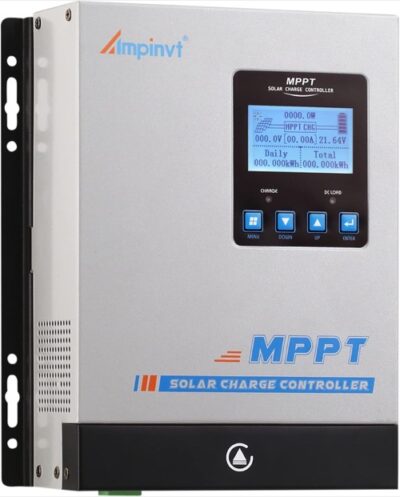
- Controller: MPPT; 60A rated charge output.
- System: 12V / 24V / 48V automatic; 36V manual; Lithium, sealed/AGM, gel, and flooded lead-acid.
- PV boundary: 150V maximum Voc; 900W @ 12V; 1,700W @ 24V; 2,700W @ 36V; 3,400W @ 48V maximum PV power.
- Controls: Front LCD with operating and history data; RS485; optional Wi-Fi monitoring box.
- Best fit: Ventilated 12V-48V off-grid systems that need 150V input and a lower purchase price.
PROS
- Large 60A envelope and multi-voltage support offer substantial system capacity.
- Local screen and settings allow operation without a phone.
- Communications options can support advanced monitoring projects.
CONS
- Fan, display, firmware, and support concerns demand early testing.
- Lithium settings require battery-specific verification.
- Remote accessories and integration can raise the real system cost.
Editor's Choice
Editorial assessment based on exact-model documentation and qualitative exact-ASIN owner evidence; no first-party bench test or population-rate claim
Will the AMPINVT 60A MPPT Fit Your Solar Array?
Estimate required charging current and check it against the documented limits for AMPINVT 60A MPPT.
Solar Charge Controller Size Calculator
What size charge controller do I need?
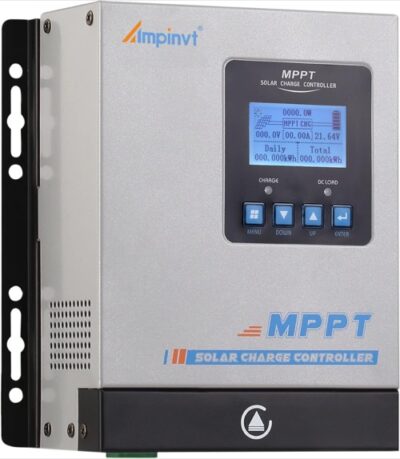
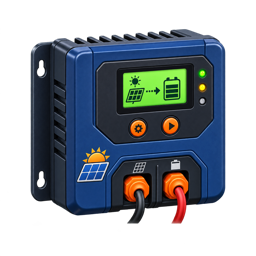
The AMPINVT APC190060 is easy to understand on paper: 60A charge output, a 150V PV ceiling, support for battery banks from 12V through 48V, a front display, and a price below many premium controllers in the same electrical class. Those specifications can make it attractive for a cabin, workshop, or secondary off-grid bank.
The owner evidence makes the decision less comfortable. supplied reports include successful multi-year or multi-unit service, accessible parameter controls, and sturdy metal construction. They also include a unit that stopped after nine months, a display that failed after two months, loud fan comments, voltage-calibration concerns, an expensive Wi-Fi accessory, and sharply different experiences with support. This is a capacity-first purchase, not the safest default recommendation.
| Best For | Main Attraction | Main Risk | Evidence Confidence |
|---|---|---|---|
| Accessible, ventilated 12V–48V off-grid systems needing 150V input | High voltage/current capacity for the price | Mixed QC, support, display, and durability reports | High for advertised core limits; medium-low for long-term ownership |
AMPINVT's Large Envelope Requires a Formal Acceptance Test
The expanded exact-ASIN evidence preserves the AMPINVT 60A controller’s appeal while raising the due-diligence bar. Owners describe useful charging, broad settings, substantial array capability, and systems ranging from cabins to larger battery banks. Critical accounts discuss fan noise, display lockups, failed units, unclear lithium behavior, costly communications hardware, and difficulty obtaining technical help.
No owner pool can predict reliability across all units. It can, however, tell a buyer what to test before the return window closes. For this model, that means every input and output limit, the local display, fan response, battery profile, error recovery, and any RS485 or Wi-Fi workflow that influenced the purchase.
A 60A charge path needs a battery bank that can accept the configured current and conductors that fit the actual terminals without modification. If the controller offers a high PV-voltage ceiling, calculate cold Voc rather than relying on a warm operating reading. If lithium is selected, compare every charging stage with the battery maker’s requirements; a chemistry label is not a complete profile.
Communications should be treated as a separate subsystem. Confirm which accessory is included, which protocol is exposed, whether local operation remains possible without the network, and what history survives a restart. Buyers who need polished remote monitoring or a clearly accountable service chain should include that requirement in the comparison—not assume the low hardware price includes it.
Why 150V and 60A Can Be Useful Together
AMPINVT publishes 150V maximum PV input and 60A maximum battery-side output. The power table scales from 900W at 12V to 1,700W at 24V, 2,700W at 36V, and 3,400W at 48V. This lets a designer raise array voltage to reduce current on a long PV run while selecting a bank voltage suited to the inverter and conductor plan.
That flexibility does not merge the limits. Cold-corrected array Voc must remain below the exact current manual’s ceiling. Total parallel-string Isc must comply with an input-current rule that was not published in the supplied evidence. Battery-side current must remain acceptable to the bank and its BMS. The wattage row must match the selected battery voltage.
| Electrical Boundary | Reviewed Value | What Must Be Calculated Separately |
|---|---|---|
| Maximum PV Voc | 150V | Complete string Voc at site design-low temperature |
| Rated charge output | 60A | Battery charge-current limit and cable/protection sizing |
| PV power at 12V | 900W | Expected current near actual charging voltage |
| PV power at 24V | 1,700W | Array configuration and unresolved PV Isc |
| PV power at 36V | 2,700W | Manual selection of the 36V bank mode |
| PV power at 48V | 3,400W | String voltage window and bank/BMS requirements |
| Maximum PV Isc | Not published in reviewed evidence | Manufacturer confirmation before parallel expansion |
One supplied buyer noticed apparently conflicting 24V voltage information and postponed installation while translating the manual. That account illustrates why a marketplace headline cannot settle a high-energy design. Obtain the manual for APC190060—not a neighboring 40A or 80A family member—and reconcile every voltage table before buying panels.
Sizing stop — A 150V label is not a target operating voltage, and 60A output is not the permitted array short-circuit current. If the exact PV-current boundary remains unavailable, do not improvise a parallel-string allowance.
Owner Evidence Splits into Three Different Stories
The positive story is straightforward. Several owners described easy parameter changes, a useful display, a substantial enclosure, and successful charging. One used the unit as a secondary controller at an off-grid cottage; another bought a second AMPINVT as their system expanded. A Spanish-language owner reported more than a year of satisfactory service.
The support story is equally mixed. The long edited review initially described unanswered contact attempts, then later praised a named representative for sending a replacement. The nine-month failure report said there was no useful warranty support. Different sellers, dates, and escalation paths may contribute, but the buyer should not assume a uniform support experience.
| Evidence Pattern | supplied Examples | Responsible Interpretation |
|---|---|---|
| Successful operation | Repeat purchase, cottage secondary bank, year-plus report | The controller can work in meaningful off-grid systems |
| Display/QC trouble | Dead replacement LCD; display failed after two months | Front-interface failure is more than a theoretical concern |
| Full controller failure | One unit reportedly stopped after nine months | Serious single account, does not predict reliability across all units |
| Support outcome | One eventual replacement versus one unsupported complaint | Seller/channel and persistence may affect resolution |
| Fan and calibration | Loud fan; one 0.1V offset report | Verify readings and place the unit away from quiet living areas |
This distribution rules out both extremes. It would be inaccurate to call the controller proven junk, and equally inaccurate to call it reliable simply because most supplied ratings were positive.
Lithium Settings Need Independent Verification
The controller supports lithium plus sealed/AGM, gel, and flooded lead-acid profiles, with user-defined lithium parameters. An external battery-temperature sensor is documented. No controller-managed low-temperature lithium cutoff was established in the reviewed evidence.
One owner set a conservative LiFePO4 maximum, measured the battery with a Fluke meter, and found the controller reading about 0.1V different. The reviewer also questioned a displayed 0.5–0.65A after the chosen voltage threshold and planned to verify it with a clamp meter. This is a single unfinished investigation, not proof of systematic overcharging. It is, however, a strong reason to commission with independent measurements.
For LiFePO4, copy neither the listing default nor another owner’s 13.7V/13.8V choice. Use the exact battery maker’s voltage, current, float, and temperature instructions. Establish which component prevents cold charging. For lead-acid, place the external sensor as directed and confirm how temperature compensation changes absorption and float values.
| Battery Commissioning Check | Evidence Needed | Why It Matters on This Model |
|---|---|---|
| System voltage | Bank nominal and actual voltage; correct auto/manual mode | 36V is described as manual while other classes are automatic |
| Charge ceiling | Battery/BMS manual | User-defined parameters make incorrect settings possible |
| Display accuracy | Suitable independent meter at controller and battery | An owner reported a small offset |
| End-of-charge behavior | Measured current plus battery state/BMS data | Displayed residual current prompted one owner’s concern |
| Temperature strategy | Sensor placement and battery cold-charge rule | External sensing does not itself prove lithium cutoff |
Commissioning requirement — Record the controller reading and an independent battery-terminal measurement at several charge stages. If the difference is material to the battery’s limit, correct the cause or configuration before unattended operation.
Display and Wi-Fi Are Not the Same Monitoring Tier
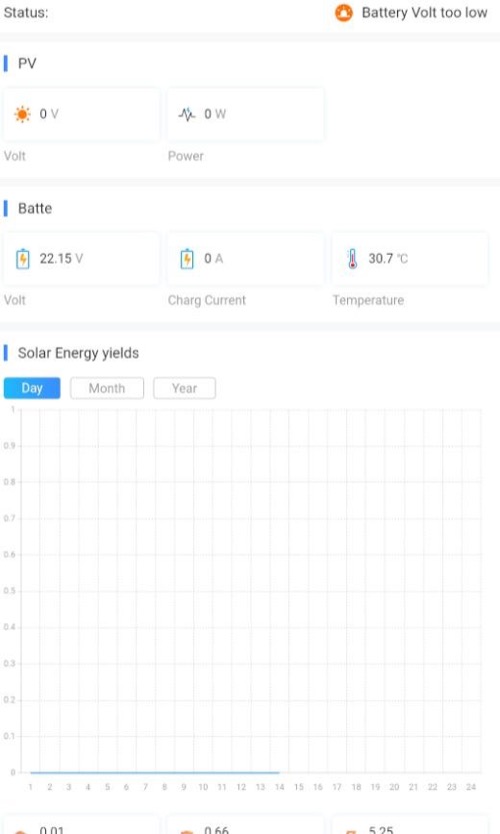
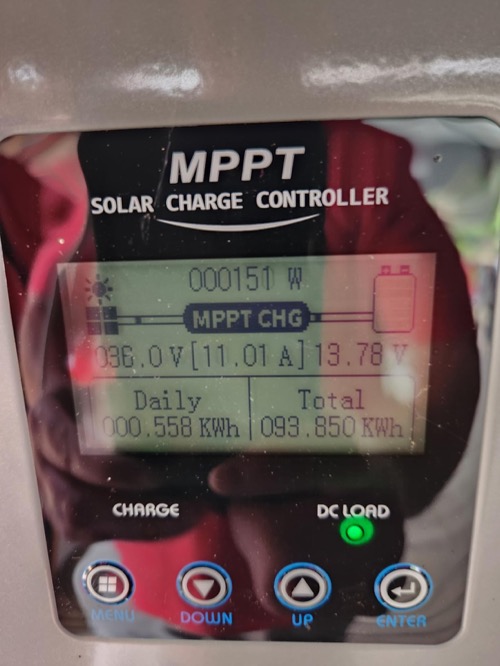
The front LCD is a meaningful advantage over app-only controllers. It shows current operating information and history without a phone. owners repeatedly liked the menu and display when the hardware worked.
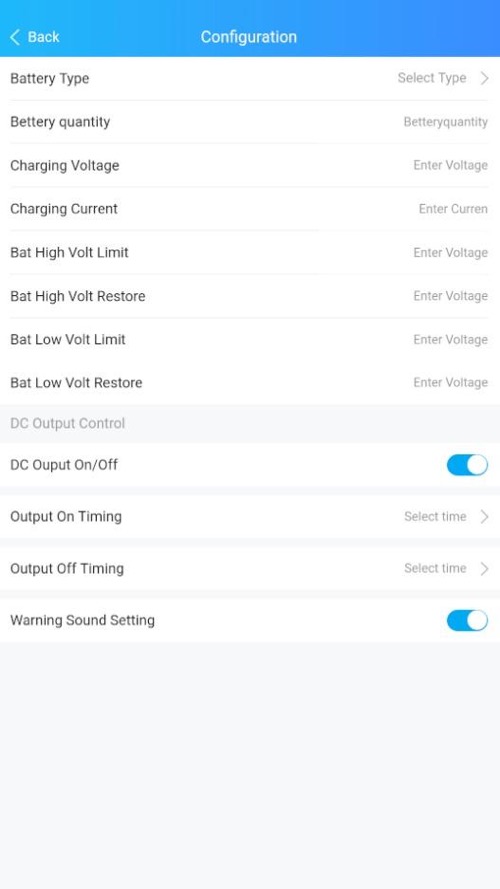
Remote monitoring is optional through RS485 and an additional Wi-Fi box. One reviewer called the accessory expensive, described inconsistent communication and setting changes, and said some displayed information appeared inaccurate. Another could continue watching charge data through the module after the physical display failed, but said a promised summary histogram did not work.
Treat the optional module as a feature requiring its own validation. Identify the exact protocol, local-versus-cloud dependency, app version, data retention, and whether settings can be changed reliably. If remote alarms are essential for an unattended property, a mature monitoring ecosystem may justify a more expensive controller.
Fan Cooling Changes Where It Belongs
The AMPINVT uses active cooling. One owner called the fan loud; a comparative reviewer also characterized AMPINVT fan noise as a downside. Fans can help remove heat from compact power electronics, but they introduce sound, dust exposure, and a moving component.
No formal IP rating or complete operating-temperature range was available in the reviewed evidence. The controller belongs in a dry, ventilated, serviceable space—not an exterior wall, battery box with corrosive vapor, or sealed cabinet. Plan intake and exhaust clearance using the exact manual and keep cable routing away from airflow obstruction.
The dimensions and maximum terminal wire size were also absent from the normalized evidence. That omission matters at 60A. Resolve conductor capacity, terminal geometry, torque, fuse/breaker size, and bend radius before purchasing cable. Never reduce conductor strands to fit a terminal.
| Installation Decision | Acceptable Direction | Reject or Redesign When… |
|---|---|---|
| Location | Dry, ventilated, audible fan acceptable, easy service access | Bedroom-adjacent, sealed, damp, dusty, or exposed position |
| Battery cable | Calculated ampacity/drop and documented terminal fit | Terminal capacity or torque remains unknown |
| PV layout | Cold Voc and verified Isc both within exact limits | Design relies only on 150V headline |
| Monitoring | LCD sufficient or optional RS485 system validated | Unattended operation depends on unverified cloud/app behavior |
| Failure consequence | Secondary or observable system with protective design | A single silent failure creates unacceptable property or battery risk |
Do Not Use an Undocumented Load Circuit as an Inverter Switch
The normalized exact-model specification does not establish a dedicated load-output rating. One detailed owner described using a DC-load function to control an inverter drawing roughly 30A and later finding the switch stuck on. The same reviewer eventually recommended limiting the control circuit to roughly 10A and using a suitably rated relay or contactor for the actual load.
That is one person’s post-failure workaround, not a manufacturer-approved design. High-current inverters belong on a properly fused battery bus. If a low-current controller signal is used to operate external switching hardware, confirm the signal rating, coil or gate requirements, fault behavior, and manual authorization.
AMPINVT 60A Versus Renogy and Victron Alternatives
Renogy’s Rover Lite 60A shares the 60A and 150V class while providing a three-year warranty and more complete enclosure/dimension documentation. It is larger and Bluetooth still costs extra. Victron’s 150V models bring stronger documentation, integrated Bluetooth, and a five-year warranty, but equivalent current can cost substantially more and may require selecting a different model size.
The AMPINVT case rests on purchase price and electrical breadth. That value erodes if the project requires the costly Wi-Fi module, silent operation, proven support, or a replacement after early failure. Conversely, a skilled owner with local monitoring and a secondary system may rationally accept those risks.
Pros & Cons Analysis
Based on documented specifications and owner feedback
Pros
- 150V — 150V PV ceiling.
- 60A — 60A output across 12V-48V systems.
- LCD — LCD and history data.
- External — External temperature sensor.
Cons
- Check: Fan-cooled.
- Check: Optional rather than built-in remote monitoring.
- Check: No published IP rating.
- Check: Mixed owner support and durability reports.
Bottom Line: Impressive Capacity with a Conditional Verdict
Verdict: The AMPINVT 60A offers unusually broad 12V–48V support, 150V input, a useful power table, local data, and configurable charging for the money. Its specification sheet makes it tempting; the captured ownership record prevents an uncomplicated recommendation.
Best reason to buy: A ventilated, accessible off-grid system needs high voltage/current capacity and the buyer can verify every limit and monitor operation independently.
Reason to pause: Unpublished PV Isc, terminal, enclosure, and warranty details combine with fan, display, QC, and support complaints. Premium alternatives cost more partly because they reduce those uncertainties.
Frequently Asked Questions
Is the AMPINVT 60A MPPT MPPT or PWM?
The exact model is documented as MPPT. That topology does not replace checks of PV voltage, input current, output current, and battery compatibility.
What battery voltage does the AMPINVT 60A MPPT support?
12V / 24V / 48V automatic; 36V manual. Confirm detection and selection behavior in the current exact-model manual.
What is the maximum PV voltage?
150V. Use cold-corrected array Voc rather than the panel's warm-day value.
How much solar can it handle?
900W @ 12V; 1,700W @ 24V; 2,700W @ 36V; 3,400W @ 48V. The PV voltage, PV current, and battery-side charge-current limits must all be satisfied at the same time.
Does the AMPINVT 60A MPPT work with lithium batteries?
Lithium, sealed/AGM, gel, and flooded lead-acid. Match every charging value and low-temperature strategy to the battery documentation.
Does it include app monitoring?
RS485; optional Wi-Fi monitoring box. Verify whether any required accessory is included in the exact bundle.
Can I connect an inverter to its load terminals?
Normally no. High-current and surge loads should use a correctly fused battery-side connection unless the controller manual explicitly permits the planned load.
Who should buy the AMPINVT 60A MPPT?
Ventilated 12V-48V off-grid systems that need 150V input and a lower purchase price.
Technical Specifications
| Brand | AMPINVT |
|---|---|
| Exact model / revision / ASIN | APC190060 (ASIN B07SWVPXWM) |
| Controller type | MPPT |
| Rated battery-side charge current | 60A |
| Supported battery-system voltage | 12V / 24V / 48V automatic; 36V manual |
| Battery chemistry and profile support | Lithium, sealed/AGM, gel, and flooded lead-acid |
| Maximum PV open-circuit voltage (Voc) | 150V |
| Maximum PV short-circuit/input current (Isc) | Not published |
| Maximum PV power by battery voltage | 900W @ 12V; 1,700W @ 24V; 2,700W @ 36V; 3,400W @ 48V |
| Minimum PV/start voltage requirement | Published working range starts at 18V for 12V, 30V for 24V, and 65V for 48V systems; PV must also be at least 3V above battery voltage |
| Load output and low-voltage disconnect | No dedicated load output documented |
| Grounding topology | Negative grounded |
| Charging stages and custom voltage control | Battery presets plus user-defined lithium parameters |
| Temperature sensing and lithium low-temperature behavior | External battery-temperature sensor; no lithium low-temperature cutoff published |
| Display and local controls | Front LCD with operating and history data |
| App, communications, and data history | RS485; optional Wi-Fi monitoring box |
| Maximum terminal conductor size | Not published |
| Controller self-consumption | Not published for the reviewed revision |
| Published tracking/conversion efficiency | >99% tracking and >98% peak conversion |
| Cooling method and thermal derating | Temperature-controlled fan cooling; keep 20cm clearance; no output-derating curve published |
| Electrical protections | Overcharge, over-discharge, overload, short-circuit, reverse-polarity, overtemperature, and battery-undervoltage protection |
| Enclosure, ingress rating, and operating temperature | Indoor, ventilated installation; published IP rating and range unavailable |
| Certifications | Not published for the reviewed revision |
| Dimensions, weight, and included accessories | Not published |
| Warranty | Warranty period not published; lifetime support stated |