AMPINVT 40A MPPT Review: Strong Specs, Mixed Evidence
At a Glance
KEY FEATURES
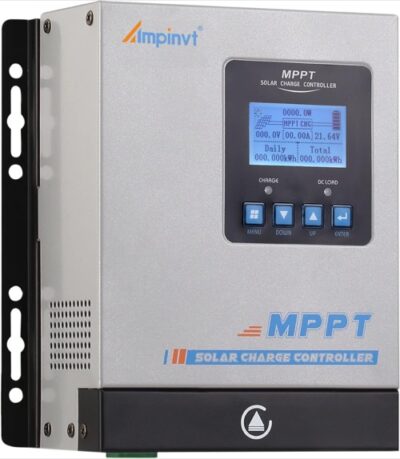
- Output: 40A MPPT controller for 12V, 24V, 36V, and 48V battery systems.
- PV limits: 150V Voc; 570W @ 12V, 1,130W @ 24V, and 2,270W @ 48V.
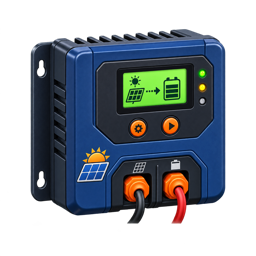
- Battery support: Lead-acid presets, user-defined lithium settings, and an included temperature sensor.
- Monitoring: Front LCD with fault history; optional RS485 Wi-Fi monitoring.
- Best fit: Budget multi-voltage systems with a ventilated utility-space installation.
PROS
- 40A MPPT output supports substantial battery-side charging.
- 12V through 48V support provides unusual system flexibility.
- Local display and optional communications offer multiple control paths.
CONS
- Automatic voltage detection and battery targets require deliberate verification.
- Fan behavior, display faults, and support concerns justify an early acceptance test.
- No documented load output or lithium low-temperature cutoff.
Editor's Choice
Editorial assessment based on exact-model documentation and qualitative exact-ASIN owner evidence; no first-party bench test or population-rate claim
Will the AMPINVT 40A MPPT Fit Your Solar Array?
Estimate required charging current and check it against the documented limits for AMPINVT 40A MPPT.
Solar Charge Controller Size Calculator
What size charge controller do I need?
A Wide Voltage Envelope Makes Configuration the Main Risk
The broader exact-ASIN owner record shows why the AMPINVT 40A is appealing: one controller can cover several battery voltages, offers a local screen, and publishes substantial PV-power allowances. It also concentrates several decisions in one box. Owners describe useful charging and configurable behavior, while critical accounts mention display behavior, fan noise, setup ambiguity, faults, and difficulty obtaining support. Those themes define tests for the delivered unit; they do not predict how every unit will perform.
Start with battery architecture rather than the advertised 40A rating. Confirm the controller detects the intended 12V, 24V, 36V, or 48V bank, then verify that the selected charging targets match the battery maker’s limits. A lithium preset is not proof of low-temperature protection, and this model does not publish a lithium charging cutoff below freezing. The included temperature sensor supports compensation, but its role must be interpreted according to the selected chemistry.
| Acceptance gate | Evidence to record | Stop condition |
|---|---|---|
| Battery detection | Measured bank voltage, detected voltage, and retained profile after restart | Wrong system voltage or lost settings |
| PV string | Module Voc, cold-temperature correction, current, and expected power | Any value approaches or exceeds the exact model limit |
| Charge path | Cable size, lug fit, fuse, voltage drop, and battery acceptance | Improvised terminals, excess heat, or current beyond the bank limit |
| Controls | Screen, fault history, fan response, and optional communications | Unrecoverable fault or required function unavailable |
The controller has no documented dedicated load output, so inverter and distribution loads belong on a correctly protected battery-side circuit. Do not infer a load-terminal capability from a menu or from another AMPINVT revision. If remote monitoring matters, price and test the optional RS485 Wi-Fi equipment as a separate subsystem, including what remains usable without a network.
This model makes the most sense when its broad voltage support and 150V PV ceiling solve a real design constraint. If the bank is permanently 12V and the array is modest, a controller with narrower but more completely documented limits may be easier to commission and support.
Quick Verdict on the AMPINVT 40A MPPT Review
This AMPINVT 40A MPPT review finds an unusually ambitious controller for the supplied $84 price: the listing claims a 150V PV ceiling, automatic 12V through 48V system detection, a local data display, and optional app monitoring. Those specifications make it tempting for a budget off-grid build where lower-voltage controllers would constrain a series array.
The catch is evidence confidence. The supplied research contains no manufacturer manual or independent Solar Power Picks test, and owners disagree about output stability, fan noise, heat, and reliability. One reported full 40A output and useful history graphs; another measured 16-17A from a 400W array before getting 28A from a Renogy 40A under what the reviewer described as comparable conditions.
Buy it only if the price matters, the controller will live in a ventilated utility area, and you can verify every limit against the current manual. Skip it when quiet operation, primary-source documentation, or consistent charging evidence matters more than the feature-to-price ratio.
| Best For | Main Strength | Main Limitation | Evidence Confidence |
|---|---|---|---|
| Budget multi-voltage off-grid projects | Claimed 150V PV ceiling and 12V-48V battery support | Mixed output, fan, heat, and reliability reports | Low to medium |
What the Evidence Actually Includes
The listing supplies the controller’s headline limits and feature claims. It does not supply a manual, input-current ceiling, conductor limit, dimensions, IP rating, operating-temperature range, warranty, or certification details in the supplied fields. Those omissions matter because a credible array design needs more than a watt number and maximum voltage.
Electrical Limits and System Fit
On paper, the AMPINVT covers more battery-system voltages than many entry-level controllers. The listing claims automatic recognition of 12V, 24V, 36V, and 48V systems, plus PV limits of 570W at 12V, 1,130W at 24V, and 2,270W at 48V. It also gives a 150V maximum PV input.
Those numbers do not mean any array below 150V and the stated watt limit is automatically safe. Series-string open-circuit voltage rises in cold weather, while parallel strings raise current. The maximum allowed PV input or short-circuit current is not present in the supplied evidence, so final string sizing remains incomplete.
| Limit | Documented Value | What It Means | Evidence Status |
|---|---|---|---|
| Rated charge current | 40A | Maximum claimed battery-side charge output | Catalog/listing snapshot |
| Maximum PV Voc | 150V | Cold-corrected series-string Voc must remain below this | Listing claim |
| Maximum PV input/Isc | Not disclosed | Parallel-string current cannot be verified from supplied evidence | Unknown |
| Maximum PV power at 12V | 570W | Listing’s array-power ceiling for a 12V bank | Listing claim |
| Maximum PV power at 24V | 1,130W | Listing’s array-power ceiling for a 24V bank | Listing claim |
| Maximum PV power at 48V | 2,270W | Listing’s array-power ceiling for a 48V bank | Listing claim |
| Battery-system voltage | 12V / 24V / 36V / 48V | Broad system range if confirmed by current manual | Listing claim; owner use at 12V/48V |
One verified owner reported using the controller first on a 12V bank and then a 48V bank, saying it reached 40A and provided useful historical graphs. Another described a 400W panel, lithium-battery RV system operating smoothly. These are encouraging usage reports, not controlled proof of every listed limit.
Compatibility Check — Max PV Voc and rated charge current protect different sides of the controller. Check cold-corrected Voc, PV input/Isc, the watt ceiling for your battery voltage, 40A output, and the battery BMS limit separately.
Enclosure, Terminals, and Installation Friction
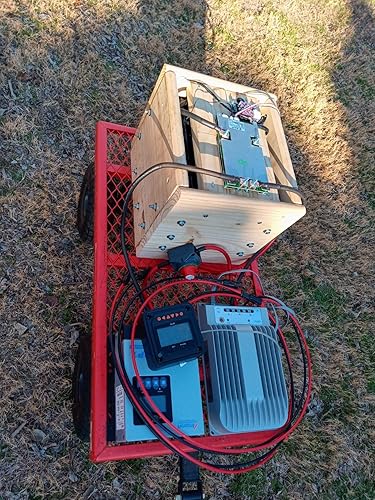
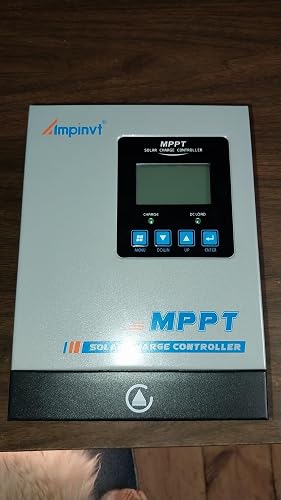
Two detailed reviewers independently praised the physical enclosure. One comparison described solid metal construction and full-clamp PV and battery terminals; another called the unit solid and nicely designed. That is enough to identify a positive build pattern, though not enough to establish years of durability.
The terminal story has an important caveat. In the multi-controller comparison, the owner said 4 AWG battery cable would not fit the AMPINVT terminal. The supplied listing evidence provides no maximum conductor size, so buyers should not assume a 40A design accepts whatever cable their voltage-drop calculation produces.
Installation Check — Do not trim conductor strands or force an oversized cable into a terminal. Verify the current manual’s conductor range, ferrule/lug rules, torque, overcurrent protection, ventilation, grounding, and connection sequence.
Display, Settings, and Optional Monitoring
The local display is the product’s best-supported feature. One verified owner praised the current and previous-day graphs, while another liked having readings on the front panel. The listing also advertises daily power-generation and current curves.
Configuration is less polished. A detailed reviewer said the manual made the parameter-setting menu difficult to find and described a key sequence needed to access it. The same owner found many adjustable fields — including date, time, key sounds, and battery parameters — and considered the controller satisfactory once configured.
Optional app monitoring should be priced as an accessory, not an included feature. The listing describes a communication connection and says Wi-Fi remote monitoring requires an additional purchase. Because the supplied text labels the interface inconsistently, confirm the current module name and compatibility rather than ordering a generic RS485 adapter.
For a controller mounted in a utility room, the display and logging may justify some setup friction. An owner who expects consumer-grade app onboarding and clear lithium presets may prefer a better-documented alternative.
Charging Behavior: Why the Reports Conflict
The seller claims at least 99% maximum-power-point tracking and greater than 98% peak conversion efficiency. No primary test report in the supplied evidence verifies those percentages, so they remain listing claims.
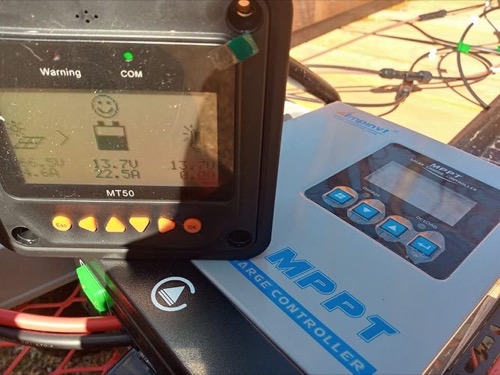
Owner reports point in both directions. One verified buyer said the controller delivered the full 40A. Another used two 200W panels with a 100Ah LiFePO4 battery and observed only 16-17A in series or parallel; the same reviewer said an existing Renogy 20A reached 20A and a replacement Renogy 40A produced 28A under similar conditions.
The most detailed comparison used four 300W panels, a 12V 280Ah LiFePO4 bank, and an external BMS reading to compare AMPINVT, EPEVER, and Victron controllers. That reviewer reported fast AMPINVT tracking but current fluctuation of roughly 2A-6A below the observed maximum during repeated rescans. The writer also reported a small disadvantage under cloud or shade, while explicitly warning that the result could not establish long-term reliability and could vary with setup, batch, and conditions.
Battery Profiles and Temperature Questions
The listing describes sealed, AGM, gel, flooded, and user-defined lithium charging. Several owners mention LiFePO4 banks, confirming that buyers are using the controller in lithium systems. That does not prove the factory profile is correct for every LiFePO4 battery.
One reviewer said the factory default was AGM and that lithium parameters needed to be changed. Low-temperature charge cutoff, remote temperature sensing, and temperature compensation are not disclosed in the supplied evidence. A lithium-compatible menu therefore cannot replace the battery manual or BMS protection.
Before commissioning, collect the battery maker’s allowed charge voltage, maximum current, low-temperature rule, and any float/equalization instructions. Then verify that the exact controller revision can implement them. If the controller cannot enforce a required value, use a different controller or a battery/BMS architecture that supplies the missing protection according to its manufacturer.
What The supplied owners Report
| Theme | Supporting Reviews | What the Evidence Supports | Limitation |
|---|---|---|---|
| Successful operation / acceptable value | 6 substantive positive or mostly positive reports | Several exact-variant owners used it successfully in workshop, RV, 12V, and 48V contexts | Duration ranges from one month to two years; setups vary widely |
| Useful display/history | 2 | The local display and generation/current graphs are practical strengths | App accessory experience was not supplied |
| Solid metal build | 2 | Enclosure construction made a positive first impression | Not a laboratory durability or ingress test |
| Fan audible or loud | 3 | Noise can be noticeable, especially in occupied space | 1 other owner called it nearly silent; load and temperature differ |
| Underperformance / unstable or declining output | 3 detailed reports | Some systems may see lower, less steady, or declining current/harvest | Conditions were owner-controlled, not standardized by Solar Power Picks |
| Heat/fan/controller failure | 1 | A serious isolated failure occurred in the owner record | One report cannot establish prevalence |
| Setup/manual friction | 1 detailed report | Parameter access and instructions can be confusing | Other owners did not describe the same issue in detail |
Owner Pattern — Fan noise has the clearest recurring complaint signal: three owners called it loud or somewhat loud, while one disagreed. Treat location and ventilation as design inputs rather than assuming silent operation.
AMPINVT 40A System-Fit Matrix
| System / Buyer | Fit | Why | Must Verify |
|---|---|---|---|
| Small 12V off-grid workshop | Conditional | Local display, 570W listing ceiling, budget price | PV input/Isc, conductor size, fan location |
| 12V RV with LiFePO4 | Conditional | Owner RV use exists and lithium user mode is claimed | Battery settings, low-temp protection, ventilation |
| 24V cabin array | Conditional | 1,130W listing ceiling and automatic 24V detection | Cold Voc, input current, current manual |
| 36V battery system | Conditional | Uncommon 36V support is claimed | Primary documentation and compatible charge profile |
| 48V off-grid bank | Conditional | 2,270W listing ceiling and one 48V owner report | PV working range, battery settings, terminal/conductor fit |
| Occupied bedroom-adjacent install | Poor | Multiple fan-noise complaints | Consider a passively cooled or quieter documented alternative |
| Exposed marine/outdoor mount | Poor | No IP rating or corrosion documentation supplied | Environmental enclosure and manual requirements |
| Buyer wanting simple phone setup | Conditional | App monitoring is claimed | Additional module, interface compatibility, setup quality |
| Buyer prioritizing proven efficiency | Poor | Listing claims conflict with mixed owner observations | Independent test data or a better-documented alternative |
Alternatives Worth Comparing
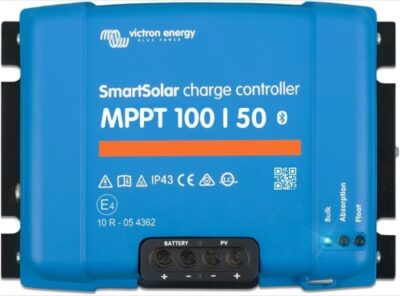
The Victron SmartSolar 100/30 is the clearest premium comparison in the approved catalog. Its lower 30A charge rating and 100V PV ceiling do not make it automatically smaller for every system, while built-in Bluetooth and stronger app evidence may suit buyers who value configuration and monitoring. Exact array fit still depends on the Victron manual and the intended battery voltage.
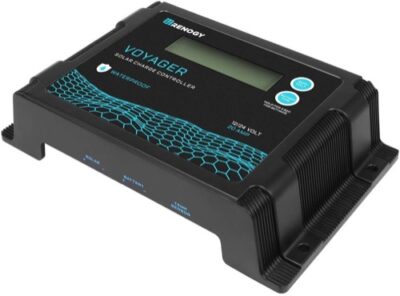
Renogy’s Rover 40A is the closer nominal-current alternative. One AMPINVT owner specifically reported 28A from a Renogy 40A after observing 16-17A from the AMPINVT in the described 400W setup. That remains one owner’s comparison, but it creates a credible reason to examine the dedicated Rover evidence before buying.
Buyers should also compare total installed cost. The AMPINVT’s optional remote module, required protection, conductors, terminals, enclosure, and any temperature hardware can narrow the gap from a controller-only price.
Who Should Buy the AMPINVT — and Who Should Skip It
Choose it if:
- You need the listing’s broad 12V-48V range or 150V PV ceiling at a low controller price.
- You value a local display and historical graphs more than polished app onboarding.
- The controller will be mounted in a ventilated utility space away from sleeping areas.
- You can obtain and follow the current manual before final array and battery design.
- You accept that owner performance evidence is mixed.
Skip it if:
- You need primary documentation before purchase to verify every input and installation limit.
- Quiet fan behavior is important.
- Your conductor design requires a terminal size the manual has not confirmed.
- You want independently verified tracking/conversion performance.
- Your lithium system depends on controller-managed cold-charge protection not documented here.
Pros & Cons Analysis
Based on documented specifications and owner feedback
Pros
- Wide claimed system-voltage support — The Amazon listing specifies automatic 12V, 24V, 36V, and 48V battery-system detection.
- High claimed PV-voltage ceiling — The listing gives a 150V maximum PV input and publishes working-voltage bands for 12V, 24V, and 48V systems.
- Useful local information — Two sampled owners specifically liked the front-panel data or historical graphs, and one reported seeing the full 40A output.
- Solid enclosure feedback — Two detailed reports described the metal construction as solid or well built.
- Attractive price snapshot — The sampled Amazon price was $84 on August 3, 2026, well below some premium MPPT alternatives.
- Expandable monitoring claim — The listing describes daily graphs plus optional app monitoring through an additional communication accessory.
Cons
- Primary documentation is missing — The supplied evidence contains listing fields but no manufacturer manual to confirm every limit or setup condition.
- Input-current ceiling is unclear — Maximum PV input or short-circuit current was not disclosed in the reviewed evidence, so wattage and Voc alone cannot finish array sizing.
- Setup can be obscure — One detailed owner said the manual was weak and that accessing the parameter menu required an undocumented-looking key sequence.
- Connection and serviceability complaints — One owner said 4 AWG cable would not fit the battery terminal, while another disliked the fuse access.
- Mixed charging evidence — One owner measured 16-17A from a 400W array where a Renogy 40A later delivered 28A; another described fluctuating current in a multi-controller comparison.
- Fan experience varies — Three captured reports called the fan loud or somewhat loud, while one described it as nearly silent.
AMPINVT 40A MPPT: Our Verdict
Verdict: A capable budget option for multi-voltage systems, but not the safest blind buy. Its 150V PV ceiling, wide battery-voltage support, LCD, and included temperature sensor provide unusual flexibility at this price.
Buy it if: You can install it in a ventilated utility space, confirm the unpublished PV-current and terminal limits, and accept mixed owner reports about charging stability and fan noise.
Skip it if: You need quiet operation, complete pre-purchase documentation, or the stronger monitoring ecosystem available from Victron and Renogy.
Frequently Asked Questions
Is the AMPINVT 40A a genuine MPPT controller?
The Amazon listing identifies the AMPINVT 40A as MPPT and publishes MPPT tracking and conversion claims. The supplied research does not include a manufacturer manual, teardown, or Solar Power Picks topology test, so this review treats MPPT performance as a seller claim supported by mixed owner observations rather than independently verified fact.
What battery-system voltages does the AMPINVT 40A support?
The listing specifies automatic recognition of 12V, 24V, 36V, and 48V battery systems. It also lists sealed, AGM, gel, flooded lead-acid modes and a user setting for lithium. Verify the exact battery manual, controller revision, charging voltages, and BMS limits before configuration.
What is the AMPINVT 40A maximum solar input?
The listing claims 570W at 12V, 1,130W at 24V, and 2,270W at 48V, with a 150V maximum PV input. Those watt limits do not replace the missing PV input-current/Isc limit. Cold-corrected array Voc, input current, controller output, and battery charge limits all need separate checks.
Does the AMPINVT 40A deliver its full 40A rating?
One sampled owner reported seeing the full 40A output. By contrast, another reported only 16-17A from two 200W panels where a Renogy 40A later produced 28A under what the reviewer described as similar conditions. A third comparison found fast but fluctuating tracking. That mixed evidence does not support one universal result.
Is the AMPINVT 40A cooling fan loud?
The sampled reports conflict. Three captured owners described the fan as loud or somewhat loud, including one who tied it to higher-current operation. Another called it nearly silent. Install it in a ventilated utility area rather than assuming it will be unobtrusive near sleeping or living space.
Can the AMPINVT 40A charge LiFePO4 batteries?
The listing includes a user-defined lithium mode, and multiple sampled owners describe LiFePO4 systems. However, low-temperature charge cutoff, an external temperature sensor, and exact lithium voltages were not disclosed in the reviewed evidence. Use the battery manual and BMS limits instead of copying another owner's settings.
Does the AMPINVT 40A have Wi-Fi monitoring?
The listing describes optional app monitoring through an additional communication accessory, so Wi-Fi should not be treated as included. The controller itself is claimed to display daily generation and current graphs, a feature specifically praised by sampled owners. Confirm the current accessory name, compatibility, and price before buying.
Will 4 AWG cable fit the AMPINVT 40A terminals?
One detailed owner reported that 4 AWG battery cable would not fit the terminal despite liking the clamp design. The supplied evidence does not state the manufacturer's maximum conductor size. Do not trim strands or improvise; verify the exact terminal specification and use an approved conductor/termination design.
Is the AMPINVT 40A a good value?
At the August 3, 2026 Amazon snapshot, the price was $84, which is attractive for a claimed 40A, 150V, multi-voltage controller with a local display. Value is conditional because charging, fan, heat, and reliability reports are mixed and primary documentation is incomplete. Budget for the required monitoring accessory and installation hardware as well.
Technical Specifications
| Brand | AMPINVT |
|---|---|
| Exact model / revision / ASIN | APC190040 (ASIN B07SWVHLY2) |
| Controller type | MPPT |
| Rated battery-side charge current | 40A |
| Supported battery-system voltage | 12V / 24V / 36V / 48V automatic selection |
| Battery chemistry and profile support | Lithium, sealed/AGM, gel, and flooded lead-acid |
| Maximum PV open-circuit voltage (Voc) | 150V |
| Maximum PV short-circuit/input current (Isc) | Not published for this model |
| Maximum PV power by battery voltage | 570W @ 12V; 1,130W @ 24V; 2,270W @ 48V |
| Minimum PV/start voltage requirement | Published working range starts at 18V for 12V, 30V for 24V, and 65V for 48V systems; PV must also be at least 3V above battery voltage |
| Load output and low-voltage disconnect | No dedicated load output documented; connect inverter loads to the battery |
| Grounding topology | Negative grounded |
| Charging stages and custom voltage control | Battery presets plus user-defined lithium parameters |
| Temperature sensing and lithium low-temperature behavior | Included battery-temperature sensor and compensation; no lithium low-temp cutoff published |
| Display and local controls | Front LCD with real-time data and fault history |
| App, communications, and data history | Optional RS485 Wi-Fi box and cloud app |
| Maximum terminal conductor size | Not published for this model |
| Controller self-consumption | Not published for the reviewed revision |
| Published tracking/conversion efficiency | >99.73% tracking; >98.5% charging efficiency |
| Cooling method and thermal derating | Temperature-controlled fan cooling; keep 20cm clearance; no output-derating curve published |
| Electrical protections | Overcharge, over-discharge, overload, short-circuit, reverse-polarity, overtemperature, and battery-undervoltage protection |
| Enclosure, ingress rating, and operating temperature | Indoor, ventilated installation; IP and temperature range not published |
| Certifications | Not published for the reviewed revision |
| Dimensions, weight, and included accessories | Not published for this model |
| Warranty | Warranty period not published; lifetime customer support stated |