Renogy Voyager 20A Review: Waterproof PWM with Clear Limits
At a Glance
KEY FEATURES
- Output: 20A PWM controller with automatic 12V/24V recognition.
- PV limits: 25V Voc @ 12V or 55V @ 24V; 260W or 520W maximum.
- Battery support: Sealed, AGM, gel, flooded, and adjustable lithium profiles.
- Monitoring: Backlit LCD and local buttons; no app connection.
- Best fit: Weather-exposed portable, fence, boat, and RV charging systems.
PROS
- IP67 enclosure suits exposed small-system locations better than indoor controllers.
- 20A output supports useful 12V and 24V PWM arrays.
- Simple local operation avoids app and communications dependencies.
CONS
- PWM architecture still requires voltage-matched panels.
- IP67 does not protect external fuses, splices, or battery terminals.
- No dedicated load output or remote monitoring.
Editor's Choice
Editorial assessment based on exact-model documentation and qualitative exact-ASIN owner evidence; no first-party bench test or population-rate claim
Will the Renogy Voyager 20A Fit Your Solar Array?
Estimate required charging current and check it against the documented limits for Renogy Voyager 20A.
Solar Charge Controller Size Calculator
What size charge controller do I need?
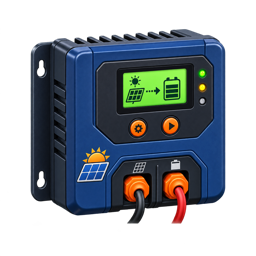
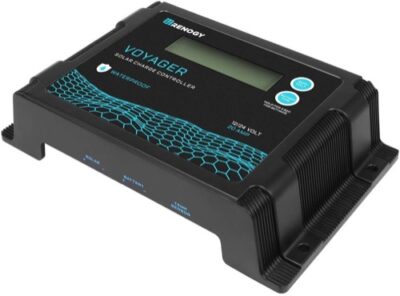
This Renogy Voyager 20A review focuses on the feature that separates it from most inexpensive controllers: a documented IP67 enclosure. The current model combines 20A PWM charging, automatic 12V/24V recognition, a backlit LCD, and profiles for common lead-acid batteries and lithium.
Weather resistance does not turn it into an MPPT controller or a complete power center. There are no load terminals, no app connection, and no conversion of excess panel voltage into additional battery current. The owner evidence also reveals some difficult button behavior and conflicting durability experiences.
| Best For | Main Strength | Main Limitation | Evidence Confidence |
|---|---|---|---|
| Portable panels, fences, boats, trailers, and exposed charging locations | IP67 enclosure with a useful local display | PWM topology and no communications | High for current specifications; medium for reliability |
IP67 Protects the Controller, Not the Entire Outdoor Circuit
The larger exact-ASIN owner record confirms the Voyager 20A’s distinctive strength: a sealed PWM controller for small marine, trailer, shed, fence, and portable installations where splashes or dust are plausible. Owners often value simple operation, visible status, and weather resistance. Critical accounts mention charging behavior, display interpretation, premature faults, battery selection, and support. These themes call for an outdoor-system inspection routine rather than a claim about population reliability.
The IP67 rating applies to the specified controller enclosure under defined laboratory conditions. It does not automatically cover ring terminals, fuses, splices, battery posts, adapters, cable jackets, or a mounting surface that traps water. Use corrosion-resistant connections, drip loops, strain relief, and an enclosure where the battery and protective devices require one. Do not submerge the system or point pressure washing at its interfaces.
| Outdoor boundary | Likely exposure | Design response |
|---|---|---|
| Controller body | Rain, spray, dust | Mount as directed and preserve cable strain relief |
| Battery terminals | Corrosion and accidental short | Use covers, correct lugs, and nearby overcurrent protection |
| Panel connector | Water entry and polarity error | Use rated connectors and verify polarity with a meter |
| Mounting surface | Heat, vibration, and standing water | Provide airflow, secure fasteners, and drainage |
As a PWM controller, the Voyager still requires voltage-matched panels. Its published allowance is 260W at 12V or 520W at 24V, but the current, voltage, and cold-Voc limits all apply independently. It has no dedicated load terminals, so connect DC loads or an inverter through an appropriately protected battery-side distribution system.
Choose the Voyager when sealing and simple local operation outweigh MPPT efficiency. If a high-voltage panel, long cable run, or shaded series arrangement drives the design, a waterproof MPPT controller may justify its additional cost. Whatever the choice, weatherproofing must extend beyond the controller case.
PWM Limits for 12V and 24V Systems
Renogy rates the Voyager at 20A and documents 260W maximum PV input with a 12V battery or 520W with 24V. Maximum PV Voc is 25V on a 12V system and 55V on 24V. Those voltage-specific boundaries are important because a generic “20A” label does not describe safe string voltage.
As a PWM controller, the Voyager switches the panel toward battery voltage rather than converting a higher operating voltage as MPPT does. It works best with panels electrically matched to the battery system. Wiring panels in series merely to raise operating voltage does not provide the same benefit it would with a suitable MPPT controller.
| Design Check | 12V Battery | 24V Battery |
|---|---|---|
| Rated charge current | 20A | 20A |
| Maximum PV power | 260W | 520W |
| Maximum PV Voc | 25V | 55V |
| Controller topology | PWM | PWM |
Cold-corrected Voc and array short-circuit current remain separate checks. Renogy’s data sheet frames 20A as the controller limit; consult the current manual for required current margin, fuse selection, and conductor sizing.
What IP67 Does — and Does Not — Cover
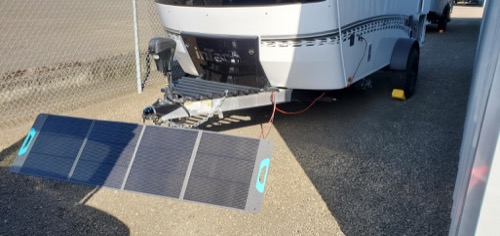
The IP67 rating is a meaningful advantage for equipment near a portable solar suitcase, trailer tongue, remote fence, or marine battery compartment. Several owners chose the controller specifically because it would sit outside or near spray. One reported more than a year of daily pasture-fence service and said the controller continued working after floodwater and mud covered it.
That dramatic anecdote is not a repeatable ingress test and should not encourage deliberate submersion. IP67 applies to the controller enclosure under defined conditions; stripped wire ends, fuses, connectors, battery terminals, and splices need their own appropriate protection. Marine installations also add corrosion, movement, and applicable electrical requirements.
The current enclosure measures 6.08 × 3.83 × 1.40 inches and weighs 0.55lb. Renogy specifies operation from -35°C to 45°C. A flush mounting surface can leave visible cable loops below the unit, as one sailboat owner noted, so plan cable routing before drilling.
Battery Profiles and Local Controls
The Voyager supports sealed/AGM, gel, flooded, and lithium batteries. Its PWM algorithm provides bulk, absorption or boost, float, and equalization behavior where appropriate. The lithium profile allows a charging limit from 12.6V to 16V, but the correct value must come from the exact battery maker rather than a universal recommendation.
Lead-acid temperature compensation is documented at -3mV/°C/2V. Renogy does not publish a lithium low-temperature cutoff for this model. LiFePO4 installations therefore need cold-charge protection elsewhere when the battery may fall below its permitted temperature.
The backlit LCD cycles through panel voltage, charge current, battery voltage, temperature, and status information. Owners appreciated checking fence and trailer systems without opening a box or using a meter. There is no Bluetooth, history database, or remote portal.
Control usability is mixed. One owner found the two-button chemistry selection ambiguous enough to worry about choosing the wrong profile. Another reported that button presses sometimes failed to register and that adding the temperature sensor changed the displayed battery voltage by 0.2V to 0.4V, although external-meter measurements suggested the charging algorithm still used appropriate values.
Setup check — Verify the selected chemistry and voltage on the display, then confirm critical battery readings with an appropriate meter or monitor before relying on the installation.
What The supplied owners Reported
Reliability evidence points in both directions. Several users described months or more than a year of continuous service, including harsh weather. One owner reported that a unit stopped working after 11 months. That single failure cannot establish a general lifespan, but it prevents an unqualified durability claim.
The most consistent tradeoff is not failure — it is simplicity. There is no app, no load automation, and no MPPT conversion. Buyers pay for a sealed enclosure and readable controls rather than a deep monitoring ecosystem.
Separating Weather Evidence from Charging Evidence
Voyager’s owner owner record covers two different questions: whether the enclosure survives exposed use and whether the controller charges correctly. The first has several concrete observations. The second is harder to judge because the installations use different panels, batteries, temperatures, and meters.
| Owner-Evidence Theme | Reports in the owner record | Supported Interpretation | Important Limitation |
|---|---|---|---|
| Outdoor or wet-location use | Multiple | Weather resistance is a genuine reason owners select this model | Anecdotes are not a formal repeat of the IP67 test |
| Useful local display | Multiple | Screen data helps check remote systems without an app | Display accuracy should be checked against a suitable meter |
| Long service | Several | Month-to-year operation is plausible in real installations | The owner record cannot predict lifespan |
| Control frustration | More than one detailed report | Buttons and chemistry selection can create setup friction | Not every owner reported the problem |
| Early failure | One 11-month report | A specific durability caution belongs in the review | One unit cannot establish a failure rate |
The strongest evidence-backed statement is therefore modest: Voyager’s sealed form has worked in genuinely exposed applications, while its controls deserve verification during commissioning. The evidence cannot support a claim that it always survives submersion or maintains laboratory-grade display accuracy.
Compatibility check — A waterproof controller does not make a battery box, inline fuse, SAE connector, splice, or cable entry waterproof. The least protected connection still determines the installation’s exposure risk.
Outdoor Scenarios: Good Fit, Conditional Fit, or Wrong Tool
The location alone cannot decide the product. Voyager still needs a voltage-matched PWM array, an appropriate battery profile, and a charging-current plan that stays within its documented envelope.
| Installation Scenario | Fit | Why | What Must Be Resolved |
|---|---|---|---|
| Portable 12V solar suitcase up to the documented power limit | Good | IP67 case and local screen suit repeated outdoor handling | Cold Voc, connector polarity, cable loss, and battery current limit |
| Remote 24V fence system | Good | 24V recognition and 520W published allowance provide useful range | 55V cold Voc ceiling and current/protection rules |
| Boat battery maintenance | Conditional | Sealed enclosure addresses spray better than IP20/IP32 models | Corrosion, ignition protection, cable entries, and marine requirements |
| LiFePO4 bank exposed to freezing weather | Conditional | Lithium voltage selection exists | Battery/BMS cold-charge cutoff is still required |
| High-voltage series array | Poor | PWM topology and 25V/55V ceilings constrain panel arrangement | Use a correctly sized MPPT controller instead |
| Unattended DC lighting controlled by the charger | Poor | Voyager has no load terminals | Add a suitable protected load-control system |
For an RV roof array with the controller mounted inside a dry compartment, Voyager’s waterproof advantage may be wasted while its PWM limitation remains. In that situation, a protected MPPT controller may deliver a better overall design even though its enclosure rating is lower.
Voyager Versus Other Sealed Controllers
Renogy Voyager stands out by combining IP67 sealing with a numeric display and documented 12V/24V power limits. SOLPERK’s sealed 8A and 10A options are smaller and cheaper for maintenance duty, but they provide less current and minimal feedback. HUINE’s 20A IP68 controller uses fixed leads and simple LEDs, trading Voyager’s screen and broader battery menu for an even more sealed, stripped-down format.
Those alternatives should be compared by exact bank voltage, chemistry, lead arrangement, PV limits, and monitoring needs. A higher IP number cannot compensate for missing electrical compatibility, and a display cannot make an indoor enclosure suitable for rain.
Outdoor-System Checklist
- Confirm the battery voltage and chemistry before connecting the array.
- Calculate cold-corrected panel Voc against the 25V or 55V ceiling for the selected bank.
- Check array current, controller output, and the battery’s permitted charge current separately.
- Protect every connector, fuse holder, splice, and battery terminal for the actual environment.
- Verify controller readings against an appropriate independent meter during commissioning.
- Plan cable routing so water does not follow conductors into another enclosure.
- Provide BMS-based or equivalent cold-charge protection for LiFePO4 where required.
- Follow Renogy’s current manual for connection order, protection, and profile selection.
Renogy Voyager 20A Review: Who Should Buy It?
The Voyager fits an appropriately sized 12V or 24V array where the controller itself may encounter rain, splash, dust, or outdoor handling. It is particularly logical for portable panels and remote battery-maintenance systems that need an immediate local readout.
Choose MPPT instead when panel voltage is substantially above battery voltage, array layout needs more series flexibility, or low-light harvest justifies the higher cost. Choose a different controller if app monitoring or programmable load terminals are essential.
The Decision in One Sentence per Buyer
For a portable-panel owner, buy the Voyager when the array is electrically matched to PWM and the controller will actually face weather. For a fence owner, buy it when a local display is worth more than app history and every exposed connection receives the same environmental attention as the controller.
For an RV owner, do not choose it merely because RV appears in the listing. Decide where the controller will mount, whether the roof array benefits from MPPT, and whether 260W at 12V leaves enough expansion room. A dry electrical compartment can remove the main reason to accept PWM.
For a LiFePO4 owner, the selectable lithium voltage is only one requirement. The battery maker’s current ceiling, charge voltage, BMS behavior, and low-temperature restriction still control the design. For a boat owner, IP67 is helpful but does not answer corrosion, ignition-protection, overcurrent-protection, or marine-installation questions.
Final fit test — If removing the IP67 enclosure from the feature list would make another controller clearly better, confirm that the planned location genuinely needs Voyager’s sealing. Its premium is easiest to justify when exposure is real, not hypothetical.
Pros & Cons Analysis
Based on documented specifications and owner feedback
Pros
- Documented IP67 enclosure — The controller is designed for dust and water exposure that would exclude most indoor models.
- Useful local information — The backlit LCD shows panel voltage, charge current, battery voltage, temperature, and status codes.
- Strong outdoor anecdotes — Owners report continuous fence, trailer, sailboat, and winter-vehicle service; one unit reportedly survived flood submersion.
- 12V and 24V support — The current data sheet documents automatic recognition and battery-voltage-specific PV limits.
- Adjustable lithium ceiling — Lithium charging voltage can be selected to match the battery maker's documented value.
Cons
- PWM conversion tradeoff — It cannot harvest excess panel voltage like an MPPT controller.
- No app or communications — All readings and changes happen at the controller.
- No load terminals — Loads must be designed and protected separately on the battery side.
- Controls drew complaints — Two sampled owners found the button combinations ambiguous or intermittently unresponsive.
- Mixed durability evidence — One sampled owner reported failure after 11 months, while others describe more than a year of outdoor service.
Bottom Line: Weather Resistance Is the Buying Reason
Verdict: The Voyager 20A is a focused waterproof PWM controller, not an all-purpose solar manager. Its IP67 rating, display, and current data sheet make it easier to specify than many outdoor budget models.
Best reason to buy: The controller must live in a weather-exposed portable, fence, RV, or boat installation that stays within PWM voltage and current limits.
Reason to pause: Controls and voltage display drew specific owner complaints, and the design provides neither MPPT conversion nor remote monitoring. This Renogy Voyager 20A review recommends it for environmental fit first, not maximum energy harvest.
Frequently Asked Questions
Is the Renogy Voyager 20A waterproof?
Renogy rates the current Voyager 20A enclosure IP67. Cable entries, connections, fuses, and other system components still need their own suitable environmental protection.
Is the Voyager 20A MPPT or PWM?
It is a PWM controller. Its main advantages are weather resistance, simplicity, and price rather than the voltage-conversion flexibility of MPPT.
What size panel array can it handle?
Renogy specifies 260W at 12V or 520W at 24V. Maximum PV Voc is 25V for a 12V system and 55V for 24V, so cold-corrected panel voltage must be checked.
Does the Voyager 20A work with LiFePO4?
Yes, the current model includes a lithium profile with an adjustable charging limit. Set it to the exact battery manufacturer's requirement; no low-temperature cutoff is documented.
Does it have Bluetooth?
No. The Voyager 20A has a backlit LCD and local controls but no Bluetooth or communications port.
Does it have load terminals?
No. The current controller provides PV, battery, and temperature-sensor connections, but no programmable DC load output.
Can it be used on a boat or outside an RV?
Its IP67 enclosure makes those use cases plausible, and sampled owners report boat and outdoor installations. Follow Renogy's mounting, connection, corrosion, and cable-protection instructions for the exact environment.
Can the display replace a battery monitor?
No. It reports controller measurements, but one sampled owner found the displayed battery voltage changed when a temperature sensor was connected. Use an appropriate independent monitor when accurate state-of-charge information matters.
Technical Specifications
| Brand | Renogy |
|---|---|
| Exact model / revision / ASIN | New Edition Voyager 20A (VOYP20 / RCC20VOYP; ASIN B07YXZMKD2) |
| Controller type | PWM |
| Rated battery-side charge current | 20A |
| Supported battery-system voltage | 12V / 24V automatic recognition |
| Battery chemistry and profile support | Sealed/AGM, gel, flooded, and lithium |
| Maximum PV open-circuit voltage (Voc) | 25V @ 12V; 55V @ 24V |
| Maximum PV short-circuit/input current (Isc) | 20A controller limit; verify array Isc and required margin |
| Maximum PV power by battery voltage | 260W @ 12V; 520W @ 24V |
| Minimum PV/start voltage requirement | 15V minimum PV input for the reviewed 12V/24V New Edition Voyager |
| Load output and low-voltage disconnect | No dedicated load terminals |
| Grounding topology | Common positive / positive ground |
| Charging stages and custom voltage control | Four-stage PWM with battery presets and adjustable lithium charging limit |
| Temperature sensing and lithium low-temperature behavior | -3mV/°C/2V compensation for lead-acid; no lithium low-temp cutoff published |
| Display and local controls | Backlit LCD and two-button controls |
| App, communications, and data history | No app or communication port |
| Maximum terminal conductor size | 6 AWG |
| Controller self-consumption | 0.24W at 12V; 0.74W at 24V |
| Published tracking/conversion efficiency | Not applicable; PWM controller |
| Cooling method and thermal derating | Not published for the reviewed revision |
| Electrical protections | PV/battery reverse-polarity, overcharge, short-circuit, reverse-current, overload, over-discharge, and controller/battery overtemperature protection |
| Enclosure, ingress rating, and operating temperature | IP67; -35°C to 45°C (-31°F to 113°F) |
| Certifications | Not published for the reviewed revision |
| Dimensions, weight, and included accessories | 6.08 × 3.83 × 1.40 in; 0.55 lb |
| Warranty | 2 years |