
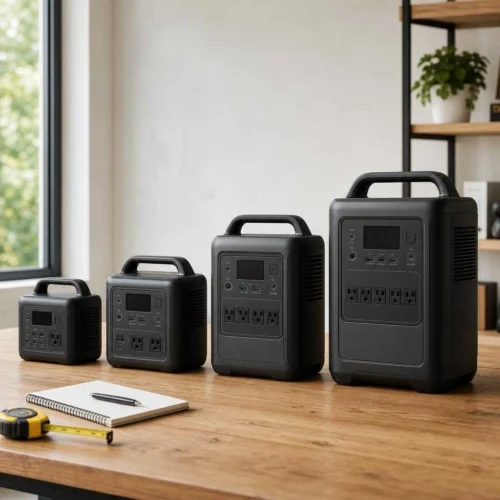
The right solar-generator size is the smallest exact system that passes three independent tests: power, energy, and recovery. Inverter watts decide what runs together. Battery watt-hours decide how long. Panel and input limits decide whether the energy returns before the next operating period.
A system that fails any required axis is undersized even if another number looks generous. A 3kWh battery with a 300W inverter cannot run a 700W appliance. A 2,000W inverter with 288Wh may start a load and stop soon after. A large battery with a tiny panel becomes progressively emptier on a multi-day trip.
Inventory Energy by a Representative Day
Write every load, measured or documented watts, hours per day, and whether it cycles. Multiply watts by hours for watt-hours. For variable loads such as refrigerators, pumps, and CPAP systems with heaters, a watt meter or manufacturer energy record is better than multiplying the nameplate by 24 hours.
| Load | Watts while active | Hours or duty | Daily Wh | Startup? |
|---|---|---|---|---|
| Example router | 12W | 24h | 288Wh | No |
| Example light | 10W | 5h | 50Wh | No |
| Your refrigerator | Measure | Measure 24h | Record | Yes |
| Your priority device | Record | Record | Calculate | Record |
The example numbers demonstrate the worksheet, not appliance promises. Use the highest credible day rather than a perfect day, then separate essential from optional loads so the plan has a load-shedding order.
Run the Three-Axis Sizing Lab
Size Battery, Inverter, and Array Together
Enter a representative day and the hardest simultaneous load. Reserve and losses are explicit so the result can be challenged.
Planning estimate only. Verify the exact load, manual limits, wiring, connectors, weather, and operating conditions.
The battery result scales the entered daily Wh for efficiency and reserve. The inverter screening floor respects the larger of the simultaneous load with margin or the entered startup demand. The solar result estimates daily harvest and compares it with consumption. It does not validate voltage, current, connector, waveform, or appliance compatibility.
Clear Running and Startup Power Separately
Add loads that can overlap, not every device owned. Then find the most difficult startup event. Refrigerators, pumps, air conditioners, and power tools may draw far more for a brief period than while running. The station must support both the ongoing total and the transient behavior.
- Write simultaneous groups. Morning cooking can be different from overnight essentials.
- Measure or document startup. Do not invent a multiplier when the consequence matters.
- Check AC voltage and waveform. A watt pass does not fix a 120V/240V mismatch.
- Add modest margin. Avoid designing at the published ceiling for a critical use.
- Commission the exact load. Test controlled startup, steady operation, and shutdown behavior.
Turn Daily Watt-Hours Into Rated Capacity
If daily essentials total 900Wh, a 1,024Wh label is not a 900Wh daily guarantee. Assume conversion and system loss—perhaps 85% usable through AC for an initial screen—and keep reserve. At 85% usable and 20% reserve, supplying 900Wh requires roughly 1,324Wh rated capacity before accounting for unusual temperature, aging, or extra loads.
Change the fractions to match the power path and consequence. Direct DC can differ from AC; a medical or food-safety plan may justify more reserve.
Expansion only counts when the exact station, battery model, cable, maximum quantity, and operating rules are documented. “Expandable family” is not enough. Price the complete target capacity before assuming the starter unit is economical.
Size the Array From the Energy Deficit
Solar does not need to refill the battery from zero every day unless that is the operating plan. It needs to replace daily consumption plus losses while leaving enough margin for poor sun. Divide the energy to restore by realistic peak-sun hours and an assumed collection efficiency. Then verify the result against the station’s input voltage, current, power, and connector rules.
Use cold-corrected open-circuit voltage for series strings and appropriate current calculations for parallel strings. If those calculations are unfamiliar, stay within an approved manufacturer configuration or obtain qualified help.
For a worked 4kWh platform example, inspect the DELTA Pro 3 exact-kit review. It demonstrates why a 4,096Wh battery, 4,000W inverter, and 400W starter panel must pass separate sizing gates.
Match the Size to the Mission
Small electronics mission
Phones, lights, camera, and laptop may fit 200–500Wh if the diary is modest and charging is frequent.
Camp or short-outage mission
Refrigeration, network, CPAP planning, and several users often push the decision near 1kWh after measurement.
Heavy or multi-day mission
Pumps, cooking, long outages, or home circuits may require 2–4kWh, more output, larger arrays, expansion, or another generator class.
These are orientation bands, not recommendations. The exact worksheet outranks the label. A tiny but high-power heat load and a low-power 24-hour load fail for different reasons.
Keep a Reserve and a Fallback
Reserve absorbs forecast error, battery-management shutdown, startup events, additional users, and declining weather. Define what happens when the battery reaches the reserve line: shed optional loads, charge from a vehicle or grid, deploy more verified solar, or transition to another safe backup source.
Work Three Examples Without Turning Them Into Rules
Example A: communications. A 15W router and 10W modem running eight hours consume 200Wh. At 85% usable efficiency and 20% reserve, the capacity screen is roughly 294Wh. A small station may fit if startup, ports, transfer behavior, and recharge pass.
Example B: refrigerator plus electronics. Suppose measured refrigerator energy is 1,000Wh per day and communications add 300Wh. The 1,300Wh daily load becomes about 1,912Wh rated capacity using the same assumptions. The inverter must also start the compressor. A 1kWh station may run the equipment but fail the full-day energy gate.
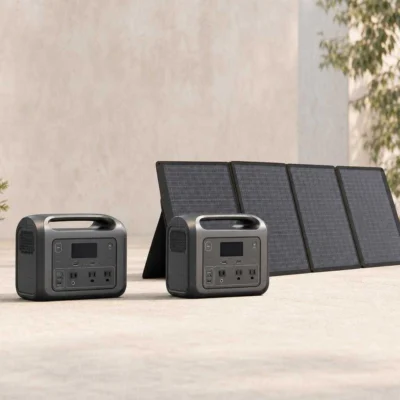
Example C: sunny camp. A 700Wh daily load paired with a 300W array, four peak-sun hours, and 75% collection yields an estimated 900Wh. The array appears able to catch up under the entered sun, but one shaded or cloudy day removes the margin. More battery reserve or a vehicle/AC fallback may still be justified.
They use invented round loads to demonstrate the method. Substitute measured watt-hours, startup demand, local sun, season, temperature, cable losses, and exact station limits. Never copy the final size without copying—and verifying—the inputs.
Examples also show why “what size for a refrigerator?” has no single answer. Two refrigerators can differ in startup, climate, age, volume, insulation, defrost behavior, and door use. Size the measured appliance in its demanding environment, not a category average.
Size for the Bad Day, Then Label the Assumption
Averages hide the day that empties the battery. A refrigerator uses more energy in heat, a pump cycles more during heavy use, a CPAP may draw more with heat and humidity, and winter solar produces fewer useful hours. Build a normal-day row and a demanding-day row. The chosen system should pass the demanding day if the load consequence requires it.
| Input | Normal day | Demanding day | Source |
|---|---|---|---|
| Essential energy | Your measured Wh | Higher measured or justified Wh | Watt meter / device record |
| Simultaneous load | Typical group | Hardest credible overlap | Operating schedule |
| Peak sun | Seasonal typical | Conservative event value | Location and season |
| Reserve | Convenience margin | Consequence-based margin | Your risk policy |
Label every assumption next to its source and date. “Fridge = 100W” is not enough; write “measured 1.0kWh over 24 hours at 78°F on this date, startup X watts.” That record can be updated when equipment, season, or household behavior changes.
Run a sensitivity check before spending
Increase daily Wh by 20%, reduce peak-sun hours by 25%, and raise the simultaneous load to the hardest credible overlap. If the recommended tier changes dramatically, the system is sensitive and needs either better evidence or more margin. If it remains in the same tier, the purchase is more robust to ordinary error.
Bottom Line: Pass All Three Tests
Choose inverter watts from simultaneous and startup loads, battery watt-hours from a measured daily energy budget plus loss and reserve, and solar watts from the energy that must return under realistic sun. Then verify voltage, current, connectors, ports, environment, and total ownership cost. That produces a defensible size instead of a bigger-number guess.
Leave a Reply