Solar Power Picks logo with sun, solar panel, and green energy icon

  • Home
  • Reviews
  • Best
    • Best portable power stations
    • Best Solar Panels
    • Best Solar Generators
  • Guides
    • Portable Power Stations Guides
    • Solar Panels Guides
    • Solar Generators Guides
  • Comparisons
    • Portable Power Stations Comparisons
    • Solar Panels Comparisons
    • Solar Generators Comparisons
  • Calculator

Renogy vs ECO-WORTHY Solar Panels: Which Brand Wins?

COMPARED PRODUCTS

Renogy 200W Solar Panel Starter Kit Review: The All-In-One Bundle for Getting Off the Grid

Best Renogy All-Around Kit

Renogy 200W Solar Panel Starter Kit Review: The All-In-One Bundle for Getting Off the Grid

Check price at Amazon Jump to details
Renogy 200W Flexible Solar Panel Review: The Lightweight, Bendable Choice for Curved Van and Marine Roofs

Best Renogy for Curved Roofs

Renogy 200W Flexible Solar Panel Review: The Lightweight, Bendable Choice for Curved Van and Marine Roofs

Check price at Amazon Jump to details
ECO-WORTHY 200W Solar Panel Kit Review: The Budget-Priced Alternative to the Renogy Starter Kit

Best ECO-WORTHY Value Kit

ECO-WORTHY 200W Solar Panel Kit Review: The Budget-Priced Alternative to the Renogy Starter Kit

Check price at Amazon Jump to details
ECO-WORTHY 400W Solar Panel Review: When You Need More Than 200W — N-Type Performance at a Competitive Price

Best ECO-WORTHY High-Output

ECO-WORTHY 400W Solar Panel Review: When You Need More Than 200W — N-Type Performance at a Competitive Price

Check price at Amazon Jump to details

The Renogy vs ECO-WORTHY debate is really a debate about what you’re buying solar for — a polished, well-supported build, or the most watts you can wring from every dollar. Both brands make solid monocrystalline panels that keep RV, van, cabin, and off-grid batteries topped up for years. The gap shows up in the extras: the controllers, the warranties, the flexible options, and the finish. Get those trade-offs straight and the choice gets easy.

To keep this grounded, we’re comparing four real products with published owner feedback — two Renogy kits and two ECO-WORTHY kits — rather than trading spec sheets. That’s where the honest differences live.

Fast Answer: Which Brand Should You Buy?

Buy Renogy if you want a complete, guaranteed-compatible kit, a flexible panel for a curved roof, and a longer warranty — you’ll pay a premium for the build, the support, and the peace of mind. Buy ECO-WORTHY if you want the best watts-per-dollar, a high-output 400W N-Type array on a budget, or a system you plan to expand — just know you’ll supply more of the finishing parts yourself.

The Main Difference: Premium Build vs Watts Per Dollar

Here’s the cleanest way to frame Renogy vs ECO-WORTHY. Renogy is the premium brand — its kits arrive more complete, its support and warranty run deeper, and it offers a flexible panel ECO-WORTHY doesn’t match in this lineup. You pay for that polish. ECO-WORTHY is the value brand — it undercuts Renogy on price while doing the same core job, and its N-Type panels push higher efficiency than Renogy’s mono cells for less money.

Neither approach is wrong. A first-time RV buyer who wants one box that just works leans Renogy. A boondocker or off-grid builder chasing maximum harvest per dollar leans ECO-WORTHY. The rest of this comparison is about which specific trade-offs matter for your setup.

Renogy vs ECO-WORTHY: Side-by-Side

Dimension Renogy ECO-WORTHY
Efficiency ~22% monocrystalline (half-cut PERC on the flexible panel) Up to 21.5% mono (200W kit); 25% N-Type (400W kit)
Cell type Monocrystalline / half-cut PERC Monocrystalline and N-Type 16BB (bifacial)
Price / value Premium — costs more, bundles more Budget — best price per watt, fewer extras included
Flexible options Yes — 200W flexible bends to 240 degrees No — rigid glass only in this lineup
Warranty Up to 5-year panel warranty + 24/7 support 1 year + responsive, fast replacements
Best for Complete first-time kits, curved-roof installs, longer backing Value builds, high-output N-Type on a budget, expandable arrays

Best Use-Case Matchups

Rather than crown one brand overall, it helps to match each kit to the buyer it fits. Here’s where each of the four featured products earns its spot — and where the Renogy vs ECO-WORTHY split gets practical.

Renogy 200W Solar Panel Starter Kit — Best Renogy All-Around Kit

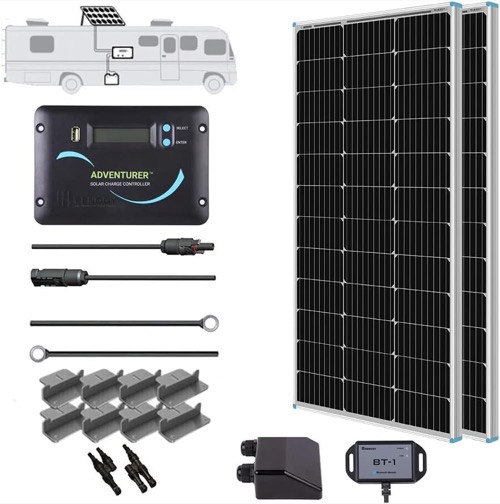
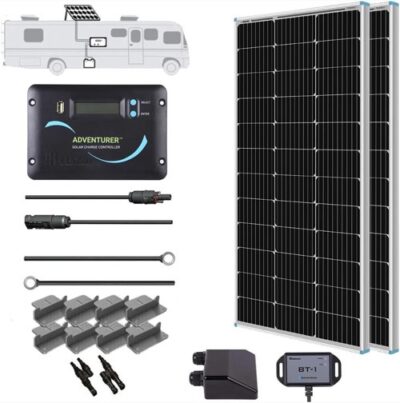
This is the pick for a first-time RV, van, or off-grid buyer who wants everything in one box. You get two 100W monocrystalline panels, a 30A PWM controller, branch connectors, and a generous run of cable — plus a 5-year panel warranty behind it. Owners keep lead-acid, AGM, and lithium banks reliably topped, and the panels earn near-universal praise for build. Just plan to add the fuses the manual requires. Full details in our Renogy 200W starter kit review.

Renogy 200W Flexible Solar Panel — Best Renogy for Curved Roofs

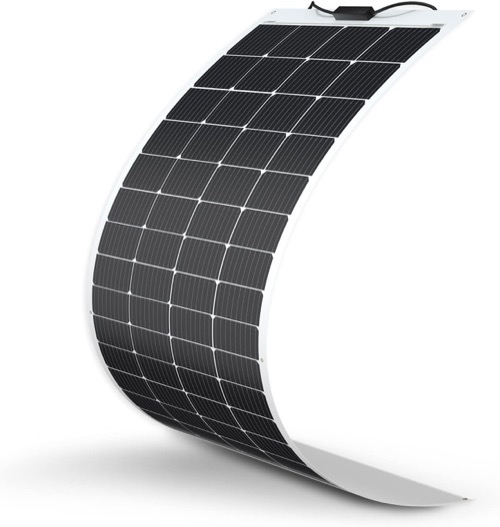
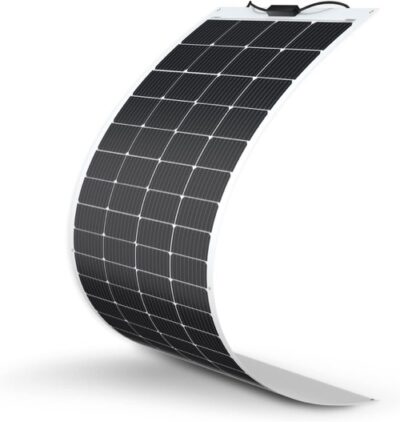
When your roof curves or can’t take the weight of glass, this is the answer ECO-WORTHY doesn’t have here. At 10.8 pounds and bending up to 240 degrees, it hugs van, camper, and boat rooflines, and owners pull a real 189-198W in full sun through IP67-sealed connections. It runs hotter flush-mounted and hates shade, and you supply your own controller — but for curves and weight limits, nothing else in this comparison fits. See the Renogy 200W flexible solar panel review for the full picture.

ECO-WORTHY 200W Solar Panel Kit — Best ECO-WORTHY Value Kit

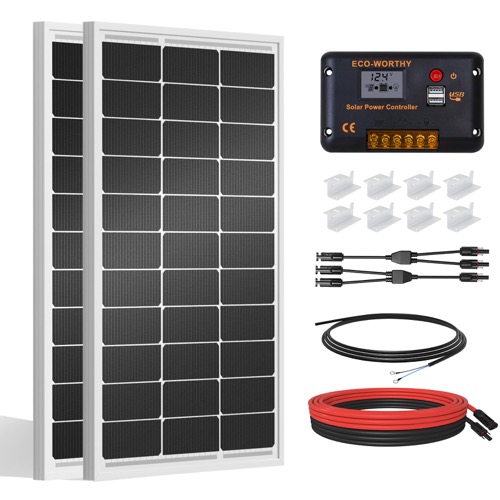
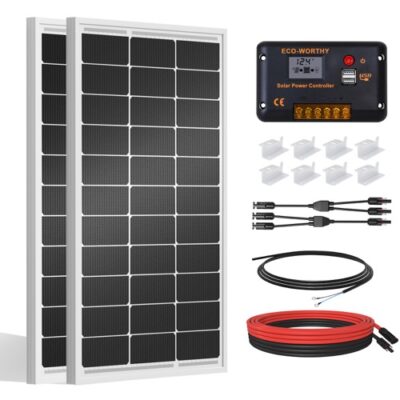
This is the direct budget answer to Renogy’s starter kit, and it consistently undercuts it while doing the same job. Two 100W mono panels, a 30A PWM controller with USB and 12V load output, MC4 wiring, and 12V/24V flexibility make it a genuinely easy first build you can expand later. The controller is the weak link — a fair share of owners swap it for MPPT — but the value per watt is hard to beat. Read the ECO-WORTHY 200W kit review for the trade-offs.

ECO-WORTHY 400W N-Type Solar Panel — Best ECO-WORTHY High-Output

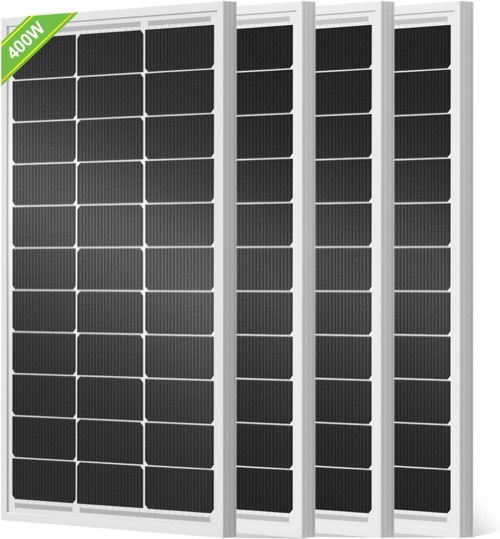
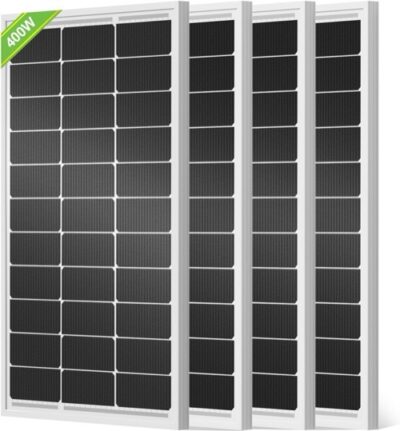
For anyone stepping up from 200W, this four-panel N-Type kit is the high-output-on-a-budget star of the group. The 25%-efficiency cells and IP68 junction box deliver a real 300-350W in good sun, and owners report panels surviving floods, hail, and years on a roof. The catch: no controller, brackets, or cables in the box, and voltage that runs higher than the advertised 18V — so plan your wiring. Our ECO-WORTHY 400W N-Type review covers the full setup.

Real-World Output and Cell Type

Rated watts and delivered watts are two different numbers, and this is where cell type and bundled hardware decide the winner. Not sure how many watts you actually need? Our solar panel calculator estimates real daily output for your location before you buy.

Renogy’s panels are efficient 22% monocrystalline (half-cut PERC on the flexible), and the flexible panel proves the cells are strong — owners see 189-198W in direct sun, roughly 624 Wh a day at a 0.78 real-world factor. The starter kit tells the other side of the story: its PWM controller caps real output near 135-141W from 200W of panels, about 560 Wh a day. The panels aren’t the limit there; the controller is.

ECO-WORTHY splits the same way but lands lower and higher at once. The 200W kit’s PWM controller and voltage mismatch pull real output to 110-145W (around 440 Wh a day) — the weakest of the four. The 400W N-Type kit flips it: 25%-efficiency N-Type 16BB cells with strong low-light behavior deliver a real 300-350W, roughly 1,280 Wh on a good day, with owners charging even at 25°F. On raw cell efficiency, ECO-WORTHY’s N-Type panels actually beat Renogy’s mono cells here. Want the math behind these numbers? See our guide on how much power a solar panel produces.

The takeaway: with either brand, the controller shapes your harvest as much as the cells. A budget PWM unit leaves watts on the table; an MPPT controller claws them back.

Build Quality and Durability

Both brands build panels that survive years outdoors, but the weatherproofing details differ. Renogy’s starter-kit panels use aluminum frames and tempered glass rated to 2400Pa wind and 5400Pa snow, with owners reporting two-plus years of trouble-free mounting — though no formal IP rating is cited. The flexible panel carries an IP67 junction box and connectors, with the one watch-point being the laminate bond, which a few owners saw peel over time.

ECO-WORTHY holds its own and then some. The 200W kit’s junction box is IP65-rated, and the 400W N-Type kit steps up to an IP68 junction box with bypass diodes, an anodized aluminum frame, and low-iron tempered glass. The durability stories are striking — owners report the 400W panels surviving flood submersion for days, hail, and a dropped-panel test. For a budget brand, that’s a genuine strength.

On flexible options, Renogy wins by default: its 200W flexible panel is the only bendable choice in this comparison, and it’s the reason curved-roof buyers reach for Renogy. If that’s your install, see our roundup of the best flexible solar panels.

Price and Value: The Per-Watt Story

This is ECO-WORTHY’s home turf. Its 200W kit undercuts the comparable Renogy starter kit by a noticeable margin, and its 400W N-Type panels sell for roughly $46-52 per 100W on sale — a fraction of the $120+ premium brands ask. Owners who ran ECO-WORTHY side by side with pricier panels report comparable energy production for far less money.

Renogy’s value is different but real. You pay more, but the starter kit bundles a controller, connectors, brackets, and plenty of cable into one guaranteed-compatible purchase, and the 5-year warranty backs it. For a first-timer, avoiding a parts-research rabbit hole is worth the premium. The nuance: some of ECO-WORTHY’s savings come out of the accessories — the 400W kit ships with no brackets or cables, so budget those back in before you crown it the cheaper option. If a bigger array is the goal, compare the field in our best 400W solar panels guide.

Connectors and Compatibility

Good news here: both brands standardize on MC4 connectors, so panels and controllers from either play nicely together and with most power stations. Renogy’s kits include Y-branch connectors for parallel 12V wiring, and the flexible panel uses IP67-rated MC4-style connectors (with short 27.6-inch leads that usually need an extension). ECO-WORTHY’s 200W kit ships 2-in-1 parallel connectors for 12V or series wiring for 24V, while the 400W kit’s 35-inch leads almost always need extensions.

On charging hardware, both are flexible: each works with lead-acid, AGM, gel, and LiFePO4 batteries through a compatible controller, and both feed EcoFlow, Bluetti, and similar power stations via solar input. One compatibility flag on the ECO-WORTHY 400W: its open-circuit voltage runs higher than the advertised 18V (around 22V per panel, 43V in series), so design your array around the real voltage. Whether you use the bundled PWM units or upgrade, our MPPT vs PWM charge controller guide explains why the controller choice matters so much for real output.

Warranty and Support

Renogy takes the paper-coverage round. Its 200W starter kit carries a 5-year panel warranty with 24/7 technical support, and some owners report genuinely helpful reps. The flip side is inconsistency — for every good support story there’s a frustrated one about hold times and slow controller replacements, and the flexible panel’s warranty terms aren’t clearly spelled out.

ECO-WORTHY offers a shorter one-year warranty on the 200W kit, but it punches above that on service. Owner after owner describes fast, generous replacements for damaged, missing, or dead-on-arrival panels — one off-grid customer had stolen panels replaced the same day. There is one serious safety note worth respecting: a single owner’s lead-acid battery exploded, with the cause traced to the bundled controller, so set the correct battery profile and add an inline fuse. Longer coverage goes to Renogy; faster real-world replacements go to ECO-WORTHY.

Lineup Breadth

Renogy’s lineup is broader and more polished across formats — complete plug-and-play starter kits, rigid panels, and the flexible option that anchors its curved-roof appeal. That range is a real reason first-time buyers gravitate to it: whatever your roof, there’s a Renogy shaped for it.

ECO-WORTHY’s strength is scaling by wattage and value. The 200W kit is an easy on-ramp you can stack, and the 400W N-Type kit is a genuine step-up array for real off-grid loads — both built to expand as you add panels. What it lacks in this comparison is a flexible panel, so a curved or weight-limited roof pushes you back toward Renogy.

The Verdict: Which Brand Wins for You

There’s no single winner in Renogy vs ECO-WORTHY — there’s a winner for each buyer. Here’s the honest breakdown by who you are.

  • First-time RV or off-grid buyer who wants it done right: Renogy. The 200W starter kit’s complete bundle, guaranteed compatibility, and 5-year warranty are worth the premium.
  • Curved-roof, van, or marine install: Renogy, no contest. The 200W flexible panel bends where rigid glass can’t, and ECO-WORTHY has no answer here.
  • Value builder chasing the most watts per dollar: ECO-WORTHY. The 200W kit does the same job for less, and you can expand it over time.
  • Stepping up to a real off-grid array: ECO-WORTHY’s 400W N-Type kit — high-efficiency cells, tough build, and unbeatable price per watt, provided you supply a good MPPT controller and mounting hardware.
  • Buyer who wants maximum efficiency out of the box: Lean ECO-WORTHY for the 25% N-Type cells, but pair either brand with MPPT to actually capture the harvest.

Bottom line: choose Renogy when you want a finished, longer-backed system and a flexible option; choose ECO-WORTHY when you want more solar for less and don’t mind finishing the build yourself. Both are honest picks — they’re just built for different buyers.

Best Renogy All-Around Kit

Renogy 200W Solar Panel Starter Kit Review: The All-In-One Bundle for Getting Off the Grid

Renogy 200W Solar Panel Starter Kit Review: The All-In-One Bundle for Getting Off the Grid

Get it now:

Check latest price

What to know

  • Real output around 135-141W from the 200W of panels — the PWM controller, not the panels, sets that ceiling
  • 5-year panel warranty with 24/7 support — the longest coverage in this comparison
  • Broad battery support — flooded, AGM, gel, and LiFePO4 via the controller's selectable profiles
  • You'll add fuses yourself — a 30A inline fuse is required but not included
  • Skip the Bluetooth — the module and DC Home app are widely panned; the system runs fine without them

Best if

  • You're new to solar and want a complete, guaranteed-compatible 12V kit in one box
  • You value a longer 5-year panel warranty and brand support
  • You want reliable battery top-ups for an RV, camper, boat, or shed

Skip if

  • You want maximum efficiency out of the box — the PWM controller caps harvest
  • You expect to run an air conditioner or microwave directly off 200W
  • You refuse to add fuses or finish the wiring yourself
If you want one box that gets an RV, van, or off-grid shed running on solar without a parts-research marathon, this is Renogy's easiest recommendation. It's built for first-time builders, and owners keep saying the same thing — two 100W monocrystalline panels, a controller, connectors, and plenty of cable all showed up together, and the panels themselves feel sturdy years later. What makes it work: everything for a 12V build in a single, guaranteed-compatible purchase, plus a controller that handles lead-acid, AGM, gel, and lithium banks and a 5-year panel warranty behind the whole thing. The MC4 hookup and included Y-branch connectors make parallel wiring genuinely beginner-friendly. The catch: it's not quite complete. The manual calls for inline fuses that aren't in the box, the PWM controller caps real output near 140W, and the Bluetooth app frustrates almost everyone who tries it.
Power output200 W (2 × 100W monocrystalline)
Cell efficiency22% monocrystalline
Real-world output~135-141W in good sun (~560 Wh/day)
Charge controllerAdventurer Li 30A PWM (included)
ConnectorMC4 with Y-branch connectors
WeatherproofingNo IP rating; aluminum frame, tempered glass, 2400Pa/5400Pa load
Weight16.5 lb per panel
Warranty5 years + 24/7 support
Best forFirst-time RV, camper, boat, and off-grid 12V systems
Best Renogy for Curved Roofs

Renogy 200W Flexible Solar Panel Review: The Lightweight, Bendable Choice for Curved Van and Marine Roofs

Renogy 200W Flexible Solar Panel Review: The Lightweight, Bendable Choice for Curved Van and Marine Roofs

Get it now:

Check latest price

What to know

  • Real 189-198W in direct sun when angled and cool — closer to ~624 Wh/day flush-mounted at a 0.78 factor
  • Bends up to 240 degrees to follow curved van, camper, and boat rooflines
  • IP67 junction box and connectors handle rain and brief immersion
  • Bring your own controller and extension — no controller included and the 27.6-inch leads rarely reach
  • Manage heat and shade — an air gap under the panel helps; even a couple inches of shade tanks output

Best if

  • Your roof is curved or weight-limited and rigid glass won't sit right
  • You want max watts on a single lightweight, all-black sheet
  • You need IP67-sealed connections for marine or exposed use

Skip if

  • Your mounting spot sees any regular shade — output drops hard
  • You have a flat, roomy roof where a rigid panel gives steadier watts per dollar
  • You want a ready-to-charge kit with the controller and cables in the box
When your roof curves or can't carry the weight of framed glass, this bendable sheet is the one option in this comparison that fits. It's built for van, camper, and marine roofs, and owners keep calling the flexibility "worth the extra cost" because it solved installs a rigid panel simply couldn't. What makes it work: at 10.8 pounds it's roughly half the weight of a comparable rigid panel, it bends up to 240 degrees, and in full sun owners pull a real 189-198W through IP67-sealed connections that shrug off rain. The all-black, glare-free laminate sits nearly flush and looks tidy on a roof rack or deck. The catch: it runs hotter flush-mounted on a dark roof, even a little shade drops output sharply, the factory leads are only 27.6 inches, and there's no controller in the box.
Power output200 W monocrystalline (half-cut PERC)
Cell efficiency22% (high for a flexible panel)
Real-world output189-198W in full sun (~624 Wh/day at 0.78)
Charge controllerNone — you supply MPPT or PWM
ConnectorMC4-style, IP67; 27.6-inch leads
WeatherproofingIP67 junction box and connectors; frameless laminate
Weight10.8 lb; bends to 240 degrees
WarrantyNot specified — verify current Renogy terms
Best forCurved van, camper, and marine roofs
Best ECO-WORTHY Value Kit

ECO-WORTHY 200W Solar Panel Kit Review: The Budget-Priced Alternative to the Renogy Starter Kit

ECO-WORTHY 200W Solar Panel Kit Review: The Budget-Priced Alternative to the Renogy Starter Kit

Get it now:

Check latest price

What to know

  • Real output 110-145W — well below the 200W rating; an MPPT swap lifts it toward 560 Wh/day
  • 12V or 24V flexibility — parallel connectors for 12V, series wiring for 24V, easy to expand
  • Controller is the weak point — failures and hot-running units show up often in owner feedback
  • One-year warranty, fast replacements — support ships parts within days, often with no return
  • Set the battery profile — a LiFePO4 setting is included; select it before connecting lithium

Best if

  • You want the most watts per dollar in a complete 12V/24V starter kit
  • You plan to expand the system into a bigger array later
  • You're comfortable treating the PWM controller as a replaceable starter part

Skip if

  • You want the most efficient harvest without ever swapping the controller
  • You need to fast-charge a large, depleted bank from a single 200W kit
  • You require certified UL/ETL safety paperwork for your install
You don't need to pay name-brand prices for a working 12V solar system, and this kit is the proof — it's the direct budget answer to Renogy's starter kit and undercuts it noticeably. It's popular with first-time and expanding builders who want to get an RV, shed, or cabin running fast, and owners consistently call it the best deal they've made on a solar build. What makes it work: two well-built monocrystalline panels, a 30A PWM controller with USB and 12V load output, and easy MC4 wiring that goes parallel for 12V or series for 24V. It stacks cleanly into a 400-600W array later, so it grows with you. The catch: the bundled PWM controller is the weak link — a fair share of owners swap it for MPPT — and the mounting hardware is incomplete, with missing washers and weak screws common.
Power output200 W (2 × 100W monocrystalline)
Cell efficiencyUp to 21.5% (claimed)
Real-world output110-145W in good sun (~440 Wh/day)
Charge controller30A PWM (included; USB + 12V load)
ConnectorMC4 with 2-in-1 parallel connectors
WeatherproofingIP65 junction box; aluminum frame, 2400Pa/5400Pa load
Output voltage12V (parallel) or 24V (series)
Warranty1 year + 24/7 support
Best forBudget RV, shed, and cabin builds you plan to expand
Best ECO-WORTHY High-Output

ECO-WORTHY 400W Solar Panel Review: When You Need More Than 200W — N-Type Performance at a Competitive Price

ECO-WORTHY 400W Solar Panel Review: When You Need More Than 200W — N-Type Performance at a Competitive Price

Get it now:

Check latest price

What to know

  • Real 300-350W in good sun — about 1,280 Wh/day at a 0.80 factor, more on cold clear days
  • 25% N-Type cells — the highest efficiency in this comparison, strong in low light and winter sun
  • Panels only — budget for an MPPT controller, brackets, hardware, and MC4 extensions
  • Voltage runs high — ~22V open-circuit per panel, ~43V in series; design your array around it
  • Very shade-sensitive in series — mount clear of trees, vents, and roofline shadows

Best if

  • You want a real 400W array at a budget cost per watt for RV, cabin, or off-grid
  • You value tough panels that survive storms, heat, and humidity
  • You're comfortable wiring through an MPPT controller you supply

Skip if

  • Your install location is shaded — series wiring craters the output
  • You want everything in one box with brackets and cables included
  • You need certified specs or a plug-straight-to-battery panel with no controller
For the buyer stepping up from 200W to a real off-grid array, this four-panel N-Type kit is the high-output-on-a-budget star of the group. It's built for semi-permanent RV, cabin, boat, and ground-mount setups, and owners keep coming back to the price per watt — roughly $46-52 per 100W on sale against $120+ for premium brands. What makes it work: 25%-efficiency N-Type 16BB cells with strong low-light behavior, an IP68 junction box with bypass diodes, and a genuinely tough build — owners report panels surviving flood submersion, hail, and years on a roof. In good sun the set delivers a real 300-350W. The catch: it's panels only — no controller, brackets, or cables in the box — and the open-circuit voltage runs higher than the advertised 18V, so you'll plan your wiring around ~22V per panel.
Power output400 W (4 × 100W N-Type monocrystalline)
Cell efficiency25% (N-Type 16BB, per manufacturer)
Real-world output300-350W in good sun (~1,280 Wh/day)
Charge controllerNone — you supply MPPT or PWM
ConnectorMC4; 35-inch leads (extensions needed)
WeatherproofingIP68 junction box with bypass diodes; anodized aluminum, low-iron glass
Output voltage18V Vmp per panel (~22V Voc, 25.2V max); 12V/24V configurable
WarrantyNot specified — owners report fast replacements
Best forRV rooftop, off-grid cabin, boat, and ground-mount arrays

Product Comparison

Feature Renogy 200W Solar Panel Starter Kit Review: The All-In-One Bundle for Getting Off the Grid Renogy 200W Flexible Solar Panel Review: The Lightweight, Bendable Choice for Curved Van and Marine Roofs ECO-WORTHY 200W Solar Panel Kit Review: The Budget-Priced Alternative to the Renogy Starter Kit ECO-WORTHY 400W Solar Panel Review: When You Need More Than 200W — N-Type Performance at a Competitive Price
Product Image
Renogy 200W Solar Panel Starter Kit Review: The All-In-One Bundle for Getting Off the Grid
Renogy 200W Flexible Solar Panel Review: The Lightweight, Bendable Choice for Curved Van and Marine Roofs
ECO-WORTHY 200W Solar Panel Kit Review: The Budget-Priced Alternative to the Renogy Starter Kit
ECO-WORTHY 400W Solar Panel Review: When You Need More Than 200W — N-Type Performance at a Competitive Price
Price $285.99 $243.34 $219.99 $169.98 $219.59 $195.99
Rating
4.6 / 5
4.5 / 5
4.6 / 5
4.6 / 5
Category Solar Panels Solar Panels Solar Panels Solar Panels
Brand Renogy Renogy ECO-WORTHY ECO-WORTHY
Model / SKU KIT-RV-200D (ASIN: B015DEY2TM) Solar Panel 200W 12V (MPN: RSP200DB-72; ASIN: B0BF4VHWJP) L02M100N-LCWMZ-2 (ASIN: B09RZZHHHM; UPC: 810127130869) US-L02M100-B-4 (ASIN: B0CYH13JJK)
Product type 12V solar starter kit — two 100W panels plus charge controller, for RV, camper, boat, and off-grid systems Flexible (bendable) monocrystalline solar panel — for curved marine, RV, van, and camper roofs Complete 12V/24V monocrystalline solar panel kit (2× 100W) with PWM controller — for RV, marine, cabin, and off-grid battery charging Rigid solar panel kit (4x 100W) for off-grid, RV, boat, and home 12V/24V systems
Solar cell type Monocrystalline silicon (2 × 100W panels) Monocrystalline silicon (half-cut PERC cells) Monocrystalline silicon N-Type monocrystalline silicon (16BB, bifacial design per manufacturer)
Maximum power output 200 W (2 × 100W; ~120-141W real-world through the PWM controller per owner testing) 200 W (rated); owners report 189-198W in full direct sun, lower when flush-mounted or shaded 200 W (rated, 2× 100W; 110-145W typical real-world based on customer metering) 400 W total (4 x 100 W; 300-350W typical real-world based on customer testing)
Open-circuit voltage (Voc) Not specified (owners report ~21-22 V in direct sun) 23.9 V (stated maximum voltage) 27.4 V (listed as maximum voltage in product details) 25.2 V (listed as Maximum Voltage; owners measure ~22V per panel)
Maximum operating voltage (Vmp) Not specified ~18.6 V (calculated: 200W ÷ 10.74A) Not specified (owners report panel Pmax near 20V) 18 V (per panel, nominal)
Output voltage 12 V (DC) 12 V (DC) 12 V DC (parallel) or 24 V DC (series) 21.6 V (per panel, listed output voltage)
Maximum current (Imp) Not specified (owners report up to ~9-12 A charging current in strong sun) 10.74 A (listed amperage capacity) 11 A (amperage capacity listed in product details) 4.96 A (per panel)
Short-circuit current (Isc) Not specified Not specified Not specified Not specified (owners report peak current up to ~8.3 A per panel in strong sun)
Cell efficiency 22% (high-efficiency monocrystalline, per listing) 22% (high-tier for a flexible panel) Up to 21.5% (manufacturer claim for monocrystalline cells) 25% (N-Type, per manufacturer)
Charge controller included Yes — Adventurer Li 30A PWM (flush-mount LCD) No — direct panel output; pair with a separate MPPT or PWM controller for 12V batteries Yes — 30A PWM solar charge controller No (pair with your own MPPT or PWM controller)
Controller features Overcharge, overload, short-circuit, and reverse-polarity protection; selectable battery types (lead-acid, AGM, gel, lithium); LCD display; BT-1 Bluetooth module for the DC Home app N/A (no controller in the box) PWM charging; USB charging ports; 12V load output; battery type settings (including LiFePO4); overcharge/over-discharge/short-circuit/reverse-polarity protection (per manufacturer; some owners report controller failures) N/A (no controller included; bypass diodes built into the junction box)
Connector type MC4 (includes Y-branch connectors for parallel wiring) Standard solar connectors (MC4-style, IP67 rated) MC4 (2-in-1 parallel connectors included) MC4
Cable length 30 ft 10AWG adapter kit + 16 ft 10AWG tray cable 27.6 in (2.3 ft) 12 AWG leads (owners commonly add an MC4 extension) 16.4 ft (5 m) 10 AWG solar cable pair + 4.92 ft (1.5 m) tray cable pair 35 in (0.9 m) per panel
Waterproof rating Not specified (no IP rating cited; aluminum frame, tempered glass, rated 2400Pa wind / 5400Pa snow load) IP67 (junction box and solar connectors) IP65 (junction box; rain and spray resistant, not submersion) IP68 (junction box; panel rated for outdoor weather exposure)
Operating temperature range Not specified Upper rating 45°C (113°F) (owners report heat derating when flush-mounted; air gap helps) Not specified (upper temperature rating listed as 85°F in product details) Up to 176°F upper rating (lower limit not specified; owners report charging at 25°F)
Dimensions (L × W × H) 41.8" × 20.9" × 1.4" (per panel) 63.2" × 29.4" × 0.1" 35.2" × 23.1" × 1.3" (per 100W panel) 35.63" × 23.03" × 1.18" (per panel)
Weight 16.5 lb (per panel) 10.8 lb (about half the weight of a comparable rigid panel) Not specified (listed weight of 150 g is a listing artifact; owners describe panels as hefty) Not specified (owners describe panels as lightweight and easy to handle)
Frame material Corrosion-resistant aluminum None — frameless flexible laminate Corrosion-resistant aluminum alloy Anodized aluminum (35mm wider frame for added stiffness)
Surface / glass material Tempered glass Polymer laminate over monocrystalline cells (all-black, glare-free; no glass) Tempered glass (over monocrystalline cells) Low-iron tempered glass (3.2mm)
Mounting type Z-brackets included (2 sets) — fixed mount; pre-drilled panel holes Pre-drilled mounting holes; adhesive or screw mount; bends up to 240 degrees for curved surfaces Z-mounting brackets (2 sets included); pre-drilled panel backs Pre-drilled holes on panel back (no brackets or hardware included)
Compatible devices / batteries 12V battery banks — flooded lead-acid, AGM, gel, and lithium (LiFePO4); for RV, camper, van, boat, shed, and off-grid 12V systems 12V batteries (deep-cycle lead-acid, AGM, gel, LiFePO4) via a charge controller; portable power stations (e.g., Bluetti) with the correct solar input adapter 12V and 24V battery systems — flooded lead-acid, AGM, gel, and LiFePO4; pairs with inverters and power stations via solar input 12V and 24V battery banks (lead-acid, AGM, LiFePO4 via compatible controller); EcoFlow and ECO-WORTHY power stations and all-in-one inverters
Required sunlight hours ~4 peak sun hours/day for the listed 800Wh-class daily output (estimated ~560 Wh/day at 0.70 real-world factor through the PWM controller) Renogy states ~1000 Wh/day at 5 sun hours (planning estimate ~624 Wh/day at 4 PSH, 0.78 real-world factor) 4 hours of full sun for ~800 Wh/day rated (manufacturer; ~440 Wh/day estimated real-world) ~4 hours of sunlight for ~1600 Wh/day (manufacturer estimate; real-world lower)
Wind / snow load rating 2400 Pa wind / 5400 Pa snow load 2400 Pa wind / 5400 Pa snow 2400 Pa wind / 5400 Pa snow Not specified (owners report good wind and snow resistance in field use)
Safety certifications Not specified Not specified Not specified Not specified
Special features All-in-one bundle; selectable battery chemistries; Bluetooth monitoring via DC Home app; flush-mount LCD controller; Y-branch connectors for parallel wiring; 5-year panel warranty Bends up to 240 degrees; half-cut PERC cells; IP67 junction box and connectors; all-black glare-free surface; roughly half the weight of rigid panels 12V/24V series/parallel flexibility; plug-and-play MC4 connectors; expandable system; controller USB ports and 12V load output; LiFePO4 battery support 25% N-Type efficiency; bifacial design; 16-busbar cells; IP68 junction box with bypass diodes; 1.18" thick frame for heat dissipation; pre-drilled mounting holes
Included in the box 2 × 100W mono panels, Adventurer Li 30A PWM controller, 30 ft 10AWG adapter kit, 16 ft 10AWG tray cable, 1 pair branch connectors, BT-1 Bluetooth module, cable entry housing, Z-brackets (2 sets) (no inline fuses) 1× 200W 12V flexible solar panel (no controller or extension cables) 2× 100W mono solar panels, 2× sets Z-mounting brackets, 1× 30A PWM controller, 1× pair 16.4 ft 10 AWG solar cables, 1× pair 2-in-1 connectors, 1× pair 4.92 ft tray cables 4x 100W solar panels (each with 35-inch cable and MC4 connectors), shipped in two boxes; no controller, cables-beyond-panel-leads, or mounting hardware
Warranty 5-year warranty with 24/7 technical support Not specified (verify current Renogy terms before buying) 1 year + 24/7 technical support Not specified (owners report responsive replacements for damaged, missing, or failed panels)
Expected lifespan Not specified (owners report 2+ years of trouble-free panel use) Not specified (multi-year owner reports; isolated laminate-peel cases) Not specified (manufacturer claims decades of frame service life; owners report multi-year use) Not specified (owners report no degradation after ~1 year of outdoor use)
Unit count 1 kit 1 2-panel kit 4 (two 2-packs)
Best for First-time RV, camper, van, and boat 12V solar systems; off-grid sheds and cabins; battery maintenance during seasonal storage Curved van/marine/RV and truck-camper roofs, 12V deep-cycle and lithium battery charging, off-grid barn and shed lighting — based on actual customer usage RV and camper battery charging, off-grid sheds and cabins, marine house batteries, and first-time solar builds intended to expand RV rooftop arrays, off-grid cabin and shed power, boat and houseboat banks, ground-mount and expandable solar systems
Buy Now View Deal View Deal View Deal View Deal

Final Verdict

The Renogy vs ECO-WORTHY question really comes down to what you value more: a polished, well-supported build or the most watts per dollar. Renogy is the premium pick — its 200W starter kit arrives as a complete, guaranteed-compatible bundle with a 5-year panel warranty, and its 200W flexible panel is the standout for curved van, RV, and marine roofs that rigid glass can't follow. You pay a little more, but you get tidier kits, a flexible option ECO-WORTHY doesn't match in this lineup, and stronger paper coverage. ECO-WORTHY wins on value and raw output for the money. Its 200W kit consistently undercuts Renogy while doing the same core job, and its 400W N-Type kit delivers 25%-efficiency cells and a real 300-350W of harvest at a budget cost per watt — the best high-output-on-a-budget play here. The trade-offs are honest: the bundled PWM controllers are the weak link, the 400W kit ships without brackets or cables, and warranty coverage is only one year (though owners praise the fast replacements). Buy Renogy if you want it done right and backed longer; buy ECO-WORTHY if you want more solar for less and don't mind finishing the build yourself. ---

Frequently Asked Questions

Are ECO-WORTHY solar panels any good?

Yes, for the money they're genuinely good. ECO-WORTHY's monocrystalline and N-Type panels are well built — owners report sets surviving flood submersion, hail, and years on a roof — and the price per watt is hard to beat, often roughly $46-52 per 100W on sale versus $120+ for name brands. The honest caveats are the bundled 30A PWM controllers, which are the weak link and fail for a notable share of owners, and real-world output that runs below the rating (about 110-145W from the 200W kit, 300-350W from the 400W N-Type kit). Treat the controller as a starter part and the panels earn their value reputation.

Are Renogy solar panels good quality?

Yes. Renogy's panels are the consistent strong point in owner feedback — sturdy aluminum frames, tempered glass, and reports of two-plus years of trouble-free outdoor mounting. The 200W starter kit backs its panels with a 5-year warranty, and the 200W flexible panel pulls a real 189-198W in full sun while bending up to 240 degrees for curved roofs. Where Renogy stumbles is the accessories: the starter kit's PWM controller caps output near 140W, the Bluetooth app frustrates almost everyone, and the kit skips the fuses the manual requires. The panels are keepers; budget a little for the extras.

Which brand of solar panel is best, Renogy or ECO-WORTHY?

Neither wins outright — it depends on your priority. Renogy is best if you want a complete, guaranteed-compatible kit, a flexible panel for a curved roof, and a longer 5-year panel warranty. ECO-WORTHY is best if you want the most watts per dollar, a high-output 400W N-Type array on a budget, or a system you plan to expand. Renogy panels tend to deliver more predictable real-world output through their bundled hardware, while ECO-WORTHY's 25% N-Type cells give you more raw efficiency for less money if you supply a good MPPT controller.

How does Renogy compare to other brands?

Renogy sits in the accessible-premium tier — pricier than budget brands like ECO-WORTHY, but cheaper than boutique names, with the trade being convenience, guaranteed compatibility, and support. Its complete starter kits and flexible-panel lineup are broader and more polished than most budget rivals, and the 5-year panel warranty beats ECO-WORTHY's one year. Against ECO-WORTHY specifically, Renogy usually costs more for similar panel performance; you're paying for the bundle and the backing, not extra watts. On pure efficiency, ECO-WORTHY's 400W N-Type panels (25%) actually edge out Renogy's 22% mono cells in this comparison.

Is Renogy or ECO-WORTHY cheaper?

ECO-WORTHY is the cheaper brand, and it's not close. Its 200W kit consistently undercuts the comparable Renogy 200W starter kit by a noticeable margin, and its 400W N-Type panels sell for a fraction of premium-brand pricing — roughly $46-52 per 100W on sale versus $120+ for the big names. The catch is that some of ECO-WORTHY's savings come out of the accessories: the 400W kit ships with no brackets or cables, and the bundled controllers are basic PWM units many owners replace. Renogy costs more but bundles more into the box.

Do Renogy and ECO-WORTHY panels work with LiFePO4 batteries?

Yes, both do. Renogy's starter-kit Adventurer controller has a selectable lithium (LiFePO4) profile and owners report excellent charge behavior, while the flexible panel simply needs an MPPT controller with an LFP profile since it ships without one. ECO-WORTHY's 200W kit controller also has a LiFePO4 setting, and owners run both the 200W and 400W kits into 100-300Ah lithium banks. With either brand, set the controller to the lithium profile before connecting — a few owners saw weak charge amps until they confirmed the battery type was set correctly.

×

About Solar Power Picks

Portable Solar Power, Backup Power, and Off-Grid Gear Guides

Your trusted source for honest, in-depth product reviews and comparisons.

Quick Links

  • Best Picks
  • Reviews
  • Guides
  • Comparisons
  • Calculator
  • Privacy policy
  • Favorites

Categories

  • Portable Power Stations
  • Solar Generators
  • Solar Panels

© 2026 Solar Power Picks. All Rights Reserved.

We may earn a commission when you purchase through links on our site. Learn more