Pecron E3600LFP Review: Big Battery Backup for RVs, Outages, and Off-Grid Power
At a Glance
KEY FEATURES
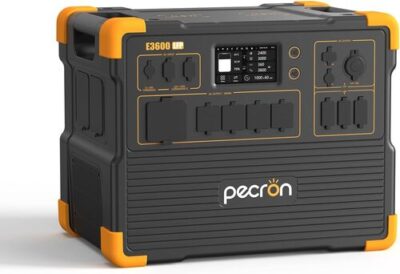
- Pecron E3600LFP: large-capacity portable power station / solar generator for RVs, home backup, off-grid use, and emergency power.
- Battery: 3,072Wh LiFePO4; manufacturer-rated 3,500+ cycles to 80% capacity.
- AC output: 3,600W continuous. Do not derive a surge allowance by doubling that figure.
- Ports: 4 AC outlets, 1 TT30-R RV outlet, 2 USB-C ports (100W and 18W maximum respectively), 4 USB-A ports, 1 cigar port, 1 DC5525 output, 1 XT60-F output, and additional listed output options.
- Recharge: AC charging up to 3200W in about 1.3 hours, 1800W AC charging in about 2 hours, solar example listed as 8 × 300W panels in about 1.5 hours.
- Smart features: app support, touchscreen controls, UPS/pass-through behavior, adjustable settings, and battery-management protection.
- Build: 79 lb, 17.5 × 12.1 × 13.8 in, plastic/metal housing, large stationary-style form factor.
- Best for: RV backup, refrigerator backup, home outage prep, off-grid cabins, Starlink setups, workshop power, and expandable emergency storage.
PROS
- 3,600W pure-sine output plus TT-30 and 12V/30A connections fit serious RV and backup work.
- Dual solar inputs support up to 2,400W with properly designed arrays.
- Expansion path reaches 15,360Wh for longer stationary backup.
- Fast AC charging is available when a suitable 30A circuit is present.
CONS
- About 79 lb before expansion; placement and movement require planning.
- UPS, app, generator, and RV grounding behavior should be tested on the exact system.
- Maximum-rate AC charging needs a suitable 30A electrical path.
- Large expansion configurations become costly, heavy, and cable-intensive.
Editor's Choice
Based on exact documentation and qualitative exact-ASIN owner evidence; no hands-on test or population-rate claim
⚡ Can the Pecron E3600LFP Run It?
Choose a common device and see the estimated runtime, whether the inverter can handle it, and how long the power station may take to recharge.
Picture this: the power drops during a storm, your fridge is full, your Wi-Fi is down, and the gas generator is loud enough to annoy everyone nearby. That’s exactly the kind of problem this unit is trying to solve.
The Pecron E3600LFP isn’t a little weekend phone charger. It’s a heavy, high-output backup battery for people who want to run real appliances, RV loads, home-office gear, Starlink, lights, fridges, and maybe even part of a small home setup.
The Pecron E3600LFP is best judged as the center of a configurable power system. Its current exact-model documentation combines a 3,072Wh LFP battery, 3,600W pure-sine inverter, TT-30 outlet, 12V/30A DC output, dual high-voltage solar inputs, and expansion support. Those interfaces make it unusually flexible for an RV, cabin, workshop, or outage station. They also create more ways to build a system incorrectly if the buyer shops by wattage alone.
The owner material reinforces that split. Successful accounts cover RV and motorhome use, refrigerators, home electronics, pumps, cooking devices, solar charging, and extended backup. Critical accounts raise UPS behavior, app persistence, charging faults, cooling sounds, grounding or bonding questions, shipping condition, and support procedure. None of those anecdotes yields a population failure rate. Together they make a strong case for a formal acceptance test before the station becomes difficult to return or is wired into a more complex system.
The 3,200W maximum AC input requires an appropriate 30A charging path; a standard 15A circuit uses the lower 1,800W route. This is not merely a speed preference. It affects circuit loading, fan operation, and how quickly a generator must supply energy. Before selecting fast charge, identify the branch rating, receptacle, extension-cord capacity, and other active loads. An overheated adapter is not an acceptable shortcut to a faster screen estimate.
| Integration question | What the manual answers | What you still must prove |
|---|---|---|
| Can it feed the RV? | TT-30 output is provided | Actual RV load, neutral-ground behavior, converter interaction, and surge |
| Can it recharge from the roof? | Two 1,200W solar inputs, each 32–150V/20A | Cold Voc, array current, connector/polarity, shade behavior, cable loss |
| Can it act as backup? | UPS functionality is provided | Transfer, shutdown, restoration, firmware, and unattended-load behavior |
| Can it grow later? | Four EP3000 packs total 15,360Wh; the current EP3800 offer lists 18,432Wh | Floor space, cable protection, total weight, cost, and balanced charging workflow |
RV buyers should treat the TT-30 outlet and 12V/30A output as different tools. The AC outlet feeds an RV distribution system through its converter and AC circuits; the 12V output is for a compatible DC route. Neither one resolves the electrical design of every RV. If a surge protector reports an open ground or an appliance behaves unexpectedly, stop and identify the system’s neutral and grounding requirements with qualified help rather than adding a bonding plug by guesswork.
Dual solar inputs are the E3600LFP’s most interesting off-grid advantage. They allow separate arrays, orientations, or string designs, but each XT60 input must remain within its own limits. Do not add the two voltage ceilings or assume that 2,400W can be connected in any arrangement. A shaded roof string and a ground array can behave differently; logging each input separately makes diagnosis much easier.
At roughly 79 pounds before expansion, the E3600LFP is portable in the legal sense but infrastructure in daily life. Its best buyers can dedicate a ventilated location, route high-current cables safely, and test each operating mode. Its weakest buyers want a light camping box or expect a TT-30 receptacle to make every RV configuration plug-and-play.
The E3600LFP Is an Integration Project, Not Just a Battery
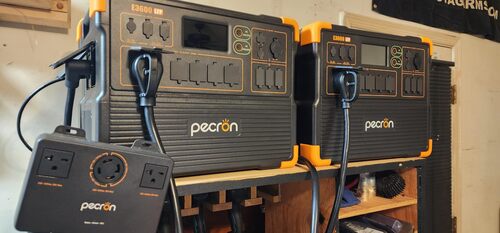
If you want serious backup power for an RV, garage, off-grid cabin, or storm setup, the Pecron E3600LFP does a lot for the money. You get a 3072Wh battery, a 3600W pure-sine inverter, a 30A RV outlet, fast AC charging, and expansion support whose total depends on the extra-battery model. That’s the short version of this Pecron E3600LFP review: the value is strong, but it comes with real trade-offs. The unit is heavy, the app can be annoying, fan noise shows up under load, and a handful of owners report reliability problems that deserve attention.
Choose the Parking Place Before the Power Station
The E3600LFP feels more like compact home-backup hardware than a grab-and-go camping power station. At 79 lb, you can move it, but you probably won’t want to carry it across a campsite or up stairs without help. Indoor placement and ventilation are covered in our garage and indoor backup safety notes.
That said, the size makes sense when you look at the battery and inverter. A 3072Wh LiFePO4 pack with 3600W output needs a large shell, heavy cells, cooling, wiring, and room for serious ports. Owners often park it in an RV, garage, workshop, under a dinette seat, or near a transfer switch rather than treating it like a portable speaker.
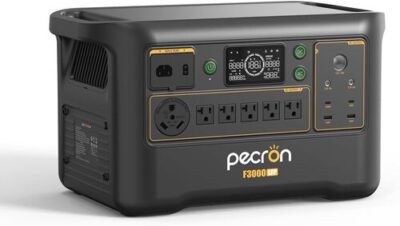
The port layout is practical for bigger setups. You get standard AC outlets, a TT30-R RV outlet, USB ports, DC output, solar cabling, and expansion capability. On the flip side, tight AC outlet spacing can still be a pain if you use bulky plugs or adapters.
Buyer Heads-Up — This is “portable” in the power-station sense, not the backpacking sense. A small cart or dolly makes ownership much easier if you plan to move it often.
Three Kilowatt-Hours Across Real Duty Cycles
The Pecron E3600LFP has a 3072Wh battery. In plain English, that’s enough to run small electronics for days, a CPAP for multiple nights, a refrigerator for a useful chunk of an outage, or an RV setup for a meaningful stretch if you manage the big loads.
In practice, the usable AC energy is lower than the nameplate number because the inverter uses power while converting battery energy into household AC. Using an 85% AC efficiency estimate and leaving a 10% reserve, you’re looking at roughly 2350Wh of practical AC energy.
| Device | Typical Power Draw | Estimated Runtime | Realistic with Margin |
|---|---|---|---|
| Smartphone charging | 10-15Wh per charge | About 200-300 charges | About 150-220 charges |
| Laptop | 50-80Wh per charge | About 32-52 charges | About 25-40 charges |
| Wi-Fi router | 10-20W | About 117-235 hours | About 95-190 hours |
| CPAP machine, no humidifier | 30-60W | About 39-78 hours | About 32-64 hours |
| Starlink Mini | 25-40W | About 59-94 hours | About 48-75 hours |
| Mini fridge | 40-80W cycling | About 29-59 hours | About 24-48 hours |
| Full-size refrigerator | 100-200W cycling plus surge | About 12-24 hours | About 9-20 hours |
| Electric blanket | 50-80W | About 29-47 hours | About 24-38 hours |
| 1500W kettle | 1500W | About 1.5 hours total draw | Brief use only |
Real-World Math — At 0.85 AC efficiency, the listed 3072Wh battery delivers roughly 2611Wh through the AC outlets. Subtract a 10% reserve, and you’re working with about 2350Wh of practical AC runtime.
Owners using it for refrigerators, freezers, lights, Starlink, laptops, and RV loads tend to be happy with the runtime. The catch is that high-draw appliances empty any battery quickly. A microwave for 10 minutes is fine; a space heater for hours is a different story.
TT-30, 12V/30A, and the Loads Between Them
The E3600LFP has a 3600W AC inverter, which is the main reason people look at this model instead of a smaller 1000W or 2000W power station. In real use, that means it can handle many kitchen, RV, garage, and emergency loads that smaller units simply can’t start.
Here’s what matters: continuous output is the number you live with. Surge output helps start compressors and motors, but it doesn’t mean you should run every high-watt appliance at once without thinking.
| Device | Typical Draw | This Unit? |
|---|---|---|
| Phone / tablet | 10-25W | Easy |
| Laptop | 50-100W | Easy |
| LED lights | 5-15W each | Easy |
| Wi-Fi router | 10-20W | Easy |
| Starlink Mini | 25-40W | Easy |
| CPAP, no humidifier | 30-60W | Easy |
| Mini fridge | 40-80W cycling | Easy |
| Full-size fridge | 100-200W cycling, higher startup surge | Easy |
| Chest freezer | 100-250W cycling, higher startup surge | Easy |
| Microwave, 700W class | About 1100W draw | Easy |
| Coffee maker | 800-1500W | Easy |
| Electric kettle | 1500W | Easy, but drains fast |
| Hair dryer | 1500-1875W | Easy, but drains fast |
| Window AC, 5000 BTU | 500W running, higher startup surge | Solid fit |
| RV 30A service | Load-dependent | Solid fit |
| Corded drill | 600W running, higher surge | Easy |
Worth Knowing — The 3600W output is the real working ceiling. Do not infer a surge rating by doubling continuous output. Check the published peak conditions and the actual appliance startup requirement before connecting a motor load.
A common theme is that the Pecron can run serious loads when the unit is healthy. At the same time, a few owners report AC shutoffs, bad inverters, voltage drops, or output failures after short use. For emergency prep, test it hard during your return window with the exact appliances you care about.
Two Solar Lanes and Two AC-Charging Speeds
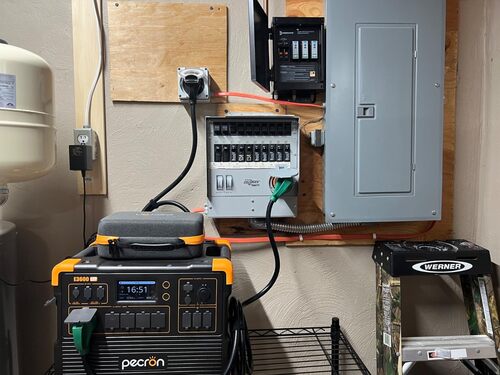
Charging speed is one of the E3600LFP’s biggest strengths. The manufacturer documentation states a full AC recharge in about 1.3 hours at 3200W or about 2 hours at 1800W. Off-grid recharge planning is covered in our solar input rate comparison across brands. That’s fast for a 3kWh-class power station.
In practice, fast charging is most useful during storm season. You can refill the battery quickly while grid power is back, or run a gas generator for a shorter window instead of listening to it all night.
| Charging Mode | Time from 0% to 100% | Noise Level |
|---|---|---|
| Lower AC charge setting | About 3-4 hours, depending on setting | Quieter |
| Standard AC, 1800W | About 2 hours | Moderate |
| Fast AC, 3200W | About 1.3 hours | Loud under fan load |
| Car charging | Slow emergency top-up | Mostly silent from the unit |
| 100W solar | About 31+ hours of ideal sun | Silent |
| 400W solar | About 8-10 hours of strong sun | Silent |
| 1200W solar | About 3-4 hours of strong sun | Silent |
| 2400W solar setup | About 1.5-2 hours in ideal conditions | Silent |
Adapter Check — The included solar cables are a nice touch, but large solar setups still take planning. Match panel voltage, wiring, connector type, and input limits before buying a pile of panels.
Solar feedback is mostly positive from owners who understand panel sizing and wiring. People mention setups around 800W, 1000W, 1200W, and larger arrays. That said, one buyer saw lower panel readings than expected, and another had an MPPT-related failure, so this isn’t a setup you should install blind.
Map Every Circuit Before You Add Adapters
The port mix is one of the big reasons the E3600LFP works for RV and home backup.
For RV owners, the 30A outlet is the standout. Buyers use it for motorhomes, van conversions, refrigerators, lights, fans, Starlink, and backup power when a gas generator is down or too loud.
Does the E3600LFP Need a Bonding Plug?
There is no universal answer for every RV or connected load. A supplied owner account mentions using one, but does not establish the correct neutral-ground arrangement for another installation. Do not add a bond or bypass a protective device to clear an error. Have Pecron and a qualified electrician confirm the arrangement for the exact station, RV, transfer equipment, and operating mode.
Cooling Noise Changes With the Charging Strategy
The E3600LFP can be reasonably quiet under lighter loads, but it is not silent. Owners generally describe the noise as manageable during normal use, though fast charging and bigger AC loads wake the fans up.
The louder complaints are worth taking seriously. Some owners mention fan grinding, high-pitched noise, odd fan behavior, or heat on replacement units. If you’re placing this in a bedroom or quiet RV at night, you’ll want to test fan noise under your normal loads before making it part of your sleep setup.
What to Configure Locally and What to Verify in the App
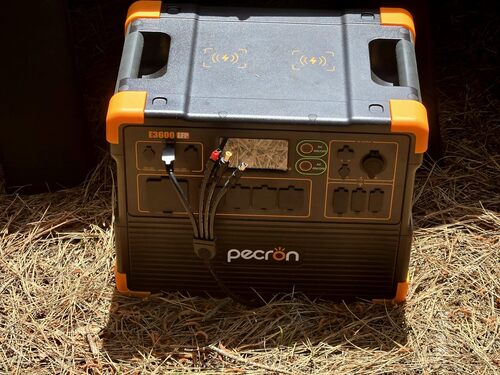
The touchscreen is one of the better everyday features. You can monitor battery percentage, live input, live output, charging behavior, and settings without depending entirely on the app. That matters because the app feedback is mixed.
In practice, many owners like that the touchscreen gives them control even when Wi-Fi or the app gets annoying. The catch is that several buyers mention app pairing trouble, forgotten settings, or connection headaches.
Pro Tip — Set up the app, update firmware, test UPS behavior, and run your main appliances before storm season. Don’t make your first test happen during an outage.
EP3000 and EP3800 Expansion Are Different Configurations
The linked manual describes four 3,072Wh EP3000-48V packs: 3,072Wh + 4 × 3,072Wh = 15,360Wh nominal. Pecron’s current E3600LFP product page also lists four 3,840Wh EP3800-48V packs for 18,432Wh. Confirm pack compatibility, cables, and any revision requirements for your unit before ordering; these totals describe different configurations, not usable AC energy.
The E3600LFP uses LiFePO4 battery chemistry. That’s the right direction for a power station meant for frequent cycling, RV use, home backup, and long-term emergency storage.
LiFePO4 packs are generally heavier than older NCM lithium-ion packs, but they’re usually preferred when you care more about cycle life and thermal stability than shaving pounds. That fits this unit well because it already weighs 79 lb and is clearly built for bigger backup jobs.
Cycle life: the current manufacturer manual lists 3,500+ cycles to 80% capacity. This is a published rating, not an independently measured result or a guarantee of the lifetime of every component.
Warranty and support feedback is more complicated. Many owners praise Pecron support, especially a representative named Kein, for replacements, return help, cables, and troubleshooting. At the same time, some replacement processes take weeks, and a few buyers are frustrated by shipping updates or repeat problems.
Storage: follow the maintenance and storage instructions for the delivered revision. Keep the manual and a dated inspection reminder with the station rather than assuming one charge percentage and interval suits every battery.
Reliability is the main caveat in this Pecron E3600LFP review. Plenty of owners report excellent performance, daily use, and strong customer support. Others mention bad cells, inverter faults, AC output failures, MPPT issues, fan problems, or batteries that drop suddenly. That mix makes stress-testing essential.
E3600LFP System-Fit Matrix
| Use Case | Fit | Why |
|---|---|---|
| Weekend car camping | Solid fit | Huge capacity, but heavy for casual campsite carrying |
| RV side-trip / van life | Strong fit | 30A outlet, high output, big battery, strong DC/AC flexibility |
| Home blackouts under 8 hours | Strong fit | Great for fridges, lights, router, laptops, and freezer backup |
| Multi-day off-grid cabin | Strong fit | Strong capacity and expansion support, especially with solar |
| CPAP overnight backup | Strong fit | Plenty of capacity for multiple nights, especially without humidifier |
| Refrigerator backup | Strong fit | Inverter output and battery size are well matched to fridge loads |
| Jobsite power tools | Solid fit | High output helps, but dust, weight, and reliability testing matter |
| Quiet bedroom UPS | With caveats | UPS support exists, but fan noise and UPS complaints need testing |
| Hurricane / multi-day outage | Strong fit | Expansion batteries and solar input make it useful for longer prep |
| Tailgating / outdoor events | Solid fit | Plenty of output, but 79 lb weight is not fun to move |
| Backpacking / lightweight EDC | Skip | Far too heavy |
| Apartment without solar access | Solid fit | Fast AC charging helps, but storage space and weight matter |
You’ll probably be happy if you want a high-capacity LiFePO4 power station for RV use, storm backup, fridges, Starlink, home-office gear, or off-grid solar projects. This also makes sense if you like the idea of expanding beyond the built-in 3072Wh battery later.
You might want to skip it if you need a light power station, silent bedroom backup, zero-fuss app control, or the lowest-risk reliability profile. To be fair, Pecron gives you a lot of hardware for the money, but buyers who hate troubleshooting may prefer paying more for a more polished brand experience.
Pros & Cons Analysis
Based on documented specifications and owner feedback
Pros
- Useful high-current interfaces — TT-30 AC and 12V/30A DC outputs give RV and mobile-system builders more appropriate choices than a collection of household outlets alone.
- Two independent solar lanes — Separate 32–150V inputs make mixed orientation or physically separate array planning possible without forcing every module into one string.
- Recharge speed can match the source — Buyers can use a standard 15A route or a much faster 30A route when the electrical installation supports it.
- Expansion is genuinely substantial — Four supported EP3000-48V batteries can turn the station into multi-day storage for measured essential loads.
- Broad owner applications — The supplied material covers RVs, refrigeration, office systems, pumps, solar, and outage use, helping define realistic system roles.
Cons
- Integration questions are unavoidable — Grounding, RV converters, generator quality, UPS recovery, solar string design, and charging-circuit capacity must be resolved for the actual installation.
- The enclosure is not casually portable — At about 79 pounds, it benefits from a cart, fixed parking place, restraint plan, and short protected cable routes.
- Owner software experience is uneven — Pairing, retained settings, and fault interpretation deserve attention before the station is assigned unattended backup duty.
- Cooling can become intrusive — High-rate charging and large loads create fan noise that may conflict with sleeping areas or quiet workspaces.
- Support preparation matters — Mixed remedy accounts make immediate inspection, serial photographs, logged fault codes, and written measurements important.
Our Verdict
For this Pecron E3600LFP review, the clearest takeaway is value with caveats. The capacity, inverter size, RV outlet, fast charging, solar potential, and expansion support are genuinely useful for RV owners, blackout prep, off-grid cabins, and people who want quiet backup power without running a gas generator all night.
That said, this isn't the unit I'd recommend to someone who wants featherweight portability or a flawless app-first experience. Buy the Pecron E3600LFP portable power station if you're comfortable testing your setup, managing a heavy battery, and trading some polish for a lot of watts per dollar. For the right buyer, it's a strong backup tool. For the wrong one, it may feel like too much power station to babysit.
Frequently Asked Questions
Can the Pecron E3600LFP run a full-size refrigerator?
Yes, the 3600W pure-sine inverter gives it enough output for most full-size refrigerators, including compressor surge. Runtime depends on the fridge, room temperature, and how often the compressor cycles, but the 3072Wh battery is a strong fit for refrigerator backup.
How long will the Pecron E3600LFP run a CPAP machine?
For a 30-60W CPAP without heated humidification, expect roughly 39-78 hours from the usable AC capacity. With humidification on, runtime drops because power draw is higher.
Is the Pecron E3600LFP good for RV use?
The TT-30 outlet is useful for a compatible RV setup, but it does not establish the correct neutral-ground arrangement. Do not copy an owner bonding-plug or converter workaround. Confirm the station, RV, transfer equipment, and operating mode with Pecron and a qualified electrician.
How fast does the Pecron E3600LFP recharge from AC power?
The listing claims about 1.3 hours with 3200W AC charging and about 2 hours with 1800W AC charging. Fast charging is useful during outages, though owners mention that fan noise becomes more noticeable.
Can it recharge from solar panels?
Yes. The listing gives an example of 8 × 300W solar panels charging the unit in about 1.5 hours under ideal conditions. Real-world solar input depends on panel wattage, sun angle, wiring, shading, and MPPT behavior.
Does the UPS mode work reliably?
Feedback is mixed. Some owners use it successfully for backup power, while others report vague instructions, shallow discharge behavior, or mains-voltage errors. If UPS use is critical, test it with your exact load before trusting it.
Is the Pecron app reliable?
The app gets mixed feedback. Some buyers connect and monitor the unit successfully, while others mention pairing trouble, forgotten settings, or needing to rely on the touchscreen instead.
Is the Pecron E3600LFP loud?
Under light use, many owners find the noise manageable. Under fast charging or heavier AC loads, the fans can become noticeable, and a few buyers report rattling, grinding, or high-pitched fan sounds.
What battery chemistry does it use?
The E3600LFP uses LiFePO4 battery chemistry. That is generally preferred for frequent cycling, daily backup use, and long-term storage compared with older NCM lithium-ion packs, though it also makes the unit heavier.
Is it easy to move?
Not really. At 79 lb, it is movable around a garage, RV, or home setup, but it is not a lightweight camping power station. Most buyers will want a cart, dolly, or semi-permanent location.
Can it replace a gas generator?
It can replace a gas generator for quiet overnight loads, refrigerators, electronics, RV use, and short-to-medium outages. For whole-home HVAC or unlimited multi-day use, you will need expansion batteries, solar charging, or a gas generator as backup.
Technical Specifications
| Brand | pecron |
|---|---|
| Model / SKU | EU-E3600LFP (ASIN: B0D83QYRDS) |
| Battery capacity | 3072 Wh |
| Battery chemistry | LiFePO4 (LFP) |
| Cycle-life rating | Manufacturer manual: 3,500+ cycles to 80% capacity |
| Expandable capacity | 15,360Wh with four EP3000-48V packs; current manufacturer offer lists 18,432Wh with four EP3800-48V packs. Confirm compatibility for the delivered revision. |
| Continuous AC output | 3600 W continuous (pure sine wave, 100V-120V) |
| Surge / peak output | Not published for this exact model in the current source set |
| AC voltage, frequency, and waveform | 100–120V AC, pure sine wave; frequency not published for this exact model |
| AC outlets | 4 × 120V AC outlets + 1 × TT30-R RV outlet |
| High-current, RV, or 240V output | 1 × TT-30R RV outlet |
| USB-C outputs | 2 × USB-C: one up to 100W, one up to 18W (manufacturer manual) |
| USB-A outputs | 4 × USB-A |
| 12V / DC outputs | 1 × cigar port; 1 × DC5525 output, 1 × XT60-F output |
| Maximum solar input | 2400 W |
| Solar input range and connector | Two XT60 inputs: 32–150V, 20A and 1,200W maximum per input; verify each array separately against the delivered manual. |
| Maximum AC input | 3200 W (fast AC charge mode) |
| AC recharge time | ~1.3 hours at 3200W / ~2 hours at 1800W |
| Solar recharge estimate | Planning estimate: ~1.5 hours with 8 × 300W panels under ideal conditions |
| UPS / EPS support and transfer time | Yes — UPS support listed |
| App / connectivity | Yes — Pecron app (mixed pairing feedback) |
| Operating temperature / weather rating | Not published for this exact model in the current source set |
| Dimensions | 17.5 × 12.1 × 13.8 in |
| Weight | 79 lb |
| Warranty | Not published for this exact model in the current source set |