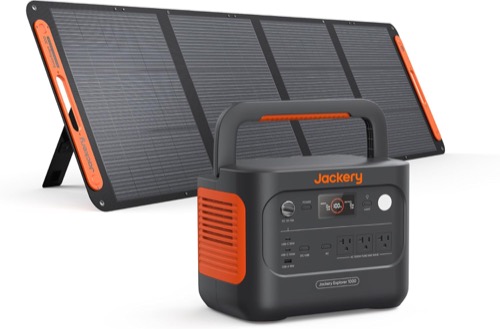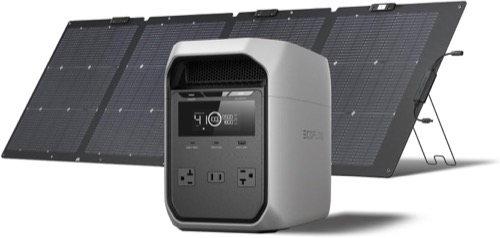
Jackery Explorer 1000 v2 and EcoFlow DELTA 3 Classic occupy the same 1kWh kit tier, but a full operating day exposes different strengths. Jackery begins with 1,070Wh, 1,500W output, a 200W panel, lower station weight, and a 12V car socket. EcoFlow begins with 1,024Wh, 1,800W output, a 220W bifacial panel, six AC outlets, and a sub-10ms UPS specification.
Morning: Start With the Highest Overlap
Morning is often the power gate: coffee equipment, food preparation, refrigeration startup, and device charging can overlap. Jackery publishes 1,500W continuous and 3,000W surge. EcoFlow publishes 1,800W continuous and 3,600W surge, plus X-Boost for selected resistive loads up to 2,600W. EcoFlow therefore has more ordinary and startup headroom, but X-Boost must not be treated as a universal rated-output increase.
EcoFlow’s six AC outlets versus Jackery’s three make a multi-device board easier to cable, but no outlet multiplies the inverter. Sum the loads. If 1,500W covers the hardest morning, Jackery remains in the comparison; if the continuous total lands between 1,500W and 1,800W, only EcoFlow passes the published ceiling.
Midday: Measure Collection, Not Panel Advertising
EcoFlow pairs 220W front-side nameplate power with a bifacial rear side and estimates about 5.8 hours under ideal conditions. Jackery supplies a 200W bifacial panel and estimates roughly 7.5 hours to full. Bifacial contribution depends on surface reflectance and installation geometry, so never add front and rear labels as if both are guaranteed.
Remove shade, aim the panel, secure it against wind, and avoid cable trip paths.
Record input watts, battery state, weather, angle, and active loads.
Check whether repositioning adds enough energy to justify the handling.
Compare watt-hours restored with the energy that evening still requires.
EcoFlow’s station accepts up to 500W solar; Jackery accepts up to 400W. With the supplied panels, both stay well below those ceilings. Credit a larger future array only after checking input voltage, current, connectors, cable loss, storage, and cold conditions.
Afternoon: Ports Decide Which Conversion Runs
Jackery offers a 12V/10A car socket. EcoFlow DELTA 3 Classic does not list a 12V DC output. That single difference can dominate a day with a compatible compressor cooler because a direct DC path avoids leaving the AC inverter on for an AC adapter. EcoFlow instead supplies six AC outlets and two USB-C ports; Jackery has three AC, two USB-C, USB-A, and the car socket.
| Afternoon device mix | Cleaner path | Reason |
|---|---|---|
| 12V cooler + USB devices | Jackery | Native 12V socket plus USB outputs |
| Several small AC adapters | EcoFlow | Six AC receptacles reduce external splitting |
| One USB-C laptop | Either | Both publish a 100W USB-C output |
| High steady AC load | EcoFlow if 1,500–1,800W | Higher continuous ceiling |
Evening: Capacity Is Almost a Tie
Jackery’s 1,070Wh is 46Wh above EcoFlow’s 1,024Wh. That is useful margin, but smaller than the uncertainty created by conversion efficiency, battery reserve, load cycling, temperature, and idle consumption. Model both with the same conservative assumptions. A difference of many hours from the same load is a sign that the comparison used different inputs, not that 46Wh became transformative.
Use the result for planning, then validate with the exact load. It is not a runtime guarantee.
Neither station accepts an expansion battery, so evening reserve cannot be fixed later with a proprietary add-on pack. If the budget routinely reaches the reserve line before bedtime, move to a larger system rather than choosing between two similarly sized batteries.
Overnight: UPS and Noise Need Commissioning
EcoFlow publishes UPS transfer under 10ms; Jackery publishes under 20ms. EcoFlow’s faster number is preferable on paper. It still does not establish zero interruption, power quality under every mode, or compatibility with a specific router, computer, CPAP, or medical system. Test utility loss, utility restoration, a nearly empty battery, overload, and app/firmware behavior using a safe controlled procedure.
Both fast-charge from AC and both use apps. EcoFlow publishes about 45 minutes to 80% and 60 minutes to full. Jackery publishes about one hour in emergency mode and 1.58 hours in standard mode. Fast modes can affect fan behavior and the room’s noise profile; owners’ qualitative evidence across these bundles includes both successful operation and reports of defects or support difficulty. Inspect your exact unit rather than converting anecdotes into a failure rate.
Departure: Count What You Actually Carry
Jackery’s station is 23.8 lb and its panel 14.33 lb, roughly 38.1 lb together. EcoFlow’s station is 26.7 lb and panel 15.4 lb, roughly 42.1 lb together. Jackery saves about four pounds across the headline pieces. The difference is meaningful across stairs or repeated campsite moves and nearly irrelevant for a permanently staged backup station.
Jackery day
Frequent carrying, a 12V cooler, loads below 1,500W, and value placed on the panel’s five-year registered warranty.
EcoFlow day
Faster solar recovery, more AC plugs, load peaks closer to 1,800W, and sub-10ms UPS screening.
Neither day
Battery expansion, native 240V, multi-day household energy, or continuous loads above 1,800W.
Owner Evidence Belongs in the Commissioning Plan
The retained owner-review samples contain observations about solar collection, panel setup, high and small loads, apps, mobility, heat/noise, failures, and support. Those records help identify test cases; they do not establish population reliability. Commission the bundle while returns are available: verify exact contents, exercise every port, collect solar data under several conditions, pair the app, and document any abnormal heat, noise, error, or shutdown.
- Day one: inventory labels, cables, and visible condition.
- Day two: test AC, DC, USB, charging, and display behavior.
- Day three: run the hardest intended load and controlled UPS event.
- First clear day: record solar input at multiple times and panel positions.
For native 120/240V planning above this portable class, see the EcoFlow DELTA Pro 3 + 400W review; the decision turns on circuit topology and recovery design, not the brand name alone.
Write a Five-Year Ownership Handoff
A useful solar generator should be understandable by someone other than its buyer. Create a one-page operating sheet with the load priority, outlet choice, reserve threshold, solar cable path, app settings, and the procedure for utility loss and restoration. The sheet reveals differences that a product table cannot.
| Handoff line | Jackery entry | EcoFlow entry |
|---|---|---|
| Quiet charging mode | Record standard versus emergency AC mode | Record selected AC charge-speed setting |
| DC cooler | Use documented 12V socket if load fits | Document compatible AC-adapter path and its overhead |
| UPS test | Record result with under-20ms published transfer | Record result with under-10ms published transfer |
| Solar setup | 200W panel, DC8020 path, 400W station ceiling | 220W panel, XT60i path, 500W ceiling |
| Warranty file | Save station and panel registration | Save app registration and separate 12-month panel term |
The handoff also prevents app dependence from becoming a hidden single point of failure. Both products offer app control, but local buttons, display information, saved settings, account access, Bluetooth/Wi-Fi behavior, and firmware can differ. Confirm which functions remain available without internet and write down the minimum local procedure.
At the end of five years, compare retained runtime with the original commissioned result rather than the battery percentage display alone. Inspect panel condition, connector wear, cable strain, error history, and warranty status. A station that still passes a reduced mission can remain useful even if it no longer meets the original full-day plan.
- One-page load list with running, startup, and priority.
- One solar diagram with model labels and input limits.
- One test record for runtime, UPS, and restoration.
- One warranty folder for invoice, serial, registration, and support.
Use Twelve Tie-Breakers in the Right Order
- AC voltage: both are 120V systems; reject both for a native 240V requirement.
- Continuous watts: EcoFlow leads 1,800W to 1,500W.
- Startup: EcoFlow publishes 3,600W versus 3,000W, but measure the load.
- Daily Wh: model 1,070Wh and 1,024Wh with identical loss assumptions.
- DC load: Jackery provides a car socket; EcoFlow does not.
- AC plugs: EcoFlow provides six; Jackery provides three.
- Included solar: compare 220W/5.8-hour ideal with 200W/7.5-hour ideal.
- Array growth: EcoFlow accepts 500W; Jackery accepts 400W.
- Transfer: under 10ms versus under 20ms, then test the device.
- Carry: Jackery saves about four pounds across station and panel.
- Panel coverage: confirm five registered years for Jackery versus twelve months for EcoFlow.
- Delivered cost: add required cables, cases, and returns—not only sale price.
Stop at the first tie-breaker that represents a true requirement. If the load needs a 12V socket, later app features cannot restore compatibility. If both pass every requirement, choose on current delivered cost and return terms rather than inventing a technical gap that does not affect the operating day.
The Winner Appears at the End of the Day
Jackery wins the day that rewards lighter carrying, a native 12V path, slightly more capacity, and longer panel coverage. EcoFlow wins the day that rewards a more productive supplied panel, higher AC output, more receptacles, and faster published transfer. Choose by tracing energy from morning load through midday recovery to overnight reserve. That operating cycle is harder to market—and much harder to regret.