Solar Power Picks logo with sun, solar panel, and green energy icon

  • Home
  • Reviews
  • Best
    • Best portable power stations
    • Best Solar Panels
    • Best Solar Generators
    • Best Solar Charge Controllers
    • Best Solar Batteries
  • Guides
    • Portable Power Stations Guides
    • Solar Panels Guides
    • Solar Generators Guides
    • Solar Charge Controllers Guides
    • Solar Batteries Guides
  • Comparisons
    • Portable Power Stations Comparisons
    • Solar Panels Comparisons
    • Solar Generators Comparisons
    • Solar Charge Controllers Comparisons
    • Solar Batteries Comparisons
  • Calculator

Victron vs Renogy Solar Charge Controllers: 20A Models Compared

COMPARED PRODUCTS

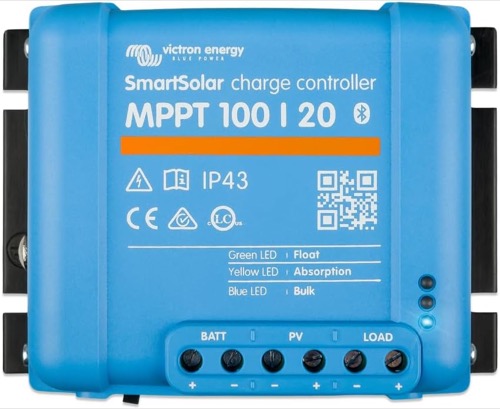
Victron SmartSolar 100/20 Review: Compact Control from 12V to 48V

Product A

Victron SmartSolar 100/20 Review: Compact Control from 12V to 48V

Check price at Amazon Jump to details
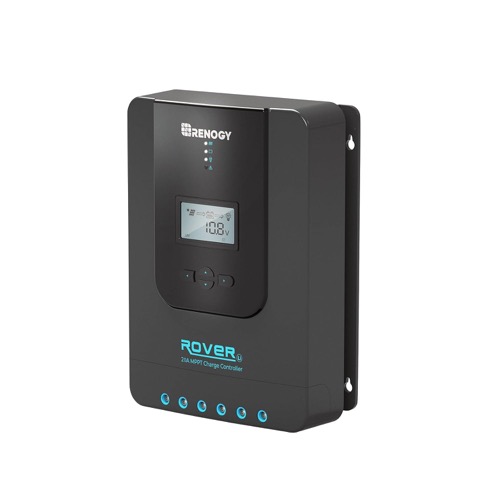
Renogy Rover 20A Review: A Capable MPPT for Small Systems

Product B

Renogy Rover 20A Review: A Capable MPPT for Small Systems

Check price at Amazon Jump to details

Victron vs Renogy solar charge controllers is a close 20A matchup until battery voltage, interface preference, and input documentation enter the decision. The SmartSolar 100/20 and Rover Li 20A both use MPPT, both cap PV open-circuit voltage at 100V, and both charge at up to 20A, but only Victron supports a 48V bank and publishes a 20A PV short-circuit-current ceiling in the evidence reviewed here.

The common mismatch is to compare the shared output rating and stop. A buyer may then discover that one controller needs a phone for detailed local data, the other needs an accessory for app access, or the planned parallel array cannot be approved because its panel-side current limit is unresolved.

This comparison uses the exact SmartSolar 100/20 and Rover Li 20A evidence packs, normalized manufacturer limits, and captured Amazon-owner reports available on August 3, 2026. Solar Power Picks did not bench-test either model; owner observations are treated as attributed experience rather than measured population-wide performance.

Quick Verdict — Victron vs Renogy Solar Charge Controllers

Choose Victron SmartSolar 100/20 If Choose Renogy Rover 20A If
The bank is 48V, or future 48V conversion is credible The system will remain 12V or 24V
Built-in Bluetooth and app-based history matter An onboard numeric LCD matters more than included Bluetooth
A published 20A PV Isc ceiling is needed for array approval Renogy confirms the proposed array against the exact input-current rule
Compact packaging and a five-year warranty have value Larger AWG 8 terminals and conventional load outputs solve an installation need

SmartSolar is the stronger default because it documents more of the input boundary, includes the remote interface, supports another battery voltage, and carries two additional warranty years. Rover can reverse the choice in a service bay where technicians need voltage and status without pairing a phone, or where its larger conductors and physical load terminals remove other hardware. The deciding check is not brand loyalty: it is whether the exact array and battery fit Rover after its unpublished PV Isc ceiling is obtained.

📌 Evidence boundary — A value absent from the reviewed Rover material is unresolved, not unlimited. Ask Renogy for the exact model and revision before approving parallel strings.

Best Fit by System Context

Scenario Better Fit Why Limit to Verify
Compact 12V cabin Victron Smaller body, built-in app, 290W published allowance Bluetooth range through the mounting surface
12V system with local status checks Renogy LCD and buttons do not require a phone PV Isc and display access after installation
24V array with remote history Victron 580W allowance and included VictronConnect Cold Voc and total array Isc
48V battery bank Victron Rover does not support 48V At 48V, Victron’s physical load output is only 1A
Modest automated DC lighting Renogy Conventional programmable 20A load terminals Continuous and startup current of the exact loads
Lithium bank in a cold compartment Victron, conditionally Configurable cutoff with the required sensing arrangement Sensor location, battery threshold, and BMS behavior
Phone-free maintenance workflow Renogy Numeric screen and four local buttons Whether the display exposes every needed setting
Long warranty priority Victron Five years versus three years Regional terms and seller eligibility

Solar Array Compatibility: Same 100V Label, Different Evidence

Both controllers accept a nominally higher-voltage PV array than a 12V or 24V battery, but the equal 100V maximum Voc does not make every string interchangeable. Add module Voc through each series string, then correct that total using the panel’s published coefficient and the site’s design-low temperature. Warm-day Vmp is an operating value; it is not the number to compare with the absolute ceiling.

At equal battery voltage, SmartSolar publishes slightly more PV capacity: 290W versus 260W on 12V, and 580W versus 520W on 24V. That 30W or 60W difference is useful only when all other limits pass. An array can sit under the watt allowance and still violate voltage or current.

Array Decision SmartSolar 100/20 Rover 20A
Maximum PV Voc 100V 100V
Published maximum PV Isc 20A Unresolved in reviewed exact-model evidence
PV allowance at 12V 290W 260W
PV allowance at 24V 580W 520W
Section winner Victron Clearer panel-side boundary and modestly higher watt allowance

Owner evidence for both models includes successful real installations, but those reports do not establish safe array limits. Nor do manufacturer peak-efficiency numbers predict annual production for a particular roof. String layout, cable drop, shade, battery state, and clipping conditions remain system-specific. Victron wins this category on documentation rather than a claimed laboratory advantage.

⚠️ Voc check — Correct series-string Voc for the coldest credible cell temperature and retain the margin required by the current manual. A 100V controller should not be designed to operate at 100V.

Charge Output and Battery Fit: 48V Breaks the Tie

On 12V and 24V banks, both units are rated for 20A battery-side charging. The battery manual or BMS limit can be lower, so a controller’s ability to produce 20A is not permission to send that current into every battery. Check the allowed charge rate across temperature and state of charge, then coordinate it with other charging sources.

SmartSolar automatically supports 12V, 24V, and 48V banks. Rover covers 12V and 24V, with automatic detection for non-lithium batteries and manual selection for lithium. The 48V difference is decisive: SmartSolar publishes a 1,160W PV allowance at 48V, while Rover is not an option for that bank voltage.

Battery Question SmartSolar 100/20 Rover 20A
Supported bank voltages 12V / 24V / 48V 12V / 24V
Profile approach Presets or user-defined algorithm Lead-acid, lithium, and user-defined modes
Temperature input Internal plus optional VE.Smart sensing Included remote sensor for lead-acid compensation
Lithium cold-charge control Configurable with supported sensing Controller-managed cutoff not established in reviewed evidence
Section winner Victron Wider bank range and a documented configurable cold strategy

Rover’s included temperature sensor is useful for supported lead-acid compensation, but temperature compensation and lithium charging inhibition are not the same feature. SmartSolar’s configurable behavior also depends on correct sensing and configuration. In either case, the battery’s own protection remains essential; verify which device initiates a cutoff and how charging resumes.

🔋 Battery check — Match voltage stages, maximum current, and temperature behavior to the exact battery manual. A menu item labeled lithium is only the start of that work.

Installation and Connections: Small Enclosure or Larger Conductors

SmartSolar measures 100 × 131 × 60 mm and weighs 0.65 kg. Rover is 210 × 151 × 68 mm and 1.4 kg, so it needs considerably more panel area and service clearance. Compactness can matter in an RV cabinet, but it should not encourage a hot, inaccessible mounting position.

The terminal comparison runs in Rover’s favor. It publishes capacity up to 8 AWG / 10 mm², while SmartSolar lists 6 mm² / AWG 10. Larger permitted conductors can help a long low-voltage run, although a designer must still verify ampacity, voltage drop, bend radius, lug or ferrule policy, strip length, and torque. Never remove strands to make a conductor fit.

Installation Point SmartSolar 100/20 Rover 20A
Package Smaller and lighter Larger, with front LCD
Maximum published conductor 6 mm² / AWG 10 10 mm² / AWG 8
Physical load output 20A at 12V/24V; 1A at 48V Programmable 20A DC terminals
Local visibility LEDs Numeric LCD and LEDs
Section winner Tie Victron saves space; Rover accepts larger wire and offers easier local inspection

Load outputs require their own design. Rover’s conventional terminals can suit small lighting or controls when both continuous and startup current remain inside the manual. SmartSolar’s BatteryLife output is useful on 12V and 24V but drops to 1A on 48V. Neither output is a shortcut for wiring an inverter; high-current loads normally use a properly protected battery-side bus.

🔧 Installation check — Use each exact manual for protection, grounding, conductor range, torque, ventilation, and energizing order. Shared 20A charging does not create a shared wiring prescription.

Monitoring and Configuration: Phone-First Versus Panel-First

VictronConnect is central to the SmartSolar experience. Bluetooth is built in, and the app exposes live values, configuration, and history; VE.Direct supports integration with other equipment. The controller face provides status LEDs but no numeric readout, so a failed or unavailable phone changes the service workflow.

Rover turns that priority around. Its LCD and four buttons make basic values and configuration available at the enclosure. RS485 is present, while Renogy DC Home access requires the optional BT-2 module. Anyone comparing purchase prices should add that module when app monitoring is part of the requirement.

Monitoring Need Better Choice Reason
Included phone configuration SmartSolar Bluetooth is built in
No-phone local voltage check Rover LCD is on the controller
Network integration Depends VE.Direct and RS485 serve different ecosystems
Lowest accessory count for app use SmartSolar Rover needs BT-2
Section winner Victron, narrowly More capability is included, though Rover’s LCD is genuinely useful

Captured owner reports for Victron commonly value the app and detailed monitoring, while some note range or pairing friction depending on placement. Rover reports include successful use of the local interface and optional monitoring, alongside isolated setup complaints. Those observations identify workflow questions to test during commissioning; they are not controlled reliability measurements.

Protection, Environment, and Ownership Evidence

Neither enclosure should be treated as outdoor waterproof equipment. SmartSolar lists IP43 for its electronics and IP22 around the terminals. Rover lists IP32. Both require a protected location that preserves cooling and keeps conductive contamination, drips, and battery fumes away from connections.

Their stated operating ranges also differ: -30°C to 60°C for SmartSolar and -35°C to 45°C for Rover. A lower minimum does not answer the lithium cold-charge question, and a published ambient range does not guarantee full output without thermal derating. Mounting clearance and actual compartment temperature need separate attention.

Ownership Factor SmartSolar 100/20 Rover 20A
Enclosure statement IP43 electronics / IP22 terminals IP32
Published ambient range -30°C to 60°C -35°C to 45°C
Warranty 5 years 3 years
Evidence limitation App range varies with placement Exact PV Isc remains unresolved
Section winner Victron Longer warranty and higher upper ambient figure, without implying waterproof use

The Amazon snapshot showed both at 4.4 stars, but ratings do not equal failure rates and can combine variants or change over time. Model-specific reviews are better used to find questions: Will the phone reach the controller? Is the display readable after installation? Are the correct communications parts included? Those questions belong in acceptance testing.

🗣️ Owner pattern — Treat repeated comments as commissioning leads, not proof that every unit behaves the same way. Preserve the model, setup, and date context.

Price and Total System Value

On August 3, 2026, the catalog snapshot was $82.79 for SmartSolar and $88.64 for Rover. That small controller-only gap favors Victron even before adding BT-2 to Rover, but marketplace prices and bundles move. Verify the seller, included sensor or communications module, warranty eligibility, and exact ASIN rather than comparing a bare controller with a bundle.

Rover may still reduce installed cost if its LCD avoids a remote display or its load terminals eliminate a separate low-voltage controller. SmartSolar can save money when built-in Bluetooth and the smaller footprint avoid accessory and cabinet changes. Cable and protection costs are system variables, not brand constants.

Cost Question Likely Advantage What Could Reverse It
Lowest snapshot controller price SmartSolar A later Rover sale or bundle
App-ready out of box SmartSolar None unless the exact listing changes
Local display included Rover A phone-first owner does not value it
Five-year ownership horizon SmartSolar Warranty terms or seller eligibility differ
Section winner Victron Lower dated price plus included Bluetooth and longer warranty

Category Winners

Category Winner Evidence-Backed Reason
Array flexibility Victron Published PV Isc plus higher watts at matching bank voltages
Battery configuration Victron Adds 48V support and configurable temperature strategy
Installation Tie Victron is compact; Rover accepts larger conductors
Monitoring Victron Bluetooth is standard, while Rover wins local display
Environmental fit Victron Higher published upper ambient limit; neither is waterproof
Total system value Victron Lower snapshot price, included app access, five-year warranty

Victron vs Renogy Solar Charge Controllers — Which Should You Buy?

Choose SmartSolar 100/20 if the array stays within 100V cold-corrected Voc, 20A Isc, and the correct 290W, 580W, or 1,160W allowance; if a 48V bank is possible; or if built-in Bluetooth and a five-year warranty simplify ownership. Its concession is the absence of a numeric front screen and its smaller published conductor capacity.

Choose Rover Li 20A if the bank will remain 12V or 24V, an LCD and physical programmable load terminals have operational value, and AWG 8 acceptance solves a real cable run. Budget for BT-2 if phone monitoring is required, and obtain the exact PV input-current ceiling before the array is finalized.

The tie-breaker in this Victron vs Renogy solar charge controllers decision is the approved one-line design summary: cold array Voc, total array Isc, battery voltage, maximum planned charging current, and required local interface. If that line includes 48V or demands a documented Isc limit today, buy Victron. If it demands a screen and larger conductors and Renogy confirms the array, Rover is the better operational fit.

Product A

Victron SmartSolar 100/20 Review: Compact Control from 12V to 48V

Victron SmartSolar 100/20 Review: Compact Control from 12V to 48V

Get it now:

Check latest price

What to know

  • Complete electrical documentation
  • Bluetooth is built in
  • Broad voltage support
  • Compact and passively cooled

Best if

  • Complete electrical documentation
  • Bluetooth is built in
  • Broad voltage support
  • Compact and passively cooled

Skip if

  • Severely reduced 48V load rating
  • No numeric screen
  • Two serious failure anecdotes
  • Protected mounting still required

The Victron SmartSolar 100/20 pairs a compact 20A controller with built-in Bluetooth, unusually complete documentation, and support for 12V, 24V, and 48V batteries. It is especially attractive when a 100V PV ceiling and VictronConnect configuration matter more than a local screen. The key limitation is its load output: it falls to only 1A on a 48V battery system, and two sampled owners described failures involving 48V load-side events. Best fit: The Victron SmartSolar 100/20 pairs a compact 20A controller with built-in Bluetooth, unusually complete documentation, and support for 12V, 24V, and 48V batteries.

BrandVictron Energy
Model / SKUSmartSolar MPPT 100/20 (ASIN B075NPQHQK)
Controller typeMPPT
Rated charge current20A
Battery-system voltage12V / 24V / 48V automatic selection
Battery compatibilityLead-acid and lithium via presets or a user-defined algorithm
Max PV open-circuit voltage (Voc)100V
Max PV input current (Isc)20A
Max PV power by battery voltage290W @ 12V; 580W @ 24V; 1,160W @ 48V
Load output20A @ 12V/24V; 1A @ 48V, with BatteryLife and configurable control
Charging profilesAdaptive multi-stage or user-defined algorithm
Temperature sensing / low-temp protectionInternal compensation; configurable low-temperature cutoff and optional VE.Smart battery sensing
Display / local controlsStatus LEDs; detailed control through VictronConnect
App / communicationsBuilt-in Bluetooth with VictronConnect; VE.Direct port
Maximum terminal wire size6 mm² / AWG 10
Maximum efficiency98% peak
Enclosure / operating temperatureIP43 electronics / IP22 terminals; -30°C to 60°C
Dimensions / weight100 × 131 × 60 mm; 0.65 kg
Warranty5 years
Product B

Renogy Rover 20A Review: A Capable MPPT for Small Systems

Renogy Rover 20A Review: A Capable MPPT for Small Systems

Get it now:

Check latest price

What to know

  • Useful published limits
  • Flexible battery setup
  • Strong sampled charging reports
  • Local control works without an app

Best if

  • Useful published limits
  • Flexible battery setup
  • Strong sampled charging reports
  • Local control works without an app

Skip if

  • Bluetooth costs extra
  • Indoor installation only
  • Lithium setup needs care
  • LCD has no backlight

The Renogy Rover 20A is a practical small-system MPPT controller with published 100V, 260W/520W, terminal, environmental, and load-output limits. Its LCD and user-defined battery profile work without an app, while optional BT-2 monitoring adds remote control. It fits documented 12V/24V systems, but it is not waterproof and lithium owners must configure the correct system voltage and battery parameters. Best fit: The Renogy Rover 20A is a practical small-system MPPT controller with published 100V, 260W/520W, terminal, environmental, and load-output limits.

BrandRenogy
Model / SKURover Li 20A (RNG-CTRL-RVR20; ASIN B01MRWTAB5)
Controller typeMPPT
Rated charge current20A
Battery-system voltage12V / 24V; automatic for non-lithium, manual selection for lithium
Battery compatibilityAGM, sealed, gel, flooded, lithium, and user-defined
Max PV open-circuit voltage (Voc)100V
Max PV input current (Isc)Not published for this model
Max PV power by battery voltage260W @ 12V; 520W @ 24V; 48V not supported
Load output20A programmable DC load terminals; not for an inverter or high-surge load
Charging profilesThree-stage lead-acid plus equalization; two-stage lithium; user-defined mode
Temperature sensing / low-temp protectionRemote sensor included; lead-acid compensation; no controller-managed lithium low-temp cutoff published
Display / local controlsLCD, status LEDs, and four buttons
App / communicationsRS485 Modbus; optional BT-2 module for Renogy DC Home
Maximum terminal wire size8 AWG / 10 mm²
Maximum efficiency>99% MPPT tracking; up to 98% conversion; >95% charger efficiency
Enclosure / operating temperatureIP32; -35°C to 45°C (-31°F to 113°F)
Dimensions / weight210 × 151 × 68 mm; 1.4 kg / 3.1 lb
Warranty3 years

Product Comparison

Feature Victron SmartSolar 100/20 Review: Compact Control from 12V to 48V Renogy Rover 20A Review: A Capable MPPT for Small Systems
Product Image
Victron SmartSolar 100/20 Review: Compact Control from 12V to 48V
Renogy Rover 20A Review: A Capable MPPT for Small Systems
Price $82.79 $88.64
Rating
4.5 / 5
4.4 / 5
Category Solar Charge Controllers Solar Charge Controllers
Brand Victron Energy Renogy
Model / SKU SmartSolar MPPT 100/20 (ASIN B075NPQHQK) Rover Li 20A (RNG-CTRL-RVR20; ASIN B01MRWTAB5)
Controller type MPPT MPPT
Rated charge current 20A 20A
Battery-system voltage 12V / 24V / 48V automatic selection 12V / 24V; automatic for non-lithium, manual selection for lithium
Battery compatibility Lead-acid and lithium via presets or a user-defined algorithm AGM, sealed, gel, flooded, lithium, and user-defined
Max PV open-circuit voltage (Voc) 100V 100V
Max PV input current (Isc) 20A Not published for this model
Max PV power by battery voltage 290W @ 12V; 580W @ 24V; 1,160W @ 48V 260W @ 12V; 520W @ 24V; 48V not supported
Load output 20A @ 12V/24V; 1A @ 48V, with BatteryLife and configurable control 20A programmable DC load terminals; not for an inverter or high-surge load
Charging profiles Adaptive multi-stage or user-defined algorithm Three-stage lead-acid plus equalization; two-stage lithium; user-defined mode
Temperature sensing / low-temp protection Internal compensation; configurable low-temperature cutoff and optional VE.Smart battery sensing Remote sensor included; lead-acid compensation; no controller-managed lithium low-temp cutoff published
Display / local controls Status LEDs; detailed control through VictronConnect LCD, status LEDs, and four buttons
App / communications Built-in Bluetooth with VictronConnect; VE.Direct port RS485 Modbus; optional BT-2 module for Renogy DC Home
Maximum terminal wire size 6 mm² / AWG 10 8 AWG / 10 mm²
Maximum efficiency 98% peak >99% MPPT tracking; up to 98% conversion; >95% charger efficiency
Enclosure / operating temperature IP43 electronics / IP22 terminals; -30°C to 60°C IP32; -35°C to 45°C (-31°F to 113°F)
Dimensions / weight 100 × 131 × 60 mm; 0.65 kg 210 × 151 × 68 mm; 1.4 kg / 3.1 lb
Warranty 5 years 3 years
Buy Now View Deal View Deal

Victron vs Renogy: Which 20A Controller Should You Buy?

Decision: Choose Victron for built-in Bluetooth, 48V support, published PV Isc, and a five-year warranty. Choose Renogy for an onboard LCD, a stronger 12V/24V load output, and a lower-cost local-control workflow.

Before buying, verify cold Voc, PV Isc, PV watts, charge current, conductors, fusing, and battery settings against the current manuals.

Frequently Asked Questions

Is the Victron SmartSolar 100/20 more powerful than the Renogy Rover 20A?

Both are rated for 20A charging and 100V PV Voc. Victron publishes slightly higher PV-watt allowances and adds 48V battery support, but neither is universally more powerful for every system.

Can I configure either 20A controller without a phone?

Rover has an LCD and buttons for local setup. SmartSolar uses status LEDs and puts detailed configuration in VictronConnect through its built-in Bluetooth connection.

Which one works with a 48V battery bank?

SmartSolar 100/20 supports 48V batteries and publishes a 1,160W PV allowance at that voltage. Rover 20A supports 12V and 24V banks.

Which controller has better lithium cold-charge protection?

SmartSolar documents a configurable cutoff with the required sensing arrangement. The reviewed Rover documentation does not establish a controller-managed lithium cutoff, so verify protection through the battery BMS or another documented control.

Which controller has the longer warranty?

Victron publishes a five-year warranty for SmartSolar 100/20, compared with three years for Rover 20A.

×

About Solar Power Picks

Portable Solar Power, Backup Power, and Off-Grid Gear Guides

Your trusted source for honest, in-depth product reviews and comparisons.

Quick Links

  • Best Picks
  • Reviews
  • Guides
  • Comparisons
  • Calculator
  • Privacy policy
  • Favorites

Categories

  • Portable Power Stations
  • Solar Batteries
  • Solar Charge Controllers
  • Solar Generators
  • Solar Panels

© 2026 Solar Power Picks. All Rights Reserved.

We may earn a commission when you purchase through links on our site. Learn more