Solar Power Picks logo with sun, solar panel, and green energy icon

  • Home
  • Reviews
  • Best
    • Best portable power stations
    • Best Solar Panels
    • Best Solar Generators
    • Best Solar Charge Controllers
    • Best Solar Batteries
  • Guides
    • Portable Power Stations Guides
    • Solar Panels Guides
    • Solar Generators Guides
    • Solar Charge Controllers Guides
    • Solar Batteries Guides
  • Comparisons
    • Portable Power Stations Comparisons
    • Solar Panels Comparisons
    • Solar Generators Comparisons
    • Solar Charge Controllers Comparisons
    • Solar Batteries Comparisons
  • Calculator

Victron SmartSolar 75/15 vs 100/20: Limits Compared

COMPARED PRODUCTS

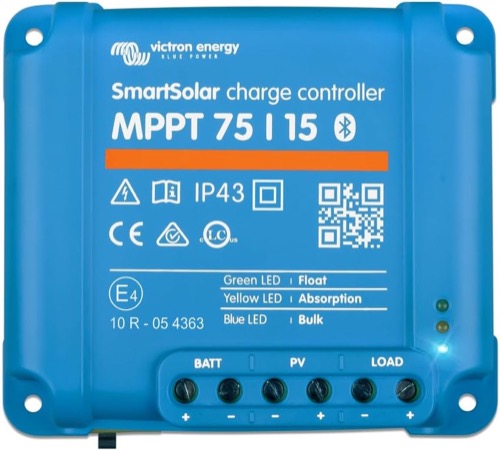
Victron SmartSolar 75/15 Review: A Strong Fit for Small Arrays

Product A

Victron SmartSolar 75/15 Review: A Strong Fit for Small Arrays

Check price at Amazon Jump to details
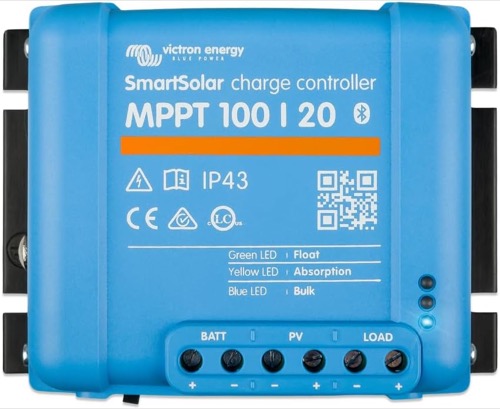
Victron SmartSolar 100/20 Review: Compact Control from 12V to 48V

Product B

Victron SmartSolar 100/20 Review: Compact Control from 12V to 48V

Check price at Amazon Jump to details

Victron SmartSolar 75/15 vs 100/20 is a sizing comparison between two controllers with nearly the same software, battery profiles, communications, enclosure concept, and warranty. The 100/20 adds 25V of PV ceiling, 5A of input Isc allowance, 5A of charge output, more PV watts, and 48V battery support; the 75/15 is smaller and was $20.79 cheaper in the dated snapshot.

A buyer can overspend on headroom that never gets used, or undersize by checking watts while missing cold Voc. Three panels may fit a 15A charging estimate yet exceed 75V after temperature correction. A 48V bank eliminates the smaller model even if the physical array is modest.

The comparison below uses exact-model published specifications and owner evidence captured for August 3, 2026. Solar Power Picks did not conduct a bench test. Because both products share much of their platform, the decision is deliberately tied to numeric system boundaries rather than invented differences.

Quick Verdict — Victron SmartSolar 75/15 vs 100/20

Choose SmartSolar 75/15 If Choose SmartSolar 100/20 If
Cold-corrected array Voc remains safely below 75V Corrected Voc or planned expansion needs more than 75V
Array Isc stays within 15A and charge demand within 15A Input Isc or battery-side charge demand requires up to 20A
PV stays within 220W at 12V or 440W at 24V PV needs 290W at 12V, 580W at 24V, or 1,160W at 48V
The bank will never be 48V and compact depth matters A 48V bank or credible expansion is part of the plan

Choose the 75/15 when it passes all four gates with margin; it delivers the same core VictronConnect workflow in a shallower, lighter package. Move to the 100/20 when one gate fails, not because the larger suffix sounds safer. Its extra capacity is modest but specific, and it cannot compensate for an array above 100V or 20A Isc.

📌 Sizing rule — Voltage, input current, output current, and battery-voltage-specific watts are independent gates. Passing three does not excuse failing the fourth.

Common System Scenarios

Scenario Winner Reason Remaining Check
12V array up to 220W 75/15 Smaller model covers published watts Cold Voc, Isc, and charge estimate
12V array from 221W to 290W 100/20 Higher 12V PV allowance Battery can accept up to 20A
24V array up to 440W 75/15 No capacity benefit if all limits fit Hot Vmp stays in operating window
24V array from 441W to 580W 100/20 Adds 140W published allowance Cable, thermal, and clipping conditions
48V battery 100/20 75/15 does not support 48V Physical load output falls to 1A
Tight shallow cabinet 75/15 40mm depth versus 60mm Ventilation and conductor bend radius
More parallel strings 100/20, often 20A Isc versus 15A Protection and exact string current
Identical small future array 75/15 Paying more creates no operating benefit Plan is genuinely fixed

Array Voltage: Why 75V Versus 100V Is a Hard Boundary

Add module Voc through a series string at standard test conditions, then correct the total using the panel’s published voltage temperature coefficient and the site’s minimum design temperature. Cold cells raise Voc. The preliminary sum must remain below the controller’s absolute ceiling with the margin and method required by Victron’s current documentation.

That calculation can make the 100/20 necessary even when expected watts and battery charge current would fit the 75/15. The reverse is also true: a low-voltage parallel array gains nothing from 100V capacity if its current remains inside the smaller controller’s separate limit.

Voltage Decision 75/15 100/20
Maximum PV Voc 75V 100V
Appropriate normal target Below ceiling with required cold margin Below ceiling with required cold margin
Series-string flexibility Lower Higher
Does Vmp replace Voc? No No
Section winner 100/20 Twenty-five additional volts can enable another layout

Vmp still matters for operation. In hot weather, array Vmp falls, so verify that it remains inside the controller’s MPPT operating conditions relative to battery voltage. Maximum Voc and useful operating voltage answer different questions; do not use one figure for both.

⚠️ Cold-weather check — A string that reads safely on a warm day can exceed its calculated winter Voc. Do the design calculation before connecting it to either controller.

Input Current, Charge Output, and PV Watts

The current limits rise together: 15A maximum PV Isc and 15A charge output on the smaller unit, versus 20A and 20A on the larger one. These values happen to match within each model but describe different sides of the converter. Array Isc belongs to the PV-input check; battery charging amps belong to output and battery acceptance.

Published PV allowances also differ with battery voltage. The 75/15 permits 220W at 12V and 440W at 24V. The 100/20 permits 290W and 580W, then adds 1,160W on 48V. Do not quote the largest number without its bank context.

Power Gate 75/15 100/20
Maximum PV Isc 15A 20A
Maximum charge output 15A 20A
PV watts at 12V 220W 290W
PV watts at 24V 440W 580W
PV watts at 48V Not supported 1,160W
Section winner 100/20 Adds measurable input, output, and watt headroom

A first-pass output estimate divides array watts by realistic target charging voltage, not merely 12 or 24. It remains preliminary because conversion, temperature, charge stage, clipping, and the battery limit still apply. If the result is 13A and all input checks fit, the 75/15 is not inferior merely because the other product can produce 20A.

🔋 Battery-current check — Compare solar plus alternator, AC charger, and any other simultaneous source with the battery or BMS limit. Controller capacity is not the same as permitted bank current.

Battery Profiles and Load-Output Differences

Both models support 12V and 24V lead-acid or lithium configurations through presets or a user-defined algorithm. Both can work with optional VE.Smart battery sensing and configurable low-temperature behavior. The 100/20 alone supports a 48V battery, which is a categorical rather than incremental difference.

The physical load outputs also need context. The 75/15 publishes a 15A programmable output. The 100/20 provides 20A at 12V and 24V but only 1A at 48V. A reader choosing the larger unit for a 48V bank must not assume its 20A suffix applies to that auxiliary circuit.

Battery/Load Point 75/15 100/20
Bank voltages 12V / 24V 12V / 24V / 48V
Charging algorithm Adaptive presets or custom Adaptive presets or custom
Sensing ecosystem VE.Smart optional VE.Smart optional
Load output 15A 20A at 12V/24V; 1A at 48V
Section winner 100/20 for bank range Otherwise feature parity dominates

For lithium, confirm the exact charge-voltage fields, maximum current, equalization behavior, and temperature control against the battery documentation. A configurable feature works only when the correct sensor and settings are present. The battery BMS remains a distinct protection layer.

Installation: The One Place the Smaller Unit Wins Clearly

The 75/15 measures 100 × 113 × 40 mm and weighs 0.5 kg. The 100/20 is 100 × 131 × 60 mm and 0.65 kg. Both accept up to 6 mm² / AWG 10 conductors, so upgrading does not solve a cable that requires a larger termination.

Twenty millimeters of depth can matter behind a panel or inside a narrow electrical compartment. The larger unit also needs a sensible conductor approach and service clearance. Neither should be squeezed against insulation simply because its electronics are compact.

Installation Detail 75/15 100/20
Width 100 mm 100 mm
Height 113 mm 131 mm
Depth 40 mm 60 mm
Weight 0.5 kg 0.65 kg
Maximum conductor 6 mm² / AWG 10 6 mm² / AWG 10
Section winner 75/15 Shallower and lighter without losing the shared interface

Both list IP43 electronics and IP22 terminals, which does not make either outdoor waterproof. Preserve cooling and protect the terminal area from condensation, spray, debris, and accidental contact. Use Victron’s exact torque, strip-length, fuse, disconnect, grounding, and sequence instructions.

🔧 Mechanical check — The upgrade increases electrical capacity but not terminal size. Recalculate cable drop and confirm the conductor actually fits before ordering.

Monitoring, Configuration, and Shared Ownership Experience

Built-in Bluetooth, VictronConnect, status LEDs, and VE.Direct are common to both products. The app provides detailed local configuration and history; neither controller has a numeric front display. A buyer who dislikes phone-based service will not solve that concern by stepping from 75/15 to 100/20.

This shared platform simplifies training and spares in a fleet. It also means Bluetooth placement issues, phone compatibility, and app workflow should be tested in the final mounting location for either model. An optional ecosystem display or gateway may be needed for permanently visible data.

Workflow Requirement Difference? Practical Meaning
Built-in Bluetooth No Both use VictronConnect
VE.Direct No Same integration family
Numeric face display No Neither includes one
Configuration depth No material difference in reviewed schema Size from electrical limits, not software
Section winner Tie Upgrade for capacity, not a different user interface

Captured owner reports are broadly positive about the app and controller behavior, with some isolated connection or setup complaints. Those anecdotes cannot establish which size is more reliable because installations and sample counts differ. They are useful for commissioning a consistent process: record firmware, confirm readings, save settings, and test the link before closing the equipment bay.

Environment, Warranty, and Price

Both publish -30°C to 60°C operating ranges, 98% peak efficiency, the same split enclosure ratings, and five-year warranties. These similarities remove the usual temptation to justify the larger model through a better warranty or outdoor rating. Ambient rating also does not equal full output at every temperature; follow derating and mounting guidance.

On August 3, the catalog showed $62.00 for the 75/15 and $82.79 for the 100/20. The $20.79 difference can be cheap insurance when expansion is documented, but it buys nothing in a fixed array that remains well inside 75V, 15A Isc, 15A output, and the appropriate watt row.

Ownership Factor 75/15 100/20
Operating range -30°C to 60°C -30°C to 60°C
Warranty 5 years 5 years
Amazon snapshot 4.7 / 5,576 4.4 / 3,929
Price snapshot $62.00 $82.79
Section winner 75/15 on cost No warranty or enclosure upgrade accompanies 100/20

Star averages should not be read as a head-to-head reliability test. Different dates, users, variants, and installations shape them. Exact specifications and system fit carry more decision weight here than a three-tenths rating gap.

🗣️ Evidence boundary — Shared manufacturer architecture is documented; identical service life is not. Avoid turning marketplace averages into a predicted failure rate.

Category Winners

Category Winner Evidence-Backed Reason
Array voltage flexibility 100/20 100V rather than 75V ceiling
PV and charge current 100/20 20A rather than 15A limits
Battery configuration 100/20 Adds 48V support
Installation footprint 75/15 Shallower, shorter, and lighter
Monitoring and warranty Tie Same app, port family, ratings, and five-year warranty
Total value Depends 75/15 for fixed small design; 100/20 for used headroom

Victron SmartSolar 75/15 vs 100/20 — Which Should You Buy?

Choose SmartSolar 75/15 if the corrected string remains below 75V with required margin, array Isc is no more than 15A, output demand is no more than 15A, and PV stays within 220W at 12V or 440W at 24V. It gives up 48V support and expansion capacity but keeps the same core interface and warranty in a smaller box.

Choose SmartSolar 100/20 if any one of those boundaries fails, the bank is 48V, or a documented future layout needs the 100V, 20A, and higher-watt envelope. Its concession is extra size and cost without a different display, terminal size, enclosure rating, or warranty.

The tie-breaker for Victron SmartSolar 75/15 vs 100/20 is a four-line worksheet containing cold Voc, array Isc, estimated charge current, and PV watts at the actual bank voltage. If every 75/15 line passes with defensible margin and the plan is fixed, buy the smaller model. If one line is close or future expansion is real, the 100/20 is the cleaner design decision.

Product A

Victron SmartSolar 75/15 Review: A Strong Fit for Small Arrays

Victron SmartSolar 75/15 Review: A Strong Fit for Small Arrays

Get it now:

Check latest price

What to know

  • Excellent documentation
  • Bluetooth included
  • Compact passive design
  • Flexible charging

Best if

  • Excellent documentation
  • Bluetooth included
  • Compact passive design
  • Flexible charging

Skip if

  • 15A output ceiling
  • 75V PV ceiling
  • No numeric display
  • AWG 10 terminal maximum

The Victron SmartSolar 75/15 is a compact, thoroughly documented controller for arrays up to 220W on 12V or 440W on 24V battery systems. Built-in Bluetooth and flexible charge configuration give it more control than most entry-level units. Its 15A ceiling and AWG 10 terminals make sizing discipline important, but the captured owner sample is consistently positive about installation, monitoring, and real-world charging. Best fit: The Victron SmartSolar 75/15 is a compact, thoroughly documented controller for arrays up to 220W on 12V or 440W on 24V battery systems.

BrandVictron Energy
Model / SKUSmartSolar MPPT 75/15 (ASIN B075NQQRPD)
Controller typeMPPT
Rated charge current15A
Battery-system voltage12V / 24V automatic selection
Battery compatibilityLead-acid and lithium via presets or a user-defined algorithm
Max PV open-circuit voltage (Voc)75V
Max PV input current (Isc)15A
Max PV power by battery voltage220W @ 12V; 440W @ 24V; 48V not supported
Load output15A programmable output with BatteryLife control
Charging profilesAdaptive multi-stage or user-defined algorithm
Temperature sensing / low-temp protectionInternal compensation; configurable low-temperature cutoff and optional VE.Smart battery sensing
Display / local controlsStatus LEDs; detailed control through VictronConnect
App / communicationsBuilt-in Bluetooth with VictronConnect; VE.Direct port
Maximum terminal wire size6 mm² / AWG 10
Maximum efficiency98% peak
Enclosure / operating temperatureIP43 electronics / IP22 terminals; -30°C to 60°C
Dimensions / weight100 × 113 × 40 mm; 0.5 kg
Warranty5 years
Product B

Victron SmartSolar 100/20 Review: Compact Control from 12V to 48V

Victron SmartSolar 100/20 Review: Compact Control from 12V to 48V

Get it now:

Check latest price

What to know

  • Complete electrical documentation
  • Bluetooth is built in
  • Broad voltage support
  • Compact and passively cooled

Best if

  • Complete electrical documentation
  • Bluetooth is built in
  • Broad voltage support
  • Compact and passively cooled

Skip if

  • Severely reduced 48V load rating
  • No numeric screen
  • Two serious failure anecdotes
  • Protected mounting still required

The Victron SmartSolar 100/20 pairs a compact 20A controller with built-in Bluetooth, unusually complete documentation, and support for 12V, 24V, and 48V batteries. It is especially attractive when a 100V PV ceiling and VictronConnect configuration matter more than a local screen. The key limitation is its load output: it falls to only 1A on a 48V battery system, and two sampled owners described failures involving 48V load-side events. Best fit: The Victron SmartSolar 100/20 pairs a compact 20A controller with built-in Bluetooth, unusually complete documentation, and support for 12V, 24V, and 48V batteries.

BrandVictron Energy
Model / SKUSmartSolar MPPT 100/20 (ASIN B075NPQHQK)
Controller typeMPPT
Rated charge current20A
Battery-system voltage12V / 24V / 48V automatic selection
Battery compatibilityLead-acid and lithium via presets or a user-defined algorithm
Max PV open-circuit voltage (Voc)100V
Max PV input current (Isc)20A
Max PV power by battery voltage290W @ 12V; 580W @ 24V; 1,160W @ 48V
Load output20A @ 12V/24V; 1A @ 48V, with BatteryLife and configurable control
Charging profilesAdaptive multi-stage or user-defined algorithm
Temperature sensing / low-temp protectionInternal compensation; configurable low-temperature cutoff and optional VE.Smart battery sensing
Display / local controlsStatus LEDs; detailed control through VictronConnect
App / communicationsBuilt-in Bluetooth with VictronConnect; VE.Direct port
Maximum terminal wire size6 mm² / AWG 10
Maximum efficiency98% peak
Enclosure / operating temperatureIP43 electronics / IP22 terminals; -30°C to 60°C
Dimensions / weight100 × 131 × 60 mm; 0.65 kg
Warranty5 years

Product Comparison

Feature Victron SmartSolar 75/15 Review: A Strong Fit for Small Arrays Victron SmartSolar 100/20 Review: Compact Control from 12V to 48V
Product Image
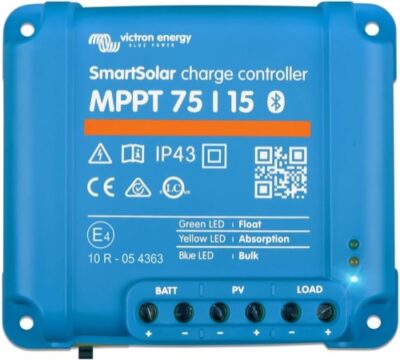
Victron SmartSolar 75/15 Review: A Strong Fit for Small Arrays
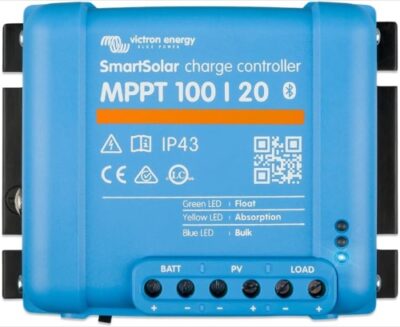
Victron SmartSolar 100/20 Review: Compact Control from 12V to 48V
Price $62.00 $82.79
Rating
4.7 / 5
4.5 / 5
Category Solar Charge Controllers Solar Charge Controllers
Brand Victron Energy Victron Energy
Model / SKU SmartSolar MPPT 75/15 (ASIN B075NQQRPD) SmartSolar MPPT 100/20 (ASIN B075NPQHQK)
Controller type MPPT MPPT
Rated charge current 15A 20A
Battery-system voltage 12V / 24V automatic selection 12V / 24V / 48V automatic selection
Battery compatibility Lead-acid and lithium via presets or a user-defined algorithm Lead-acid and lithium via presets or a user-defined algorithm
Max PV open-circuit voltage (Voc) 75V 100V
Max PV input current (Isc) 15A 20A
Max PV power by battery voltage 220W @ 12V; 440W @ 24V; 48V not supported 290W @ 12V; 580W @ 24V; 1,160W @ 48V
Load output 15A programmable output with BatteryLife control 20A @ 12V/24V; 1A @ 48V, with BatteryLife and configurable control
Charging profiles Adaptive multi-stage or user-defined algorithm Adaptive multi-stage or user-defined algorithm
Temperature sensing / low-temp protection Internal compensation; configurable low-temperature cutoff and optional VE.Smart battery sensing Internal compensation; configurable low-temperature cutoff and optional VE.Smart battery sensing
Display / local controls Status LEDs; detailed control through VictronConnect Status LEDs; detailed control through VictronConnect
App / communications Built-in Bluetooth with VictronConnect; VE.Direct port Built-in Bluetooth with VictronConnect; VE.Direct port
Maximum terminal wire size 6 mm² / AWG 10 6 mm² / AWG 10
Maximum efficiency 98% peak 98% peak
Enclosure / operating temperature IP43 electronics / IP22 terminals; -30°C to 60°C IP43 electronics / IP22 terminals; -30°C to 60°C
Dimensions / weight 100 × 113 × 40 mm; 0.5 kg 100 × 131 × 60 mm; 0.65 kg
Warranty 5 years 5 years
Buy Now View Deal View Deal

Victron 75/15 vs 100/20: Which Size Should You Buy?

Decision: Choose the 75/15 for compact 12V/24V systems within 75V, 15A Isc, and 220W/440W. Step up to the 100/20 for 100V headroom, 20A output, more PV watts, or a 48V battery.

Before buying, verify cold Voc, PV Isc, PV watts, charge current, conductors, fusing, and battery settings against the current manuals.

Frequently Asked Questions

Can I replace a SmartSolar 75/15 with a 100/20?

Usually yes after confirming conductor, fuse, battery, mounting, and configuration requirements. The 100/20 provides higher PV-voltage, PV-current, output-current, and power limits.

How close can an array operate to the 75V limit?

Do not design from warm-weather operating voltage. Calculate cold-corrected array Voc and keep the margin required by Victron's current manual below the absolute 75V ceiling.

Which model supports a 48V battery?

SmartSolar 100/20 supports 48V. SmartSolar 75/15 is limited to 12V and 24V battery systems.

Is the 100/20 more efficient than the 75/15?

Both publish 98% peak efficiency. The reason to upgrade is additional electrical headroom and 48V support, not a documented peak-efficiency advantage.

Which controller is better for future expansion?

The 100/20 provides more headroom, but expansion should be based on a defined future array and bank. If that plan exceeds 100V, 20A Isc, 20A output, or the published PV watts, an even larger model is required.

×

About Solar Power Picks

Portable Solar Power, Backup Power, and Off-Grid Gear Guides

Your trusted source for honest, in-depth product reviews and comparisons.

Quick Links

  • Best Picks
  • Reviews
  • Guides
  • Comparisons
  • Calculator
  • Privacy policy
  • Favorites

Categories

  • Portable Power Stations
  • Solar Batteries
  • Solar Charge Controllers
  • Solar Generators
  • Solar Panels

© 2026 Solar Power Picks. All Rights Reserved.

We may earn a commission when you purchase through links on our site. Learn more