Victron SmartSolar 75/15 Review: A Strong Fit for Small Arrays
At a Glance
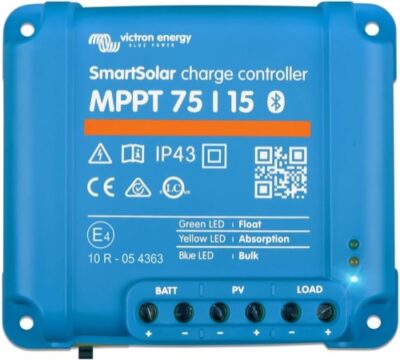
KEY FEATURES
- Output: 15A MPPT charging for 12V or 24V batteries.
- PV limits: 75V Voc and 15A Isc; 220W @ 12V or 440W @ 24V.
- Battery support: Adaptive presets, user-defined charging, and VE.Smart sensing options.
- Monitoring: Built-in Bluetooth with VictronConnect plus a VE.Direct port.
- Best fit: Compact RV, shed, gate, and portable systems within a 15A ceiling.
PROS
- Built-in VictronConnect monitoring makes commissioning and history review unusually clear.
- Strong documentation defines the 75V, 15A, PV-power, terminal, and enclosure limits.
- Quiet passive hardware fits compact 12V and 24V systems.
CONS
- The 15A ceiling can make array growth poor value even when PV voltage still fits.
- Detailed readings require a phone, and metal enclosures can shorten Bluetooth range.
- No 48V battery support; the 100/20 is the more flexible step-up.
Editor's Choice
Editorial assessment based on exact-model documentation and qualitative exact-ASIN owner evidence; no first-party bench test or population-rate claim
Will the Victron SmartSolar 75/15 Fit Your Solar Array?
Estimate required charging current and check it against the documented limits for Victron SmartSolar 75/15.
Solar Charge Controller Size Calculator
What size charge controller do I need?
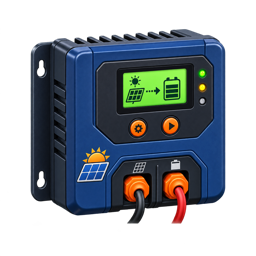
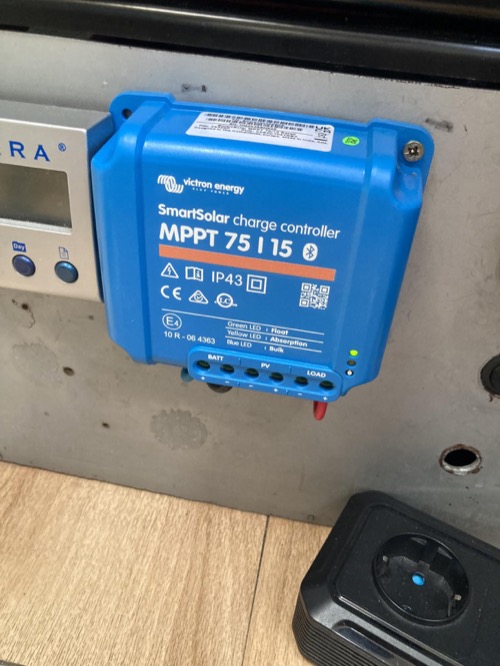
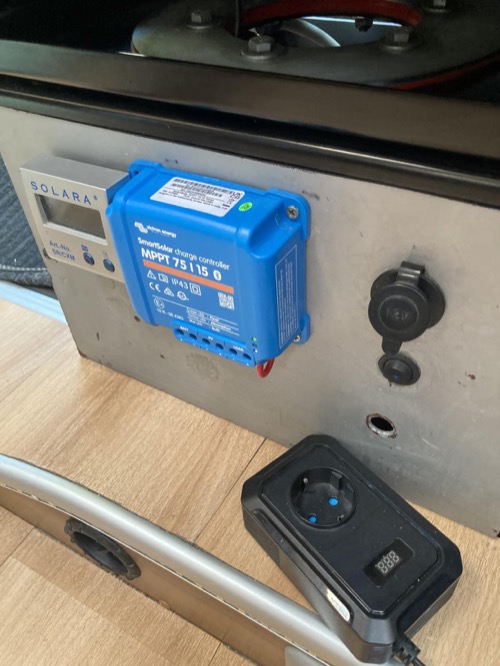
Built-in Bluetooth adds configuration and history without a dongle. The tradeoff is that all detailed readings live in VictronConnect because the controller has status LEDs rather than a numeric screen. Its 15A output can also become the bottleneck sooner than buyers expect when a 12V array grows.
| Best For | Main Strength | Main Limitation | Evidence Confidence |
|---|---|---|---|
| Small RV, shed, gate, work-truck, and portable systems | Built-in Bluetooth and documented electrical limits | 15A output and 75V PV ceilings | High for specifications; medium-high for owner patterns |
What the Larger Owner Record Changes About the 75/15 Decision
The expanded exact-ASIN owner material strengthens the case for the SmartSolar 75/15 as a small-system controller, but it also makes undersizing the clearest buyer risk. Repeated accounts describe useful VictronConnect data, quiet passive operation, and successful service in sheds, trailers, gates, and modest off-grid systems. More technical accounts repeatedly return to the 15A output ceiling: an array can remain below 75V and still produce more battery-side current than this model can pass.
That distinction changes the shopping method. First calculate cold-corrected array open-circuit voltage against 75V. Then calculate expected charge current and compare it with 15A. Finally, check the published PV guidance for the chosen battery voltage. Passing only one of those gates is not enough. A buyer expecting near-term array growth should price the 100/20 before treating the smaller controller as the economical choice.
Owner reports also clarify what Bluetooth does and does not solve. The app can make commissioning and trend review unusually transparent, yet radio range depends on the enclosure and installation. Record the serial number, pair the controller, confirm the intended battery profile, and inspect history before closing the cabinet. For load-output use, test the real DC load and its startup behavior; the terminals are not a substitute for a protected battery-side inverter circuit.
Sizing the 75V and 15A Boundaries
The two numbers in the model name describe different sides of the controller. The PV array may reach no more than 75V open circuit, while the battery-side charge output stops at 15A. Victron also specifies 15A maximum PV short-circuit current, so adding parallel strings requires more than a voltage check.
Victron’s nominal array limits are 220W on a 12V battery and 440W on 24V. One owner using 200W of work-truck panels reported a 189W live peak and a slightly lower stored-history peak. Another owner said a 500W-plus array regularly held the controller at full output and concluded that the 100/20 would have been a better size.
| Limit | Published Value | Planning Consequence |
|---|---|---|
| Maximum PV Voc | 75V | Correct series-string Voc for the coldest site temperature |
| Maximum PV Isc | 15A | Check total parallel-string short-circuit current |
| Rated charge current | 15A | Battery-side output clips at this value |
| PV power at 12V | 220W | Larger 12V arrays can reach the output ceiling early |
| PV power at 24V | 440W | Higher battery voltage supports more PV power at the same current |
Overpaneling cannot override Voc or Isc. If the design exceeds Victron’s nominal wattage, confirm the current manual, clipping expectation, thermal conditions, and warranty position rather than assuming unused panel capacity is harmless.
VictronConnect Is the Main Interface
Bluetooth is built into the SmartSolar version. VictronConnect shows live PV power, battery voltage, charge current, stage, trends, and 30-day history. It also manages battery presets, user-defined parameters, firmware, alarms, and load behavior.
The supplied owner pattern is strongly positive. Users repeatedly described simple pairing, useful graphs, quick setup, and accurate-looking live data. Metal enclosures shortened range in two accounts: roughly 10 feet in one gate installation and about 30 feet around a work-truck box in another. Radio range therefore depends on the mounting environment.
There is no numeric display on the controller. A phone-free installation needs a compatible external Victron display or another model. Internet access also requires more system hardware; built-in Bluetooth alone is not remote cloud monitoring.
Battery Profiles, Load Output, and Temperature
Victron provides adaptive multi-stage charging and a user-defined algorithm. Common lead-acid and lithium requirements can be configured, but the exact battery manual still determines charge voltage, float behavior, maximum current, and low-temperature rules.
The controller uses internal temperature compensation and can work with compatible VE.Smart battery sensing. Configurable low-temperature behavior must have a suitable temperature source. “Lithium compatible” does not prove that every installation has controller-managed cold-charge protection.
The physical load output is rated at 15A and supports BatteryLife or configurable voltage control. Owners used it for lighting and gate-related loads, but one detailed reviewer warned that surge handling is limited. Inverters and high-inrush equipment belong on a properly protected battery circuit, not directly on these terminals.
Installation and Enclosure Details
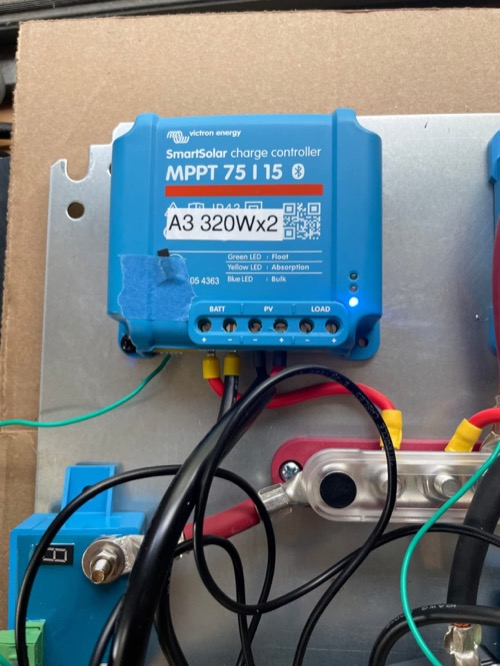
The 75/15 measures 100 × 113 × 40 mm, weighs about 0.5kg, and uses passive cooling. Its terminals accept up to 6 mm² or AWG 10. One owner used ferrules with 12 AWG cable successfully but found the flat-head terminal screws small; the physical maximum does not remove the need for careful cable preparation.
Victron rates the electronics IP43 and the connection area IP22. The unit is not an exposed outdoor controller. It needs the manual-specified mounting orientation, clearance, dry terminal protection, fusing, and conductor design.
The operating range is -30°C to 60°C, with temperature-dependent output limits. supplied users reported cool or quiet operation in their installations, but enclosure temperature and sustained load can change that result.
What Owner Evidence Shows—and What It Cannot
This positive skew limits complaint visibility. It supports confidence in common setup and monitoring experiences, but it cannot establish failure frequency. The most credible weaknesses come from hard specifications: the 15A ceiling, 75V maximum, lack of a screen, and terminal size.
| Repeated Owner Observation | Context in the owner record | What It Does—and Does Not—Support |
|---|---|---|
| VictronConnect was easy to pair and useful | Several Android and iPhone users described live readings, setup, and history | Strong support for interface usability; not a test of every phone or firmware version |
| Bluetooth range changed with placement | Two installations reported roughly 10-foot and 30-foot practical ranges around gates or metal boxes | Mounting material can matter; there is no universal range promise |
| The controller ran silently and without obvious heat problems | One detailed 24V owner discussed operation at the 15A limit; others noted passive, quiet operation | Encouraging thermal evidence for those systems, not a substitute for required clearance |
| The 15A ceiling became the binding limit | A 500W-plus/24V owner described continuous clipping; a work-truck owner upgraded from 10A after reaching its ceiling | Direct evidence that output sizing matters even when PV voltage remains compliant |
| The load output was useful for lights and control logic | Gate, lighting, and resistive-load examples appear in detailed reviews | Appropriate for modest DC loads; a detailed owner warned about surge sensitivity |
Owner-pattern takeaway — The strongest recurring theme is not a vague claim that the 75/15 “works great.” It is that owners value the app and compact, silent hardware while the better-documented users repeatedly return to the same planning issue: 15A is a small ceiling.
Three Realistic Ways to Use the 75/15
The controller makes the most sense when its modest current limit is part of the design rather than an accidental constraint. A small 12V-class array on a work truck is one plausible use. The documented 200W owner example produced a live peak near 189W and stayed within the controller’s nominal 220W-at-12V guidance. That does not guarantee the same harvest elsewhere, but it shows why the model can be appropriately sized without being oversized.
A second use is a 24V battery with a modest array. At 24V, Victron’s nominal PV-power table rises to 440W because the same 15A battery-side current represents more power. This is not permission to connect any 440W string blindly: array Voc and Isc still need separate calculations, and the controller remains limited to 24V batteries.
A third use is an automated low-power site such as a gate, shed, or lighting system. The physical load output and BatteryLife logic can disconnect modest DC loads before the battery is excessively depleted. The owner gate and lighting examples support this role. They do not support attaching a large inverter or a motor with a high start-up surge to the controller’s load terminals.
| Proposed System | Likely Fit | Deciding Check | Better Direction If It Fails |
|---|---|---|---|
| 100–200W, 12V work-truck or small RV array | Strong | Cold-corrected string Voc below 75V and total Isc below 15A | 100/20 if another panel is likely |
| Up to the documented 440W nominal level on 24V | Conditional | Confirm that 15A charging is acceptable and neither PV limit is exceeded | 100/20 or a larger model for more charge current |
| Gate, shed, or lighting with a small controlled DC load | Strong | Verify load current and start-up behavior | Battery-side fused relay/contactor for higher or surge loads |
| 48V battery bank | No fit | The 75/15 is a 12V/24V controller | SmartSolar 100/20 or another documented 48V-capable model |
| Exposed exterior mounting | No fit | IP43 electronics and IP22 connection area require protection | A genuinely sealed controller or protected enclosure design |
Sizing warning — “75/15” is not a 75V, 15A solar-panel allowance that can be traded between voltage and current. The 75V Voc, 15A PV Isc, 15A battery output, and voltage-specific PV-watt guidance are independent checks; the design must pass all of them.
A Worked Boundary Check Without Guessing the Weather
Suppose a buyer is considering two panels in series. The first step is to take each panel’s Voc from its label or datasheet and apply the maker’s temperature coefficient at the site’s design-low temperature. Adding the corrected panel voltages tells you whether the string remains below 75V. This review cannot calculate that value without the exact panel and climate data, and using room-temperature Voc alone would understate winter risk.
Next, check the string Isc. Series wiring raises voltage but does not add string current; parallel strings add current. Total array Isc must remain within Victron’s published 15A boundary. Then compare the array’s expected power with the 220W-at-12V or 440W-at-24V nominal guidance and decide whether clipping at 15A is acceptable.
Finally, check the battery. Its chemistry, charge-voltage limits, maximum current, temperature behavior, and BMS rules determine the profile. A preset is a starting point, not evidence that every battery carrying the same chemistry label wants identical settings.
| Commissioning Check | Evidence to Record | Stop Condition |
|---|---|---|
| Array voltage | Panel datasheet, string layout, temperature-corrected Voc calculation | Corrected Voc reaches or exceeds 75V |
| Array current | Per-string Isc and number of parallel strings | Total Isc exceeds 15A |
| Battery-side output | Battery capacity and permitted charge current | Battery maker allows less current than the configured maximum |
| Conductors and protection | Cable length, voltage drop, fuse/breaker plan, 6mm²/AWG 10 terminal limit | Cable or protection cannot terminate safely at the controller |
| App and profile | Exact preset/custom values and firmware noted at commissioning | Values do not match the battery documentation |
| Load output | Continuous and start-up current of the intended DC load | Load has an inverter, motor surge, or exceeds the 15A circuit design |
What Else Belongs on the Shortlist?
The SmartSolar 100/20 is the closest step up when the design needs 100V PV headroom, 20A charging, or a future 48V battery. The supplied 75/15 owner evidence itself contains a detailed owner who wished they had selected the 100/20 after pairing the smaller controller with more than 500W of PV on a 24V bank.
The Renogy Rover 20A is worth comparing when a local LCD matters more than built-in Bluetooth. It provides a different interface and feature balance, but requires its own Voc, Isc, battery-profile, accessory, and terminal checks. A waterproof PWM controller such as the Renogy Voyager is a different solution again: it gives up MPPT conversion and app depth in exchange for a sealed form factor suited to exposed portable use.
The right alternative therefore depends on the failed requirement. More watts alone do not answer whether the buyer needs higher cold-weather voltage headroom, more charge current, a local display, weather sealing, or a different monitoring system.
Victron SmartSolar 75/15 Review: 75/15 or 100/20?
Choose the 75/15 when a documented calculation stays within 75V Voc, 15A Isc, 15A output, and 220W/440W nominal PV power. It is a strong match for a small array where built-in Bluetooth is more valuable than a local screen.
The 100/20 is the better path when the string needs 100V headroom, the battery can use another 5A, the array exceeds the smaller wattage table, or a 48V battery is planned. Buying the smaller controller only to replace it after adding panels is rarely economical.
Pros & Cons Analysis
Based on documented specifications and owner feedback
Pros
- Excellent documentation — Victron publishes all the major electrical, terminal, environmental, load, and enclosure limits.
- Bluetooth included — VictronConnect provides live data, history, configuration, alarms, and firmware updates.
- Compact passive design — The controller weighs about 0.5kg and operates without a fan.
- Flexible charging — Presets and a user-defined algorithm support documented lead-acid and lithium requirements.
- Consistent owner evidence — Sampled users repeatedly praised setup, the app, charging visibility, and small-system performance.
Cons
- 15A output ceiling — Larger 12V arrays can clip output and may justify the SmartSolar 100/20.
- 75V PV ceiling — It offers less series-string headroom than 100V models after cold correction.
- No numeric display — Detailed readings depend on a phone or external Victron monitor.
- AWG 10 terminal maximum — Long or high-drop cable runs may require a different layout rather than oversized conductors at the controller.
- Bluetooth range depends on installation — Owners reported shorter range through metal enclosures.
Bottom Line: Excellent When 15A Is Enough
Verdict: The SmartSolar 75/15 is one of the better-documented small MPPT controllers and an easy recommendation inside its electrical envelope. VictronConnect adds meaningful monitoring and configuration without an accessory.
Best reason to buy: You need a compact, quiet 12V/24V controller for no more than 15A and value app-based setup.
Reason to pause: Growing arrays can hit the 15A and 75V boundaries quickly. This Victron SmartSolar 75/15 review recommends calculating the 100/20 alternative before choosing the lower-priced model.
Frequently Asked Questions
What does 75/15 mean on the Victron SmartSolar?
The controller accepts up to 75V PV open-circuit voltage and supplies up to 15A of battery charge current. Both are hard limits that must be checked independently.
How much solar can the SmartSolar 75/15 handle?
Victron specifies 220W for a 12V battery or 440W for a 24V battery, subject to the 75V Voc and 15A Isc limits.
Does the 75/15 include Bluetooth?
Yes. The SmartSolar version has built-in Bluetooth for VictronConnect; do not confuse it with older BlueSolar variants that may require an accessory.
Can it charge LiFePO4 batteries?
Yes, using an appropriate preset or user-defined algorithm. The battery's specified voltage, current, and low-temperature requirements still control the final configuration.
Does it have a load output?
Yes. Victron documents a 15A programmable load output with BatteryLife control. It is for suitable DC loads, not an inverter or a high-surge appliance.
Can it run a 300W array on a 12V battery?
Its nominal 12V PV rating is 220W and charge output is capped at 15A. Do not assume overpaneling is acceptable without checking Victron's current limits and warranty guidance for the exact array.
Is it waterproof?
No. Victron specifies IP43 for the electronics and IP22 for the connection area, so the controller needs the manual-required orientation and a protected location.
Should I choose the 75/15 or 100/20?
Choose the 75/15 when 75V, 15A, and its PV-watt limits cover the system. The 100/20 adds voltage headroom, five more output amps, more PV capacity, and 48V battery support.
Technical Specifications
| Brand | Victron Energy |
|---|---|
| Exact model / revision / ASIN | SmartSolar MPPT 75/15 (ASIN B075NQQRPD) |
| Controller type | MPPT |
| Rated battery-side charge current | 15A |
| Supported battery-system voltage | 12V / 24V automatic selection |
| Battery chemistry and profile support | Lead-acid and lithium via presets or a user-defined algorithm |
| Maximum PV open-circuit voltage (Voc) | 75V |
| Maximum PV short-circuit/input current (Isc) | 15A |
| Maximum PV power by battery voltage | 220W @ 12V; 440W @ 24V; 48V not supported |
| Minimum PV/start voltage requirement | PV voltage must exceed battery voltage by 5V to start and by 1V to continue charging |
| Load output and low-voltage disconnect | 15A programmable output with BatteryLife control |
| Grounding topology | Isolated chassis; positive or negative battery grounding permitted at one point; do not ground PV positive or negative |
| Charging stages and custom voltage control | Adaptive multi-stage or user-defined algorithm |
| Temperature sensing and lithium low-temperature behavior | Internal compensation; configurable low-temperature cutoff and optional VE.Smart battery sensing |
| Display and local controls | Status LEDs; detailed control through VictronConnect |
| App, communications, and data history | Built-in Bluetooth with VictronConnect; VE.Direct port |
| Maximum terminal conductor size | 6 mm² / AWG 10 |
| Controller self-consumption | 20mA at 12V; 10mA at 24V |
| Published tracking/conversion efficiency | 98% peak |
| Cooling method and thermal derating | Natural convection / passive cooling; full rated output through 40°C, then temperature-limited |
| Electrical protections | PV reverse-polarity, output short-circuit, and overtemperature protection; no internal ground-fault protection |
| Enclosure, ingress rating, and operating temperature | IP43 electronics / IP22 terminals; -30°C to 60°C |
| Certifications | EN/IEC 62109-1, UL 1741, and CSA C22.2 No. 107.1-16 |
| Dimensions, weight, and included accessories | 100 × 113 × 40 mm; 0.5 kg |
| Warranty | 5 years |