
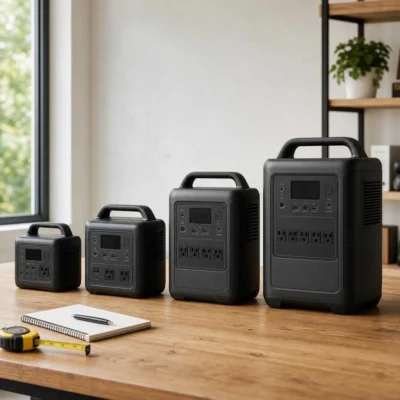
Start with a portable solar generator when you need movable power for individual appliances. Start with a fixed-system design discussion when the job involves building circuits, permanent equipment or an ongoing off-grid supply. These are starting points, not capacity rules: the connection, operating schedule and charging opportunities matter more than the name on the box.
Home backup is a use case, not a third equipment type. A battery station might support a few plug-in devices during an outage, while an installed system might serve selected circuits. Neither arrangement automatically supplies everything in the house. This guide helps you choose a research and purchasing route before comparing models; it is not an installation plan.
Start with the connection, not the product name
Write down what you want to keep working, then separate the loads you can use through their normal plugs from equipment that belongs to the building’s electrical installation. A laptop and a hardwired well pump are not simply different wattages of the same purchase.
- Individual plug-in appliances
- Investigate a station with documented support for the actual appliances, their outlets and their operating conditions. Check how you will reach the loads and operate the equipment, not just where the battery fits. If the terminology is unfamiliar, first read what a solar generator includes.
- Existing circuits or hardwired equipment
- Investigate the complete connection arrangement with a qualified installer before choosing the power source. Ask which circuits can be supplied, how transfer is handled, what happens during an outage and who is responsible for the finished installation. Do not assume that a station’s output rating establishes compatibility with a house.
Do not feed house wiring through an ordinary wall outlet. Puget Sound Energy’s generator safety guidance warns that backfeeding can endanger utility workers and explains the need for an appropriate professionally installed transfer arrangement. This guide does not specify that equipment or its wiring.
If you already have rooftop solar, establish what it can do during an outage before purchasing another system. The US Department of Energy explains that ordinary residential solar alone does not establish outage resilience; appropriate inverter configuration and storage matter. Ask for a description of your actual system’s backup operation, rather than inferring it from the presence of panels.
Will the equipment travel, or serve one site?
Mobility is an operating requirement. If the same equipment must leave with you every weekend, carrying, loading and repeated setup belong in the decision. If it serves one property, permanent positioning and service access may matter more than whether the battery has handles.
| Decision | Movable station and solar setup | Fixed installation |
|---|---|---|
| Changing locations | Check the complete carry: battery, panels, cables and any extra batteries. | Plan around a specific property and its installation constraints. |
| Getting ready | Decide who retrieves, positions and connects the equipment using its instructions. | Specify the required operating and transfer behavior as part of the design. |
| Solar collection | Confirm where panels can be deployed during the hours you need to collect energy. | Assess the proposed mounting area, seasonal conditions and access for service. |
| Future changes | Verify the exact product’s expansion and charging options. | Have added loads or equipment reviewed against the installed design. |
Do not treat these columns as rigid product categories. For a proposed integrated battery system with a building-connection accessory, ask whether that exact combination supports the intended installation. Its portability does not answer the connection question. Conversely, buying separate components does not make a system suitable for permanent use without the rest of the design.
Consider a practical rehearsal before committing: could the intended user move the complete setup along the actual route, store it and deploy the panels? Stairs, limited storage and the absence of someone to set equipment out can eliminate an otherwise attractive approach.
Is this occasional backup or the normal power supply?
The University of Maryland Extension distinguishes grid-connected systems, battery-backed systems and stand-alone systems by their relationship to the utility and their operation. Being able to run without the grid for a while is not the same planning problem as providing the site’s regular supply.
The following situations are illustrative decisions, not customer accounts or performance promises:
- A short outage while someone is home: a movable station may be a useful route for selected plug-in appliances if the loads, runtime and operating procedure are verified. Decide what happens if the outage lasts longer than expected.
- A cabin that remains occupied through poor weather: investigate a supply plan that can meet continuing demand and recover afterward. Compare permanent installation options and a documented fallback; do not assume a larger battery resolves an ongoing energy shortfall.
- A property that needs backup when nobody is present: focus on the required transfer behavior, monitoring and service response. A plan that depends on someone unfolding panels and moving appliance plugs does not meet that requirement.
For a portable setup, use the solar-generator sizing guide once you have chosen the operating scenario. It handles power, stored energy and recovery separately. Here, the decision is whether that portable operating routine fits your life at all.
For an installed backup proposal, request explicit confirmation of which loads operate when utility power disappears. Australia’s government solar design guidance notes that even some battery systems do not power a property during an outage. That technical distinction is useful here; Australian approval rules are not a substitute for US local requirements.
Screen the site before choosing a route
A sunny product photograph cannot tell you whether solar collection is practical at your home or campsite. Before asking for equipment recommendations, resolve these questions:
- Where can panels actually go? Identify usable space and shade during the relevant season and hours, not just at one convenient moment.
- Who controls that space? Confirm access and any owner or property restrictions before relying on it for deployment or mounting.
- Where will the other equipment operate? Compare the location with the exact manuals’ environmental and access requirements. A panel and its battery station need not have the same exposure rating.
- Who will operate and maintain it? Include setup, storage, monitoring and service access in the plan. If the system must work unattended, say so.
- What if solar is unavailable? Identify a supported alternative charging source, a reduction in loads or another backup plan. Record what remains unresolved.
A location unsuitable for solar does not necessarily rule out battery backup, but it changes the charging plan. Be explicit about whether you are buying solar-supported operation or stored energy that normally comes from another source. Avoid paying for a panel package before confirming that you can use it.
Compare complete proposals, not just boxes
Once the route is plausible, ask comparable questions of each seller or installer. What exactly is included? What still has to be purchased or installed? Who confirms that the proposed arrangement supports the intended use? Who handles a fault involving more than one component?
For a movable system, compare the complete station, panel and accessory arrangement. Once portable operation looks suitable, use the station-only versus solar-bundle guide to decide whether a package or separately purchased equipment better meets your requirements.
For a fixed system, compare equipment plus design, installation, required approvals, commissioning and support. The complete off-grid kit checklist helps identify exclusions in a proposal. If you intend to organize separate components, the DIY solar kit planning guide takes that route toward a design review.
Keep two decisions separate: whether the approach fits, and whether a particular offer is good value. A discounted portable bundle is not a substitute for an installed connection you actually need. A substantial fixed installation is not automatically justified when a few movable loads are the whole task.
Choose the next action—not a model yet
Finish this selection stage with a short statement: “I need to supply these loads, through this connection, at these locations, on this schedule; charging will come from these sources.” Add who will operate the system and the questions you cannot yet answer.
If the statement describes movable plug-in loads and a workable deployment routine, proceed to measuring and sizing an exact portable setup. If it includes building circuits, an unattended backup requirement or a continuing off-grid supply, take it to a qualified designer or installer before comparing equipment offers.
If the connection or charging plan is still unknown, settle that uncertainty first. The useful outcome is a clear purchasing route—or a specific reason to pause—not a bigger battery selected to cover an undefined job.
Leave a Reply