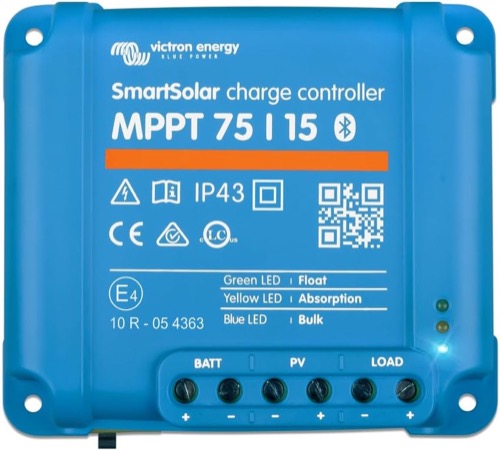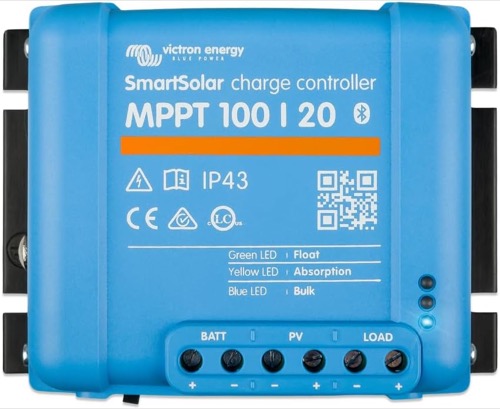
Victron SmartSolar 75/15 vs 100/20 comes down to which boundary your next array crosses: PV voltage, panel current, battery charging current, or battery-bank voltage. Choose the 75/15 for a settled small 12V or 24V design. Choose the 100/20 when its extra electrical room has a specific job, and confirm the 48V-capable version if that is your reason for buying.
Both controllers already offer MPPT and built-in Bluetooth. Upgrading solely to obtain an app buys a feature the smaller model already has. Conversely, keeping a 75/15 because its output usually looks adequate can be a mistake when a redesigned series string exceeds its voltage limit.
This comparison uses the published SmartSolar limits and the exact models in our reviews. The examples below are editorial calculations with stated assumptions; they are not measurements of either controller. Product cards retain the two reviewed variants, and the automatic comparison table supplies the full specifications.
Victron SmartSolar 75/15 vs 100/20: Find the First Boundary
Write down the battery voltage, panel Voc, panel Isc, series and parallel layout, and planned array watts before choosing a model. Each quantity answers a different question. Passing a wattage check cannot compensate for excessive open-circuit voltage, and output clipping cannot protect a wrongly designed string.
The 75/15 has a 75V PV ceiling, 15A battery-current rating, and 15A maximum PV short-circuit current. The 100/20 raises those three figures to 100V, 20A, and 20A. These are separate limits even though two happen to share the same number. Use the current manual for the precise version on the product label.
| Your change | Decision | Remaining check |
|---|---|---|
| Same modest array and battery | Keep or choose 75/15 | Measured charging and voltage margins remain adequate |
| Series string no longer fits below 75V | Evaluate 100/20 | Cold Voc must still fit below 100V |
| Parallel array exceeds the 75/15 Isc limit | Evaluate 100/20 | Add Isc across parallel strings |
| Planned bank becomes 48V | Confirm 100/20-48V identity | PV startup headroom and reduced load-output rating |
Run the Cold-String Calculation Before Counting Watts
Consider two illustrative panels, each with Voc of 40V at 25°C and a Voc coefficient of −0.30% per °C. At a design cell temperature of −10°C, the 35-degree change increases each panel’s Voc by 10.5%. Their series string reaches an estimated 88.4V. That excludes the 75/15 and leaves the 100/20 as a candidate, subject to the remaining checks and required design allowance.
Putting those panels in parallel changes the problem: voltage stays at one panel’s level while string currents add. The smaller controller might now pass voltage but fail Isc or usable-power expectations. Series and parallel are design choices, not interchangeable ways to make a controller fit.
Use the actual panel coefficient, site design temperature, and applicable installation requirements. If the panel documentation omits a coefficient, do not substitute the illustrative value as if it belonged to the panel. Get the missing data or use a documented design method accepted for that installation.
Illustrative cold Voc: 2 × 40V × [1 + 0.003 × (25 − (−10))] = 88.4V. Compare this with the absolute PV ceiling, not with the controller’s battery voltage.
Estimate the Value of Five More Charging Amps
On a 12V battery, Victron lists nominal PV power of 220W for the 75/15 and 290W for the 100/20. At 24V those figures become 440W and 580W. They describe the controller’s nominal conversion envelope; the manual also explains power limiting when more PV power is connected within permitted input boundaries.
The extra five output amps are valuable only when sunlight, panel temperature, wiring, battery acceptance, and charge stage let the array supply them. A full battery or small panel will not charge faster because the controller name changed. During absorption the battery may deliberately accept less current, which is normal regulation rather than lost controller capacity.
At an illustrative 14.4V charging voltage, five amps represents about 72W of additional battery-side power. If that entire difference lasted two hours, it would be 144Wh. This is a scenario ceiling for those assumptions, not a daily harvest forecast. Logged clipping duration is more informative than the largest number briefly displayed in the app.
Keep several days of yield and peak-current history. Separate cloudy days, full-battery days, and genuinely current-limited periods before assigning an energy benefit to the upgrade.
Treat the 48V Version as a Different Installation Decision
The 75/15 supports 12V and 24V banks. The relevant 100/20 variant adds 48V support, but the complete label and manual must establish that capability. An abbreviated marketplace title is insufficient when ordering a part for a higher-voltage battery.
The 100/20’s physical load output is rated differently at 48V: the manual lists 1A, compared with 20A at 12V or 24V. That is the load-terminal limit, not the solar charging-current limit. A small control circuit may fit; an inverter or substantial DC distribution circuit needs its own protected battery connection.
Startup voltage matters too. Victron requires PV voltage above battery voltage by 5V to begin charging, then 1V above it to continue. A string that starts a 12V system may lack sufficient hot-weather operating voltage for a 48V bank. Verify both the cold upper voltage and the hot operating lower voltage; solving one does not solve the other.
- Confirm 100/20-48V capability from the delivered model label and manual.
- Check the battery charging profile and combined current from all chargers.
- Recalculate cold Voc and hot operating voltage for the new battery bank.
- Design the 48V load circuit around its own current and protection requirements.
Keep the App Benefits in Proportion to the Hardware Change
Both SmartSolar sizes provide Bluetooth and VE.Direct. Basic phone configuration and charge history are therefore shared benefits. The larger model does not automatically add internet access: remote access beyond local Bluetooth involves the appropriate system communications hardware and connection.
Compare the installation itself. The 100/20 enclosure needs more depth and width, and existing mounting holes or cable routing may not suit it. Recheck conductor capacity, terminals, protection, torque, and clearances against the new manual. A cable that carried 15A comfortably is not automatically approved for sustained 20A operation.
Neither model should be installed as an exposed waterproof device. Keep the terminal area dry and accessible, and allow cooling. A warm cabinet can reduce output even with electrically compatible panels. For lithium, verify battery-temperature sensing and configured charge inhibition separately from the controller’s ambient operating range.
The ownership question is how easily you can diagnose the finished system. Pair from the final mounting location, record the profile, and compare displayed battery voltage with a suitable independent measurement. Save those baseline values before a future fault makes the normal behavior difficult to reconstruct.
Choose the Smallest Model That Passes the Planned Design
Choose the 75/15 when the complete array fits its voltage, Isc, and charging envelope, the battery remains 12V or 24V, and future growth is speculative. Its strongest value is giving a small system the same basic SmartSolar monitoring approach without buying unused capacity.
Choose the 100/20 when a specific string layout, repeated current limitation, or documented 48V plan needs it. Accept the larger enclosure and any associated wiring changes as part of the upgrade cost. If the intended string exceeds 100V after cold correction, neither controller is the answer.
For a final Victron SmartSolar 75/15 vs 100/20 decision, identify the single boundary that fails on the smaller unit and show that the larger unit passes every boundary. If you cannot identify that failed constraint, the smaller controller deserves serious consideration.
Read the 75/15 review and 100/20 review alongside Victron’s small-SmartSolar technical specifications. For a broader choice of controls and ecosystem, use the Victron versus Renogy comparison.