Victron vs Renogy charge controllers should begin with the system you intend to operate and the person who will maintain it. Victron can be a strong fit for configurable monitoring and a connected equipment ecosystem. Renogy can be a strong fit when local controls, a compatible kit or a specific installation format matters more.
The featured reference pair is deliberately equal in rated output: SmartSolar 100/20 and Rover Li 20A. This keeps the brand discussion anchored to actual products without repeating the separate SmartSolar 100/30 versus Rover 40A comparison. Other models appear only as clearly identified routing options, not replacement featured products.
Brand identity never overrides an electrical limit. The following framework uses the reviewed product documentation and a practical ownership checklist. We do not infer that one brand has a lower failure rate from marketplace stars, review volume, or unbalanced owner accounts.
Victron vs Renogy Charge Controllers: Start With the Operator
Ask who visits the battery compartment and what they need to do there. An owner who routinely uses a phone may value configuration, saved history and the ability to inspect several compatible devices. A technician working without the owner’s phone may place more value on local numeric readings and physical controls.
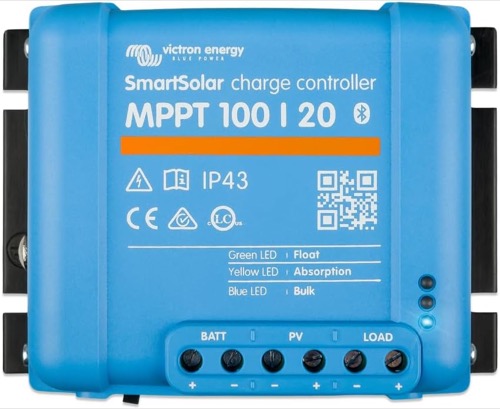
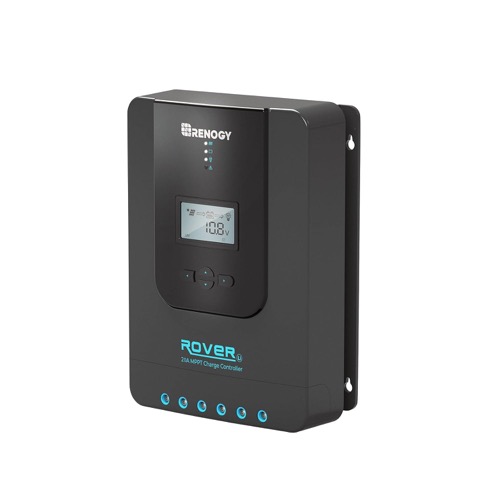
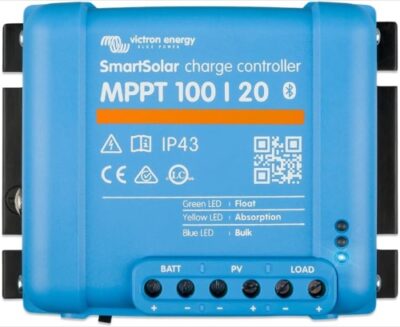
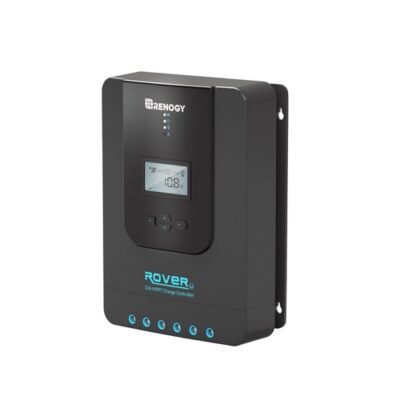
The SmartSolar 100/20 includes Bluetooth and a VE.Direct port, with status LEDs on its face. The Rover Li 20A has a local LCD and buttons, and its compatible app route typically adds a BT-2 accessory. These are characteristics of the reference pair, not a promise about every product bearing either logo.
Choose the maintenance task before counting features. Reading today’s charging voltage, changing a battery parameter, reviewing a week of yield, and checking the system from another city are different tasks. The cheapest way to satisfy one may be quite different from the cheapest way to satisfy all four.
| Your priority | Reference-pair direction | Question still to answer |
|---|---|---|
| Included local phone monitoring | SmartSolar 100/20 | Does Bluetooth work from the finished cabinet? |
| Numeric reading without a phone | Rover Li 20A | Can the operator access the display and required menus? |
| Internet monitoring while away | Evaluate complete system | Which gateway, power supply and connection are required? |
| Future bank-voltage change | Confirm exact model capability | Does every other device support the new bank voltage? |
Use the 20A Pair as a Reference, Not a Brand-Wide Verdict
Both reference controllers use MPPT and are rated for 20A battery-side charging with a 100V PV Voc ceiling. That similarity makes the controls comparison useful. It does not make the array and battery limits identical or create an interchangeable wiring design.
The relevant SmartSolar 100/20-48V version supports a 48V bank, while the reviewed Rover Li 20A covers 12V/24V. Confirm the full Victron model label for a 48V purchase. Also check startup voltage and the 1A physical load-output rating at 48V; a larger bank voltage changes several design assumptions at once.
Victron publishes a 20A maximum PV short-circuit-current value for this small SmartSolar model. For Rover, the reviewed material leaves the exact input-current limit unresolved. Obtain the manufacturer-approved array-current boundary before finalizing parallel strings. That missing information is an open design question, not proof of unlimited capability or absent protection.
Keep the article’s reference pair separate from the rest of the family. A different Victron model may omit physical load terminals or support a different bank voltage. A different Renogy controller may use PWM or offer a waterproof format. Model selection follows the system requirements after the brand shortlist is formed.
Price a Complete Monitoring Route Through Both Ecosystems
List every component needed for your intended view of the system. A solar controller reports its own charging activity; that is not necessarily the battery’s total energy balance. Loads, other chargers and inverter consumption may require a battery shunt or other monitoring hardware.
Local Bluetooth also differs from a network gateway. To check equipment from another location, identify the compatible gateway, communications cable, internet connection and ongoing power demand. Confirm what continues operating if the network fails and whether local configuration remains available.
An existing ecosystem can change the marginal cost. If you already own compatible Victron monitoring hardware, another supported controller may be easier to integrate. A Renogy installation with the correct module and familiar local controls may have a different cost advantage. Existing ownership is useful only when the specific interfaces are actually compatible.
Avoid comparing a bare controller from one supplier with a complete bundle from the other. Include the same required functions, then compare the delivered equipment and installation work. A feature that you will never use has little value, but a missing feature needed for unattended service can dominate the final decision.
- Define the numeric readings and history the operator needs.
- Separate solar-controller data from total battery energy monitoring.
- List optional modules, gateways, cables and internet requirements.
- Test local operation when the internet or phone is unavailable.
- Keep model numbers and accepted firmware/settings in the service record.
Route Family Choices by the Constraint That Changes
Stay with the reference 20A pair when its output envelope covers the actual array and battery. If the unresolved decision is extra charge current, move to a comparison that evaluates that output range. Increasing brand commitment does not remove the need to recalculate array and battery limits.
For a small SmartSolar expansion, the 75/15 versus 100/20 comparison isolates voltage and current thresholds while retaining the same basic monitoring approach. For a larger 12V/24V system, the 100/30 versus Rover 40A comparison tests whether additional output or the controls workflow matters more.
Within Renogy, Rover versus Wanderer changes the underlying conversion approach as well as features. The compared Rover Li 30A is MPPT; the compared Wanderer Li 30A is a 12V PWM controller. A move between them may require a different array layout even when the amperage on the labels matches.
If a wet or exposed mounting position drives the purchase, select equipment with a documented suitable enclosure and protect the complete circuit. Neither reference controller should be chosen merely because a brand also sells an outdoor-oriented model. Terminals, cable entries and battery protection remain installation-specific.
Follow the small-SmartSolar upgrade comparison, the 100/30 versus Rover 40A decision, or the Rover/Wanderer array comparison when one of those specific constraints becomes decisive.
Judge Support by a Usable Diagnosis and a Clear Seller Route
Before buying, identify the seller, exact model, regional warranty terms and route for a defective unit. A longer stated warranty is not the same as a faster replacement, and marketplace anecdotes cannot establish how every future claim will be handled. Save the documentation attached to the actual purchase.
Good fault reporting begins with battery voltage, array configuration, temperature, charge settings, displayed error and the events preceding it. An app screenshot may help one service team; a photograph of local LCD information may help another. Either is more useful than saying only that the controller stopped charging.
Owner evidence can identify questions about pairing, menu clarity or installation access. Use those themes to make an acceptance checklist, rather than ranking brands by the share of negative stories in a collected set. Reviews may combine revisions, system designs and user experience levels.
Documentation quality also affects installed cost. Clear terminal limits, input boundaries and battery-setting instructions can reduce uncertainty during commissioning. If a critical field is unresolved, ask a precise model-specific question before designing around an assumption. Keep the answer with the system record so future maintenance has the same evidence.
Include controller model and revision, battery model, module count and wiring, measured voltages, charge settings and the exact symptom. Avoid changing several settings at once while trying to reproduce a fault.
Choose the Ecosystem After the Electrical Design Passes
Choose Victron when the specific controller fits electrically and its included phone interface, documented configuration or compatible monitoring equipment has daily value. For the reference pair, SmartSolar 100/20 is the natural candidate for an operator who wants those functions without adding a Bluetooth dongle.
Choose Renogy when a specific compatible model’s local controls, kit integration or installation format better fits the job. In the reference pair, Rover Li 20A is a credible candidate when the LCD matters and the array’s remaining input questions have been resolved. Add the appropriate communications accessory when the task requires it.
The Victron vs Renogy charge controllers decision ends with a bill of materials and a maintenance workflow. Both should describe the exact purchased equipment. If you can show that each required electrical boundary passes, every essential task is possible and the complete cost is acceptable, you have a defensible choice without declaring an entire brand universally better.
The SmartSolar 100/20 review and Rover Li 20A review give the product-level detail. Consult Victron’s model-specific limits and Renogy’s current manual library before final configuration.