Victron SmartSolar 150/35 Review: Built for Series Voltage, Not Raw Amps
At a Glance
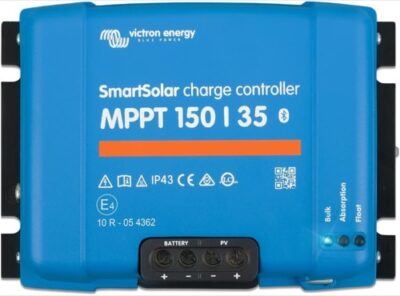
KEY FEATURES
- Controller: MPPT; 35A rated charge output.
- System: 12V / 24V / 48V automatic; 36V manual; Lead-acid and lithium through presets or user-defined algorithm.
- PV boundary: 150V maximum Voc; 500W @ 12V; 1,000W @ 24V; 1,500W @ 36V; 2,000W @ 48V maximum PV power.
- Controls: Status LEDs; optional external display; Built-in Bluetooth with VictronConnect; VE.Direct.
- Best fit: High-voltage series arrays charging 12V-48V lead-acid or LiFePO4 banks.
PROS
- The 150V PV ceiling supports longer series strings and lower-current array runs.
- VictronConnect provides detailed configuration, history, and firmware access.
- 12V through 48V support gives the model broad system-design flexibility.
CONS
- Charge output remains 35A; the 150V name does not mean greater battery current.
- Cold-corrected string Voc needs disciplined calculation because the ceiling is absolute.
- Metal cabinets can reduce Bluetooth range, and passive cooling still needs airflow.
Editor's Choice
Editorial assessment based on exact-model documentation and qualitative exact-ASIN owner evidence; no first-party bench test or population-rate claim
Will the Victron SmartSolar 150/35 Fit Your Solar Array?
Estimate required charging current and check it against the documented limits for Victron SmartSolar 150/35.
Solar Charge Controller Size Calculator
What size charge controller do I need?
The Victron SmartSolar 150/35 is the controller for buyers whose main problem is array voltage rather than maximum charge current. Its 150V PV ceiling supports longer series strings, while 35A output covers 12V, 24V, 36V, and 48V battery systems. Built-in Bluetooth, VE.Direct, published 35A PV Isc, passive cooling, and a five-year warranty complete a well-documented package.
The tradeoff is deliberate. At 35A, it carries less battery-side current than the 100/50, and there are no physical load terminals or numeric screen. It is most valuable when higher series voltage reduces PV cable current or makes an existing roof run usable—not when the project simply wants the largest amperage number.
| Best For | Distinctive Benefit | Main Compromise | Evidence Confidence |
|---|---|---|---|
| High-voltage series arrays feeding 12V–48V banks | 150V input with published 35A Isc | 35A output, app-centered interface, premium price | High for specifications; medium-high for owner use patterns |
Buy the 150V Ceiling for String Design, Not for a Bigger Amp Number
The larger exact-ASIN evidence makes the SmartSolar 150/35’s main purpose clearer. Owners choose it when higher PV voltage simplifies a long cable run, supports a series string, or fits a 48V battery design—not because 150 is a general measure of power. Battery charge output still stops at 35A, and the published nominal PV guidance changes with system voltage.
Higher string voltage can reduce current and voltage drop between array and controller, but it raises the importance of cold-corrected Voc. Add the module open-circuit voltages in series, apply the manufacturer temperature coefficient for the lowest expected cell temperature, and keep the result below the controller’s absolute maximum with design margin. Nominal panel voltage and a warm midday reading are not sufficient.
Owner accounts generally favor charging behavior, silent passive cooling, and app configuration. Critical reports mention warmth, reduced Bluetooth range through cabinets, individual hardware or radio failures, and seller-dependent support. That combination argues for purchasing through a support path you can identify and testing connectivity before the return window closes.
Choose the 150/35 when 150V string headroom solves a documented layout problem and 35A is sufficient for the battery. Choose the 100/50 when strings fit below 100V and greater charge current matters more. Move to another 150V model if both high string voltage and more than 35A are required.
The Case for 150V Is Often in the Cable Run
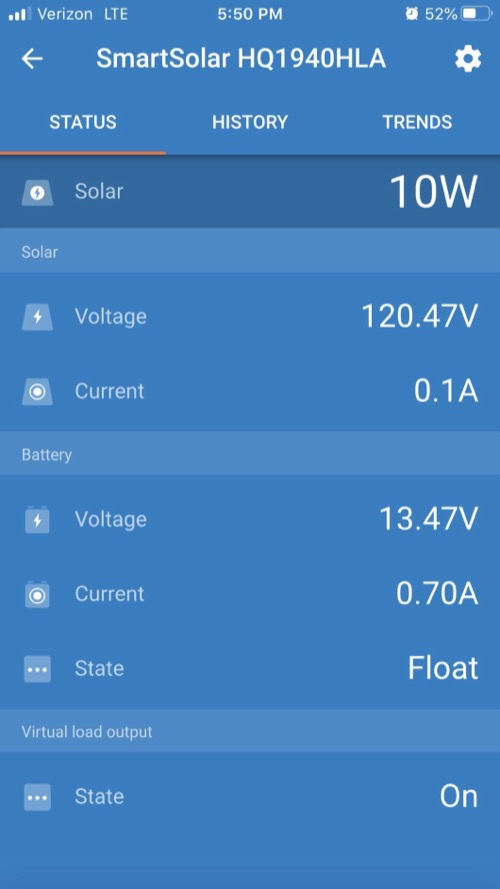
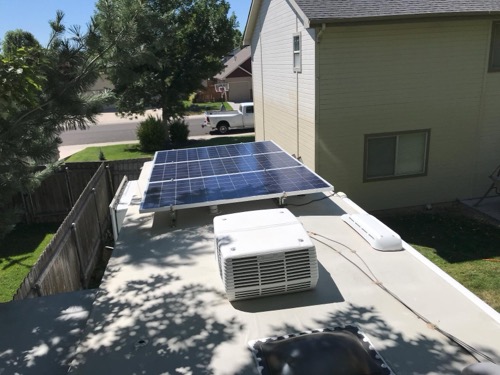
One owner had factory-installed #10 cable between a trailer roof and controller and did not want to cut new holes. The buyer wired three nominal 335W, roughly 40V panels in series, describing about 120V and 8.3A at the array. Higher voltage kept PV current low on the existing conductor while the controller charged a 12V bank initially, with a planned move to 48V.
That is a compelling system-level reason to choose the 150/35. It is not a ready-made design to copy. The owner’s stated 120V appears to be an operating or nominal snapshot; cold-corrected open-circuit voltage from the exact modules must stay below 150V. Three panels whose warm Voc totals near the ceiling may become unsafe in winter.
| Series-Array Benefit | What Changes | What Does Not Change |
|---|---|---|
| Lower PV cable current for equal power | Reduced voltage drop and conductor heating | Conductor ampacity, connectors, and protection still matter |
| More panels per string | Fewer parallel branches may be needed | Cold Voc must remain below 150V |
| Greater headroom above a 48V bank | Controller can sustain its operating window | Battery charge current remains capped at 35A |
| Use an existing roof run | May avoid new penetrations | Existing cable and insulation ratings must still be verified |
The 150/35 requires PV voltage sufficiently above battery voltage to begin and continue charging. A 48V bank therefore needs an array operating voltage comfortably above its charge voltage, while still respecting the 150V ceiling during cold open-circuit conditions.
String-design rule — Use the panel datasheet’s Voc temperature coefficient and the site’s design-low temperature. Never approve a string from nominal “40V panel” labels or a warm-day app reading.
The Power Table Reveals the Real 35A Envelope
Victron specifies 500W nominal PV power at 12V, 1,000W at 24V, 1,500W at 36V, and 2,000W at 48V. The same controller current produces more power as bank voltage rises. This is why the 150/35 can be a poor fit for a large 12V array and a strong fit for a 48V series-string system.
| Battery Bank | Nominal PV Allowance | Common Fit | Likely Upgrade Trigger |
|---|---|---|---|
| 12V | 500W | Modest array needing unusually high PV voltage | More than 35A charging or larger low-voltage array |
| 24V | 1,000W | RV/cabin with series wiring and moderate current | Sustained array growth beyond 1kW |
| 36V | 1,500W | Specialized bank configured manually | Need for automatic 36V handling or more current |
| 48V | 2,000W | Off-grid bank using high-voltage strings | More than 35A charge current |
Maximum PV Isc is 35A, independent of the 35A battery-side output. In an MPPT converter, input and output current can differ; the matching number does not make them interchangeable. Add array Isc across parallel strings and follow Victron’s oversizing and protection rules.
One owner with three series panels noted that a 12V battery limited delivered power to roughly the controller’s low-voltage range and expected a later 48V conversion to use more array capacity. That is consistent with the published table and demonstrates why battery architecture must be selected alongside the controller.
150/35 or 100/50?
These models solve different bottlenecks. The 100/50 supplies 50A but stops at 100V and supports only 12V/24V batteries. The 150/35 accepts higher array voltage and supports 48V, but its output is 35A.
| Decision | SmartSolar 150/35 | SmartSolar 100/50 |
|---|---|---|
| Series-string headroom | 150V | 100V |
| Charge output | 35A | 50A |
| Battery classes | 12V / 24V / 36V / 48V | 12V / 24V |
| PV Isc ceiling | 35A | 60A |
| Best reason to choose | Higher PV voltage or future 48V bank | More current on a 12V/24V bank |
Choose after running both designs. A 24V bank with many parallel modules may favor 100/50 current capacity. A long series string or 48V bank favors 150/35. If both 150V and more than 35A are required, neither is the final model; move to a larger 150V controller.
What Owners Say About Charging and Heat
The owner record is strongly positive. Owners describe the controller reacting quickly to changing light, producing expected power, operating silently, and supporting 48V LiFePO4 banks. One buyer was replacing a Renogy unit that could not accept the planned panel voltage. Another used multiple SmartSolar sizes across an off-grid cabin, portable battery box, vehicle maintenance, e-bike charging, and outdoor lighting.
| Owner Pattern | Recurrence | Editorial Weight |
|---|---|---|
| Easy app configuration and useful data | Multiple | Strong support for VictronConnect usability |
| Successful higher-voltage/48V use | Multiple | Supports the model’s intended system class |
| Weak Bluetooth through enclosures | More than one | Real placement-dependent limitation |
| Warm operation | One detailed report | Prompts ventilation check, not a defect conclusion |
| Packaging complaint | One one-star report before testing | Seller/shipping evidence, not controller performance |
Evidence discipline — A star rating is not automatically product evidence. Packaging, seller service, and untested first impressions must be separated from charging performance and longevity.
Bluetooth Works Well—Until the Cabinet Wins
VictronConnect provides live PV and battery values, 30-day history, presets, custom parameters, alarms, and firmware updates. Bluetooth is built in, and VE.Direct supports external monitoring or control integration.
Two owners specifically described limited Bluetooth range through cabinets or compared it unfavorably with a nearby battery BMS/sensor. Another said range exceeded expectations. These reports are compatible: metal, orientation, walls, and radio conditions change practical distance.
Commission Bluetooth before closing the cabinet. If access from a living area is essential, test from that position. True remote internet monitoring requires additional ecosystem hardware; Bluetooth alone remains local.
One multi-controller owner valued that VictronConnect stores firmware packages on the phone, allowing updates at an off-grid site without cell service. That is a specific operational advantage for remote cabins.
Battery Profiles, VE.Smart, and Low Temperature
The controller supports lead-acid and lithium presets plus user-defined charging. It can use compatible VE.Smart voltage and temperature data, including configurable low-temperature lithium behavior when the complete sensing arrangement supports it.
Do not rely on automatic voltage detection as the entire commissioning process. Victron documents 12V, 24V, and 48V automatic detection, while 36V is manual. Verify the detected/selected bank before PV loading, then compare each voltage and current parameter with the battery/BMS manual.
For a 48V LiFePO4 bank, series cell count and maximum charge voltage must be explicit. “48V” can describe batteries with different full-charge targets. Identify which component blocks charging below the permitted temperature and how the system restarts afterward.
No Screen and No Physical Load Terminals
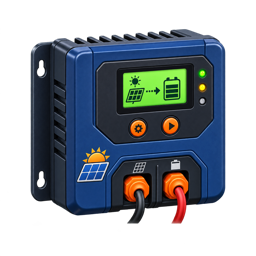
The front has status LEDs rather than a numeric display. Detailed local information requires a phone or external Victron display. Buyers who prohibit phones in the equipment workflow should budget the display or select another controller.
There are no physical load terminals. Inverters and DC distribution belong on a properly fused battery bus. Virtual load behavior can be implemented through VE.Direct and suitable external switching, but the controller is not a direct low-voltage load center.
This design matches the 150/35’s likely systems: at 35A and up to 48V, large loads should not pass through small controller terminals anyway.
For remote lighting or battery protection, use a properly rated external device driven by documented control logic. That keeps high load current on the battery bus and preserves the controller’s role as the charger. The extra design step is preferable to choosing another model solely because it exposes load screws whose current or surge rating does not fit the application.
Mechanical and Environmental Boundaries
The unit measures about 130 × 186 × 70 mm, weighs 1.25kg, and accepts up to 16mm² / AWG 6 conductors. Electronics are rated IP43 while the terminal area is IP22. It operates from -30°C to 60°C with temperature-dependent limits.
Mount it vertically in a dry protected position with required clearance. Support cables so movement does not stress the terminals—an issue one owner wished Victron addressed with an intermediate connector box. Never expose the IP22 terminal area merely because the electronics section has a higher rating.
High-Voltage Commissioning Checklist
- Photograph every panel label and record Voc, Vmp, Isc, Imp, and temperature coefficient.
- Calculate cold-corrected series Voc below 150V with required margin.
- Add parallel-string Isc and remain within 35A.
- Confirm PV voltage stays high enough above the selected battery to operate.
- Use the 500W/1,000W/1,500W/2,000W row for the actual bank.
- Verify 36V manual selection or 12V/24V/48V detection before full operation.
- Configure battery voltage, current, float, and temperature behavior from its manual.
- Test Bluetooth range before closing a metal cabinet.
- Size protection and AWG 6 / 16mm²-or-smaller conductors without strand trimming.
- Provide dry IP22 terminal protection and passive-cooling clearance.
Pros & Cons Analysis
Based on documented specifications and owner feedback
Pros
- 150V — 150V PV ceiling.
- 12V-48V — 12V-48V battery support.
- Built-in — Built-in Bluetooth and VE.Direct.
- Five-year — Five-year warranty.
Cons
- Check: No physical load terminals.
- Check: No numeric front display.
- Check: Bluetooth range varies by mounting.
- Check: Premium price.
Bottom Line: Choose It for Voltage Architecture
Verdict: The Victron SmartSolar 150/35 is a premium, well-documented solution for series arrays and 12V–48V banks when 35A output is sufficient. Built-in Bluetooth, explicit PV Isc, flexible charging, passive cooling, and a five-year warranty justify much of the price.
Best reason to buy: A higher-voltage string reduces cable current, fits an existing PV run, or supports a planned 48V battery without exceeding 150V.
Reason to pause: The 35A ceiling, lack of a screen/load terminals, and placement-sensitive Bluetooth may favor another model. Calculate whether voltage or current is the true bottleneck before choosing between 150/35 and 100/50.
Frequently Asked Questions
Is the Victron Energy SmartSolar 150/35 MPPT or PWM?
The exact model is documented as MPPT. That topology does not replace checks of PV voltage, input current, output current, and battery compatibility.
What battery voltage does the Victron Energy SmartSolar 150/35 support?
12V / 24V / 48V automatic; 36V manual. Confirm detection and selection behavior in the current exact-model manual.
What is the maximum PV voltage?
150V. Use cold-corrected array Voc rather than the panel's warm-day value.
How much solar can it handle?
500W @ 12V; 1,000W @ 24V; 1,500W @ 36V; 2,000W @ 48V. The PV voltage, PV current, and battery-side charge-current limits must all be satisfied at the same time.
Does the Victron Energy SmartSolar 150/35 work with lithium batteries?
Lead-acid and lithium through presets or user-defined algorithm. Match every charging value and low-temperature strategy to the battery documentation.
Does it include app monitoring?
Built-in Bluetooth with VictronConnect; VE.Direct. Verify whether any required accessory is included in the exact bundle.
Can I connect an inverter to its load terminals?
Normally no. High-current and surge loads should use a correctly fused battery-side connection unless the controller manual explicitly permits the planned load.
Who should buy the Victron Energy SmartSolar 150/35?
High-voltage series arrays charging 12V-48V lead-acid or LiFePO4 banks.
Technical Specifications
| Brand | Victron Energy |
|---|---|
| Exact model / revision / ASIN | SmartSolar MPPT 150/35 (ASIN B073ZHRG9K) |
| Controller type | MPPT |
| Rated battery-side charge current | 35A |
| Supported battery-system voltage | 12V / 24V / 48V automatic; 36V manual |
| Battery chemistry and profile support | Lead-acid and lithium through presets or user-defined algorithm |
| Maximum PV open-circuit voltage (Voc) | 150V |
| Maximum PV short-circuit/input current (Isc) | 35A |
| Maximum PV power by battery voltage | 500W @ 12V; 1,000W @ 24V; 1,500W @ 36V; 2,000W @ 48V |
| Minimum PV/start voltage requirement | PV voltage must exceed battery voltage by 5V to start and by 1V to continue charging |
| Load output and low-voltage disconnect | No physical load terminals; virtual load control through VE.Direct |
| Grounding topology | Isolated chassis; positive or negative battery grounding permitted at one point; do not ground PV positive or negative |
| Charging stages and custom voltage control | Adaptive multi-stage; presets and user-defined settings |
| Temperature sensing and lithium low-temperature behavior | Internal sensing; external sensing and configurable lithium low-temp cutoff through VE.Smart |
| Display and local controls | Status LEDs; optional external display |
| App, communications, and data history | Built-in Bluetooth with VictronConnect; VE.Direct |
| Maximum terminal conductor size | 16 mm² / AWG 6 |
| Controller self-consumption | 20mA at 12V; 15mA at 24V; 10mA at 48V |
| Published tracking/conversion efficiency | 98% |
| Cooling method and thermal derating | Natural convection / passive cooling; full rated output through 40°C, then temperature-limited |
| Electrical protections | PV reverse-polarity, output short-circuit, and overtemperature protection; no internal ground-fault protection |
| Enclosure, ingress rating, and operating temperature | IP43 electronics / IP22 terminals; -30°C to 60°C |
| Certifications | EN/IEC 62109-1, UL 1741, and CSA C22.2 No. 107.1-16 |
| Dimensions, weight, and included accessories | 130 × 186 × 70 mm; 1.25 kg |
| Warranty | 5 years |