HUINE 20A IP68 Review: Sealed PWM for Lead-Acid Maintenance
At a Glance
KEY FEATURES
- Controller: PWM; 20A rated charge output.
- System: 12V / 24V automatic; Lead-acid battery types; reviewed manual says not lithium.
- PV boundary: Not published maximum Voc; Not published maximum PV power.
- Controls: Status LEDs only; No app or communications port.
- Best fit: Simple exposed 12V/24V lead-acid maintenance systems requiring sealed electronics.
PROS
- Potted IP68 body suits exposed maintenance applications.
- Compact fixed-lead design simplifies basic installation.
- Load cutoff can protect modest unattended DC equipment.
CONS
- PWM architecture sacrifices harvest with mismatched PV voltage.
- LEDs provide less diagnostic detail than a numeric display.
- Every splice and battery connection still needs weather protection.
Editor's Choice
Editorial assessment based on exact-model documentation and qualitative exact-ASIN owner evidence; no first-party bench test or population-rate claim
Will the HUINE 20A IP68 Fit Your Solar Array?
Estimate required charging current and check it against the documented limits for HUINE 20A IP68.
Solar Charge Controller Size Calculator
What size charge controller do I need?
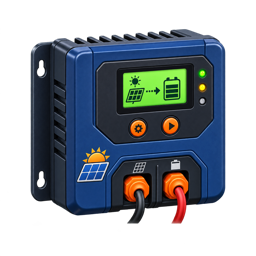
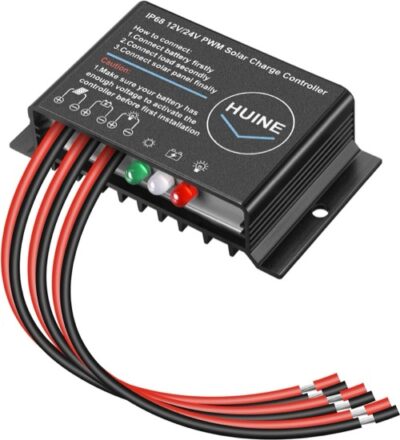
The HUINE 20A is unusually focused. Its electronics are sealed to IP68, fixed leads eliminate open screw terminals at the controller, and automatic PWM charging supports 12V or 24V lead-acid batteries. Status comes from LEDs rather than a screen or app.
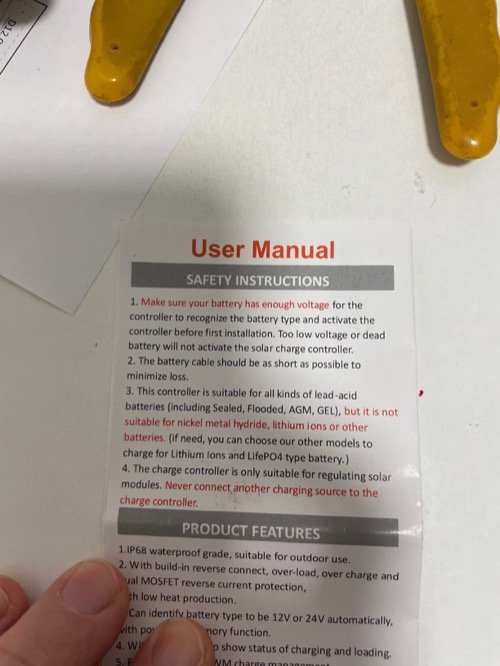
That simplicity suits generator batteries, gates, fuel stations, outdoor showers, boats, and cabin maintenance. It also creates hard boundaries: the reviewed manual says not to use lithium, there are no general-purpose load terminals, cable length/gauge are fixed, and maximum PV Voc, Isc, and watts were not published in the supplied evidence.
| Best For | Defining Strength | Defining Limitation | Evidence Confidence |
|---|---|---|---|
| Outdoor 12V/24V lead-acid maintenance where sealing matters | IP68 potted enclosure with fixed leads | Missing PV envelope and no lithium/display/app | Medium |
IP68 Packaging Is Valuable Only When the Whole Circuit Is Protected
The expanded exact-ASIN record reinforces the HUINE 20A’s main advantage: a compact, potted controller that can live closer to an outdoor panel or battery than an ordinary open-terminal indoor unit. Owners use it for gates, cameras, generators, boats, trailers, portable panels, and small network equipment. The same record also shows why enclosure rating must not be confused with complete system weatherproofing.
Positive accounts mention simple wiring, cool operation, useful low-voltage load control, and service in exposed applications. Critical accounts describe confusing LEDs, fixed-wire limitations, failed protection, battery drain, or units that stopped working. These reports identify tests; they cannot quantify reliability.
Because this is PWM, match panel voltage to the battery system and accept that excess panel voltage is not converted the way a buck MPPT controller would use it. The fixed leads may simplify sealing but limit conductor choice and cable length. Do not hide undersized conductors inside a weatherproof splice.
The LEDs are useful for status at a glance, yet they cannot show precise charge current, voltage drop, or the cause of a weak battery. Commission with an independent meter. Choose this controller when exposure resistance and simple lead-acid maintenance matter more than app data or maximum harvest; choose documented MPPT hardware when energy capture, configurable lithium charging, or numeric monitoring is the priority.
IP68 Solves Only the Controller-Enclosure Problem
IP68 indicates a high level of dust and water ingress protection under defined test conditions. It does not automatically waterproof wire splices, fuse holders, panel connectors, battery terminals, or the enclosure around the battery. Fixed leads move the vulnerable connection away from the electronics; they do not remove it.
One boat owner soldered and heat-shrank connections for longevity. That is an owner’s method, not universal marine guidance. Marine and outdoor systems must consider corrosion, strain relief, cable support, overcurrent protection, ignition sources, and applicable rules.
| Environmental Layer | HUINE Coverage | Work Still Required |
|---|---|---|
| Controller electronics | IP68 sealed body | Preserve enclosure/lead integrity |
| Fixed cable exit | Factory sealed | Avoid pulling, sharp bends, or abrasion |
| Field splice | Not covered by controller rating | Use appropriately rated connection system |
| Fuse/disconnect | Separate component | Match exposure and circuit requirements |
| Battery | Separate enclosure/system | Venting, corrosion, temperature, and touch protection |
Weather rule — The installation is only as weather-resistant as its least protected energized connection. Do not advertise the entire solar system as IP68 because the controller body is sealed.
The Clearest Applications Are Battery Maintenance
One owner used a 160W 12V panel to maintain electric-start batteries for two generators. The controller sat inside a small generator enclosure, so the review does not test direct water exposure. LEDs showed panel, battery, and load status, and the owner reported no obvious overcharge.
A boat owner paired a 20W panel with a deep-cycle battery after an old controller reportedly allowed more than 15V. The reviewer measured a charge cycle and said bulk and float stayed within the battery maker’s recommendations. Another owner kept an outdoor-shower pump battery charged after integrated maintainers allegedly ruined two batteries.
| Owner Application | Solar/Battery Detail | Supported Takeaway |
|---|---|---|
| Two generator-start batteries | 160W panel, 12V system | Plausible multi-battery maintenance, wiring details incomplete |
| Boat deep-cycle battery | 20W panel | Useful small-panel voltage-regulation evidence |
| Outdoor shower / RV water pump | Small maintainer application | Fixed leads and simple setup are convenient |
| 12V fuel station | Several years reported | Strongest positive duration evidence |
| Off-grid cabin | No electrical detail | General satisfaction only |
The generator review refers to unused “load side” wires and recommends insulating them. The canonical product specification does not document general-purpose load terminals. Fixed leads may include battery, panel, or variant-specific conductors; identify each lead from the exact manual and cap every unused energized end safely.
The two-generator arrangement also needs careful interpretation. The owner described maintaining electric-start batteries but did not publish whether the batteries were permanently paralleled, isolated, or charged through separate protection. Connecting batteries together solely because they share nominal voltage can create equalization current and fault paths. Use a documented multi-battery arrangement, and measure each battery independently; this review is evidence that the owner was satisfied, not a reproducible two-bank wiring diagram.
Lead-Acid Only Is a Non-Negotiable Boundary
The controller belongs with supported flooded, sealed/AGM, or gel lead-acid batteries after verifying its profile. Do not rely on the battery’s BMS to make an incompatible charger safe. A lead-acid algorithm may use voltage/float behavior inappropriate for lithium and provides no documented low-temperature lithium cutoff.
| Battery Type | Reviewed Support | Decision |
|---|---|---|
| Flooded lead-acid | Supported class | Verify charge/ventilation requirements |
| AGM/sealed | Supported class | Match exact voltage recommendations |
| Gel | Supported class | Confirm profile does not exceed gel limits |
| LiFePO4 | Manual says not to use | Choose another controller |
| Lithium-ion / NiMH | Manual says not to use | Choose chemistry-specific charging hardware |
Chemistry warning — IP68 does not compensate for the wrong charging algorithm. Sealing and battery compatibility are independent requirements.
The Missing PV Limits Prevent a 20A Recommendation
HUINE calls the controller 20A, but maximum PV Voc, Isc, and watts were not available. PWM topology generally expects panel voltage suited to the bank. A series string can exceed an unknown ceiling without providing MPPT conversion benefits.
Owner examples range from 20W to 160W. These establish basic use at modest power, not full 20A capacity. One user claimed ownership of two 10A and three 20A units and praised meter-checked behavior but did not publish array electrical values.
| Sizing Input | Evidence | Responsible Position |
|---|---|---|
| Rated output | 20A nominal | Treat as ceiling, not verified continuous design point |
| Maximum PV Voc | Missing | No series string approval |
| Maximum PV Isc | Missing | Parallel current cannot be sized safely |
| Maximum PV power | Missing | Use modest verified setup or obtain manual data |
| Attached lead gauge/length | Fixed but not normalized | Check voltage drop and circuit protection |
The fixed cable cannot be upsized at the controller. Extensions add connections and voltage drop. Measure the actual run, determine lead gauge from documentation or markings, and keep the controller near enough to the battery for acceptable drop without placing it in a hazardous battery environment.
At 20A, even modest resistance matters. A round-trip conductor resistance of 0.02 ohm would lose 0.4V and dissipate 8W at the full rating; a loose splice can concentrate that heat in one small point. Those figures are an illustration, not a claim about HUINE’s lead resistance. Measure voltage at the controller-side lead and battery posts under the highest expected current, then inspect every connection for temperature rise.
LEDs Keep Operation Simple—and Diagnostics Limited
Status LEDs indicate solar, battery, and perhaps attached-load state. There is no numeric voltage/current display, history, Bluetooth, or communications port. This is appropriate for a system that only needs “charging/charged/fault” indications and has a separate meter for commissioning.
LEDs cannot prove that charge current is adequate or the battery reached a healthy state. The boat owner improved the evidence by checking voltage through a cycle. Repeat that practice with an appropriate meter and, when battery health matters, a dedicated monitor or periodic capacity/service testing.
| Question | LEDs Can Answer | LEDs Cannot Answer |
|---|---|---|
| Is solar detected? | Usually | Exact PV voltage/current |
| Is battery connected? | Usually | State of health or capacity |
| Is charging stage active? | Basic indication | Exact absorption/float behavior |
| Did yesterday produce enough energy? | No | Historical amp-hours |
| Is a splice heating? | No | Physical inspection required |
Durability Evidence Includes Years—and a Two-Year Failure
The owner record cannot yield a failure rate, but it rejects an “IP68 means lifetime” narrative. Potting can improve moisture resistance while making internal repair impossible. Cable damage, thermal cycling, components, and connections can still fail.
Test voltage and charge current periodically, especially before seasonal reliance. A sealed black box with LEDs can appear normal while a battery ages or a panel connection deteriorates.
For a seasonal gate, generator, or boat, establish a service interval rather than waiting for a no-start event. Record battery resting voltage, full-sun charging current, and the LED state when the system is known to be healthy. Later comparisons can reveal reduced harvest even when the light pattern has not changed. After storms or maintenance, inspect the fixed lead for cuts and pulling at the potted exit.
Potting also changes the repair decision. An IP68 controller is normally replaced rather than opened; cutting or drilling the enclosure destroys the environmental barrier and may expose energized parts. Diagnose the external array, battery, protection, and wiring first, then replace a failed unit with the correct revision.
Connection Sequence and Unused Leads
One boat reviewer emphasized battery first and disconnected last. Many automatic controllers need a battery reference, but use the current HUINE manual for the exact sequence. Label fixed leads before routing and verify polarity with an appropriate meter.
Unused conductors must be separately insulated and secured. Do not bundle exposed ends together or assume an LED indicates they are de-energized. If a fixed lead is too short, use a connection method and conductor sized for current, weather, vibration, and voltage drop.
HUINE Outdoor Checklist
- Confirm exact 10A/20A model and matching lead diagram.
- Use only a supported lead-acid chemistry.
- Obtain PV Voc/Isc/watt limits before scaling beyond modest examples.
- Verify polarity and the manual’s connection/disconnection order.
- Calculate drop in fixed leads and any extensions.
- Protect every splice, fuse, disconnect, and battery terminal for exposure.
- Insulate and secure unused conductors individually.
- Check bulk and float voltage with an independent meter.
- Inspect cable exits and splices for strain, abrasion, and corrosion.
- Do not infer battery health from status LEDs alone.
HUINE Versus Voyager and SOLPERK
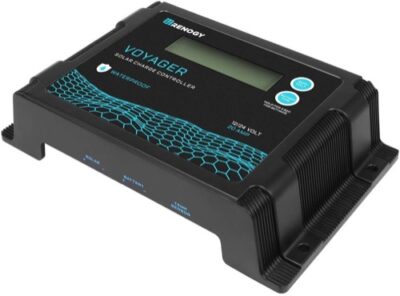
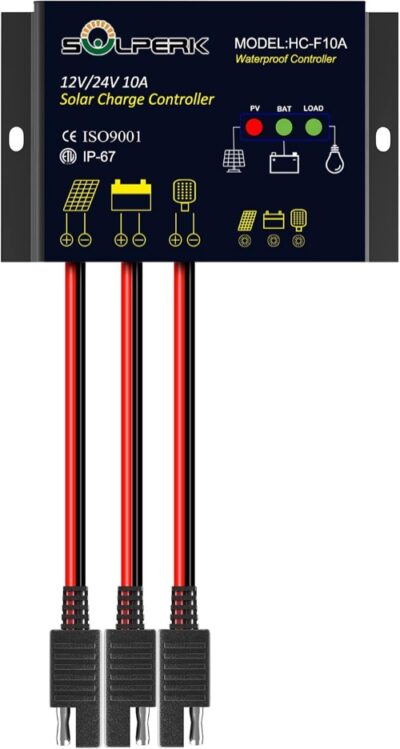
Renogy’s Voyager 20A supplies an LCD, published 12V/24V PV power and voltage limits, and lithium selection while retaining IP67. It costs more and uses PWM. SOLPERK’s 8A/10A sealed controllers target smaller SAE-connected maintenance systems but have their own drain/polarity evidence.
HUINE is strongest when fixed leads, IP68 sealing, and lead-acid simplicity matter more than configuration or measurements. Voyager is safer when the system requires a designable array envelope and screen.
Pros & Cons Analysis
Based on documented specifications and owner feedback
Pros
- IP68 — IP68 sealed enclosure.
- 20A — 20A PWM rating.
- Fixed — Fixed weather-resistant leads.
- Simple — Simple status LEDs.
Cons
- Check: Manual says not to use lithium batteries.
- Check: No numeric display or app.
- Check: PV Voc and Isc limits not published.
- Check: Cable length and gauge are fixed.
Bottom Line: Good Sealing, Narrow Role
Verdict: The HUINE 20A has credible outdoor lead-acid maintenance evidence, including multi-year service and voltage-checked boat charging. IP68 and fixed leads solve real installation problems.
Best reason to buy: A small-to-moderate exposed lead-acid system needs sealed electronics and can be commissioned with independent measurements.
Reason to pause: Lithium is excluded, core PV limits and lead gauge remain unpublished, and LEDs provide little diagnostic depth. Do not design near 20A until exact electrical documentation is available.
Frequently Asked Questions
Is the HUINE 20A IP68 PWM MPPT or PWM?
The exact model is documented as PWM. That topology does not replace checks of PV voltage, input current, output current, and battery compatibility.
What battery voltage does the HUINE 20A IP68 PWM support?
12V / 24V automatic. Confirm detection and selection behavior in the current exact-model manual.
What is the maximum PV voltage?
Not published. Use cold-corrected array Voc rather than the panel's warm-day value.
How much solar can it handle?
Not published. The PV voltage, PV current, and battery-side charge-current limits must all be satisfied at the same time.
Does the HUINE 20A IP68 PWM work with lithium batteries?
Lead-acid battery types; reviewed manual says not lithium. Match every charging value and low-temperature strategy to the battery documentation.
Does it include app monitoring?
No app or communications port. Verify whether any required accessory is included in the exact bundle.
Can I connect an inverter to its load terminals?
Normally no. High-current and surge loads should use a correctly fused battery-side connection unless the controller manual explicitly permits the planned load.
Who should buy the HUINE 20A IP68 PWM?
Simple exposed 12V/24V lead-acid maintenance systems requiring sealed electronics.
Technical Specifications
| Brand | HUINE |
|---|---|
| Exact model / revision / ASIN | 20A IP68 PWM (ASIN B07CK2PCC7) |
| Controller type | PWM |
| Rated battery-side charge current | 20A |
| Supported battery-system voltage | 12V / 24V automatic |
| Battery chemistry and profile support | Lead-acid battery types; reviewed manual says not lithium |
| Maximum PV open-circuit voltage (Voc) | Not published |
| Maximum PV short-circuit/input current (Isc) | Not published |
| Maximum PV power by battery voltage | Not published |
| Minimum PV/start voltage requirement | Not published for the reviewed revision |
| Load output and low-voltage disconnect | No separate programmable load terminals |
| Grounding topology | Not published for the reviewed revision |
| Charging stages and custom voltage control | Automatic PWM lead-acid charging |
| Temperature sensing and lithium low-temperature behavior | No external sensor or low-temperature protection documented |
| Display and local controls | Status LEDs only |
| App, communications, and data history | No app or communications port |
| Maximum terminal conductor size | Fixed attached leads |
| Controller self-consumption | Not published for the reviewed revision |
| Published tracking/conversion efficiency | Not published |
| Cooling method and thermal derating | Passive bottom heatsink; no thermal-derating curve published |
| Electrical protections | Short-circuit, overcharge, over-discharge, and reverse-connection protection |
| Enclosure, ingress rating, and operating temperature | IP68; operating range not published |
| Certifications | Not published for the reviewed revision |
| Dimensions, weight, and included accessories | Not published |
| Warranty | Not published |