ECO-WORTHY 30A PWM Bluetooth Review: Cheap App Access, Uneven Evidence
At a Glance
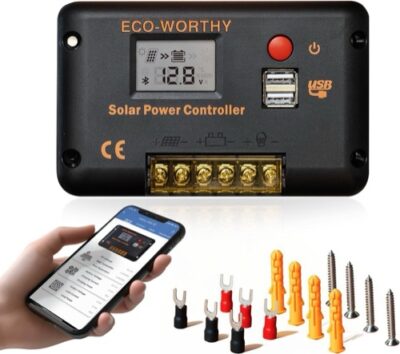
KEY FEATURES
- Controller: PWM; 30A rated charge output.
- System: 12V / 24V automatic; AGM, gel, flooded lead-acid, and LiFePO4.
- PV boundary: 50V maximum Voc; Not published maximum PV power.
- Controls: LCD, buttons, and USB; Built-in Bluetooth with mobile app.
- Best fit: Budget 12V/24V systems where built-in Bluetooth matters more than MPPT efficiency.
PROS
- Programmable dusk and timed-load modes suit lights and other modest DC loads.
- The local display keeps core setup available without a phone.
- Low purchase cost can make sense where PWM losses are acceptable.
CONS
- PWM conversion can waste available panel power when PV and battery voltages differ.
- Bluetooth behavior appears dependent on the delivered revision and app access.
- Use conservative current and careful terminal-temperature checks near the rating ceiling.
Editor's Choice
Editorial assessment based on exact-model documentation and qualitative exact-ASIN owner evidence; no first-party bench test or population-rate claim
Will the ECO-WORTHY 30A PWM Bluetooth Fit Your Solar Array?
Estimate required charging current and check it against the documented limits for ECO-WORTHY 30A PWM Bluetooth.
Solar Charge Controller Size Calculator
What size charge controller do I need?
The ECO-WORTHY 30A PWM offers something uncommon near the bottom of the market: an LCD, USB, programmable load modes, lithium and lead-acid selection, and Bluetooth described as built into the controller. For a small woodshed, lantern, or RV battery system, the combination can be more useful than another anonymous controller with no trustworthy display.
The evidence is conflicted. One owner compared the readings with a multimeter and clamp meter and found close agreement. Another measured roughly 33W from the ECO-WORTHY versus 59W from an MPPT controller under similar conditions and correctly treated the gap as expected from PWM. Other reports describe heat, failed Bluetooth, a faulty unit, and return friction. The 50V PV ceiling is published, but array Isc and power allowances are not.
| Best For | Distinctive Value | Main Compromise | Evidence Confidence |
|---|---|---|---|
| Modest 12V/24V systems wanting local display and low-cost app visibility | Bluetooth and load automation at a PWM price | Incomplete array limits and mixed app/thermal reports | Medium for small-system operation; low near 30A |
The 30A Label Does Not Remove the PWM Tradeoff
The programmable load output can be more valuable than maximum harvest.
Use conservative current, ventilation, and independently checked voltage thresholds.
PWM operation can leave meaningful panel power unused.
Bluetooth availability and access should be proven on the exact delivered revision.
The expanded owner material confirms that this ECO-WORTHY controller should be bought for a simple PWM system and its programmable load behavior, not because “30A” makes it equivalent to a 30A MPPT controller. Useful accounts describe lights, speakers, small refrigeration, and dusk-to-timer projects. Measurement-oriented owners also illustrate the central PWM compromise: when panel operating voltage is substantially above battery charging voltage, available panel power can be left on the table.
Bluetooth is a revision-and-commissioning question rather than a safe assumption. Some owners describe connectivity or account-access problems, while others focus entirely on the local display. Before permanent installation, confirm that the delivered unit exposes the promised radio function, that the intended app recognizes it, and that the controller remains useful if the app is unavailable. Photograph the label and firmware information because marketplace listings can combine revisions.
| Decision gate | Evidence to collect | Reason |
|---|---|---|
| Harvest fit | Panel Vmp, battery charge voltage, expected current | Shows whether PWM conversion wastes enough energy to justify MPPT |
| Thermal fit | Actual current, conductor size, terminal temperature, airflow | A printed 30A ceiling is not a preferred continuous design point |
| Load fit | Startup current, cutoff setting, timer behavior | Small lighting loads differ from motors and inverters |
| Monitoring fit | Local reading, app pairing, independent meter | Prevents one interface from becoming the only source of truth |
This remains a budget controller for buyers who understand PWM, keep wiring protected, and value automatic DC-load scheduling. Buyers paying for energy harvest, stronger documentation, or dependable app-centered monitoring should compare a documented MPPT model.
The Best Owner Evidence Compares Instruments
A woodshed owner used two 100W panels to support lights and speakers. The reviewer said displayed battery voltage closely matched a multimeter and the charging/load current aligned with a clamp meter. The programmable low-voltage cutoff was important because the owner wanted to avoid drawing the battery below roughly half charge.
This is stronger evidence than “works great” because it names the system and comparison tools. It still does not establish laboratory calibration: meter model, placement, simultaneous readings, battery state, and uncertainty were not fully documented.
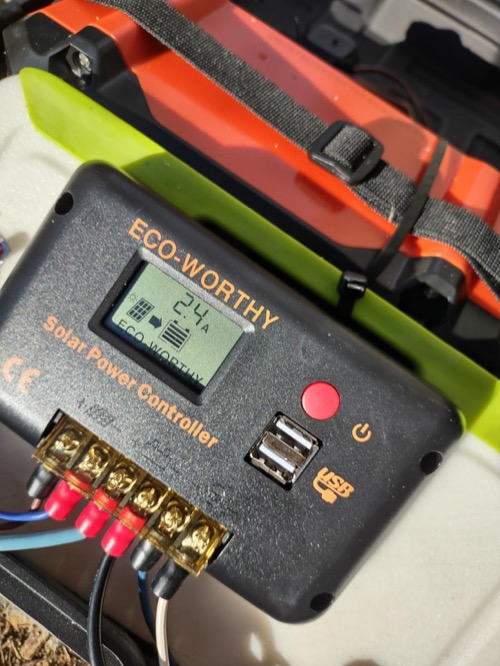
Another owner compared the PWM controller with a separate MPPT unit using the same panel in close succession. The ECO-WORTHY showed about 13.8V at 2.4A, or 33.1W, while the MPPT showed about 13.92V at 4.1A, or 59W. The reviewer explicitly said nothing was wrong with the PWM unit; the result illustrated topology.
| Owner Measurement | Reported Result | Supported Conclusion | Limitation |
|---|---|---|---|
| LCD vs multimeter voltage | Nearly identical | Display may be useful for basic monitoring | Not a calibration certificate |
| Display current vs clamp meter | Similar | Charging/load readings were plausible in that setup | Exact test points not supplied |
| PWM output snapshot | 13.8V × 2.4A ≈ 33.1W | Lower harvest can be normal with voltage mismatch | Conditions can change between readings |
| MPPT comparison snapshot | 13.92V × 4.1A ≈ 59W | MPPT can convert excess panel voltage into current | Different controller and transient irradiance |
Topology takeaway — Bluetooth does not turn a PWM controller into MPPT. If panel operating voltage sits materially above battery charging voltage, app data may simply make the lost opportunity easier to see.
50V Is Published; the Rest of the Array Envelope Is Not
The controller is rated 30A and 50V maximum PV input for automatic 12V/24V systems. The reviewed evidence does not publish maximum PV Isc or permitted panel watts. Those omissions make a design near 30A difficult to defend.
PWM normally favors parallel voltage-matched panels. Parallel branches add current, so the missing Isc rule becomes critical exactly where a buyer tries to approach the headline rating. Higher series voltage does not provide the same useful conversion as MPPT and can reach 50V quickly in cold conditions.
| Array Question | Available Answer | Responsible Decision |
|---|---|---|
| Maximum cold Voc | 50V ceiling published | Calculate each proposed string at design-low temperature |
| Maximum array Isc | Not published | Obtain exact current rule before parallel expansion |
| PV watts at 12V/24V | Not published | Avoid treating 30A × nominal voltage as an official allowance |
| Terminal wire capacity | Not published in normalized record | Confirm full-strand fit before cable purchase |
| Continuous thermal output | No independent full-load test | Keep protected ventilation and monitor initial operation |
One skeptical reviewer correctly identified the product as PWM and worried that three nominal 100W panels in parallel could approach the current class. The reviewer did not install it, so that post contributes sizing logic rather than operating evidence.
Heat Matters More Than the 30A Printing
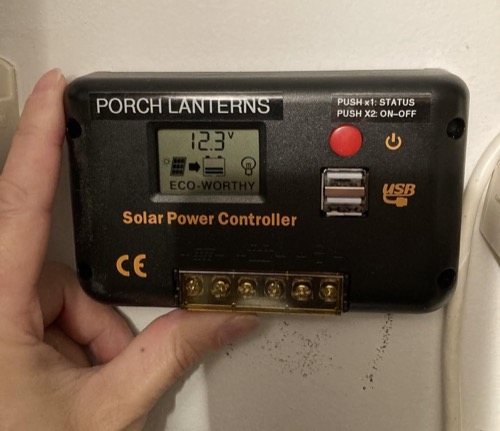
A lantern-project owner used only about 1A of controlled load and liked the dusk/timer behavior. The same reviewer criticized exposed wiring and said the controller could become hot near its advertised maximum because the metal rear plate was the only substantial heat path and internal components appeared lightly coupled.
This is an observational report, not a thermal teardown. It raises a reasonable question: can the compact 216g enclosure dissipate sustained high current in a warm cabinet? ECO-WORTHY publishes an operating range of -20°C to 75°C, but ambient range is not the same as guaranteed continuous 30A output under every mounting condition.
Mount the controller against an appropriate surface in a dry ventilated space. Do not modify the enclosure or thermal coupling as the reviewer considered unless qualified and authorized; changes can create shock, fire, and warranty risks.
Thermal stop — Unexpected case heating, odor, discoloration, unstable display, or cycling under load requires safe shutdown and diagnosis. Do not interpret a wide temperature range as permission to trap heat.
Bluetooth Appears to Depend on the Exact Unit and Revision
Marketplace variants and visually similar controllers can create this conflict. Before installation, verify the Bluetooth symbol/model label, scan the correct app, and confirm pairing while the return window is open. Save the exact digital manual and firmware/app version.
| Monitoring Need | Controller Provision | Check Before Final Mounting |
|---|---|---|
| Local voltage/current | LCD | Compare against an appropriate meter |
| Load programming | Buttons/display | Confirm timer and cutoff behavior with the intended load |
| Phone status | Built-in Bluetooth on reviewed model | Prove pairing on the received revision |
| Historical energy | Not established in evidence | Do not assume live Bluetooth means data logging |
| Off-site internet access | Not documented | Bluetooth remains local unless a supported gateway exists |
One return complaint focused on supplier pricing and paid return postage. It called the product great and therefore should not be counted as a performance failure. Evidence about product, seller, delivery, and returns must remain separate.
Lithium Selection Is Not a Complete Lithium Strategy
The controller provides AGM, gel, flooded, and LiFePO4 selection. One measurement-focused reviewer said that in the lithium setting, behavior depended on the battery’s internal BMS and described voltage regulation rather than conventional lead-acid pulsing. That is the owner’s reading of the manual and system, not a universal architecture guarantee.
Use the exact battery manual to verify charge ceiling, current, float behavior, and recovery. No external temperature sensor or controller-managed low-temperature cutoff was documented. A LiFePO4 bank exposed to freezing conditions must have verified BMS or external protection.
For lead-acid, select the matching profile and confirm low-voltage load cutoff. Voltage-only state-of-charge estimates can be misleading under charging or load; the woodshed owner used the programmable threshold as practical protection, but a dedicated battery monitor provides better context.
| Battery Question | Evidence | Remaining Obligation |
|---|---|---|
| LiFePO4 option present | Yes | Match exact voltage/current to battery/BMS |
| Lead-acid choices | AGM, gel, flooded | Confirm profile behavior and compensation |
| Low-temperature lithium cutoff | Not documented | Supply protection elsewhere |
| External battery sensor | Not documented | Account for controller/battery temperature difference |
| User-adjustable load cutoff | Owner used it successfully | Verify thresholds and reconnect behavior |
The Load Output Is Its Most Distinctive Non-App Feature
The current product specification describes a 30A programmable load output. It can switch lights manually or by dusk/timer modes. The lantern owner selected the unit specifically to turn lights on at sunset and off after a set number of hours.
Do not equate the stated load rating with permission for a 30A motor or inverter. Startup surge, terminal capacity, enclosure heat, and protection remain separate. Large inverters belong on a fused battery bus. For outdoor lanterns, the controller itself remains dry even if the panel and fixture are weatherproof.
Terminals and Exposed Wiring Require Planning
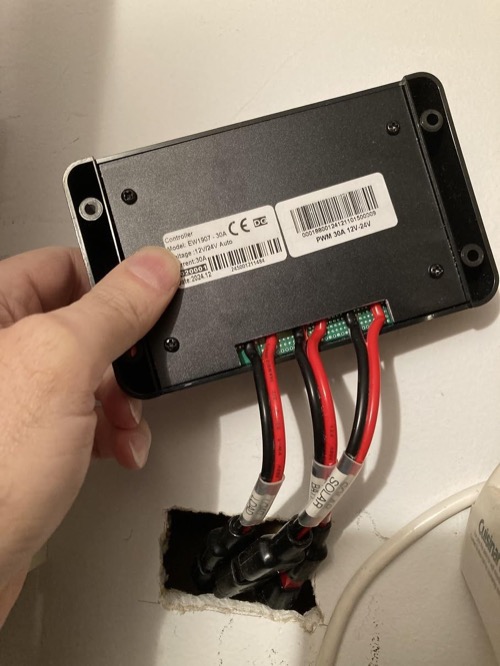
One positive owner found the terminal openings small but successfully inserted panel cables alongside loosened screws. Another wanted a clean wall mount and rerouted wiring through a self-made rear modification. Neither method should override the manual.
Do not wrap conductors around unsuitable screws, remove strands, drill the case, or route wires against sharp edges. Determine the exact terminal geometry, permitted ferrule/lug, wire size, and torque. The controller has no formal IP rating and belongs in a protected dry location.
| Physical Check | Pass Condition | Failure Condition |
|---|---|---|
| Cable entry | Full conductor fits supported clamp | Strand trimming or improvised wrap required |
| Mounting | Ventilation and accessible terminals/display | Heat trapped behind decorative enclosure |
| Weather | Dry protected position | Outdoor exposure justified only by lantern use |
| Bluetooth | Pairs before installation | Expected feature absent from received unit |
| Load wiring | Known continuous/surge current and separate protection | Inverter or high-inrush device on controller output |
Commissioning Checklist
- Confirm exact 30A Bluetooth revision and matching manual.
- Calculate cold Voc below 50V and obtain the PV Isc/power rules.
- Use voltage-matched panel architecture appropriate for PWM.
- Select the battery profile from its manufacturer documentation.
- Provide independent LiFePO4 cold-charge protection when required.
- Compare LCD voltage/current with appropriate instruments.
- Pair the app and test load modes before final mounting.
- Keep the enclosure dry, ventilated, and accessible.
- Verify complete conductor fit and connection temperature.
- Do not route an inverter through the programmable load output.
When MPPT Is Worth the Upgrade
Choose MPPT when panel voltage sits significantly above battery voltage, cable length rewards higher-voltage series wiring, roof area is constrained, winter/partial-light harvest matters, or future expansion is likely. The owner’s 33W-versus-59W snapshot demonstrates the type of loss that can make the upgrade worthwhile, while also reminding us that one snapshot is not an annual-energy study.
Choose this ECO-WORTHY only when PWM matching is understood, the array is modest, Bluetooth/local load control are valuable, and cost matters more than maximum harvest or complete documentation.
Pros & Cons Analysis
Based on documented specifications and owner feedback
Pros
- Built-in — Built-in Bluetooth.
- LCD — LCD and USB output.
- 12V/24V — 12V/24V automatic operation.
- Lead-acid — Lead-acid and LiFePO4 selection.
Cons
- Check: PWM rather than MPPT.
- Check: PV current and power limits are incompletely documented.
- Check: No IP rating.
- Check: Mixed app and reliability reports.
Bottom Line: Feature-Rich for PWM, Not a 30A Leap of Faith
Verdict: The ECO-WORTHY 30A Bluetooth controller can be a useful low-cost monitor and load controller in a modest 12V/24V system. Specific owners obtained credible instrument agreement and practical dusk control.
Best reason to buy: Built-in app visibility and programmable loads matter more than MPPT efficiency in a small voltage-matched array.
Reason to pause: Missing PV Isc/power limits, heat concerns, one Bluetooth mismatch, and sparse warranty detail prevent a confident near-30A recommendation. Verify the received revision and keep the design conservative.
Frequently Asked Questions
Is the ECO-WORTHY 30A PWM Bluetooth MPPT or PWM?
The exact model is documented as PWM. That topology does not replace checks of PV voltage, input current, output current, and battery compatibility.
What battery voltage does the ECO-WORTHY 30A PWM Bluetooth support?
12V / 24V automatic. Confirm detection and selection behavior in the current exact-model manual.
What is the maximum PV voltage?
50V. Use cold-corrected array Voc rather than the panel's warm-day value.
How much solar can it handle?
Not published. The PV voltage, PV current, and battery-side charge-current limits must all be satisfied at the same time.
Does the ECO-WORTHY 30A PWM Bluetooth work with lithium batteries?
AGM, gel, flooded lead-acid, and LiFePO4. Match every charging value and low-temperature strategy to the battery documentation.
Does it include app monitoring?
Built-in Bluetooth with mobile app. Verify whether any required accessory is included in the exact bundle.
Can I connect an inverter to its load terminals?
Normally no. High-current and surge loads should use a correctly fused battery-side connection unless the controller manual explicitly permits the planned load.
Who should buy the ECO-WORTHY 30A PWM Bluetooth?
Budget 12V/24V systems where built-in Bluetooth matters more than MPPT efficiency.
Technical Specifications
| Brand | ECO-WORTHY |
|---|---|
| Exact model / revision / ASIN | 30A PWM Bluetooth (ASIN B08JBLMC33) |
| Controller type | PWM |
| Rated battery-side charge current | 30A |
| Supported battery-system voltage | 12V / 24V automatic |
| Battery chemistry and profile support | AGM, gel, flooded lead-acid, and LiFePO4 |
| Maximum PV open-circuit voltage (Voc) | 50V |
| Maximum PV short-circuit/input current (Isc) | Not published |
| Maximum PV power by battery voltage | Not published |
| Minimum PV/start voltage requirement | Not published for the reviewed revision |
| Load output and low-voltage disconnect | Programmable load output; current product specification states 30A |
| Grounding topology | Negative ground |
| Charging stages and custom voltage control | Battery presets and adjustable load-control parameters |
| Temperature sensing and lithium low-temperature behavior | Internal sensing; no external sensor or lithium low-temp cutoff documented |
| Display and local controls | LCD, buttons, and USB |
| App, communications, and data history | Built-in Bluetooth with mobile app |
| Maximum terminal conductor size | Not published |
| Controller self-consumption | Not published for the reviewed revision |
| Published tracking/conversion efficiency | Not published |
| Cooling method and thermal derating | Natural convection; mount on a flat, well-ventilated surface; no derating curve published |
| Electrical protections | Short-circuit, open-circuit, reverse-connection/reverse-current, and overload protection |
| Enclosure, ingress rating, and operating temperature | Protected dry mounting; -20°C to 75°C |
| Certifications | Not published for the reviewed revision |
| Dimensions, weight, and included accessories | 136.5 × 85 × 30 mm; 216 g |
| Warranty | Not published |