Renogy Rover 20A Review: A Capable MPPT for Small Systems
At a Glance
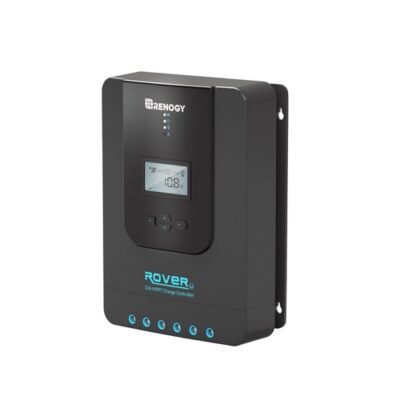
KEY FEATURES
- Output: 20A MPPT charging for 12V or 24V battery systems.
- PV limits: 100V Voc; 260W @ 12V or 520W @ 24V.
- Battery support: Lead-acid and lithium presets plus a user-defined profile.
- Monitoring: Built-in LCD; optional BT-2 module and Renogy DC Home app.
- Best fit: Small RV, cabin, and portable systems needing configurable MPPT charging.
PROS
- 20A MPPT charging and user-defined settings suit small RV and off-grid systems.
- Local LCD keeps essential setup available without an app.
- Optional Bluetooth adds convenient live monitoring and configuration.
CONS
- Lithium presets still require comparison with the exact battery specification.
- Voltage accuracy, display function, and Bluetooth workflow should be checked early.
- High-surge loads and inverters must use a protected battery-side connection.
Editor's Choice
Editorial assessment based on exact-model documentation and qualitative exact-ASIN owner evidence; no first-party bench test or population-rate claim
Will the Renogy Rover 20A Fit Your Solar Array?
Estimate required charging current and check it against the documented limits for Renogy Rover 20A.
Solar Charge Controller Size Calculator
What size charge controller do I need?
This Renogy Rover 20A review finds a well-documented controller for small 12V and 24V systems that need more configuration than a basic PWM unit provides. Its 100V PV ceiling, 20A charge output, local LCD, user-defined battery mode, and optional app connection cover the essentials without pushing into large-system pricing.
The main caveats are equally concrete. The enclosure is IP32 rather than weatherproof, Bluetooth requires an extra BT-2 module, and Renogy does not publish a maximum array short-circuit-current value for this exact model. Lithium owners must also select system voltage manually and verify every charge parameter against the battery documentation.
| Best For | Main Strength | Main Limitation | Evidence Confidence |
|---|---|---|---|
| Small RV, cabin, trailer, and portable 12V/24V systems | Published limits, LCD, and configurable charging | Optional Bluetooth and indoor-only enclosure | High for specifications; medium for owner patterns |
The Rover 20A Needs a Measured Battery Profile, Not a Chemistry Label
The expanded exact-ASIN owner record supports the Rover 20A as a practical step from PWM to configurable MPPT, especially for small RV, cabin, and off-grid arrays. It also surfaces the most important setup lesson: selecting “lithium” is not the same as matching a particular LiFePO4 battery. Owners describe cases where a user-defined profile was needed, along with concerns about voltage-reading accuracy and interface behavior.
Before charging, record the battery maker’s bulk/absorption target, float recommendation, low-temperature rule, maximum current, and any BMS disconnect behavior. Compare those values with the Rover’s exact profile and change only settings you understand. A controller that reads a few tenths of a volt differently from the battery terminals can change when charging tapers or stops, so measure at both locations under charge and after rest.
| Rover check | How to test it | Escalation point |
|---|---|---|
| Voltage accuracy | Compare controller, battery terminals, and monitor under the same condition | Difference alters the required charge targets |
| 20A output | Observe sustained high-sun current and terminal temperature | Heat, clipping, or battery limit suggests redesign |
| Bluetooth | Pair, power-cycle, change one reversible setting, and verify it | Accessory or software cannot provide the intended workflow |
| Load output | Test only a modest DC load with known startup current | Inverter, motor, or high-surge equipment belongs battery-side |
Owner accounts range from long service and straightforward mounting to isolated display failures, inadequate charging, or difficult support cases. Use that mixed evidence to shape acceptance testing rather than to predict the fate of one unit. Preserve screenshots, meter readings, serial information, and the exact configuration if a remedy is needed.
The Rover 20A makes sense when 20A and its PV envelope fit with margin and local controls matter. Buyers who want a simpler fixed profile may not use its flexibility; buyers planning more array power should compare the next current class before buying twice.
What the Rover 20A Can Actually Support
Renogy documents a 20A battery-side charge ceiling, 260W nominal PV power on a 12V battery, and 520W on 24V. The current manual sets maximum PV open-circuit voltage at 100V and an operating PV range of 17V to 100V. A panel string must remain inside that voltage ceiling at the site’s coldest design temperature, not just under normal sunshine.
The 20A limit applies after conversion on the battery side. One detailed owner using two 250W panels described the controller reaching and holding its 20A output while charging three parallel 12V AGM batteries. Another reported seeing 20A from a folding array in direct sun. These are useful system anecdotes rather than laboratory verification, but they match the model’s documented charge rating.
| Design Check | Documented Value | Practical Meaning |
|---|---|---|
| Maximum PV Voc | 100V | Cold-corrected series-string Voc must not exceed this value |
| Rated charge output | 20A | Maximum battery-side charging current |
| Nominal PV power at 12V | 260W | Appropriate planning value for a 12V battery system |
| Nominal PV power at 24V | 520W | Appropriate planning value for a 24V battery system |
| Maximum terminal size | 8 AWG / 10 mm² | Cable design must fit both the current and the physical terminal |
Renogy does not publish an exact maximum PV Isc in the reviewed sources. That omission does not make arbitrary parallel-string current acceptable. Confirm the array-current boundary with Renogy when the planned Isc approaches the controller rating, and follow the manual’s fuse and conductor guidance.
Battery Profiles and LiFePO4 Setup
The Rover supports AGM, sealed, gel, flooded, lithium, and user-defined profiles. Non-lithium 12V/24V systems can be detected automatically; lithium voltage is selected manually. The current manual describes three lead-acid stages plus equalization and a two-stage lithium process, so the displayed mode is not merely a label.
One supplied LiFePO4 owner found the default lithium behavior unsuitable for that particular bank and moved to the user-defined profile. After entering the battery maker’s values, the owner reported normal charging. This is a useful warning against assuming that any generic lithium preset is universally correct, not evidence that every Rover requires custom settings.
The included remote temperature sensor supplies lead-acid temperature compensation. Renogy specifies zero voltage compensation in lithium mode and does not document a controller-managed lithium low-temperature cutoff. A LiFePO4 system therefore needs confirmed cold-charge protection in the battery/BMS or another documented component.
Battery check — Match system voltage, boost or absorption behavior, float policy, current limit, and low-temperature protection to the exact battery manual before enabling solar input.
LCD, Bluetooth, and Load Control
The built-in LCD displays PV, battery, load, temperature, history, and error information without requiring a phone. Several owners called the interface easy to learn, although others noted that the non-backlit screen is hard to read in darkness or from an angle. Programming from the front panel also takes more button presses than an app-based workflow.
Remote monitoring is optional rather than included. The current RS485 model works with Renogy’s BT-2 module and DC Home app. Owners who used Bluetooth liked viewing charge rate and changing battery type from a phone, while one technically detailed owner described older desktop configuration software as awkward and unreliable. Confirm that the accessory matches the controller’s communication port before buying it.
Renogy rates the programmable DC load output at 20A and provides timer, always-on, manual, test, and automatic modes. That figure does not make the terminals suitable for an inverter. Both the manual and owner reports direct high-current or high-surge equipment to an appropriately protected battery-side design.
Installation, Enclosure, and Terminals
The Rover measures 210 × 151 × 68 mm and weighs 1.4kg. It uses passive heatsink cooling, accepts up to 8 AWG cable, and includes a temperature sensor plus mounting brackets. Renogy specifies common-negative grounding and an operating range from -35°C to 45°C.
IP32 is a protected-indoor rating. The manual calls for vertical mounting in a ventilated location away from direct sun, high temperature, and water. It also warns against a sealed enclosure with flooded batteries because gas can accumulate.
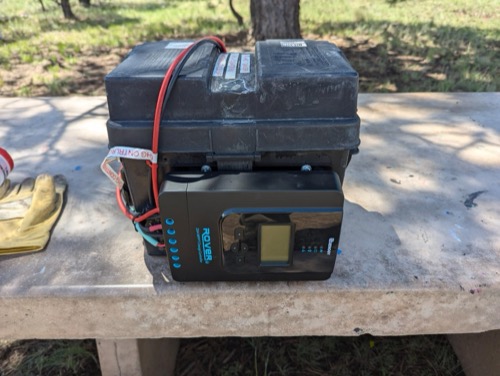
Most supplied installation reports were positive. Owners described straightforward mounting, secure screw terminals, and clear instructions. Two more detailed reports still noted slightly offset terminal openings or Phillips screws that demand a correctly fitting driver. Cable preparation should follow the manual; trimming conductor strands to force a fit is not an acceptable workaround.
What Owners Reported
The most actionable drawbacks are interface-related: no LCD backlight, optional connectivity, and more complicated custom-profile setup. The evidence does not support presenting those as universal failures.
Where the Evidence Is Strong — and Where It Stops
Rover 20A is easier to evaluate than many controllers in its price range because Renogy publishes the voltage window, battery-voltage-specific power allowances, terminal capacity, enclosure rating, load-output rating, and charging modes. That documentation supports a real compatibility screen instead of a recommendation built around its Amazon star average.
The remaining gaps still affect system design. The reviewed sources do not state a model-specific maximum array Isc, and the owner owner record is heavily positive. Neither gap proves a defect, but both limit what this review can conclude.
| Evidence Area | What We Have | Confidence | What Remains Open |
|---|---|---|---|
| Electrical output | Manual values for 20A, 260W at 12V, and 520W at 24V | High | Performance under a controlled repeatable test |
| PV input | 100V Voc ceiling and operating range | Medium-high | Exact maximum array Isc for parallel strings |
| Ownership | 13 detailed owner accounts, including long-use updates | Medium | Representative failure frequency across all buyers |
| Lithium setup | Published profile and user-defined controls | Medium-high | Controller-managed cold cutoff is not documented |
| Monitoring | LCD and optional BT-2/RS485 workflow | High | Accessory compatibility can vary by controller revision |
One four-year owner update is more informative than a one-line first impression, but it remains one installation. Conversely, the absence of a failure report in this owner record cannot establish a low failure rate. The responsible conclusion is narrower: Rover has credible documentation and several plausible long-use reports, while the exact array-current boundary still needs confirmation.
Four System Scenarios for the Rover 20A
The following matrix is a compatibility screen, not a wiring plan. Every row still depends on cold-corrected panel voltage, total array Isc, conductor and fuse selection, and the battery maker’s charge-current limit.
| Proposed System | Fit | Why | Must Verify Before Buying |
|---|---|---|---|
| 12V AGM bank with roughly 200W of PV | Good | Inside the published 260W allowance with local temperature compensation | Cold Voc, array Isc, cable drop, and battery charge limit |
| 24V lead-acid bank with 400-500W of PV | Conditional | Within the 520W nominal allowance when the string also passes voltage checks | Parallel-string Isc and minimum operating PV voltage |
| 12V LiFePO4 bank in a cold climate | Conditional | Lithium and user-defined profiles are available | Correct manual voltage selection and BMS cold-charge protection |
| Exposed marine or roof mounting | Poor | IP32 does not support direct weather exposure | A dry, ventilated enclosure and protected connections |
| System requiring more than 20A charging | Poor | Output is capped at 20A | Select a larger exact model and repeat every input calculation |
| Small lighting circuit using load terminals | Good, within limits | Programmable 20A DC output supports timer and low-voltage modes | Load surge, conductor size, and the manual’s mode behavior |
Rover is most convincing in a protected service bay where the LCD remains accessible. A hidden installation can still work, but the optional BT-2 becomes part of the true system cost rather than a bonus feature.
Rover Alternatives for More Current or Simpler Control
Victron SmartSolar 100/20 is the closest same-current alternative in this cluster. It includes Bluetooth, publishes a PV Isc ceiling, supports 48V batteries, and carries a longer warranty, but it replaces Rover’s numeric LCD with phone-based detail and uses smaller published terminals.
Renogy Rover 30A is the logical step up when the calculated battery-side demand exceeds 20A. It should not be chosen by multiplying the 20A model’s limits: its exact PV watts, current boundary, terminal requirements, and accessories need their own check. A basic PWM controller can cost less for a small voltage-matched array, but it gives up Rover’s higher-voltage MPPT design flexibility.
Pre-Purchase and Commissioning Checklist
- Confirm whether the bank is 12V or 24V and whether lithium voltage requires manual selection.
- Calculate series-string Voc at the site’s minimum design temperature.
- Obtain the exact Rover 20A PV Isc rule when parallel strings are planned.
- Compare expected charge current with both the controller’s 20A ceiling and the battery/BMS limit.
- Include the BT-2 in the budget only after verifying the communication-port revision.
- Mount the IP32 enclosure vertically in a dry, ventilated location.
- Use the exact manual for connection order, conductor preparation, protection, and settings.
Renogy Rover 20A Review: Who Should Buy It?
Choose the Rover 20A when the calculated system stays within 100V Voc, 20A output, and 260W/520W PV limits, and when an onboard screen matters. It is a particularly sensible step up from PWM for a small array with higher panel operating voltage or variable light.
Skip it for exposed outdoor mounting, arrays needing more than 20A, buyers who expect Bluetooth in the box, or lithium systems without independent cold-charge protection. The larger Rover models share familiar controls, but their electrical and terminal limits must be checked separately rather than copied from this review.
Pros & Cons Analysis
Based on documented specifications and owner feedback
Pros
- Useful published limits — Renogy documents PV watts, Voc, terminal size, load current, enclosure rating, and operating range.
- Flexible battery setup — AGM, sealed, gel, flooded, lithium, and user-defined modes cover common small systems.
- Strong sampled charging reports — Owners describe reaching the 20A ceiling, maintaining remote batteries, and improving harvest over PWM units.
- Local control works without an app — The LCD and four buttons expose status, settings, and error information.
- Programmable 20A load output — Timed and voltage-based modes suit modest DC lighting and control loads.
Cons
- Bluetooth costs extra — App monitoring requires the correct optional BT-2 module.
- Indoor installation only — IP32 does not support exposed outdoor mounting.
- Lithium setup needs care — System voltage is selected manually and one owner found the default lithium behavior unsuitable for a specific LiFePO4 bank.
- LCD has no backlight — Several owner comments note restricted viewing in darkness or at an angle.
- PV Isc is not published — Array design still requires confirmation from Renogy when short-circuit-current margin is critical.
Bottom Line: Well Documented, but Check the Accessories
Verdict: The Renogy Rover 20A earns a recommendation for properly sized, protected 12V/24V systems. It combines a useful LCD, configurable charging, a real 20A load output, and better documentation than many similarly priced controllers.
Best reason to buy: You want small-system MPPT charging with local controls and the option to add app monitoring later.
Reason to pause: Bluetooth is extra, the enclosure is not weatherproof, and the exact PV Isc boundary remains unpublished. This Renogy Rover 20A review therefore recommends confirming array current and lithium protection rather than relying on the product title alone.
Frequently Asked Questions
Is the Renogy Rover 20A a real MPPT controller?
Renogy documents MPPT operation, greater than 99% tracking efficiency, and up to 98% conversion efficiency. Sampled owners also reported voltage conversion and current behavior consistent with MPPT, although Solar Power Picks did not bench-test it.
What size solar array can the Rover 20A handle?
Renogy specifies 260W with a 12V battery or 520W with a 24V battery, with PV open-circuit voltage no higher than 100V. Cold-corrected Voc and array current must also be checked.
Does the Rover 20A work with LiFePO4 batteries?
Yes, but lithium battery voltage is selected manually and the profile must match the battery maker's requirements. The controller does not document a lithium low-temperature charging cutoff.
Does it include Bluetooth?
No. The RS485 version requires the optional Renogy BT-2 module for DC Home app monitoring and parameter changes.
Can I connect an inverter to the Rover load terminals?
No. Renogy rates the load output at 20A, but the manual and owner evidence warn against inverters and high-surge loads. Connect an inverter through a properly protected battery-side design.
Is the Rover 20A waterproof?
No. Its IP32 enclosure is intended for a protected, ventilated indoor location away from water and direct sunlight.
What wire size fits its terminals?
Renogy publishes an 8 AWG maximum and recommends 8-12 AWG depending on circuit length. Final conductor and fuse sizing must follow the exact manual and installation requirements.
Does the included temperature sensor protect lithium batteries from cold charging?
No such cutoff is documented. The sensor supplies lead-acid temperature compensation; lithium mode uses no voltage compensation, so low-temperature protection must come from the battery system or another documented control.
Technical Specifications
| Brand | Renogy |
|---|---|
| Exact model / revision / ASIN | Rover Li 20A (RNG-CTRL-RVR20; ASIN B01MRWTAB5) |
| Controller type | MPPT |
| Rated battery-side charge current | 20A |
| Supported battery-system voltage | 12V / 24V; automatic for non-lithium, manual selection for lithium |
| Battery chemistry and profile support | AGM, sealed, gel, flooded, lithium, and user-defined |
| Maximum PV open-circuit voltage (Voc) | 100V |
| Maximum PV short-circuit/input current (Isc) | Not published for this model |
| Maximum PV power by battery voltage | 260W @ 12V; 520W @ 24V; 48V not supported |
| Minimum PV/start voltage requirement | Not published for the reviewed revision |
| Load output and low-voltage disconnect | 20A programmable DC load terminals; not for an inverter or high-surge load |
| Grounding topology | Common negative / negative ground |
| Charging stages and custom voltage control | Three-stage lead-acid plus equalization; two-stage lithium; user-defined mode |
| Temperature sensing and lithium low-temperature behavior | Remote sensor included; lead-acid compensation; no controller-managed lithium low-temp cutoff published |
| Display and local controls | LCD, status LEDs, and four buttons |
| App, communications, and data history | RS485 Modbus; optional BT-2 module for Renogy DC Home |
| Maximum terminal conductor size | 8 AWG / 10 mm² |
| Controller self-consumption | 100mA or less at 12V; 58mA or less at 24V |
| Published tracking/conversion efficiency | >99% MPPT tracking; up to 98% conversion; >95% charger efficiency |
| Cooling method and thermal derating | Passive heatsink; output derates above 65°C controller temperature and shuts down above 80°C |
| Electrical protections | PV short-circuit, PV overvoltage, PV overcurrent, load overload/short-circuit, PV/battery reverse-polarity, and overtemperature protection |
| Enclosure, ingress rating, and operating temperature | IP32; -35°C to 45°C (-31°F to 113°F) |
| Certifications | FCC Part 15 Class B, CE, RoHS, and RCM |
| Dimensions, weight, and included accessories | 210 × 151 × 68 mm; 1.4 kg / 3.1 lb |
| Warranty | 3 years |