
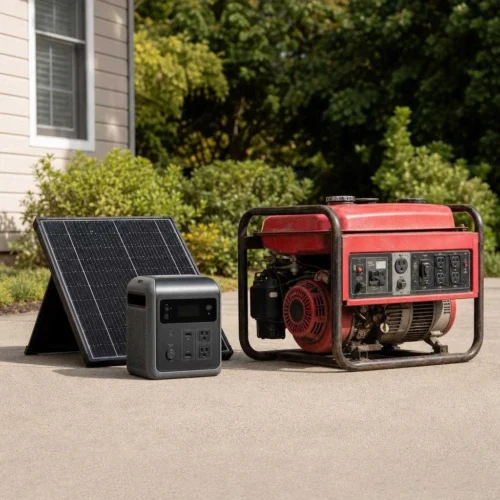
A solar generator and a gas generator solve different parts of an outage. A battery system stores a limited amount of electricity and can collect more from sun without combustion. A gasoline generator converts stored fuel into electricity, offering fast refueling and strong continuous output but creating exhaust, noise, heat, and maintenance obligations.
Start With the Non-Negotiable Safety Boundary
A portable fuel generator is outdoor-only equipment. The US Consumer Product Safety Commission advises using it outside at least 20 feet from the home, directing exhaust away, and installing working carbon-monoxide alarms. Never run one in a home, garage, basement, shed, porch, carport, or near openings. An open garage door does not make a garage safe.
A battery station produces no combustion exhaust, but “no CO” does not mean no rules. Use it within the exact manual: dry location, clear vents, permitted temperature, intact battery, suitable cable, and no unsupported connection to building wiring.
Map the Outage by Duration and Consequence
| Outage pattern | Battery/solar strength | Gas strength | Planning note |
|---|---|---|---|
| Brief, modest essential loads | Immediate, quiet, indoor point-of-use power | May be unnecessary setup | Battery often simpler if capacity passes |
| Day-long with usable sun | Array can offset part of consumption | Refuels independent of sun | Compare daily energy, not peak watts |
| Multi-day cloudy event | Recovery may fall behind | Strong while safe fuel remains | Fuel logistics and CO safety become decisive |
| High continuous loads | Large battery/inverter becomes expensive | Often more watts per initial dollar | Measure voltage, running, surge, and fuel burn |
| Overnight near occupants | Quiet, no combustion exhaust | Must remain outdoors at safe distance | Cable routing and security still matter |
Model One Outage Day
Estimate One Outage Day
Compare entered load energy with stored plus collected electricity and with a gasoline runtime assumption.
Planning estimate only. Verify the exact load, manual limits, wiring, connectors, weather, and operating conditions.
The gasoline result is only as credible as the fuel-burn input; generator consumption changes with model and load. The battery result is only as credible as usable Wh and collected solar. Enter conservative values from exact manuals and measurement. The tool compares energy availability, not safety, power quality, startup compatibility, or installation.
Power and Energy Favor Different Machines
Gas generators often provide more continuous watts per purchase dollar, which suits pumps, large tools, multiple refrigeration loads, and other sustained demand—if voltage and startup requirements pass. Battery systems can also deliver high power, but storing many kilowatt-hours remains costly and heavy.
Energy endurance tells a different story. A gasoline unit can refuel in minutes but depends on safe stored fuel, functioning supply chains, and maintenance. A battery can recharge from grid, vehicle, compatible generator, or solar depending on its design. Solar is renewable at the site but slow and weather-dependent. Neither “full tank” nor “sunlight” should replace an outage-day calculation.
Fast to add, exhaust-producing, finite onsite supply.
Quiet at point of use, slow to add, limited by chargers and sources.
Noise, Maintenance, and Readiness Shift the Cost
A gasoline engine needs fuel management, oil and service according to its manual, periodic exercise, and safe outdoor operation every time. Noise continues whenever it runs. A battery station has far less routine mechanical maintenance and is quiet except for cooling fans, but it must be kept charged, stored correctly, updated where necessary, and periodically tested as the battery ages.
- Gas readiness: fuel age and quantity, oil, starter, extension cables, outdoor placement, weather protection that does not enclose exhaust, CO alarms.
- Battery readiness: state of charge, storage interval, cable set, app/firmware, representative load test, solar setup, reserve policy.
- Both: exact load list, startup measurements, safe transfer method, labeled cables, household operating instructions.
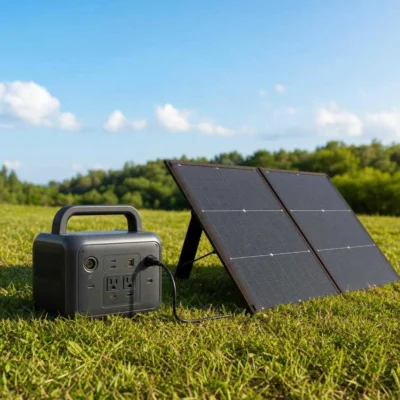
The Anker F3800 + one PS400 review illustrates the hybrid question: a powerful expandable station can reduce engine runtime, while one 400W panel remains a starter array rather than rapid daily recovery.
A Hybrid Plan Can Reduce Engine Hours
Where both manuals allow it, a fuel generator can recharge a battery station outdoors during a limited daytime window, while the battery carries quiet overnight loads. That can reduce—but not eliminate—fuel use, noise, and maintenance. It also introduces charger limits, conversion losses, additional cables, and the need to coordinate two systems.
Place and operate the generator under CPSC and manufacturer safety rules.
Use the station’s supported AC input and avoid overloading the generator.
Refuel only as directed after cooling; never move exhaust closer for convenience.
Run selected quiet loads from the battery with a defined reserve.
A hybrid is not automatically economical. Calculate fuel consumed during charging, energy delivered after losses, battery wear, and the value of quiet operation. Commission the complete sequence before an emergency.
Choose by Scenario, Not Identity
Apartment or no safe generator location
A battery station may be the practical option for modest loads; do not improvise fuel-generator placement.
Short outage with communications and refrigeration
A measured battery plan can be immediate and quiet, especially if it begins fully charged.
Remote multi-day high-load work
A fuel generator may provide more sustained output, subject to safe fuel, exhaust, and maintenance logistics.
Resilience-focused household
A documented hybrid or installed system can cover more failure modes than one portable machine.
Commission the Operating Plan
- Measure the priority loads and startup events.
- Stage the exact cables without unsafe backfeeding or overloaded household cords.
- Test battery runtime and recharge using conservative conditions.
- Test gas placement, exhaust direction, alarms, fuel procedure, and load while following the manual.
- Write the load-shedding order and who is permitted to operate each system.
Price Resilience Instead of Fuel Alone
A gas generator can look cheaper because its fuel storage sits outside the equipment price; a battery can look cheaper to run because sunlight has no invoice. Compare complete resilience: generator, transfer method, cords, weather-safe outdoor arrangement that does not trap exhaust, fuel containers, stabilizer, maintenance, alarms, station, panels, adapters, installation, battery expansion, and replacement.
| Failure mode | Battery/solar response | Gas response |
|---|---|---|
| Cloudy weather | Collection falls; stored reserve or alternate charging required | Unaffected while fuel and equipment remain available |
| Fuel shortage | Unaffected if battery/solar loop sustains loads | Runtime ends when onsite fuel ends |
| Cannot place engine safely | Battery remains a candidate within its manual | Portable gas plan fails |
| Battery reaches reserve | Shed load or recharge | Can charge battery only if interface is supported and generator runs safely |
| Engine fault or maintenance lapse | Independent battery can preserve modest loads | Fuel inventory cannot produce power |
Redundancy has value when the failure modes differ. A battery and fuel generator can complement each other because one is limited by stored/collected electricity and the other by safe engine operation and fuel. Two identical battery stations or two identical generators may add capacity but share more failure modes.
Do not use the matrix to justify unsafe improvisation. Building backfeed, undersized cords, wet connections, enclosed fuel operation, and refueling a hot engine remain hazards regardless of outage duration. A resilience plan is only valuable if people can execute it safely under stress.
Weather Creates Opposite Operational Pressures
Solar collection is often weakest during the same storms that cause outages. Rain, cloud, snow, smoke, short winter days, and unsafe outdoor panel deployment can reduce recovery. A full battery before the event is therefore more valuable than optimistic post-outage solar. Charge early from the grid when forecasts and the manual allow it.
Fuel generators also face weather constraints. They must remain outdoors at safe distance while being protected according to the manufacturer’s instructions without enclosing exhaust or creating electrical exposure. Wind can change exhaust direction. Flooding can eliminate a planned placement. Refueling in severe conditions adds operational risk.
Cloudy but calm
Solar harvest may be low; safe gas operation may remain possible if placement and fuel pass.
High wind and driving rain
Panel and generator deployment can both become unsafe; stored battery energy gains value.
Clear post-storm day
Solar can restore reserves without fuel, while gas remains useful for large loads.
Build the plan around conditions in which equipment can actually be used. “I own a panel” and “I own fuel” are inventories, not deployment permissions. Pre-stage safe locations and fallback loads before the forecast becomes an emergency.
Bottom Line: Match the Failure Mode
Choose battery/solar for quiet, fume-free point-of-use power when stored plus collected energy covers the plan. Choose gas when sustained high output and rapid refueling are essential and the site can operate it safely outdoors. Choose both only when the interfaces, safety procedures, and economics are documented. The winner is the system that still works during the outage you actually have.

Leave a Reply