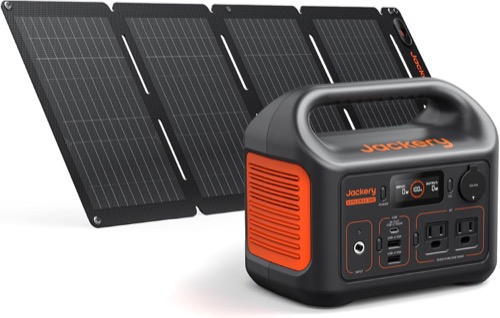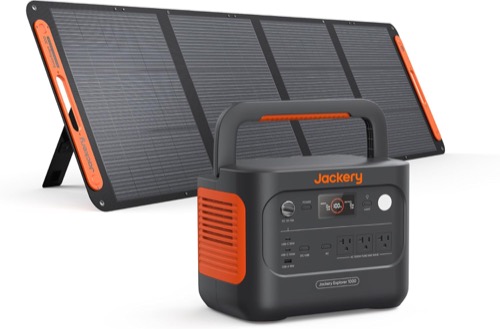
Jackery Explorer 300 v2 versus Explorer 1000 v2 is a minimum-sufficient-system decision, not a close spec race. The 300 stores 288Wh and delivers 300W. The 1000 stores 1,070Wh and delivers 1,500W. One is a roughly 10.1 lb station-and-panel travel kit; the other is a roughly 38.1 lb energy system that can support appliances the smaller model should never be asked to carry.
This Is a Class Jump, Not an Upgrade Question
The 1000 v2 holds about 3.7 times the rated energy and supplies five times the continuous AC power. It is also about 2.9 times the station weight before the panel is added. Asking which is “better” hides the decision: the 300 can be more useful when every pound matters, while the 1000 is the only candidate when the load exceeds 300W or the trip energy exceeds a small-device budget.
Low carry cost, low energy and output ceiling.
Large operating margin, much larger transport commitment.
Build a Pack List Before a Power List
For a day trip or one-night camp, the best system may be the one that leaves the vehicle. The 300’s 40W SolarSaga Air folds into a small, light panel and also exposes direct USB outputs. Its station adds two AC outlets, 100W USB-C input/output, another USB-C port, USB-A, and a car socket. The 1000 adds a third AC outlet, a 30W second USB-C path, a stronger inverter, and a 200W panel with much more collection area.
- Write the number of times each piece must be lifted, carried, unfolded, and repacked.
- Add cable, case, extension, and adapter weight instead of comparing station weights alone.
- Reserve dry, ventilated storage for the station; IP68 applies to both listed panels, not either station.
- If the 1000 will never leave a vehicle or house, its higher carry cost may be irrelevant.
Keep a Small-Load Energy Diary
The 300 belongs in a small-load plan. Record device watts and hours instead of guessing from names. A 10W light used five hours is 50Wh; a 60W laptop charge lasting two hours is 120Wh. Add conversion loss and reserve, then compare the result with 288Wh. The 1000 gives much more room, but the same arithmetic prevents a 1,070Wh battery from being treated as unlimited.
| Daily plan | Energy before losses | 300 v2 screening result | 1000 v2 screening result |
|---|---|---|---|
| Phone, camera, lights | About 100Wh | Comfortable candidate | More capacity than this plan requires |
| Laptop workday + network gear | About 300–500Wh | Needs recharge during use | Candidate with reserve |
| Refrigeration + electronics | Measure over 24 hours | Often energy- or startup-limited | Candidate after startup check |
| Cooking heat + other loads | Often high power and energy | Usually fails output | Only if every load stays within 1,500W and energy budget |
These examples are a worksheet, not appliance guarantees. Standby draw, cycling, temperature, duty cycle, and inverter efficiency change the result. Measure the exact equipment whenever failure matters.
A Compressor Changes the Ladder
Motors and compressors create two gates: running power and startup power. The 300 is rated 300W continuous and 600W surge. The 1000 is rated 1,500W continuous and 3,000W surge. A refrigerator that averages modest energy can still demand a brief startup the small station cannot support. A device can also pass the watt gate but consume too many watt-hours across a day.
Included Solar Reverses the Battery-Size Intuition
The 300’s battery is smaller, yet its 40W panel produces a stated ideal full-charge estimate of about 9.5 hours. The 1000’s much larger battery comes with a 200W panel and an estimate around 7.5 hours. Panel-to-battery ratio matters more than battery size alone. A small panel can make a small battery slow to recover; a larger panel can make a larger system operationally quicker.
The 300 accepts up to 100W solar, though the current US page does not publish the full voltage/current window. The 1000 accepts up to 400W across two inputs and publishes its limits. Any alternate array must be verified electrically and mechanically; wattage alone does not establish compatibility.
Controls and Charging Define the Daily Routine
The 1000 connects to Jackery’s app; no app is published for the 300 v2. The 300 therefore suits a direct local-control routine, while the larger model supports remote status and settings. From AC, the 300 reaches full in about 76 minutes. The 1000 is about one hour in emergency mode or 1.58 hours in standard mode. A vehicle cable is included with the 1000 but not with the exact 300 bundle, so add that cost if drive charging is part of the plan.
Both publish UPS behavior, but with different transfer figures: 10ms or less for the 300 and under 20ms for the 1000. Neither number proves compatibility with a particular load. Commission the exact station, cable, outlet, and device together.
Three Stop Rules Prevent a Bad Buy
When the measured ledger genuinely exceeds the 1kWh tier, compare it with the Jackery 2000 v2 two-panel review, where the included 400W array matches the station’s full published solar ceiling.
Compare the Cost of an Unnecessary Tier
The larger station costs more in four currencies: purchase price, weight, storage volume, and solar-deployment effort. The smaller station costs more when its limits force load shedding, extra charging stops, or a second purchase. A useful comparison assigns each cost to a named trip or outage rather than treating capacity as automatically valuable.
| Question | If yes | If no |
|---|---|---|
| Does any required load exceed 300W or 600W startup? | Move above the 300 tier | Keep evaluating the 300 |
| Does the measured day exceed the 300’s usable energy with reserve? | Move above the 300 tier or add verified charging | The 1000 may be excess capacity |
| Will the kit be carried far or frequently? | Charge the 1000 a real mobility penalty | Weight may not matter |
| Will the supplied panel be the main recharge source? | Credit the 1000’s stronger panel-to-battery ratio | Wall/vehicle habits may dominate |
Neither model expands with an add-on battery, which makes the tier decision durable. A buyer cannot begin at 288Wh and attach enough battery to turn it into the 1,070Wh system later. A 300 owner can change charging habits or reduce loads, but fundamentally larger energy and output require a new station.
Conversely, the 1000’s stronger inverter can tempt unnecessary loads into the plan. A kettle or cooker that fits under 1,500W can still consume hundreds of watt-hours quickly. Higher output expands what is possible, not how much energy is stored. Keep the load diary after upgrading so capability does not silently erase runtime margin.
Plan Charging Away From a Wall Outlet
The 300 can accept up to 100W solar and USB-C input, but its exact bundle supplies 40W and omits the vehicle cable. The 1000 supplies a 200W panel and a vehicle cable, supports up to 400W solar, and lists about twelve hours for vehicle charging. These paths change trip logistics even when the departure batteries are equally full.
One-night walk-in camp
The 300’s low mass can outweigh its slow 40W recovery when the battery begins full and the load diary is small.
Three-day vehicle base
The 1000’s panel and included vehicle path provide more ways to restore a larger daily budget.
Frequent AC access
Both fast-charge from the wall; the panel ratio may matter less than carry and load limits.
Never charge from an undocumented vehicle or USB-C path merely because the plug fits. Confirm included versus optional cables, current limits, ignition behavior, and whether the vehicle outlet remains live when parked. Protect the starting battery and follow both vehicle and station instructions.
Choose the Tier, Then Verify the Exact Kit
The 300 wins when portability is a functional requirement and the measured energy/output diary passes. The 1000 wins when it is the smallest tier that clears refrigerator, cooking, multi-user, or longer-runtime requirements. After choosing the tier, confirm the exact panel, cable set, warranty registration, connector path, and returned-condition policy. Bigger is safer only when the extra margin solves a named problem.