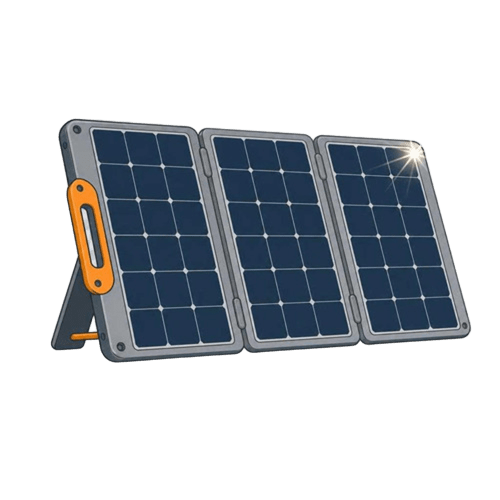
Anker SOLIX C1000 Gen2 Review: A 1024Wh Kit That Wall-Charges in 49 Minutes and Ships With Its Own Panel
At a Glance
KEY FEATURES
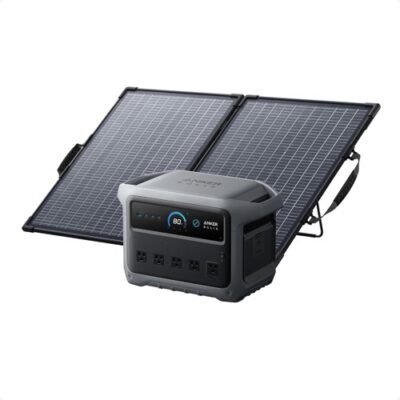
- Exact kit: Anker SOLIX C1000 Gen 2 with PS100 Compact 100W bifacial panel.
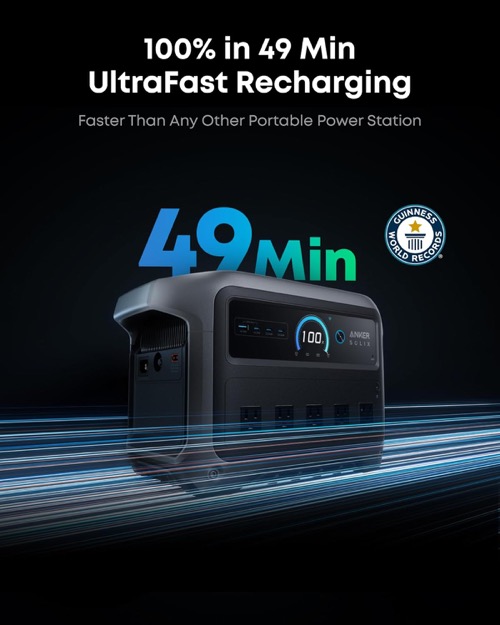
- Station: 1,024Wh LFP, 2,000W continuous AC, and 3,000W surge.
- Solar mismatch: 100W included versus a 600W station input ceiling.
- Fast recovery: Up to 1,600W AC input and a published 49-minute HyperFlash full charge.
- Evidence confidence: Only seven usable exact owner records; commissioning matters more than broad inference.
PROS
- 2,000W output is unusually strong for a compact 1kWh station.
- HyperFlash can restore the battery rapidly from a suitable AC source.
- PS100 Compact is light, small, and one owner observed about 94W.
- Wi-Fi/Bluetooth app and rich USB-C outputs improve daily use.
CONS
- 100W panel is only one-sixth of the station's 600W solar ceiling.
- Empty-to-full solar recovery requires roughly 12–14 favorable peak-sun hours in planning.
- Exact-bundle owner evidence is sparse, limiting reliability conclusions.
- A supplied account reports a missing bundle component, so delivery must be audited.
Best fast-charge station with starter solar
Exact documentation plus seven usable exact-bundle owner records. Solar score reflects the 100W-to-600W mismatch; ownership confidence is deliberately capped by the sparse sample. No first-party test.
Evidence-confidence notice: only seven supplied owner records were exact and usable enough for this new bundle. The review therefore relies primarily on exact Anker documentation for limits and uses owner evidence only for observed panel output, use cases, and fulfillment cautions. Sparse evidence is disclosed rather than padded.
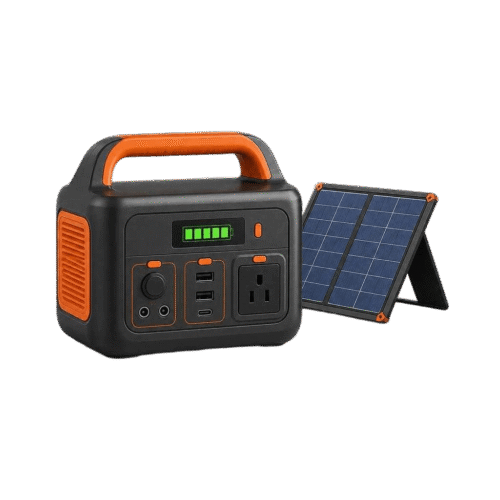
The Anker SOLIX C1000 Gen 2 and PS100 Compact bundle combines a high-output 1,024Wh station with the smallest panel that can reasonably demonstrate its solar input. The station is rated for 2,000W continuous AC, 3,000W surge, up to 600W of solar, and 1,600W AC input. The box includes one 100W bifacial panel. That is a six-to-one gap between receiver ceiling and panel nameplate, so the kit is best understood as a powerful station plus a starter panel.
One exact owner account reports about 94W from the 100W panel under favorable conditions, which is a useful individual observation but not a guaranteed result. Another supplied account describes receiving only part of the order, making fulfillment part of the acceptance process. Camping and home-office backup appear in the small exact-use set. The evidence does not justify broad reliability conclusions, so the verdict is driven by system sizing and verifiable purchase gates.
The Six-to-One Solar Mismatch Is the First Buying Question
The C1000 Gen 2 can accept 600W of solar, while the PS100 Compact is rated at 100W. A small panel is not inherently a bad panel. It is easier to carry, deploy, and store, and it can offset light daytime loads. The problem begins when the buyer expects it to recover 1,024Wh quickly. Idealized division already gives more than ten hours before loss and taper; a practical planning range is roughly 12–14 peak-sun hours under favorable conditions.
That means one 100W panel can work for a weekend with modest phone, laptop, light, and router use. It is poorly matched to daily deep cycling, refrigeration plus cooking, or an outage plan that consumes most of the battery overnight. If solar autonomy is the goal, price an electrically compatible array closer to the station ceiling before deciding the bundle is inexpensive.
Plan One Day of Energy Before You Plan 2,000W of Output
The 2,000W inverter determines which appliances may run; the 1,024Wh battery determines how long the energy lasts. Create a one-day ledger using measured watt-hours. A short microwave task, an eight-hour computer session, and a cycling refrigerator place very different demands on the battery even when all fit below 2,000W.
Apply a conservative usable factor for inverter loss, station overhead, reserve, temperature, and aging. Keep high-draw tasks scheduled and protect a reserve for the device that matters most. If the daily consumption exceeds the panel’s daily harvest, the state of charge will fall even though the display occasionally shows strong solar input.
| Mission | Likely system constraint | Buying response |
|---|---|---|
| Home office continuity | Daily watt-hours and restoration behavior | Measure the complete desk/network load and test the UPS sequence |
| Weekend camping | Panel storage and daily harvest | 100W may work when cooking/heating loads are excluded |
| Refrigerator outage | Compressor start plus overnight energy | Prove startup and compare 100W harvest with duty-cycle consumption |
| Heavy appliance use | Battery energy, not just inverter rating | Schedule tasks and retain AC or a larger PV recovery path |
A 94W Observation Is Encouraging, Not a Forecast
One supplied owner observed about 94W from the PS100 Compact, close to its nameplate. That demonstrates the exact panel can deliver useful input in suitable conditions. It does not mean every hour will look the same. Cloud, shade, sun angle, panel heat, rear-side exposure, cable loss, battery state, and active output all change what the station accepts.
Because the panel is bifacial, give the rear surface light and clearance rather than laying it flat on dark ground. Record watt-hours over the full solar window, not only the best peak. If output is unexpectedly low, test with the short included cable, remove shade, change angle, confirm connector seating, and leave enough battery headroom to accept charge.
- Identity: confirm PS100 Compact rather than another Anker 100W revision.
- Geometry: direct front sun plus useful rear reflection and clearance.
- Electrical: dry, fully seated MC4-to-XT60i path with correct polarity.
- Receiver: battery below the taper region and solar input enabled.
- Evidence: time, weather, angle, input watts, state of charge, and active load.
HyperFlash Solves a Different Problem Than the Panel
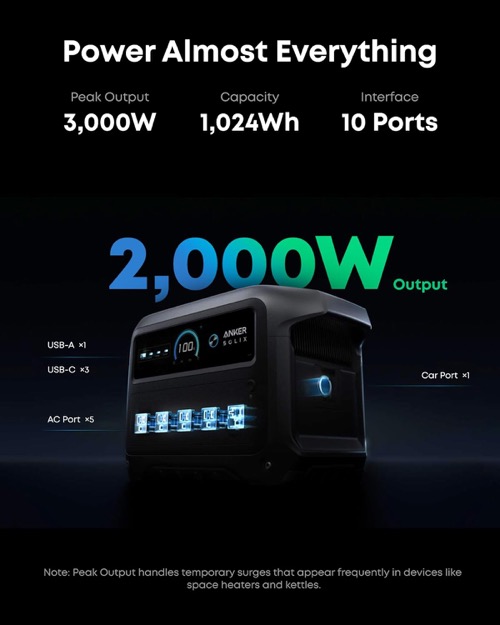
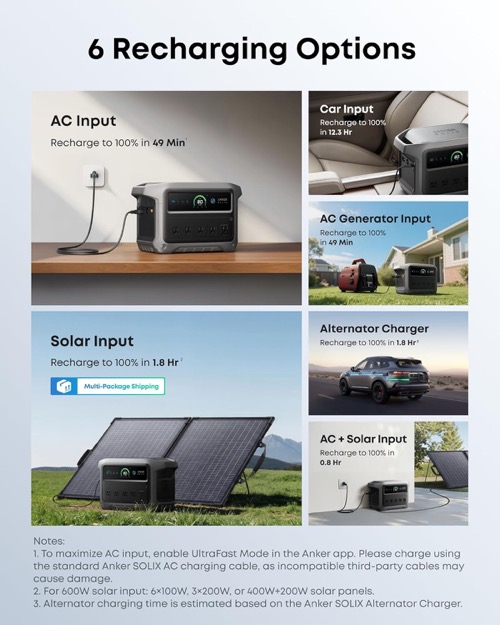
Anker publishes a 49-minute full-charge route when HyperFlash is enabled in the app and the source supports the required input. That is a major advantage during a short utility window. It also highlights the bundle’s two charging modes: the wall can reset the battery quickly; the 100W panel preserves energy slowly. Both can be useful, but they should not be described as equivalent.
Fast AC charging demands a suitable circuit and ventilation and may increase fan noise. Record the input setting before connecting to a campground, shared circuit, or generator. Use a lower rate when time permits, and reserve HyperFlash for short recovery windows if that better fits noise and circuit limits.
The 2,000W Inverter Is Broad, but Not Universal
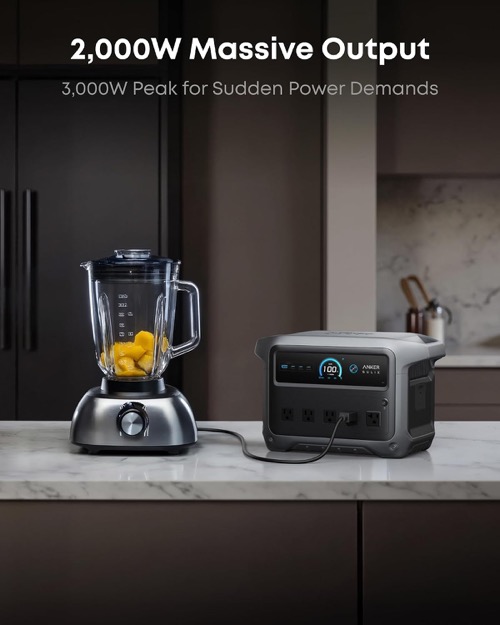
The continuous output gives the station meaningful capability for kitchen tasks, refrigeration, computers, tools, and travel appliances. Verify startup behavior for compressors and motors. The 3,000W surge figure is not an alternate continuous rating and does not create support for 240V equipment. Disconnect other loads when proving the hardest start.
For home backup, use safe direct connections or compatible listed transfer equipment. Never backfeed a receptacle. A well pump, central air conditioner, dryer, or other 240V circuit requires the correct voltage and approved integration, not merely enough total watts. If uninterrupted computing matters, complete a utility-loss and restoration drill on the actual equipment.
Strong fit when the measured load and restoration test pass.
Good for scheduled appliances, but one 100W panel will not replace heavy daily use.
Plausible after compressor-start and duty-cycle measurement.
Outside the default bundle mission without additional compatible equipment and design.
Compact Hardware Still Needs a Complete Delivery Audit
The C1000 Gen 2 weighs 24.9 pounds and the PS100 Compact about 7.7 pounds, making the system much easier to move than home-backup trolley units. The panel folds small, but the station and panel may ship separately. One exact supplied account reports a missing component. Treat every bundle as incomplete until both exact model labels and all cables are present.
Photograph the packages, serials, panel cells, stand, connectors, and cable ends. Charge from AC, vehicle, and solar. Run every output family. Confirm app pairing and local controls. A sparse owner record makes your own acceptance data more important because there is less external evidence to resolve a problem later.
- Match ASIN, station model, and PS100 Compact label.
- Inventory AC cable, car cable, extensions, and both solar adapters.
- Test the panel near the station before adding extension length.
- Run a stable load and the hardest planned startup separately.
- Save invoice, serial photos, firmware version, and support transcript.
App Features Add Control—and a Commissioning Obligation
Wi-Fi and Bluetooth control can make charge rate, reserve, and operating modes easier to manage. It also means the delivered behavior may depend on configuration and firmware. Record the initial version and a known-good setup. Do not update immediately before an outage unless there is time to repeat the critical tests.
Anker publishes UPS support with a fast transfer figure, but the protected device determines whether that interruption is acceptable. Test transfer, endurance, low-battery shutdown, and restoration. Use a dedicated online UPS where zero transfer, voltage regulation, or controlled shutdown is required.
When the 100W Bundle Is Actually the Right Choice
The exact bundle works well for buyers who prioritize a capable station, fast wall recovery, and a small solar panel for phones, laptops, lights, or gradual top-up. It can also be a first solar module while the owner learns array design. Portability is better than a 400–600W multi-panel set, and one owner observation near nameplate is encouraging.
Choose another package when the panel is expected to recover a deeply cycled battery every day, especially in winter or while appliances run. Compare the station alone, a bundle with more PV, or a compatible custom array. Also pause if the purchase depends on a large owner-reliability record; this exact new bundle does not yet have one in the supplied evidence.
The Port Layout Favors Modern Electronics but Still Has Shared Limits
Two high-power USB-C outputs are valuable for laptops, cameras, drones, and device charging because they can avoid AC conversion. Confirm each device’s supported power-delivery profile and the station’s total shared-output behavior. A 100W label on two ports does not automatically mean every USB and AC connector can deliver its individual maximum at once. Test the real device mix and watch total output.
The 12V car socket can be useful for a compatible cooler or vehicle accessory, but plug shape is not a guarantee of voltage tolerance, current, polarity, or regulated behavior. Use the device manufacturer’s approved cable and account for overnight hours. Turn off output groups that are not needed; a 1kWh battery used for very small loads can lose a noticeable share to always-on conversion overhead.
Low-Temperature Use Requires More Than a Weather Forecast
The exact documentation publishes different charge and discharge temperature ranges. A battery may supply power at a temperature where charging is restricted. Do not assume a cold panel and cold station can accept full solar immediately. Store and operate the station within documented conditions, allow it to reach an approved charging temperature, and keep condensation in mind when moving between cold and warm environments.
Cold weather also raises panel open-circuit voltage and reduces available solar hours. Any expanded array needs a cold-corrected voltage calculation. A compact 100W panel may be easy to place in winter sun, but it cannot overcome a short day and high heating load. Resistance heating is especially poorly matched to a 1kWh battery; protect communications, refrigeration, controls, and lighting first.
A Sparse Evidence Product Needs a Scheduled Recheck
Because this exact bundle is new and the supplied owner record is small, repeat the audit after several months of indexed reviews, firmware releases, and support documentation. That future update should not merely add praise or complaints. It should check whether the exact ASIN remains the same station/panel combination, whether accessories or warranty terms changed, and whether recurring identity-explicit patterns emerge.
Until then, the strongest buyer protection is local: document delivery, test every source and output, keep the 100W-to-600W mismatch visible, and choose the system for what can be proved today.
Price monitoring should use the same exact bundle identity. A discount on the station alone, an older C1000 generation, or a different PS100 panel is not a direct comparison. Capture the ASIN, station revision, panel revision, warranty terms, and included adapters for every competing offer. A seemingly higher-priced package can be cheaper once the compatible solar cable and a panel sized for the actual recovery mission are included.
Bottom Line: Powerful Station, Token-Sized Solar Recovery
The SOLIX C1000 Gen 2 is the clear reason to buy this kit. It provides high AC output, fast wall charging, a strong port set, and portable 1kWh-class storage. The PS100 Compact is credible and easy to carry, but it is only one-sixth of the station’s solar-input ceiling.
Buy the exact bundle if small-panel portability and light daily solar offset match the mission. If the battery will be cycled deeply or solar is the primary recovery path, budget for a larger compatible array before purchase. The low owner-evidence volume also calls for an unusually thorough delivery and commissioning test during the return window.
Pros & Cons Analysis
Based on documented specifications and owner feedback
Pros
- Station capability is the anchor — The 1,024Wh LFP battery and 2,000W inverter support a wide range of travel, office, and household tasks after startup verification.
- AC recovery is genuinely fast — High input can reset the station during a short utility window, reducing dependence on perfect solar weather.
- The panel travels easily — A compact 100W module is simpler to store and deploy than a 400–600W array.
- Observed solar can approach rating — One exact owner saw about 94W under favorable conditions, showing the included panel can provide meaningful input.
- Controls are flexible — App-adjustable behavior and multiple high-power USB-C ports suit modern device-heavy use.
Cons
- Solar sizing is the central compromise — A 100W module cannot exploit the 600W receiver and is slow relative to a 1,024Wh battery.
- High output can hide short runtime — A 2,000W-capable appliance can consume the battery quickly even though it stays within the inverter limit.
- Sparse evidence needs restraint — Seven exact usable records cannot support failure rates or confident claims about typical long-term ownership.
- Fulfillment is a system risk — Station and panel may ship separately, and missing hardware can make the advertised kit unusable.
- Software-dependent modes require records — Charge rate, reserve, UPS behavior, and firmware should be documented and retested after changes.
A High-Performance Station Sold With a Low-Power Starter Panel
The C1000 Gen 2 is compelling for high output and exceptionally fast AC recovery. The included 100W panel is portable and useful for light offset, but solar-first buyers should plan a larger compatible array and treat the sparse owner record with appropriate caution.
Frequently Asked Questions
How long will the 100W panel take to charge the C1000 Gen 2?
Planning is roughly 12–14 peak-sun hours from empty under favorable conditions, and longer with cloud, shade, heat, cable loss, taper, or active loads.
Can I add more solar?
Yes, the station accepts up to its documented limit, but every panel/string must match the exact voltage, current, connector, and polarity requirements. Do not expand by wattage alone.
Can the C1000 Gen 2 run a microwave or refrigerator?
Many such loads fit its output, but measure running energy and test compressor or microwave behavior on the exact unit. Runtime depends on watt-hours, not only the 2,000W rating.
Is the PS100 Compact bifacial?
Yes. Rear-side contribution depends on reflected light and clearance; do not assume a fixed bifacial gain in every placement.
How strong is the owner evidence?
The supplied exact-bundle pool contains only seven usable records. It supports limited observations, not a population reliability conclusion.
What should I check when it arrives?
Confirm both exact boxes, models, serials, all cables/adapters, panel condition, AC/vehicle/solar charging, every output family, app pairing, and the hardest planned load during the return window.
Technical Specifications
| Brand | Anker |
|---|---|
| Kit model / SKU / ASIN | SOLIX C1000 Gen 2 + PS100 Compact bundle (ASIN B0GYDL6PHP; US) |
| Power-station model | Anker SOLIX C1000 Gen 2 |
| Included solar-panel model and quantity | 1 × Anker SOLIX PS100 Compact 100W bifacial portable panel |
| Battery capacity | 1,024Wh |
| Battery chemistry | LiFePO4 (LFP) |
| Cycle-life rating | 4,000 cycles to at least 80% capacity |
| Expandable capacity | No expansion-battery port published for C1000 Gen 2 |
| Continuous AC output | 2,000W |
| Surge / peak output | 3,000W |
| AC voltage, frequency, and waveform | 120V, 60Hz, pure sine wave |
| AC outlets and high-current / RV / 240V outputs | 5 × 120V AC; no 30A RV or 240V output |
| USB and DC outputs | 3 × USB-C (2 × 100W, 1 × 15W), 1 × USB-A, 1 × 12V car socket |
| Maximum station solar input | 600W |
| PV input voltage/current range and connector | 11–28V DC / 8.2A; 28–60V DC / 14.5A; XT60i |
| Included panel rated power | 100W |
| Panel Voc / Vmp / Isc / Imp | Published operating point: 16.8V / 5.95A; Voc and Isc are not published for the exact PS100 Compact |
| Panel construction and cell type | Foldable bifacial monocrystalline panel with integrated stand |
| Panel weather rating | IP68 panel |
| Panel dimensions and weight, folded / deployed | Folded 14.0 × 10.9 × 2.6 in; deployed 46.5 × 28.0 × 0.9 in; 7.7 lb |
| Solar recharge estimate with included panel | Calculated about 12–14 peak-sun hours from empty with 100W; Anker's 1.8-hour figure requires a 600W array |
| Maximum AC input and AC recharge time | 1,600W; 0–100% in 49 minutes with HyperFlash enabled in the Anker app |
| Car, alternator, and other charging methods | 12V vehicle charging through the included car cable |
| UPS / EPS support and transfer time | UPS supported; under 10ms transfer |
| App and connectivity | Anker app over Wi-Fi and Bluetooth |
| Station dimensions, weight, operating limits, and weather rating | 15.1 × 8.2 × 9.6 in; 24.9 lb; charge 32–104°F, discharge -4–104°F; station has no published IP rating |
| Station and panel warranties | Station 5 years; panel term is not published on the exact US bundle page |
| Included in the box | C1000 Gen 2, AC cable, car cable, guides; PS100 Compact, two MC4 extensions, MC4-to-XT60i and XT60-to-DC7909 cables |