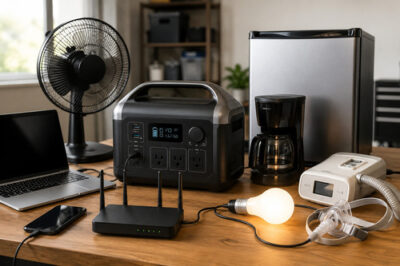
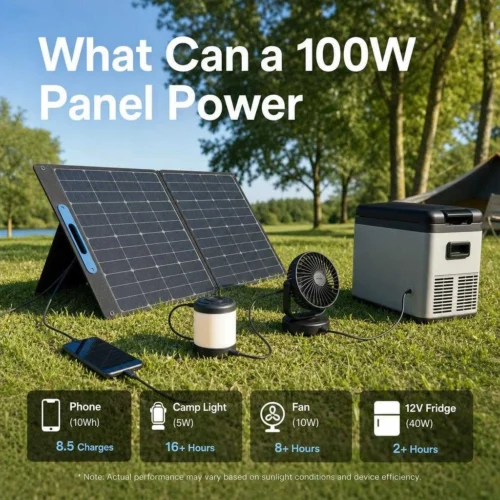
A 100W solar panel makes roughly 288-400 Wh of usable energy on a good day — enough to charge phones, tablets, and a laptop, run LED lights, a Wi-Fi router, a small fan, and a CPAP machine overnight, keep a small 12V fridge cold for part of the day, or top up a portable power station. What it can’t do is run high-draw AC appliances. A microwave, kettle, hair dryer, space heater, or air conditioner pulls more power in a few minutes than a 100W panel harvests in an entire day.
The catch most people miss: a “100W” panel almost never puts out 100W. That number is a lab rating under perfect sun and temperature. In real conditions you’ll see closer to 60-80W in strong light, and the total energy you collect depends on how many good sun hours you get. So the honest way to think about a 100W panel isn’t “100 watts” — it’s “about 300 watt-hours a day, in good weather.”
Key Takeaways
- Think in watt-hours, not watts — a 100W panel harvests roughly 288-400 Wh on a good day, not a steady 100W.
- Great for small loads — phones, laptops, lights, routers, fans, CPAP, and topping up a power station.
- A 12V fridge is borderline — it can run one for part of a day, but not reliably around the clock by itself.
- You need storage — a battery or a power station holds the energy so you can use it at night and run things steadily.
- High-draw AC appliances are out — anything with a heating element or a compressor-driven AC unit needs far more panel.
The Daily-Energy Math Behind a 100W Panel
Everything starts with one simple formula. The energy a panel collects in a day is its wattage times a real-world efficiency factor times the number of peak sun hours where you live:
- Daily energy (Wh) = panel watts × real-world factor × peak sun hours
- The real-world factor is about 0.7-0.8 — it accounts for heat, imperfect angle, dust, wiring, and controller losses that keep a panel from ever hitting its lab rating.
- Peak sun hours is not the same as daylight hours. It’s the number of hours per day the sun is strong enough to count as full power — typically 4-5 hours across most of the US in decent weather, less in winter or cloudy regions.
Run the numbers for a 100W panel and you get a realistic range:
- Low end: 100W × 0.72 × 4 hours = ~288 Wh/day
- High end: 100W × 0.80 × 5 hours = ~400 Wh/day
This isn’t just theory. In our hands-on reviews, real 100W panels land right in this band. The ZOUPW 100W portable panel commonly delivers 60-80W in good sun and works out to about 300 Wh/day across four peak sun hours. The Renogy 100W flexible panel is similar — owners measured 5.9 amps in full sun, and it collects roughly 280 Wh/day once you apply a realistic factor. So plan around ~300 Wh on a good day, and treat 400 Wh as the ceiling for a bright summer day with the panel angled well.
Want to run these numbers for your own panel and location? Our guide to how much power a solar panel produces walks through the math in more detail.
What a 100W Panel Can Actually Run — Device by Device
Here’s where the ~300 Wh/day budget goes in practice. The table shows the typical power draw of common devices and roughly how much a 100W panel’s daily harvest supports. Remember these are approximate — your real numbers depend on sun, season, and the exact device.
| Device | Typical Power Draw | What ~300 Wh/Day Supports |
|---|---|---|
| Smartphone | 5-10W (~12 Wh per full charge) | 20-25 full charges |
| Tablet | 10-20W (~20 Wh per charge) | 12-15 full charges |
| Laptop | 30-65W (~50 Wh per charge) | 5-6 full charges |
| LED lights | 5-10W each | Three lights for ~10 hours, easily |
| Wi-Fi router | 6-12W | Runs 24 hours (uses ~150-290 Wh) |
| Portable fan | 10-30W | 10-25 hours of run time |
| CPAP (no heated humidifier) | 30-40W | ~8 hours — one full night |
| 32-inch LED TV | 30-50W | 6-8 hours of viewing |
| Small 12V fridge | 40-60W running (cycles on/off) | Part of a day — see below |
| Satellite internet (Starlink) | 50-75W | 4-6 hours (a heavier, steady draw) |
Notice the pattern: a 100W panel is a small-electronics and low-draw workhorse. It keeps phones, lights, internet, and entertainment going indefinitely off-grid. Where it starts to strain is anything that runs continuously at 50W or more — and where it hits a wall entirely is heating and cooling appliances.
To be clear about what’s off the menu: a microwave (700-1,200W), an electric kettle (1,000-1,500W), a hair dryer (1,200-1,800W), a space heater (1,500W), and a window air conditioner (500-1,500W) all draw more in a single minute than a 100W panel collects in a whole day. No 100W panel runs those, battery or not.
Will a 100W Solar Panel Run a 12V Fridge?
This is the single most-asked question about 100W panels, and the honest answer is partly — it depends on the fridge and your sun. Let’s work it out.
Worked Example: The 12V Fridge Math
A small 12V compressor fridge — the 30-45 quart cooler style popular for camping and vans — draws about 40-60W while the compressor is running. But the compressor doesn’t run constantly. It cycles on and off to hold temperature, typically working 40-60% of the time depending on how hot it is outside and how often you open the lid.
- Fridge daily use: ~45W average draw × roughly 50% duty cycle × 24 hours ≈ 350-600 Wh/day
- 100W panel daily harvest: ~288-400 Wh/day in good sun
Line those up and the picture is clear. On a bright summer day with an efficient, well-insulated fridge, a 100W panel can cover most or nearly all of the fridge’s daily appetite — enough to run it for a good chunk of the day and keep a battery from draining fast. But on a hot day, in partial shade, or in winter with fewer sun hours, the fridge will out-eat the panel and you’ll lean on the battery to make up the gap.
So a 100W panel can help run a small 12V fridge, and in ideal conditions it can nearly break even — but it is not a reliable way to keep a fridge cold around the clock on its own. For dependable 24/7 fridge duty, pair the fridge with a decent battery buffer and step up to 150-200W or more of panel so you’re comfortably ahead of the daily draw even on bad-weather days.
Why You Need a Battery or Power Station
A solar panel has one fundamental limitation: it only makes power while the sun is shining on it, and even then the output rises and falls with clouds and angle. That’s fine for charging a phone in real time, but it’s useless for running a light at night or keeping a fridge steady. The fix is storage — you charge a battery during the day and draw from it whenever you need to.
There are two ways to do this:
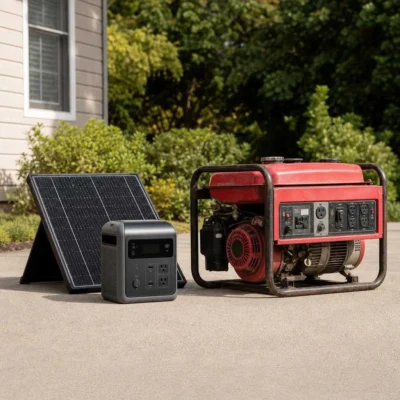
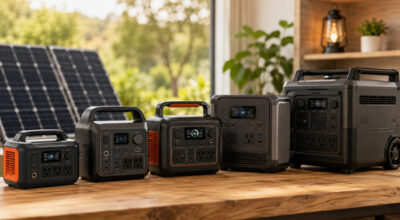
- A portable power station — the simplest option. These have a battery, an inverter, and a built-in MPPT charge controller all in one box. You plug the 100W panel straight into the solar input, and the station handles everything: voltage regulation, charging, and giving you clean AC outlets and USB ports on the other side. No wiring, no separate controller. This is the most common and beginner-friendly way to use a 100W panel.
- A raw 12V battery plus a charge controller — the traditional off-grid approach. Here you wire the panel to a separate MPPT or PWM charge controller, which safely charges a standalone 12V battery. It’s more flexible and often cheaper per watt-hour, but you assemble and size the parts yourself.
Either way, the storage is what turns a 100W panel from “a trickle of daytime power” into “a small system you can actually live off.” The panel fills the tank; the battery lets you spend it whenever you want.
How Many Batteries Do You Need for a 100W Panel?
For a 100W panel, the answer is almost always one — and the reason is worth understanding. The panel is the bottleneck, not the storage. A 100W panel only harvests about 288-400 Wh on a good day, so you don’t need much battery to hold it.
- A single 12V 50-100Ah battery is the natural match for a 100W panel.
- A 100Ah 12V battery holds roughly 1,200 Wh nominal (about 600 usable Wh for lead-acid at 50% depth of discharge, or close to 1,000-1,200 Wh for LiFePO4).
- Because the panel only makes ~300 Wh/day, it would take two to four sunny days to fully refill a deeply drained 100Ah battery from empty.
That last point is the key takeaway: adding a second battery to a lone 100W panel usually doesn’t help, because the panel can’t keep up with the storage you already have. You only add batteries when you also add panels. If you’re using a power station, this is moot — the battery is built in, and you just match the station’s size to how much energy you need to bank overnight.
When to Step Up to 200W or More
A 100W panel is the right size for a lot of people — weekend camping, keeping phones and lights going during an outage, running a CPAP, or topping up a small power station. But there are clear signals that you’ve outgrown it and should jump to 200W or beyond:
- You want to run a 12V fridge 24/7 — the single biggest reason people upgrade. Getting comfortably ahead of a fridge’s daily draw takes 150-200W or more.
- You’re charging a big power station — a 1,000 Wh-plus station will take days to refill on 100W. Double or triple the panel to fill it in a day.
- You have a larger battery bank — if you’ve moved past a single 100Ah battery, a 100W panel can’t refill it fast enough to be useful.
- You live somewhere cloudy or you rely on winter sun — fewer peak sun hours means less daily harvest, so you need more panel to hit the same watt-hours.
- You need any real headroom — if your daily use is bumping up against ~300 Wh, a bigger panel gives you margin for bad-weather days instead of running your battery flat.
Not sure exactly how much panel you need for your gear? Plug your devices and sun hours into our solar panel output calculator to size a setup in a couple of clicks. And if a 100W panel is the right call, our roundup of the best 100W portable solar panels covers the models worth buying.
The Bottom Line
So, what can a 100W solar panel power? Think of it as about 300 watt-hours of energy on a good day — plenty for phones, tablets, laptops, lights, a router, a fan, a CPAP overnight, and topping up a power station, with enough left to help run a small 12V fridge for part of the day. Pair it with a battery or a power station so you can actually use that energy when you need it, and keep your expectations grounded: it’s a small, dependable off-grid workhorse, not a substitute for the grid.
The moment you want to run a fridge around the clock, refill a large power station in a day, or cover higher-draw loads, that’s your cue to move up to 200W or more. But for keeping the essentials alive off-grid and through outages, a single 100W panel and one battery is a genuinely useful little system.

Leave a Reply