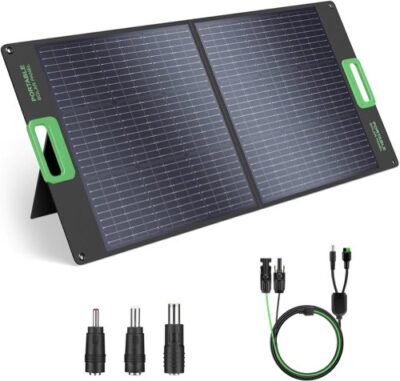
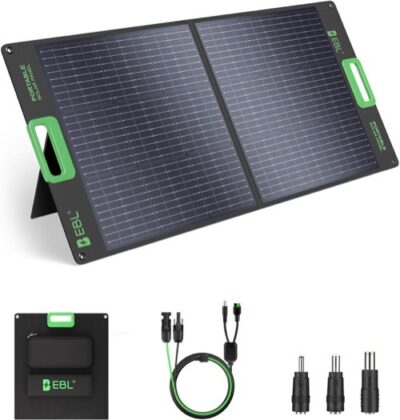
A 100W panel delivers roughly 328 Wh on a clear 4-peak-sun-hour day — enough to put about two-thirds of a 500Wh power station back in the tank — and that one number is the lens we used to rank the best 100w portable solar panels here. It’s not a spec-sheet abstraction. It’s the energy you actually carry back to camp or feed into a 12V battery, and it’s where the real differences start.
Since every panel on this list is rated the same 100W, the spec sheet stops being useful fast. What actually separates them is real-world output — a foldable panel feeding a station’s MPPT delivers more than a rigid one wired through a cheap PWM controller — plus format (a 4 lb foldable versus a 13 lb rigid frame), the connector match for your power station, and whether the panel has any certified weatherproofing at all. Two “100W” panels can hand you very different days.
This guide ranks eight 100W panels by what they realistically put back in a day, then sorts them by who they’re for: foldable for power-station campers, rigid for a fixed 12V install, kit-with-controller for first-time 12V buyers, and budget for cost-first shoppers. Weight here spans about 4 lb to 13 lb, and connectors run from USB-rich foldables to MC4-only rigid frames. Honestly, that range is the whole story at this tier.
Not Sure 100W Is Enough?
Our Solar Panel Output Calculator estimates how much energy a 100W panel produces per day based on your location’s sun hours — so you can see whether 328 Wh covers your power station, a 12V battery, or a day of devices before you buy.
Use the Solar Calculator — Jump to What 100W Powers
How We Chose the Best 100W Portable Solar Panels
We didn’t run these in a lab, and we won’t pretend otherwise — our rankings lean on manufacturer specs, the connector and IP details printed on each panel, and what owners report in real sun conditions. Because every panel is 100W, we ranked on what actually varies at this tier: real-world daily output (cell quality, efficiency, and the controller path the power flows through), format (foldable portability versus rigid efficiency at a fixed angle), connector match for the most common power stations, certified weatherproofing, and what’s in the box — a kit with a controller versus a bare panel. That’s how we sorted the best 100W portable solar panels into clear buyer types rather than a single “winner.”
| Criterion | Why It Matters at the 100W Tier | Weight |
|---|---|---|
| Real-world output (vs rated 100W) | Every panel claims 100W; what reaches the battery depends on cell quality and controller path | High |
| Format (foldable vs rigid) | 4 lb foldable for power stations vs 13 lb rigid frame for a fixed 12V mount — two different buyers | High |
| Connector compatibility | XT60, Anderson, DC, MC4 — the right plug is what lets a 100W panel actually charge your station | High |
| IP weatherproofing rating | Several budget 100W panels carry no certified IP rating — that matters for anything left outside | Medium |
| What’s in the box | A kit with a PWM controller and cables vs a bare panel changes the real cost of getting started | Medium |
| USB outputs | Foldables with USB-C/USB-A charge phones without occupying the power station’s ports | Low |
| Warranty and brand support | Longer warranty = more confidence for a panel that lives outdoors | Low |
Selection criteria:
- Real-world output — N-Type/high-efficiency mono into a station’s MPPT (~0.82 factor) vs PWM/direct (~0.68); rated watts are not delivered watts
- Format — foldable for portability and power stations; rigid for a fixed-angle 12V install
- Connector compatibility — native or included cables for EcoFlow (XT60), Jackery (DC8020/DC7909), Bluetti, plus MC4 for controllers
- IP rating — certified IP65/IP67 preferred; flag any panel with no certified rating
- What’s in the box — bare panel vs full kit (controller, cables, bag)
- USB outputs — direct device charging without occupying the power station
- Weight — roughly 4 lb (FlexSolar) to 13 lb (Renogy rigid) across this lineup
- Warranty — longer coverage preferred for an always-outdoors product
What One 100W Panel Actually Powers Per Day
Let’s turn the abstract “100W” into one honest daily number, then into devices you recognize. At 4 peak sun hours with a 0.82 real-world factor — a good foldable feeding a station’s built-in MPPT — a 100W panel delivers roughly 328 Wh per day. Run that same panel through a basic PWM controller into a 12V battery and you land closer to 272 Wh. Here’s what that energy realistically recovers.
| Device / Power Station | Typical Capacity or Daily Draw | What ~328 Wh/Day Does |
|---|---|---|
| EcoFlow RIVER 2 (256Wh) | 256 Wh | Full recharge with headroom on one good sun day |
| Jackery Explorer 500 / EcoFlow RIVER (~500Wh) | ~500 Wh | About 65% recovered per day — roughly 1.5 sunny days to full |
| Power station ~1000Wh | ~1000 Wh | About a third per day — pair two 100W panels to keep up |
| 12V fridge / cooler | ~300-450 Wh/day | Covers a small efficient fridge on a clear day; tight in heat |
| Phone charges | ~12-15 Wh each | Roughly 20+ full phone charges of energy |
| Laptop charges | ~50-60 Wh each | About 5-6 laptop charges, or one laptop plus lights and a fan |
Real-World Math — That 328 Wh comes from 100W × 4 PSH × 0.82. Drop to a cloudy day at 2 effective sun hours and you’re closer to 160 Wh — half a phone-heavy day, not a full station recharge. Push to a sunny 5-PSH afternoon and a clean foldable can clear 400 Wh.
How to Choose a 100W Portable Solar Panel
What to prioritize when buying a 100W panel:
- Real daily output, not just the “100W” label — check cell efficiency and the controller path
- The right format for the job — foldable for power stations, rigid for a fixed 12V mount
- A connector that matches your station — XT60 (EcoFlow), DC8020 (Jackery), MC4 for controllers
- Certified IP65/IP67 if the panel lives outside — several budget 100W panels have none
- USB-C/USB-A output if you also want to charge phones without the station
Common buyer mistakes at the 100W tier:
- Treating all “100W” panels as equal — output varies by cell quality and controller
- Buying a rigid 13 lb frame when you wanted a foldable for camping (or vice versa)
- Wiring a bare 100W panel straight to a 12V battery with no charge controller
- Ignoring whether the panel has any certified IP rating before leaving it in the rain
Why 100W Is the Sweet Spot
For one-person setups, 100W is the most popular portable tier for a reason. It’s enough to meaningfully recover a small-to-midsize power station in a day, light and compact enough to actually carry, and far cheaper per usable day than a single 200W slab. A 60W panel often charges a station too slowly to keep up with real loads, while a 200W panel is heavy and frequently overkill unless you’re running a 12V fridge full-time. In practice, 100W is the line where portability and useful output meet. If you want the head-to-head, see our 100W vs 200W portable solar panel comparison. The takeaway: for most campers and power-station owners, one or two 100W panels is the right call.
Worth Knowing — Two 100W foldables often beat one 200W panel for flexibility: you can split them across two stations, angle them separately, and carry them in two lighter loads. The catch is two sets of cables and connectors to manage.
Real-World Output From a 100W Panel
The label says 100W at Standard Test Conditions — real output is always lower. Here’s how the factors play out across this lineup:
- High-efficiency / N-Type mono feeding a station’s built-in MPPT: ~0.82 factor (~328 Wh/day at 4 PSH)
- Standard mono through direct/IC output: ~0.78 factor
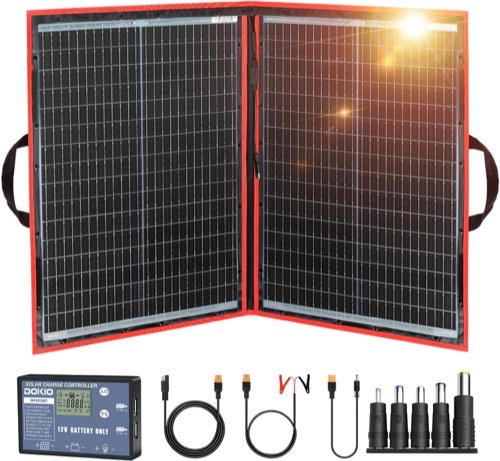
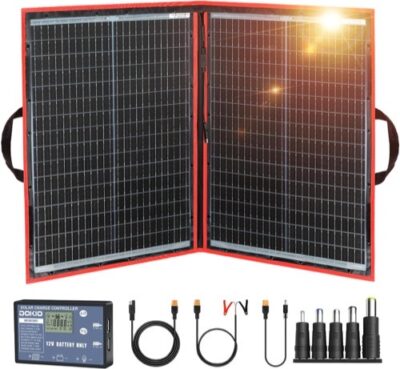
- Through a basic PWM controller into a 12V battery (DOKIO kit): ~0.68 factor (~272 Wh/day)
- Bifacial (HQST): front-side comparable to mono, plus a rear-side gain on bright or reflective ground
Notice the spread. The same nominal panel can hand you anywhere from 272 to 328 Wh on the same day depending on how the power flows. For the full breakdown, our guide on how much power a solar panel produces walks through the math. The takeaway: at this tier, the controller path and cell quality move the number more than the brand name does.
Foldable vs Rigid 100W Panels
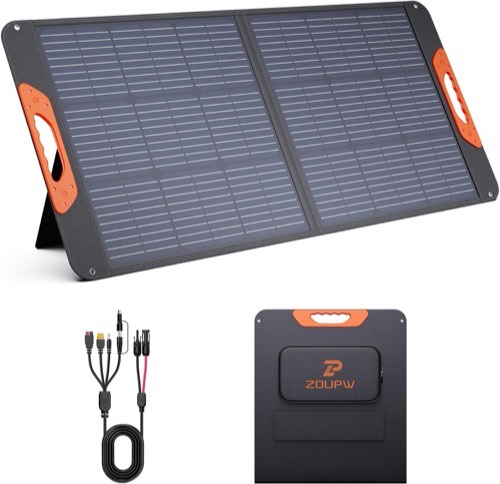
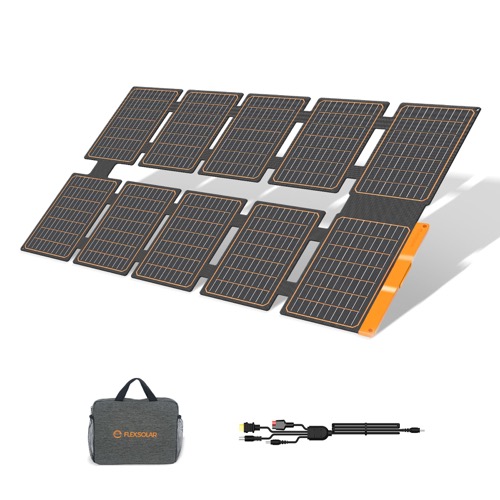
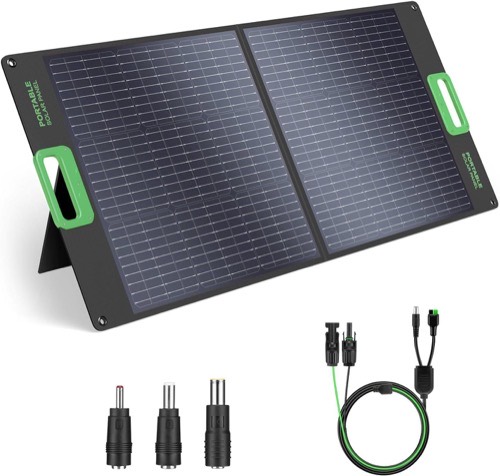
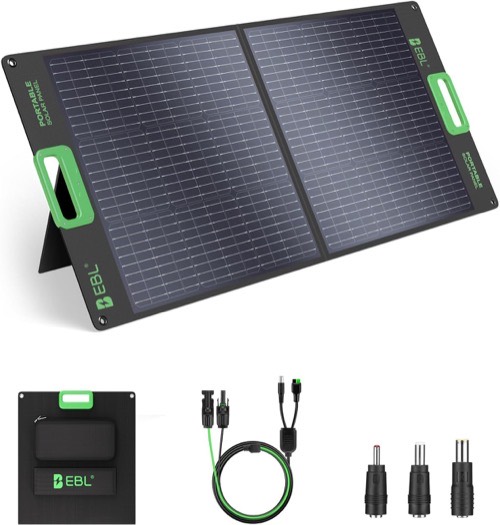
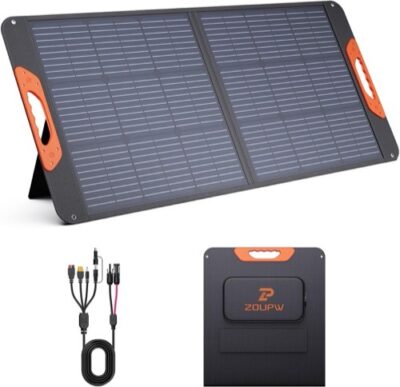
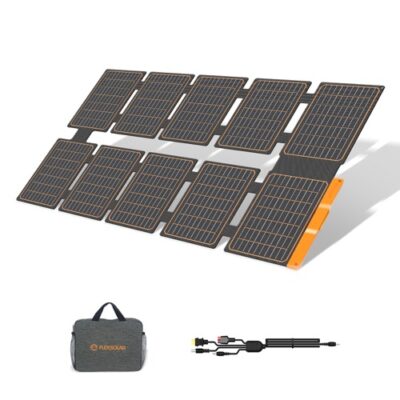
This is the core format split in the lineup. Foldables — the ZOUPW, FlexSolar, DOKIO kit, GRECELL, EBL, plus the unbranded pick — pack down, carry easily, and deploy on kickstands or carabiners, which makes them ideal for power-station charging and camping. Rigid framed panels like the Renogy 100W and HQST bifacial are heavier at 12-13 lb, but they’re cheaper per watt and built for a fixed-angle 12V install on a roof, shed, or ground mount. As a rough rule, anything under about 6 lb is genuinely backpack-friendly, while a 13 lb rigid frame wants a permanent home. Pick the one that matches how you’ll actually use it.
Best Practice — Pick the format from the use case, not the price. If you’re charging a power station and moving around, a foldable like the ZOUPW or FlexSolar is worth the small premium. If the panel will live bolted to a van roof or a cabin wall, the rigid Renogy or HQST gives you more output per dollar.
Connectors & Power Station Compatibility
The plug decides whether your 100W panel charges anything at all. Here’s how the lineup maps to real stations:
- USB-rich foldables with many adapters: ZOUPW (XT60 + Anderson + DC5521/7909/8020 + USB-C + 2× USB-A) and FlexSolar (USB-A/C + XT60 + Anderson + DC5521 + DC8MM)
- MC4-based panels that need an adapter for most stations: GRECELL, EBL, Renogy, HQST, and the unbranded pick
- The major station inputs: EcoFlow (XT60), Jackery (DC8020/DC7909), Bluetti (T500/aviation), Anker SOLIX (XT60)
These 100W panels output roughly 18-20V, which sits inside the input range of most portable stations — but confirm your station’s solar input ceiling and connector before you buy. Our portable solar panel for power station guide and the EcoFlow vs Jackery solar panel comparison cover the connector details. The takeaway: connector matters as much as wattage here.
Weatherproofing
The IP rating tells you what a 100W panel can survive outside. In this lineup it breaks down cleanly:
- IP67 panel body: ZOUPW and FlexSolar — handle rain and brief splashing confidently, though connectors and pockets still need care
- IP65: EBL and Renogy (junction box) — fine for rain and spray
- No certified rating: the DOKIO kit, GRECELL, and the unbranded pick — manufacturers imply weather resistance but cite no standard, so treat them as fair-weather or sheltered panels
To be fair, “no certified IP rating” is a real limitation for anything left out overnight, not a marketing nitpick. The takeaway: if your panel will face weather unattended, buy a certified rating.
Buying Note — A panel rated IP67 protects the laminate, not always the connector pocket or USB hub. Even on the ZOUPW and FlexSolar, owners should keep the connector pocket zipped and out of standing water. For panels with no certified rating at all, plan to bring them in if rain is coming.
Do You Need a Charge Controller (12V batteries)?
This is the split that trips up first-time 100W buyers. Charging a power station? No separate controller needed — the station’s built-in MPPT handles it, so you just match the connector. Charging a bare 12V battery — AGM, lead-acid, or LiFePO4 — is different: you need a charge controller, because a bare 100W panel wired straight to a battery can overcharge it and backfeed at night. The DOKIO kit ships with a PWM controller, while the Renogy, EBL, GRECELL, HQST, and unbranded panels are bare and need you to supply one. Our MPPT vs PWM charge controller guide explains the difference. The takeaway: LiFePO4 owners should choose an MPPT controller with an LFP profile.
What Can a 100W Panel Do Across Conditions?
The 328 Wh figure assumes a clean 4-PSH day. Real days vary — here’s how a single 100W panel’s output and best use shift from bright sun to heavy overcast, so you can size expectations before a trip.
| Conditions | Effective Sun Hours | Est. Daily Output (100W) | What It Realistically Covers |
|---|---|---|---|
| Bright, clear sky, panel angled to sun | 5 PSH | ~400 Wh/day | Full ~500Wh station recovery in a day with room to spare |
| Average sunny day, flat or fixed mount | 4 PSH | ~328 Wh/day | About two-thirds of a 500Wh station; a small 12V fridge |
| Hazy or partly cloudy | 3 PSH | ~245 Wh/day | Phones, lights, a laptop; slows station drain rather than reversing it |
| Through a basic PWM controller into 12V | 4 PSH | ~272 Wh/day | 12V battery maintenance and modest daily 12V loads |
| Heavy overcast | ~2 effective | ~160 Wh/day | Topping phones and lights only; not a station recharge |
Cloudy stretches hurt a 100W panel more than buyers expect. Two grey days in a row can leave a power station well behind, so on multi-day off-grid trips, plan for a second panel, a flexible departure, or a wall-outlet top-off — don’t assume one 100W panel keeps up through a storm.
Will Your 100W Panel Work With Your Setup?
Most 100W portable panels output around 18-20V DC, which falls inside the input range of nearly every EcoFlow, Jackery, and Bluetti portable power station — the station’s built-in MPPT does the work, so you only need the right cable. The picture changes when you charge a bare 12V battery: then a separate controller is mandatory. Here’s the quick decision table for the most common 100W setups.
| 100W Charging Scenario | Separate Controller Needed? | Why |
|---|---|---|
| 100W panel to EcoFlow / Jackery / Bluetti power station | No | Station has built-in MPPT; just connect the right cable (XT60 / DC8020) |
| 100W panel to a standalone 12V AGM or lead-acid battery | Yes — PWM or MPPT | No overcharge or backfeed protection without a controller |
| 100W panel to a LiFePO4 battery (van, RV, DIY bank) | Yes — MPPT with LFP mode | LiFePO4 needs a specific charge profile; the wrong one shortens battery life |
| 100W kit with included PWM controller (DOKIO) to 12V | Included (PWM) | Kit ships with a controller; fine for lead-acid maintenance |
| 100W panel to phone / tablet via onboard USB | No | USB output is already regulated; plug your cable directly |
Best Practice — If you ever wire a 100W panel straight to a 12V battery without a controller, the panel can backfeed current at night and slowly drain the battery you meant to charge. Power stations handle this automatically; bare batteries never do. When in doubt, add an MPPT controller with anti-drain protection.