EBL 100W Portable Solar Panel Review: The Budget 100W That Punches Above Its Price Tag — Sometimes
At a Glance
KEY FEATURES
- Power output: 100 W (claimed), monocrystalline silicon (A+ grade cells)
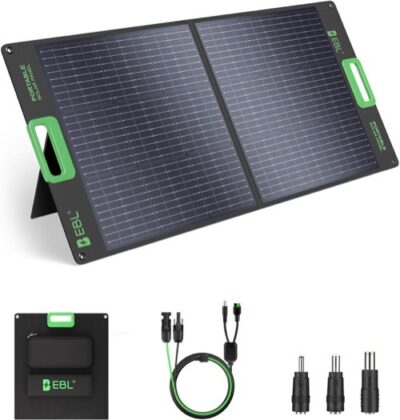
- Output: 18 V DC; MC4 connectors with Anderson and DC5521 pigtail plus barrel adapters
- Cell efficiency: Up to 23% (high tier, per manufacturer)
- Weatherproofing: IP65 — splash-resistant; ETFE laminate surface; aluminum frame
- Charge controller: None — direct connection to a power station or your own controller (not included)
- Best for: Topping up a 300-600Wh power station while camping, RV and off-grid use, 12V battery charging via a controller, and emergency outage backup
PROS
- Strong real output — 70-90W in good sun, up to 99W measured
- IP65 handles dew, light rain, and snow glare without damage
- Wide adapter kit fits Jackery, EcoFlow, Bluetti, and more
- Folds like a briefcase with magnetic clasp and pouch for cables
- Plug-and-play with power stations or a separate controller
- Foldable kickstands plus corner grommets for hanging
CONS
- Never hits the rated 100W; one comparison showed 80W vs a rival's 94W
- Not rated for rain or submersion — splash-resistant only
- No XT60 adapter and no built-in USB port
- Bigger and heavier than photos suggest — around 11 lbs
- Attached cables run short — an extension is often needed
- Legs too short to angle the panel for low winter sun
Editor's Choice
Based on exact documentation and qualitative exact-ASIN Amazon owner evidence; no hands-on test or population-rate claim
This EBL 100W portable solar panel review cuts straight to what matters: does a budget-brand folding panel actually deliver real watts in the field, or is it just another lookalike in a crowded category? The short answer is that it does better than its price suggests — most of the time. Owners consistently pull 70 to 90 watts out of it in good sun, and one careful tester even hit 99W.
Here’s the thing about the 100W folding-panel market: it’s packed. FlexSolar, ZOUPW, Anker, and a parade of generic brands all sell similar-looking briefcase panels at similar prices. So the only question worth asking is whether EBL’s version separates itself — through better build, a broader connector kit, or stronger real-world output — or whether it’s just one more option on a shelf full of options.
Let’s set expectations first. A 100W portable panel is enough to meaningfully top up a 300-600Wh power station over a day of camping. It’s not enough to fast-fill a big unit from empty. The honest measure of the EBL 100W is whether it hits that realistic target reliably and holds up outdoors — and that’s what the rest of this review digs into.
The useful promise
A roughly 100W vehicle-portable panel with a folding body, adjustable support, solar output, and several station-adapter routes.
The compatibility trap
Owners still needed exact-generation adapters for some EcoFlow and Jackery stations, and receiver ceilings can make two working systems show different watts.
Owner accounts make the Solar Apollo easiest to understand as a power-station accessory, not a universal charger. Several buyers describe quick deployment during camping, cabin use, and an outage, and some documented strong input after improving angle or obtaining the correct adapter. Other accounts criticize the stand geometry, the absence or usefulness of direct USB on a particular revision, or incomplete fit with a newer station. Before purchase, match the exact panel revision and exact receiver—not just “EBL 100W” and a brand logo.
The official ESP-100 documentation identifies a 100W panel with a 20V operating voltage and 5A operating current, but EBL has sold more than one Solar Apollo bundle and revision. The delivered label governs. A 100W laboratory nameplate is also not a promise that a station will show 100W: sunlight intensity, cell temperature, angle, cable loss, conversion overhead, receiver limits, and battery taper remain in the path. The strongest owner observations include the station model and adjustment process; bare watt figures without those details carry less weight.
Good fit when a modest station can sit inside while the panel reaches clear outdoor sun through a verified cable.
Good fit if the folded dimensions and roughly briefcase-style weight have a dedicated storage slot.
Possible only on the delivered revision’s supported port path; a power bank smooths cloud interruptions.
Needs a compatible charge controller and battery profile; never connect an unregulated panel directly.
Portability is conditional. Owners like the magnetic closure, cable pouch, and one-hand carry, but the opened panel still needs ground area and stable support. The kickstands attracted both praise and criticism. In calm conditions they simplify setup; on uneven ground or in wind, independent support and anchoring are safer than forcing the fabric legs. Do not drag the panel face, close it on grit, or put concentrated weight on a folded edge.
Read IP65 as splash and dust resistance for the specified assembly, not permission to leave a textile-backed folder exposed indefinitely. Shelter open ports, adapters, and the receiving station; dry the panel before folding; and inspect seams, cable exits, and connector caps after wet trips. That routine is more useful than a generic “waterproof” label.
Connectors and Compatible Devices
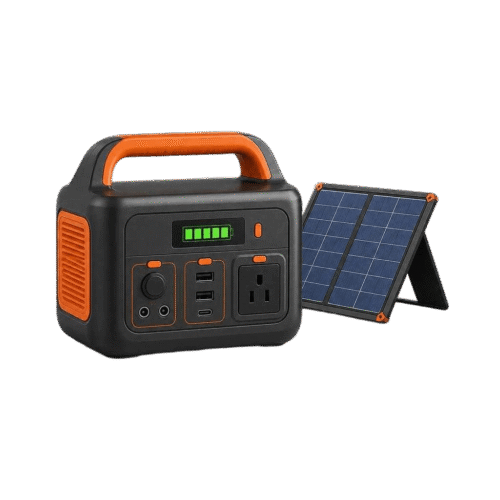
The first question most buyers have is simple: will it plug into my power station? For the EBL 100W, the answer is usually yes, thanks to a generous adapter kit. It ships with MC4 connectors plus an Anderson and DC5521 pigtail and three barrel adapters, so it slots into most of the popular stations without a separate purchase.
In practice, owners confirm it works with Jackery, EcoFlow (including the River 2), Bluetti, and GRECELL units. One buyer ran it instead to a PWM solar controller and charged a 12V deep-cycle battery at a steady 5A — a reminder that the 18V output also suits a 12V battery setup if you add your own controller.
| Power Station / Battery | Typical Use | Compatible? | Connector |
|---|---|---|---|
| Jackery Explorer series | Camping power station | Compatible | DC barrel adapter |
| EcoFlow River 2 | Portable power station | Compatible | DC5521 / barrel adapter |
| Bluetti portable stations | Camping / backup | Compatible | Anderson / barrel adapter |
| GRECELL power station | Camping / backup | Compatible | Included adapter |
| Power station with XT60 input | Newer portable stations | Needs adapter | XT60 (buy separately) |
| 12V lead-acid / AGM battery | Car, marine, RV | Needs adapter | Via separate charge controller |
| 12V LiFePO4 battery | Van life, RV | Verify first | Via LFP-capable controller |
Adapter Check — The kit covers most stations, but there’s no XT60 adapter in the box. If your power station uses an XT60 input, grab an MC4-to-XT60 adapter before your trip — it’s cheap, but you don’t want to discover the gap at the campsite.
A note for 12V users: never wire the 18V output straight to a 12V battery. You need a charge controller in between, as the owners charging marine and deep-cycle batteries do.
Does It Really Charge?
The EBL 100W is rated at 100W — which in good sun translates to roughly 78W of real output, or about 312 Wh on a typical day with four peak sun hours. That’s the realistic number to plan around, and it’s genuinely strong for a budget folding panel.
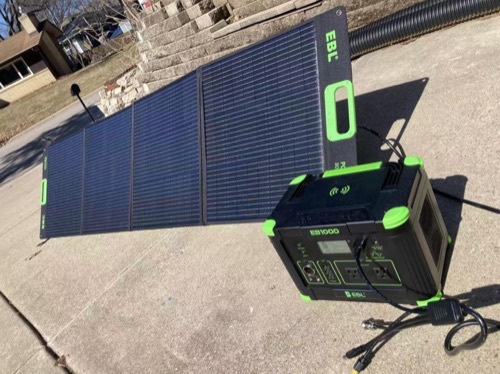
Owners back this up. Several report 70-90W into their power stations in full sun, and one tester with a proper PV meter measured 99W (5.5A, 19.7Voc) on a clear day with thin high clouds. In owner accounts, an off-grid cabin owner had his EcoFlow back to 100% by noon, running a Starlink Mini, lights, and a fan off it afterward. That’s exactly the camping-and-cabin scenario this panel is built for.
Cloudy days are the number-one worry buyers have, so here’s the honest picture: it slows down but keeps working. Owners report 26-60W under heavy cloud cover, and one buyer kept a heat pad, phones, and laptops topped up through an overcast winter day during a blizzard outage. On fully grey days, expect output to drop to roughly 20-30% of rated — enough to slow a battery drain, not enough for fast charging.
| Condition | Estimated Output | What That Means |
|---|---|---|
| Full sun, ideal angle | ~78 W | Tops up a 300-600Wh station noticeably; ~312 Wh over the day |
| Partly cloudy sky | ~39 W | Steady trickle; keeps a station from draining during light use |
| Overcast / heavy clouds | ~20-30 W | Slows the drain; keeps phones and small loads alive, won’t fast-charge |
| Panel angle 45° off optimal | ~50-55 W | Real hit to output; tilt it toward the sun whenever you can |
| Winter sun (northern US) | ~40-47 W avg | Still charges; 2-3 peak sun hours vs summer’s 4-5 |
| Panel in partial shade | ~8-25 W | Big drop; avoid shading any part of the panel |
Real-World Math — Using the 0.78 output factor, this 100W panel delivers roughly 78W in good sun. Over a 4-hour peak sun day, that’s about 312 Wh — enough to refill a 256Wh station from empty, or to add a meaningful chunk back to a 500Wh unit while you’re still using it.
These are estimates. Real output swings with panel angle, sky conditions, shade, temperature (panels lose efficiency above 25°C), and how long your cable run is.
How Quick Is Setup?
Setup is about as simple as solar gets: unfold the panel, pop out the kickstands, and plug into your power station or a controller. Owners describe it as plug-and-play, and one had a 12V battery charging through a PWM controller within minutes of unboxing.
The catch is the kickstand legs. They’re the most common complaint by a wide margin — too short to tilt the panel up for low winter sun. Owners work around it by propping the legs on 2x4s, leaning the panel on an easel, or weighting the corners with rocks on windy days. That tilt actually matters: one buyer measured roughly 20% more output at a 45-degree angle versus laying the panel flat. On windy days the narrow stands can feel tippy, so a couple of rocks on the corners helps.
Cables are the other quibble. The attached MC4 cable and pigtail run short, so many owners pick up an inexpensive extension cord to place the panel in full sun while the station sits in the shade. The cables are rated 14-16 AWG, which is normal for this class.
Practical Tip — Before your first trip, buy a short MC4 extension and keep a couple of scrap 2x4s or a small folding stand in the car. Those two cheap fixes solve the panel’s two biggest real-world annoyances — short cables and short legs — for under $20.
Honestly, the setup itself is genuinely easy. The friction comes from those two budget shortcuts, not from anything complicated.
Form Factor and Construction
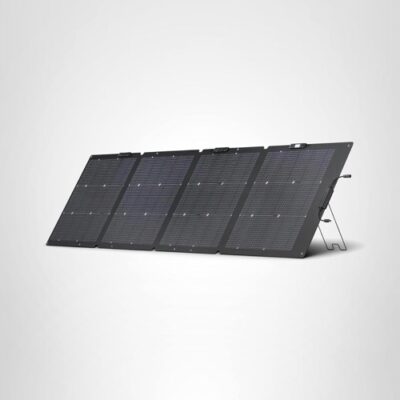
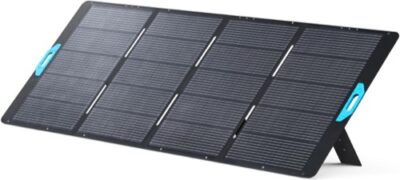
Out of the box, the EBL 100W feels more solid than its budget price tag suggests. It folds shut like a briefcase with a magnetic clasp, and the handle is comfortable enough to grab one-handed. Owners describe the surface — an ETFE laminate over the cells — as durable, with several noting it still looked new after a month of sitting on gravel, dirt, and grass.
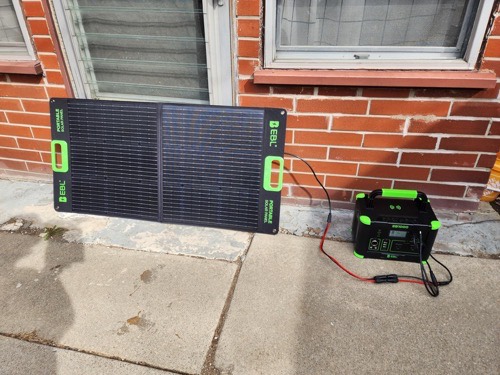
The frame is aluminum, and the cells are A+ grade monocrystalline. On the back you get fold-out kickstands plus reinforced grommets in all four corners for hanging on a tent or RV. There’s also a zippered pouch that holds the attached cable and the bundle of adapters, which keeps everything together so you’re not hunting for a barrel tip at a campsite.
Now the gripes. A few buyers were surprised the panel is larger than the product photos suggest — one got a good chuckle out of how short the people in the listing images must have been. To be fair, it matches the listed specs; the photos just undersell the size. One detailed reviewer also noticed the panels curve slightly rather than sitting dead flat, and the support legs feel a touch flimsy. None of that is a dealbreaker, but it’s the kind of corner-cutting you’d expect at this price.
Made for the Outdoors
The EBL 100W carries an IP65 rating — which means it’s protected against splashing and rain jets from any direction, but not against soaking or submersion. EBL is upfront about this: the listing tells you not to leave it out in the rain or dunk it in water. Treat it as splash-resistant gear, not a storm-proof panel.
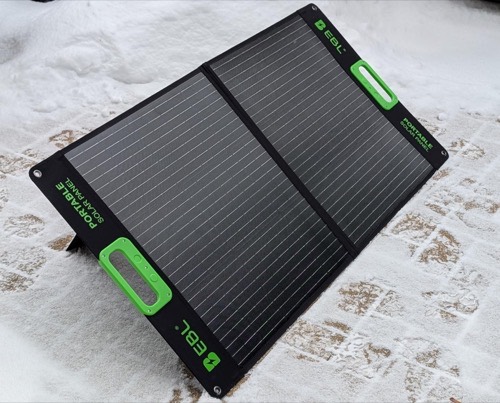
In owner accounts, owners trust it. Buyers report leaving it out in morning dew and light rain with no issues, and one camper used it for over a month across gravel, dirt, and grass and said it still looked almost new. Another ran it through a snowy blizzard outage, where the snow glare actually boosted output a little.
The ETFE laminate and aluminum frame are the right materials for outdoor life — ETFE resists scuffs better than cheap PET, and aluminum won’t warp in summer heat. The slight panel curve a couple of owners noticed is more cosmetic than functional.
| Feature | This Panel | What It Means Outdoors |
|---|---|---|
| IP rating | IP65 | Handles dew, splashing, and rain jets — not soaking |
| Frame material | Aluminum | Resists corrosion and heat warping |
| Panel surface | ETFE laminate | Scuff-resistant; holds up to gravel and dirt contact |
| Junction box seal | Not stated | No specific seal rating published |
| Connector weatherproofing | Not stated | Standard MC4; tuck the pouch closed in wet weather |
| Operating temperature range | Not specified | No published range — verify for extreme-cold climates |
| Long-term owner reports | Still like-new after a month-plus of outdoor use | Early durability feedback is positive |
Worth Knowing — IP65 means protected against low-pressure water jets, not immersion. For a portable panel you set out during the day and pack up at night, that’s plenty. Just don’t leave it face-up collecting a puddle through an overnight storm.
Where It Fits Best — Use-Case Fit Matrix
| Use Case | Fit | Why |
|---|---|---|
| Topping up a 300-600Wh power station while camping | Strong fit | 70-90W real output refills a midsize station over a day |
| Off-grid cabin (lights, fan, Starlink Mini) | Strong fit | Owners run exactly these loads; refilled a station by noon |
| RV / van solar charging via station or controller | Solid fit | Wide adapter kit and 18V output suit most setups |
| 12V / marine battery maintenance | Solid fit | Works well through a separate charge controller |
| Emergency outage backup | Strong fit | Kept phones, laptops, and a heat pad alive through a blizzard outage |
| Weekend tent camping device charging | Strong fit | Folds compact, plugs into a station, easy to angle at the sun |
| Power station with XT60 input | With caveats | Works, but you must buy an MC4-to-XT60 adapter |
| Fast-charging a large station from empty | Borderline | 100W tops up but won’t fully refill a big unit in one day |
| Backpacking / ultralight trips | Skip | Around 11 lbs and 23 inches square — too big and heavy |
| Permanent rooftop / fixed installation | Skip | This is a portable folding panel, not a fixed-mount unit |
| Leaving out in heavy rain or storms | Not recommended | IP65 is splash-resistant only, not for soaking |
| Low-winter-sun charging without props | With caveats | Short legs can’t angle it steeply — bring 2x4s or a stand |
Support, Safety, and Certification
No third-party safety certifications (UL, ETL, CE) are listed for the EBL 100W beyond the IP65 weather rating, so the published safety story is thin. That’s common for budget Amazon panels, and for low-stakes use — topping up a power station that has its own input protection — it’s not a major concern.
The bigger safety note is about how you connect it. The panel puts out 18V with no built-in controller, so wiring it straight to a 12V battery is a no-go. Owners who charge 12V or marine batteries always route through a separate charge controller, and you should too. Connected to a power station, the station’s own charge circuit handles regulation, so there’s nothing to manage.
Nothing alarming turned up in owner feedback — no overheating, no melting junction boxes, no cracked insulation reports. The main long-term unknowns are the unpublished warranty and operating temperature range, which EBL doesn’t state.
Long-Term Ownership — Monocrystalline panels typically lose around 0.5% efficiency a year, so the cells themselves should outlast the rest of the panel. On folding panels like this one, the cable, connectors, and hinges usually wear out first — so keep the connectors clean and dry and don’t over-flex the fold lines.
For camping and emergency use, the lack of a stated warranty is a tolerable trade-off at this price. For permanent year-round 12V maintenance on a boat or RV, a longer-warrantied, established-brand panel is worth considering.
EBL Solar Apollo 100W: Decision Snapshot
| Spec | Value |
|---|---|
| Max Power Output | 100 W (monocrystalline A+) |
| Output Voltage | 18 V DC |
| Connector | MC4 (with Anderson + DC barrel adapters) |
| Cell Efficiency | Up to 23% (manufacturer claim) |
| Weatherproof Rating | IP65 (splash-resistant, not for soaking) |
| Charge Controller | None — direct connect (not included) |
| Cable Length | Not specified (runs short) |
| Mount Type | Fold-out kickstands + corner grommets |
| Best For | Topping up a power station while camping or off-grid |
EBL 100W Portable Solar Panel: The Short Take
If you want a budget-friendly panel to keep a midsize power station topped up while camping, the EBL 100W does what you’d hope. In practice, owners pull a steady 70-90W in good sun, it folds like a briefcase for easy hauling, and the adapter kit plugs into most Jackery, EcoFlow, and Bluetti stations without extra shopping. The IP65 rating shrugs off dew and light rain too. Just know going in: the kickstand legs are too short to angle it well for low winter sun, and the cables run short — so budget for a couple of 2x4s and an extension cord unless you’re charging in flat summer sun.
You'll probably be happy if you want: — EBL Solar Apollo 100W
- A budget 100W panel that actually pulls 70-90W in good sun
- Something to keep a midsize power station topped up at a campsite or cabin
- A foldable, IP65 panel that plugs into Jackery, EcoFlow, and Bluetti stations out of the box
- Emergency outage backup that keeps phones and small loads alive
You might want to skip it if you need: — EBL Solar Apollo 100W
- A lightweight panel for backpacking — this one’s around 11 lbs
- To fully refill a large power station from empty in a single day
- A fixed rooftop panel for permanent installation
- A panel you can leave out through heavy rain or storms
This is a different tool for a different job — great for portable, set-it-down camping power, not for ultralight hiking or permanent installs.
The Honest Bottom Line
The EBL 100W portable solar panel earns its keep as a budget camping and off-grid panel. Real output of 70-90W in good sun is genuinely strong for the price, the adapter kit fits most popular power stations, and the IP65 build holds up to dew and light rain. For weekend campers, RV owners, and anyone who wants emergency outage backup, it delivers on the realistic promise of a 100W folding panel.
The trade-offs are the kind you’d expect at this price, not surprises. The kickstand legs are too short for low winter sun, the cables run short, and there’s no XT60 adapter or stated warranty. None of that sinks the EBL 100W solar panel — but it does mean budgeting a few dollars for an extension cord and a way to prop it up. If you want a no-fuss panel to keep a midsize station charged on trips, this is a solid pick. If you need ultralight weight, a full refill of a big station, or a permanent install, look elsewhere.
Pros & Cons Analysis
Based on documented specifications and owner feedback
Pros
- Solid real-world output for the price — customers consistently report 70-90W in good sun, with one tester measuring 99W (5.5A, 19.7Voc) on a clear West Texas day. For a budget 100W folding panel, that's strong real output, and several buyers describe it as a "big bang for the buck."
- Wide connector kit covers most power stations — it ships with MC4 connectors plus an Anderson and DC barrel pigtail and three barrel adapters (3.5×1.5, 5.5×2.5, 7.9×0.9). Buyers with Jackery, EcoFlow, and similar stations report plugging in without buying extra cables.
- Genuinely portable and well-built — it folds like a briefcase with a magnetic clasp and a comfortable handle. Owners call the ETFE-and-laminate surface durable, noting it still looks new after a month of use on gravel, dirt, and grass.
- IP65 weather resistance owners trust — customers report leaving it out in light rain, morning dew, and snow-reflected glare without any issues. The waterproofing gives confidence for dewy mornings and dusty trails.
- Easy plug-and-play setup — unfold, pop the kickstands, plug into your power station or a solar controller, and you're charging. One owner ran it straight to a PWM controller and charged a 12V deep-cycle battery at a steady 5A.
- Charges essentials even on grey days — buyers report 26-60W under heavy cloud cover and still keeping a heat pad, phones, and laptops topped up through an overcast winter day. It slows down but keeps working.
- Useful for off-grid and emergency power — owners use it to keep a Starlink Mini, lights, and a fan running at a remote cabin, recharge marine batteries, and serve as blizzard-outage backup. It charged a power station back to full by noon for one off-grid user.
- Grommets and zippered pouch add flexibility — reinforced corner grommets let you hang it on a tent or RV, and the rear zippered pouch keeps the cables and adapters together so nothing gets lost.
Cons
- Support legs are too short — the single most common complaint. The fold-out kickstands don't tilt the panel high enough for low winter sun, and owners report propping the panel on 2x4s or an easel to get a usable angle. One buyer measured the legs as roughly four inches too short.
- Misses some connectors — there's no XT60 adapter, so XT60-input power stations need a separately purchased adapter. A few owners with newer stations also wished it had a USB charging port built in.
- Bigger and heavier than some expected — a few buyers were surprised the panel is larger than the product photos suggest, and at around 11 lbs it's comfort-camping gear, not a backpacking panel.
- Not for rain or submersion — IP65 handles splashing, but EBL specifically warns against leaving it out in the rain or soaking it. It's splash-resistant, not a leave-it-in-a-storm panel.
- Cables run a bit short — owners note the attached MC4 cable and pigtail are on the short side, so an extension cord is often needed to place the panel in the best sun while the station stays in the shade.
- Won't hit the rated 100W — like all panels, the 100W figure is a lab number. Several owners landed at 70-80W in full sun, and one direct comparison had it at 80W while a rival 100W panel hit 94W.
- Some panel curve and flimsy-leg feel — one detailed reviewer noted the panels curve slightly rather than sitting flat, and the support legs feel flimsy enough to be hard to set up steadily on uneven ground.
- Underperformed for a few owners — a small group felt EBL cut corners, citing only 70-80W on perfectly sunny days and a panel that didn't keep up with a competitor. For these buyers, the value didn't land.
Our Verdict
Charging performance (4.0/5) — The EBL 100W delivers a genuinely strong real-world 70-90W in good sun from its A+ monocrystalline cells, with one verified 99W reading and 26-60W even under heavy cloud. A minority measured only 70-80W in full sun and one side-by-side had it trailing a rival, which keeps this just under a higher mark.
Value & compatibility (4.2/5) — This is the panel's highlight: a wide adapter kit (MC4, Anderson, DC5521, and three barrel tips) fits Jackery, EcoFlow, Bluetti, and GRECELL stations out of the box, with strong price-per-watt. The missing XT60 adapter and lack of a USB port hold it slightly back.
Build & weatherproofing (4.1/5) — ETFE laminate, an aluminum frame, and IP65 hold up well in dew, light rain, and snow glare per owners. A slight panel curve and the "not for rain" limitation keep it from a higher score.
Install & usability (3.6/5) — The weak spot: the kickstand legs are too short to angle it for low winter sun, and the attached cables run short, forcing workarounds like 2x4s and extension cords.
Bottom line — Best for topping up a 300-600Wh power station while camping, off-grid cabin power, and emergency outage backup. Skip it if you need backpack-friendly weight, a full refill of a large station from empty, or a permanent rooftop install.
Frequently Asked Questions
Does the EBL 100W solar panel actually put out 100 watts?
In real conditions, expect roughly 70-90W in good sun rather than the full 100W rating, which is a lab figure. One owner measured 99W (5.5A, 19.7Voc) on a clear day with thin clouds, while others landed at 70-80W. A few buyers found it trailed a competing 100W panel in a side-by-side. Output depends on angle, sun strength, temperature, and cable length.
Does it charge on cloudy or overcast days?
Yes, just more slowly. Owners report 26-60W under heavy cloud cover, with one buyer keeping a heat pad, phones, and laptops running through an overcast winter day. On fully grey days expect output to drop to around 20-30% of rated, which is enough to slow a power station drain or keep essentials topped up but not enough for fast charging.
What power stations does the EBL 100W work with?
It comes with MC4 connectors plus an Anderson and DC5521 pigtail and three barrel adapters (5.5x2.1 to 3.5x1.5, 5.5x2.5, and 7.9x0.9). Owners confirm it works with Jackery, EcoFlow (including the River 2), Bluetti, GRECELL, and similar stations. There's no XT60 adapter included, so XT60-input stations need a cheap adapter bought separately. Check your station's input before buying.
Can I use it to charge a 12V battery instead of a power station?
Yes, but you need a separate charge controller. The panel outputs 18V with no built-in controller, so connecting it straight to a 12V battery isn't safe. One owner ran the MC4 cable to a PWM solar controller and charged a 12V deep-cycle battery at a steady 5A. Others use it to keep marine batteries topped up the same way.
Is the EBL 100W waterproof?
It carries an IP65 rating, which means it shrugs off dew, splashing, and light rain. EBL specifically warns against leaving it out in heavy rain or soaking it in water. Owners report no issues using it in morning dew and light precipitation, but treat it as splash-resistant, not a leave-it-in-a-storm panel.
Why do people complain about the support legs?
The fold-out kickstands are short, so they can't tilt the panel high enough to catch low winter sun. Owners report propping the panel on 2x4s, an easel, or rocks to get a steeper angle and better output. Tilting it toward the sun matters — one buyer noticed roughly 20% more output at a 45-degree tilt versus laying it flat.
Are the cables long enough?
The attached MC4 cable and pigtail run a bit short for many setups. Buyers commonly pick up an inexpensive extension cord so the panel can sit in full sun while the power station stays in the shade. The cables are rated 14-16 AWG, which is normal for a panel in this class.
How heavy and big is it?
It folds like a briefcase to roughly 23 inches square and weighs around 11 lbs by the listed spec, though several owners weighed theirs closer to 8.4-8.6 lbs. Either way it's comfort-camping and car-trunk gear, not a backpacking panel. A few buyers were surprised it's larger than the product photos suggest.
Can I connect more than one panel together?
Yes. The included instructions cover wiring panels in series or parallel if you own more than one. Series raises voltage and parallel raises current, so check your power station's input limits before combining panels. If you're new to this, read the documentation first to avoid exceeding your station's safe input range.
Who is the EBL 100W best for?
It's a good fit for weekend campers and RV owners topping up a 300-600Wh power station, off-grid cabin users running lights and small electronics, and anyone wanting emergency outage backup. It's less ideal if you need to fast-charge a large power station from empty or want a backpacking-light panel.
Technical Specifications
| Brand | EBL |
|---|---|
| Model / SKU | ESP-100 (ASIN B0G64S2WTV) |
| Panel format | Folding portable panel |
| Rated output (Pmax) | 100W |
| Cell technology | Monocrystalline |
| Module efficiency | — |
| Voltage at maximum power (Vmp) | 18V |
| Current at maximum power (Imp) | 5.56A |
| Open-circuit voltage (Voc) | — |
| Short-circuit current (Isc) | — |
| Power tolerance | — |
| Maximum system voltage | — |
| Maximum series fuse | — |
| Output connector | MC4 with power-station adapters |
| Output cable | — |
| Deployed dimensions | — |
| Folded dimensions | 23.23 × 23 × 1.2 in |
| Weight | 11.1 lb |
| Surface and frame | ETFE surface with folding support body |
| Positioning / mounting | Integrated kickstands and hanging eyelets |
| Environmental protection | Panel IP65 |
| Wind / snow load | — |
| Operating temperature | — |
| Included accessories | Panel, adapter cable set, and storage bag |
| Product warranty | — |