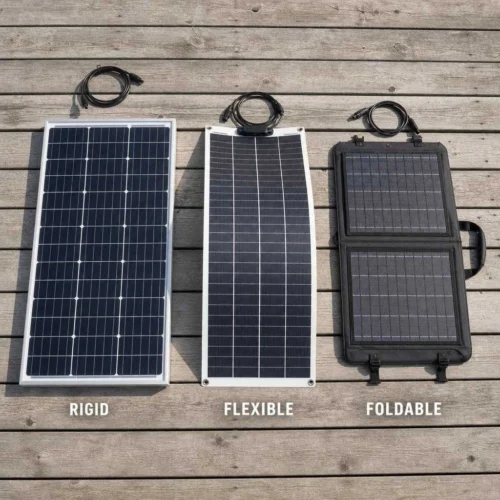
For most buyers, a rigid solar panel is the right choice — it’s the most efficient, the most durable, and the cheapest per watt. A framed glass panel routinely hits or beats its wattage rating and lasts the better part of a decade outdoors. Its only real downside is that it’s heavy, stiff, and needs a flat surface with brackets to bolt to.
A flexible solar panel wins in one situation: when your surface curves, or when weight and thickness matter more than raw output. A bendable laminate is roughly a tenth of an inch thick and a few pounds, and it hugs a van roof, an airstream curve, or a boat bimini where a rigid rectangle can’t sit. The catch is that it runs hotter, produces a bit less, tends to fail sooner, and costs more per watt.
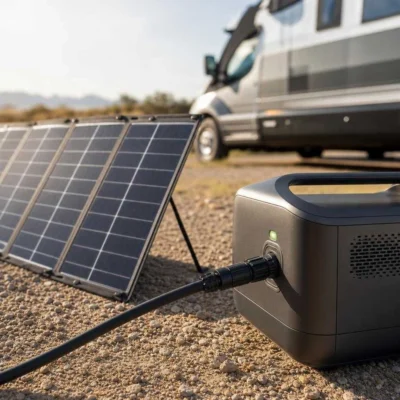
A foldable or suitcase panel is the portable middle ground — rigid segments on hinges that fold to briefcase size, open on a kickstand, and are built to be set up and packed away daily. You pay a premium for that convenience, but for camping and power-station charging it’s often the easiest form factor to live with.
Key Takeaways
- Rigid is the value and longevity pick — best efficiency, cheapest per watt, and 8 to 9 years or more of outdoor life. Best for flat roofs, ground mounts, and permanent installs.
- Flexible is for shape and weight — curved roofs, stealth van builds, and boat decks where thin, light, and no-drill matter. It trades some efficiency, lifespan, and price to get there.
- Foldable is for portability — folds small, deploys on a stand, and pairs cleanly with a portable power station. Highest cost per watt, but the most convenient to move.
- Heat is the flexible panel’s enemy — glued flat with no air gap, output drops roughly 10% versus rigid, and long-term delamination becomes a risk.
How Each Panel Is Built
The differences in weight, price, and lifespan all trace back to how these three form factors are constructed. Understanding the build makes the trade-offs obvious.
Rigid: Framed Glass
A rigid panel is the classic solar module — monocrystalline cells sandwiched under low-iron tempered glass, sealed onto a backsheet, and wrapped in a corrosion-resistant aluminum frame. The glass protects the cells and the frame keeps everything flat and stiff. That construction is why rigid panels are heavy (a 100W panel runs around 13 pounds) and why they’re so tough: owners report units surviving storms, snow, and even a fall onto a rock with only a cosmetic glass scuff. The frame has pre-drilled holes so you bolt it down with Z-brackets or tilt mounts.
Flexible: Bendable Laminate
A flexible panel drops the glass and the frame entirely. The same monocrystalline cells are sealed inside a polymer laminate over a thin aluminum-alloy backing — no glass to crack, no frame to bolt. That’s what makes it about a tenth of an inch thick, roughly 4 pounds, and bendable enough to curve over an uneven surface. The price of losing the glass and frame: there’s no rigid structure to protect the cells, no air gap to shed heat, and the laminate layers can separate over time. You mount it with adhesive, 3M tape, or velcro rather than brackets.
Foldable and Suitcase
A foldable or suitcase panel is really several small rigid or semi-rigid panels joined together — hinged like a briefcase or sewn into a fabric backing that folds. It opens flat or props up on a built-in kickstand, usually ships with a cable and sometimes a charge controller, and packs down to a size you can stow in a trunk or an RV bay. You’re paying for the hinges, the stand, the carry handle, and the convenience of a deploy-and-pack design, which is why cost per watt is the highest of the three.
Side-by-Side: Flexible vs Rigid vs Foldable
| Factor | Rigid (framed glass) | Flexible (laminate) | Foldable / suitcase |
|---|---|---|---|
| Weight | Heaviest — ~13 lb for 100W | Lightest — ~4 lb for 100W, ~1/10 in thin | Moderate — folds small but adds hinges and a stand |
| Efficiency | Highest — often hits or beats its rating in good sun | Lower — runs hotter flat-mounted, roughly 10% below rigid | Good — rigid-grade cells, but best only when angled on its stand |
| Durability / lifespan | Longest — 8 to 9+ years, glass and aluminum shrug off weather | Shortest — years of use, but delamination and hotspots are risks | Moderate — sturdy panels, but hinges, fabric, and stands wear |
| Mounting | Bolt-down brackets on a flat surface | Adhesive, tape, or velcro on flat or curved surfaces | No mounting — unfolds on a kickstand, set out and packed away |
| Price per watt | Lowest — near a dollar per watt on sale | Higher — you pay for the bendable form factor | Highest — you pay for hinges, stand, case, and often a controller |
| Best for | Flat roofs, ground mounts, cabins, permanent 12V systems | Curved RV and van roofs, boat decks, stealth no-drill builds | Camping, power-station charging, deploy-and-pack portable use |
The Disadvantages of Flexible Solar Panels
Flexible panels are genuinely useful in the right spot, but they come with four real drawbacks you should weigh before buying.
- Heat under the adhesive — glued flush to a dark roof with no air gap, the laminate heat-soaks and hot cells make fewer watts. In our Renogy 100W flexible panel review, one owner measured only about 36W flat-mounted while expecting closer to 100, and another pegged flexible efficiency at roughly 10% below rigid for the same rooftop job. That’s exactly why the panel’s real-world output factor sits around 0.70, below a comparable rigid mono panel.
- Delamination and hotspots — the laminate layers can separate over time, and a single overheating spot can melt part of the panel. A few owners report both, and it’s the main long-term durability worry with the flexible form factor.
- Lower efficiency and peak output — even in good sun, a flat, untilted flexible panel gives up watts to both angle and heat. Tilted on a stand it recovers a lot (one owner measured 5.9 amps in full sun), but flat on a roof it lands well short of its rating.
- No frame and no glass — there’s nothing rigid to bolt to and no hard surface protecting the cells. You mount with adhesive, which is clean and stealthy but hard to reverse, and overbending a flexible panel can crack a cell outright.
When Rigid Wins
Rigid is the default for a reason. It wins any time you have a flat surface and value output and longevity over weight, which covers most installs:
- Flat roofs, ground mounts, and cabins — a stiff framed panel bolts down solidly and stays put for years.
- Maximum watts per dollar — rigid is the cheapest per watt and frequently beats its rating. Our Renogy 100W 12V monocrystalline review found owners routinely measuring 105W, 109W, even 118W on cold, clear days with an MPPT controller, with a real-world output factor around 0.82.
- Long service life — the aluminum frame and tempered glass survive storms, snow, and heat, and owners report panels still going strong after 8 to 9 years outdoors.
- Cold climates — rigid mono cells actually produce more when it’s cold and clear, and the glass surface wipes clean and keeps charging even when dusty.
The trade-off is bulk and rigidity: a rigid panel is heavy, it needs brackets, and it can’t sit on anything that curves. On a flat surface, none of that matters — which is why rigid is the value benchmark.
When Flexible Wins
Flexible stops being a compromise and becomes the right tool the moment your surface isn’t flat, or weight rules rigid out:
- Curved roofs — an airstream curve, a van’s rounded top, or any surface a stiff rectangle would tent up on. This is the whole point of the form factor.
- Stealth, no-drill van builds — adhesive or tape mounting keeps a roof watertight and a build looking clean, with no holes drilled.
- Boat biminis and decks — light, sealed, and low-profile, with no frame to corrode and nothing to catch the wind.
- Weight-sensitive setups — where roughly 4 pounds and a tenth of an inch beat 13 pounds of glass and aluminum, even on a flat surface.
If any of those describe your setup, the extra cost per watt and the shorter lifespan are worth it, because a rigid panel physically can’t do the job. For a shortlist of proven options, see our roundup of the best flexible solar panels. One tip that pays off: tilt the panel or leave airflow behind it wherever you can — that alone claws back much of the output heat would otherwise cost you.
Where Foldable and Suitcase Panels Fit
Foldable and suitcase panels answer a different question than the flexible-versus-rigid debate. They’re not about the shape of a permanent mounting surface — they’re about portability. Because they’re built from rigid-grade cells that fold to a compact size and open on a kickstand, they give you rigid efficiency in a package you can carry to the sun and pack away at the end of the day.
That makes them the natural pick for campers, tailgaters, and anyone charging a portable power station, since most fold-out kits are designed to plug straight into a Jackery, EcoFlow, or Bluetti with the cable already included. The downside is cost: you pay the most per watt of any form factor for the hinges, stand, and case. If you set up and tear down often, that convenience is worth it; if the panel will live in one permanent spot, a plain rigid panel gives you more watts for less. For options built around deploy-and-pack use, browse our best portable solar panels guide.
Which Should You Choose?
Here’s the honest bottom line on flexible vs rigid solar panels. If you have a flat surface and you care about output, longevity, and value, buy rigid — it’s the most efficient, the cheapest per watt, and the longest-lasting, and nothing else comes close on a flat roof or ground mount. Don’t pay more for a form factor you don’t need.
Choose flexible when the shape of your surface or the need to stay thin and light rules rigid out — a curved roof, a stealth van build, or a boat deck. You’ll trade some efficiency, some lifespan, and a bit more money, but you’ll get a panel that fits where rigid can’t. And choose foldable when portability is the whole point: set up, charge, pack away, repeat. Not sure how much panel you actually need for your batteries or power station? Run the numbers with our solar panel output calculator before you buy.

Leave a Reply