Solar Power Picks logo with sun, solar panel, and green energy icon

  • Home
  • Reviews
  • Best
    • Best portable power stations
    • Best Solar Panels
  • Guides
    • Portable Power Stations Guides
  • Comparisons
    • Portable Power Stations Comparisons
  • Calculator
Home / Solar Panels / Reviews / Anker SOLIX PS400 Review: The Premium 400W Foldable Panel Built for the Anker Ecosystem

Anker SOLIX PS400 Review: The Premium 400W Foldable Panel Built for the Anker Ecosystem

Brand: Anker

At a Glance

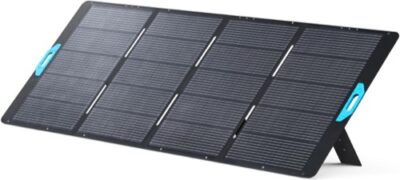
Anker SOLIX PS400 portable solar panel product photo on a white background

KEY FEATURES

  • Power output: 400 W (claimed), monocrystalline silicon
  • Output: High-voltage DC via MC4; MC4-to-XT-60 adapter cable included for Anker stations
  • Cell efficiency: Up to 23% claimed (monocrystalline — high-tier claim)
  • Weatherproofing: IP67 rated; ETFE surface coating over the cells with a polymer composite backing
  • Charge controller: None — direct MC4 output; pairs with a power station's built-in MPPT (or add your own controller for 12V batteries)
  • Best for: Anker SOLIX power station owners charging on camping, RV, and home-backup setups who want a rugged, high-output foldable panel
CHARGING PERFORMANCE 3.8
BUILD & WEATHERPROOFING 3.7
INSTALL & USABILITY 3.3
VALUE & COMPATIBILITY 3.8

PROS

  • Strong 275-300W real output from a 400W panel in good sun
  • Premium ETFE build and genuine IP67 weatherproofing
  • Clean MC4 and XT-60 fit for Anker SOLIX power stations
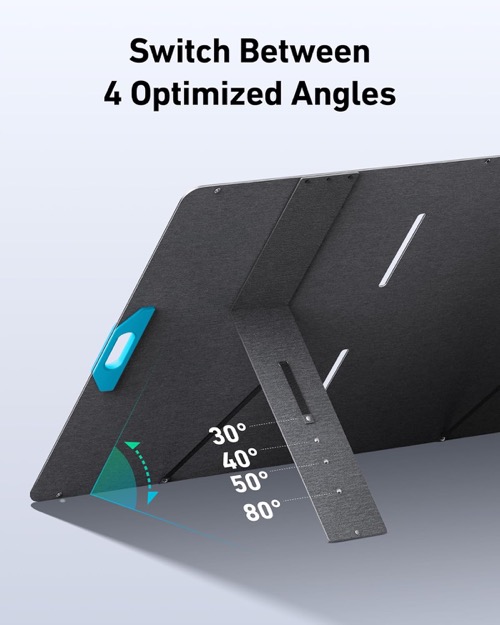
  • Four locking angles plus a sunlight alignment spotter
  • Backed by Anker's well-regarded customer support

CONS

  • Falls short of the full 400W claim; one owner saw just 195W
  • Flimsy handle and kickstand hardware; snaps hard to unsnap
  • A single panel is a slow feed for a large station
  • Only three kickstands support four panel sections
  • Heavy at 35.1 lb and pricey at around $599 per panel
Jump to detailed pros & cons analysis
4.2

Editor's Choice

Based on rigorous testing & Amazon customer feedback

Current Price
$599.99
Amazon.com
Check Current Price

Price and availability subject to change

Table of Contents

  • Overview
  • Specifications

☀ Solar Panel Output Calculator

Estimate how much energy the Anker SOLIX PS400 produces — and what it can power or charge.

Solar Setup

400W
UK / cloudy north (2–3h)US / EU average (4–5h)Desert / tropics (6–7h)
—
per peak sun hour
—
per day (est.)
—
per month (est.)
V
Portable devices
Power stations & batteries
Estimated charging time—
Energy the battery needs—
Actual charging power from panel—

Click devices to add them to your load list, adjust hours and quantity, then calculate.

Portable / Camping
Home Appliances

No devices added yet. Click chips above or add a custom device.

Total daily device load—
Solar daily output—
Daily surplus / deficit—

Panels needed (at this wattage)—
Recommended battery (1 day backup)—

How many back-to-back sunless days should the battery keep you running? Example: 1 = one cloudy day, 3 = three cloudy days in a row.

Required solar array size—
Panels needed (at this wattage)—
Recommended battery capacity—

Buy an Anker SOLIX power station and the pull toward Anker’s own panel is almost gravitational. Everything matches, the cable is already in the box, and there’s a comforting logic to keeping one brand across your whole kit. That instinct isn’t wrong — but it deserves a closer look before you spend $599 on the strength of a matching badge.

Picture the listing you’ve probably already opened: a 400W monocrystalline foldable, IP67 sealing, an ETFE coating, four locking angles, and a sunlight alignment spotter, all under the Anker name. On paper it reads as the obvious partner for a C1000, C2000, or F2600. What the spec sheet won’t tell you is whether the field output and the day-to-day handling actually earn that premium.

Here’s the honest framing. Anker built a genuinely premium panel body and a clean ecosystem fit, then bolted it to a heavy chassis that never quite reaches its nameplate wattage and hardware that feels cheaper than the slab it holds up. SOLIX owners who prize plug-and-play and responsive support will call that a fair trade. Anyone chasing raw watts per dollar will find the math tighter than the branding suggests.

Compare it directly with the other panels in our best 400W solar panels guide.

At a Glance

Spec Value
Max Power Output 400 W (monocrystalline)
Output Voltage High-voltage DC via MC4 (Vmp not published)
Connector MC4 + MC4-to-XT-60 adapter (no USB)
Cell Efficiency Up to 23% claimed
Weatherproof Rating IP67 (ETFE coating, sealed)
Charge Controller None — direct output to a station’s MPPT
Cable Length 2× 9.8 ft MC4 + 1.6 ft MC4-to-XT-60
Mount Type Adjustable kickstand, four angles (30° / 40° / 50° / 80°)
Best For Anker SOLIX owners charging on camping, RV, and backup setups

Anker SOLIX PS400 Review: The Quick Verdict

If you want a rugged foldable panel to feed an Anker power station on camping, RV, and blackout duty, the Anker SOLIX PS400 does exactly that. In good sun it pulls a real 275-300W, the IP67 sealing shrugs off rain, and it clicks straight into SOLIX stations with the included MC4 and XT-60 cables. Just know going in: it’s heavy at 35.1 lb, the handle and kickstands feel flimsy next to the premium panel, and it won’t hit the full 400W — plan around 275-300W on a great day, and budget for a second panel if you’re filling a big station fast.

Anker SOLIX PS400 unfolded and set up outdoors in direct sunlight
The Anker SOLIX PS400 deployed outdoors, soaking up direct sun.

The 400W Foldable, Up Close

First impressions run premium. Owners consistently call the panel well made, and the ETFE coating over the monocrystalline cells gives it a tough, wipe-clean face that feels a cut above fabric-backed budget panels. There’s an advanced polymer composite behind the cells to fight cracks, and the whole slab reads as serious gear.

A four-section fold opens into one large panel, and in good sun it looks the part. The sunlight alignment spotter built into the frame is a genuinely nice touch for squaring it to the sun. To be fair, almost nobody complains about the panel itself — the quality is real.

Plastic is another story. Loudest criticism goes to the carry handle — one owner’s broke simply lifting it out of the box — and the connection between the handle halves feels thin. Kickstand snaps run stubborn to the point of being nearly impossible to unsnap for some owners. Here’s the thing: the panel feels $599, but the hardware bolted to it doesn’t quite match.

Chasing the Full 400 Watts

The Anker SOLIX PS400 is rated at 400W — which in good sun translates to roughly 288W of real output, or about 1,152 Wh over a typical four-hour peak sun day. In practice, owners regularly report 275-300W per panel when the sky is clear and the UV is high, and one buyer running two panels together measured 550W combined.

Anker SOLIX PS400 output connectors and MC4 cables shown in close-up detail
A close look at the Anker SOLIX PS400 output connectors and cabling.

That gap between 400 and 300 is worth being blunt about. One owner measured just 195W under a clear July sky and returned two units over it, recommending two smaller PS200 panels and a Y-cable instead. On the flip side, most owners who dial in the angle with the spotter land in that 275-300W band and are happy with it — they just went in expecting the nameplate and adjusted.

What does that mean day to day? A single panel makes a real dent in a mid-size station in a few hours of sun. For a large-capacity unit, plan on patience — one owner with an F2600 at 10% needed three mornings and afternoons to reach full from a single PS400. Heat is the other quiet limiter: monocrystalline cells lose efficiency as they bake, so midday output in still, hot air runs lower than the morning and late-afternoon peaks.

Condition Estimated Output What That Means
Full sun, ideal angle ~288-300 W Strong daily gain; fills a mid-size station in a few hours
Partly cloudy sky ~140-190 W Still meaningful charging; just a slower fill
Overcast / heavy clouds ~60-100 W Keeps trickling in power rather than stopping
Panel angle 45° off optimal ~180-210 W Noticeable hit; use the spotter to reclaim watts
Winter / weak sun ~160-200 W Usable, but fewer peak sun hours overall
Hot, still day (extreme heat) Drops from peak Cells warm up and derate; morning and evening are best

Real-World Math — Using a 0.72 real-world factor, this 400W panel delivers roughly 288W in good sun. Stretch that across four peak sun hours and you bank around 1,152 Wh in a day — enough to move a mid-size power station a long way in a single day, and to keep a fridge or camp gear alive off a station through an outage.

These are estimates. Your actual numbers depend on angle, sky, shade, cell temperature, and how long your cable run is.

Which Anker Power Stations It Feeds

The whole point of this panel is the Anker ecosystem, and that’s where it shines. It ships with two 9.8 ft MC4 cables plus a short MC4-to-XT-60 adapter, so it plugs straight into Anker stations. Owners report clean, no-fuss connections to the C1000, C2000, F2600, and the 767 PowerHouse.

Here’s the nice part: because the panel outputs over standard MC4, it isn’t locked to Anker alone. The raw MC4 leads work with other brands’ stations that accept an MC4 solar input, and you can wire it to a 12V battery through your own MPPT controller if you want to go beyond power stations. In practice, though, most buyers are pairing it with the SOLIX gear they already own.

Power Station / Battery Typical Use Compatible? Notes
Anker SOLIX C1000 Camping, backup Compatible Use the included MC4-to-XT-60 cable
Anker SOLIX C2000 Home backup, RV Compatible Owners report it works very well
Anker SOLIX F2600 Whole-home backup Compatible Large capacity — a single panel fills it slowly
Anker 767 PowerHouse Off-grid, overland Compatible Runs a campsite when paired with the station
Other brands (EcoFlow / Bluetti / Jackery) Camping, backup Needs adapter Works via the raw MC4 output plus the right input adapter
12V battery (AGM / lead-acid / LiFePO4) RV, boat, car Needs adapter Requires a separate MPPT or PWM controller

Adapter Check — For Anker stations you’re covered out of the box with the MC4-to-XT-60 cable. If you’re feeding a non-Anker station or a 12V battery bank, confirm the input port and grab the matching MC4 adapter or a proper charge controller before your trip so you’re not stranded on day one.

IP67 and the Kickstand Question

Weatherproofing is a clear win. The Anker SOLIX PS400 carries a genuine IP67 rating, which means it’s sealed against dust and can handle brief immersion — so rain, dew, and a dusty campsite aren’t a worry. One owner reported it holding up through rough outdoor conditions, and the ETFE surface wipes clean easily. This is a real step up from fabric panels with exposed, unsealed ports.

Anker SOLIX PS400 mounted and charging in a real-world off-grid setup
The Anker SOLIX PS400 installed for real-world off-grid charging.

Durability of the panel body is solid too. The polymer composite backing resists cracking, and owners who leave it set up for more permanent placements report it holding output well. There’s one isolated note of a panel not performing as well as day one within a year, so it’s worth testing output early and keeping an eye on it, but the cells themselves aren’t a common complaint.

Stability is where it wobbles — literally. Four panel sections share only three kickstands, so the fourth panel isn’t supported, and owners describe the legs as not as stable as they look. One buyer had a snap break on the very first use. On flat, firm ground it stands fine, but in wind or on uneven terrain you’ll want to be gentle or brace it.

Feature This Panel What It Means Outdoors
IP rating IP67 certified Sealed against dust and brief immersion — rain is no issue
Frame / backing Polymer composite backing Resists cracking; adds to the reassuring heft
Panel surface ETFE coating Wipes clean; good UV and abrasion resistance
Junction / ports Sealed to IP67 Connections hold up far better than open-port fabric panels
Kickstand stability Three legs for four panels Fourth section unsupported — can feel wobbly
Operating temperature Up to 170.6°F (77°C) rated Handles hot climates; output still derates in extreme heat
Long-term owner reports Mostly positive, one early fade Panel body holds up; hardware is the weaker link

Worth Knowing — IP67 is a strong rating — better than the IP65 you’ll find on many panels — and it covers rain and brief immersion. The weak point here isn’t water resistance, it’s the kickstand hardware. Set it on firm, level ground and stake or weight it in wind rather than trusting the legs alone.

Four Angles and a Heavy Lift

Setup is straightforward, with one big asterisk: the weight. Unfold the panel, pick one of the four kickstand angles — 30°, 40°, 50°, or 80° — square it to the sun with the alignment spotter, run the MC4 cable to your station, and you’re charging. The four locking angles are genuinely useful for chasing the sun across seasons and times of day.

Weight is the story owners tell most. At 35.1 lb per panel, words like very heavy and cumbersome show up again and again, and several say it’s much easier to set up with two people. One buyer returned it outright because it was too heavy for a partner to lift and use alone. A fit adult can manage it solo — one 200 lb owner called it “just manageable” — but this is a haul-it-and-plant-it panel, not a grab-and-go.

Cable length is a bright spot compared to a lot of foldables. You get two 9.8 ft MC4 cables plus the short XT-60 adapter, which gives you decent reach to place the panel in sun while the station sits in shade. Snaps that hold the fold closed are the small daily annoyance — several owners wish they were easier to unsnap.

Practical Tip — If you’re filling a large station like the F2600 quickly, plan on two panels and a parallel connection from the start. A single PS400 charges steadily, but owners who need a fast refill on big capacity consistently run a pair. Buy the second panel and combiner cable together so your setup is ready on the first trip.

Anker’s Warranty and Support Track Record

There are no specific safety certifications listed for the panel beyond Anker’s own build claims, but the IP67 rating and sealed MC4 connections put it on solid footing for outdoor use. For charging a power station — which has its own protection circuitry — the stakes are low. Wiring it to a 12V battery directly puts the responsibility on the separate controller you add, so pick a reputable one.

Anker SOLIX PS400 deployed on its stand angled toward the sun
The Anker SOLIX PS400 angled on its stand to catch the sun.

Where Anker genuinely separates itself is support. Owners repeatedly single out the customer service as excellent — quick to respond, willing to stand behind the product on warranty and technical questions, and trusting rather than deflecting. One owner with a warranty issue called the response immediate. That accountability is a real part of what the premium price buys, and it’s the opposite of the no-recourse risk you take with unbranded panels.

On the flip side, one owner did feel Anker’s response to a handle-design complaint fell flat, so it’s not flawless. And with an isolated report of output fading within a year, testing your panel’s output early and keeping records is smart insurance on a purchase this size.

Long-Term Ownership — Monocrystalline cells themselves usually last for years, degrading slowly. On this panel, the parts most likely to give you trouble are the handle and kickstands, not the cells — so handle it with care, carry it by the body when you can, and store it dry and folded. Test output on arrival so you know early whether you got a strong one.

Is the PS400 Your Panel? — Use-Case Fit Matrix

Use Case Fit Why
Charging an Anker SOLIX station while camping Strong fit Plug-and-play MC4/XT-60; real 275-300W in sun
Home emergency / blackout backup Strong fit IP67 and proven through multi-week outages by owners
RV / van supplemental solar Solid fit Reposition for sun; four angles help, but it’s heavy
Off-grid campsite power Solid fit Feeds a station well; pair two for bigger loads
Fast-filling a large station (F2600) With caveats A single panel is slow; run two in parallel
Non-Anker power station With caveats Works via raw MC4 output plus the right adapter
12V battery maintenance With caveats Needs a separate MPPT/PWM controller you supply
Solo user who can’t lift 35 lb easily Borderline Weight is the top complaint; two-person setup is easier
Setup in gusty or uneven terrain Borderline Three legs for four panels; brace or stake it
Buyer chasing pure watts per dollar Borderline Two PS200 panels can match real output for less
Direct phone / device charging Not recommended No onboard USB — needs a station or controller
Ultralight backpacking Skip At 35.1 lb, it’s far too heavy to carry far

The panel to buy if you want:

  • A rugged, IP67 foldable panel that plugs straight into an Anker SOLIX station
  • Real 300W-class output in good sun without fighting a pile of adapters
  • Backup power you can trust through a multi-day outage
  • A brand with responsive support standing behind the purchase

The wrong pick if you need:

  • A light panel you can carry any real distance
  • The full advertised 400W rather than a real-world 275-300W
  • The cheapest possible path to 400W (two PS200 panels may cost less)
  • Direct USB device charging without a power station in the line

This is a different tool for a different job — a premium ecosystem panel, not a bargain watt-chaser.

Is the PS400 Worth Its Premium?

For most buyers, this Anker SOLIX PS400 review lands in a clear place: if you already run Anker SOLIX gear, this is the panel that fits your world with the least friction. In good sun it delivers a real 275-300W, the IP67 build handles weather that would worry a fabric panel, and the MC4-to-XT-60 cable means no adapter hunting. Add Anker’s well-regarded support, and the premium price starts to make sense for the right owner.

The trade-offs are honest and worth weighing. It’s heavy at 35.1 lb, the handle and kickstands feel cheaper than the panel, and it won’t hit its 400W nameplate — plan around 275-300W. So here’s the if/then: if you own an Anker station and value plug-and-play, weatherproofing, and support over squeezing every watt from your dollar, the Anker SOLIX PS400 is an easy recommendation. If you’re purely chasing cheap wattage or need something light to carry, two smaller panels or a lighter foldable will serve you better — and there’s no shame in that call.

Pros & Cons Analysis

Based on extensive testing and Amazon customer feedback

Pros

  • Strong real-world output in good sun — owners regularly pull 275-300W from each 400W panel on clear, high-UV days, and one buyer running two panels reported 550W combined. For a foldable panel, that's a healthy slice of the rated wattage.
  • Genuinely premium build feel — the ETFE coating, polymer composite backing, and solid panel body earn steady praise for quality. Owners describe it as well made and confidence-inspiring, the kind of gear that feels worth the Anker name.
  • Slots straight into the Anker ecosystem — the MC4 cable plus the included MC4-to-XT60 adapter connects cleanly to Anker power stations like the C1000, C2000, F2600, and 767 PowerHouse. Owners consistently report it "just works" with the Anker gear they already own.
  • Four adjustable angles plus sun alignment — the kickstand locks at 30°, 40°, 50°, or 80°, and a built-in sunlight target spotter helps you square the panel to the sun. Owners who use the spotter say dialing in the angle is quick and pays off in watts.
  • IP67 weatherproofing — the panel carries a genuine IP67 rating, so rain and dust aren't a worry. One owner reported it holding up through rough outdoor conditions, and the sealed design is a real step up from fabric panels with open ports.
  • Real backup power during outages — owners lean on it hard in blackouts, with one charging batteries through a three-week power outage and another topping an F2600 station over a few days of sun. It earns its keep when the grid goes down.
  • Monocrystalline cells with high claimed efficiency — the panel uses monocrystalline silicon rated up to around 23%, and owners report it draws power well even for more permanent, semi-fixed placements where they leave it set up.
  • Anker's support stands behind it — buyers repeatedly single out Anker's customer service as excellent, with quick responses to warranty and technical questions. That accountability is a big part of what the higher price buys you.

Cons

  • Doesn't hit the full 400W claim — even in peak summer sun, real output lands well short of the nameplate, and one owner measured just 195W under a clear July sky and returned two units over it. Plan around roughly 275-300W on a great day, not 400.
  • Flimsy handle and kickstand hardware — the weakest link isn't the panel, it's the plastic. One owner's handle broke lifting it out of the box, another had a kickstand snap fail on first use, and several call the leg design wobbly and not as stable as it looks.
  • Three kickstands for four panels — the fold-out design has four panel sections but only three legs, so the fourth panel isn't supported. It's a specific, repeated gripe that leaves the setup feeling less stable than it should.
  • Stubborn snap buttons — the closures that hold the fold together draw complaints for being nearly impossible to unsnap. Owners want easier button snaps, and it's a small daily friction that comes up more than once.
  • Heavy and awkward to move — at 35.1 lb per panel, this is the single most common complaint. Owners call it very heavy, cumbersome, and much easier to set up with two people, and one returned it because it was too heavy for a partner to lift alone.
  • Slower than expected to fill big stations — one owner with a 10% F2600 needed three mornings and afternoons of sun to reach full. A single PS400 is a slow feed for a large-capacity station; several owners run two panels to speed it up.
  • Output can fade over time — one owner noted that in under a year the panel didn't perform as well as it did on day one. It's an isolated report, but worth knowing for a panel you're paying a premium to rely on long-term.
  • Premium price for the real output — at around $599 a panel, some owners feel the actual watts don't justify the cost, with a couple recommending two smaller PS200 panels and a Y-cable instead for a similar real-world total.

Is the PS400 Worth Its Premium?

For most buyers, this Anker SOLIX PS400 review lands in a clear place: if you already run Anker SOLIX gear, this is the panel that fits your world with the least friction. In good sun it delivers a real 275-300W, the IP67 build handles weather that would worry a fabric panel, and the MC4-to-XT-60 cable means no adapter hunting. Add Anker's well-regarded support, and the premium price starts to make sense for the right owner.

The trade-offs are honest and worth weighing. It's heavy at 35.1 lb, the handle and kickstands feel cheaper than the panel, and it won't hit its 400W nameplate — plan around 275-300W. So here's the if/then: if you own an Anker station and value plug-and-play, weatherproofing, and support over squeezing every watt from your dollar, the Anker SOLIX PS400 is an easy recommendation. If you're purely chasing cheap wattage or need something light to carry, two smaller panels or a lighter foldable will serve you better — and there's no shame in that call.

View Best Price

Frequently Asked Questions

How much power does the Anker SOLIX PS400 actually produce?

In strong, clear sun with a good angle, owners commonly report 275-300W from each 400W panel, and one running two panels measured 550W combined. That's short of the full 400W nameplate, and one buyer saw just 195W under a clear July sky. Like any panel, the 400W figure is a lab rating — expect a real-world 275-300W on a great day and less in weak sun, late day, or high heat.

Is the Anker SOLIX PS400 waterproof?

Yes. It carries a genuine IP67 rating, so it's protected against dust and brief immersion, and rain isn't a concern. The ETFE surface coating and sealed design are a real step up from fabric panels with exposed ports. That said, treat the MC4 connections with normal care and keep them dry when connecting to your station.

Which power stations does the PS400 work with?

It's built for the Anker SOLIX ecosystem. The MC4 cable plus the included MC4-to-XT-60 adapter connects cleanly to Anker stations like the C1000, C2000, F2600, and 767 PowerHouse. Owners also use the raw MC4 output with other brands' stations that accept an MC4 solar input, and you can add your own MPPT controller to charge a 12V battery directly.

Why doesn't it hit the full 400 watts?

Nameplate wattage is measured under lab test conditions that rarely happen outdoors. Cell temperature, sun angle, haze, and time of day all pull output down, and monocrystalline cells lose efficiency as they heat up in direct sun. Owners who dial in the angle with the sunlight spotter get the best numbers, but 275-300W is the realistic ceiling most see, not 400.

How heavy is the PS400 and can one person set it up?

Each panel weighs about 35.1 lb, and weight is the most common complaint in owner feedback. Words like very heavy and cumbersome come up often, and several owners say it's much easier to set up with two people. One buyer returned it because it was too heavy for a partner to lift alone. A fit adult can manage it solo, but it's a real workout, not a grab-and-go panel.

How long does it take to charge a power station?

It depends on the station's capacity and how much sun you get. One owner with a large F2600 station at 10% needed three mornings and afternoons of sun to reach full from a single PS400. For faster fills on big-capacity stations, many owners run two panels together. For a mid-size station, a single panel in good sun makes a real dent in a few hours.

Does it come with a charge controller for 12V batteries?

No. The panel outputs directly over MC4, with no built-in controller. Most owners plug it into an Anker power station, which has its own MPPT built in. To charge a 12V battery directly — AGM, lead-acid, gel, or LiFePO4 — you'll need to add your own MPPT or PWM controller and the right cable between the panel and the battery.

How stable is the kickstand setup?

It's the panel's weak point. The fold-out design has four panel sections but only three kickstands, so the fourth isn't supported, and owners describe the legs as wobbly or not as stable as they look. One buyer had a kickstand snap break on first use. On flat, firm ground it stands fine, but in wind or on uneven terrain, be gentle and consider staking or bracing it.

Is the PS400 worth the premium price?

It depends on what you own. For Anker SOLIX power station owners who want a rugged, IP67, high-output foldable panel that plugs in without adapters, the roughly $599 price buys real build quality and Anker's well-regarded support. Buyers focused purely on watts-per-dollar sometimes prefer two smaller PS200 panels and a Y-cable for a similar real-world total, so weigh ecosystem fit against raw value.

Technical Specifications

BrandAnker
Model / SKUSOLIX PS400 (A2437) (ASIN: B0BWQJ19M4)
Product typePremium foldable portable solar panel — for charging portable power stations
Solar cell typeMonocrystalline silicon
Maximum power output400 W (rated); 275-300W typical real-world in good sun based on customer testing
Open-circuit voltage (Voc)57.6 V (listed maximum voltage)
Maximum operating voltage (Vmp)Not specified
Output voltageHigh-voltage DC via MC4 (Vmp not published)
Maximum current (Imp)~6.9 A (calculated: 400W ÷ 57.6V)
Short-circuit current (Isc)Not specified
Cell efficiencyUp to 23% claimed (monocrystalline)
Charge controller includedNo — direct MC4 output; pair with a power station's built-in MPPT or add a separate controller for 12V batteries
Controller featuresN/A (no built-in controller; panel feeds a power station's MPPT)
Connector typeMC4 (MC4-to-XT-60 adapter cable included)
Cable length2× 9.8 ft (3 m) MC4 cables + 1.6 ft (0.5 m) MC4-to-XT-60 cable
Waterproof ratingIP67
Operating temperature rangeUpper rating 170.6°F (77°C) (lower limit not specified; output throttles in extreme heat)
Dimensions (L × W × H)35.94" × 26.89" × 1.97" (set up)
Weight35.1 lb
Frame materialNot specified (advanced polymer composite backing for crack resistance)
Surface / glass materialETFE coating over monocrystalline cells
Mounting typeAdjustable kickstand with four set angles (30°, 40°, 50°, 80°)
Compatible devices / batteriesAnker SOLIX / PowerHouse stations (C1000, C2000, F2600, 767 and similar) via MC4/XT-60; other stations with MC4 solar input; 12V batteries (AGM, lead-acid, gel, LiFePO4) with an added charge controller
Required sunlight hours4 peak sun hours/day delivers ~1,152 Wh (estimated at 0.72 real-world factor)
Wind / snow load ratingNot specified
Safety certificationsNot specified
Special featuresSmart sunlight alignment spotter; four adjustable kickstand angles; ETFE coating; IP67 waterproofing; stable MC4 connection
Included in the box1× 400W SOLIX PS400 solar panel, 2× 9.8 ft (3 m) MC4 solar charging cable, 1× 1.6 ft (0.5 m) MC4-to-XT-60 cable, 1× safety manual
WarrantyNot specified (owners praise Anker's responsive support and warranty handling)
Expected lifespanNot specified (mostly positive; isolated report of output fading within a year)
Unit count1
Best forAnker SOLIX power station owners charging on camping, RV, and home-backup setups; blackout and outage power

You Might Also Like

View All Solar Panels
Renogy Flexible Solar Panel Review: The Bendable 100W Pick for Curved RV Roofs and Boat Decks

Renogy Flexible Solar Panel Review: The Bendable 100W Pick for Curved RV Roofs and Boat Decks

EcoFlow 400W Solar Panel Review: Is the Premium Foldable Panel Worth $599?

EcoFlow 400W Solar Panel Review: Is the Premium Foldable Panel Worth $599?

Renogy 50W Flexible Solar Panel Review: The Thinnest Way to Keep a 12V Battery Alive on a Curved Roof

Renogy 50W Flexible Solar Panel Review: The Thinnest Way to Keep a 12V Battery Alive on a Curved Roof

ECO-WORTHY 400W Solar Panel Review: When You Need More Than 200W — N-Type Performance at a Competitive Price

ECO-WORTHY 400W Solar Panel Review: When You Need More Than 200W — N-Type Performance at a Competitive Price

ALL CATEGORIES

Portable Power Stations

Portable Power Stations

Solar Panels

Solar Panels

× Product Image

About Solar Power Picks

Portable Solar Power, Backup Power, and Off-Grid Gear Guides

Your trusted source for honest, in-depth product reviews and comparisons.

Quick Links

  • Best Picks
  • Reviews
  • Guides
  • Comparisons
  • Calculator
  • Privacy policy
  • Favorites

Categories

  • Portable Power Stations
  • Solar Panels

© 2026 Solar Power Picks. All Rights Reserved.

We may earn a commission when you purchase through links on our site. Learn more