EcoFlow 400W Portable Solar Panel Review: Power You Have to Wrestle
At a Glance
KEY FEATURES
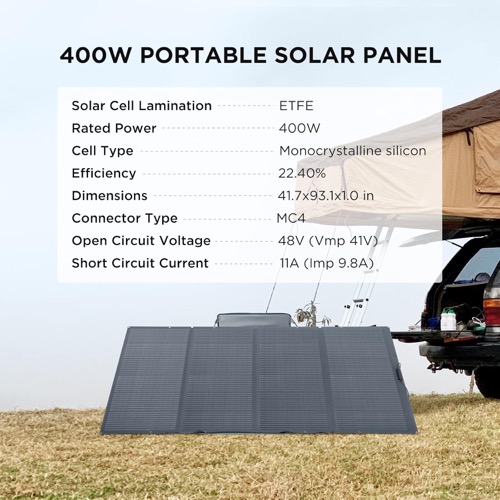
- 400W original EF-Flex-400 model with 41V Vmp and 48V Voc.
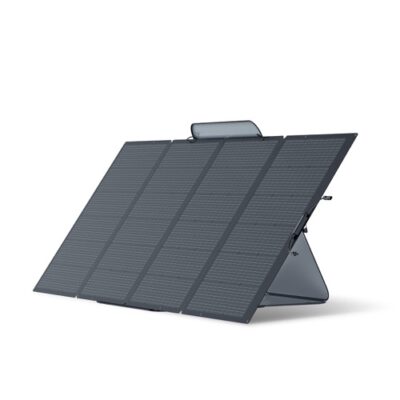
- Four-section panel weighs 35.3 pounds before its case.
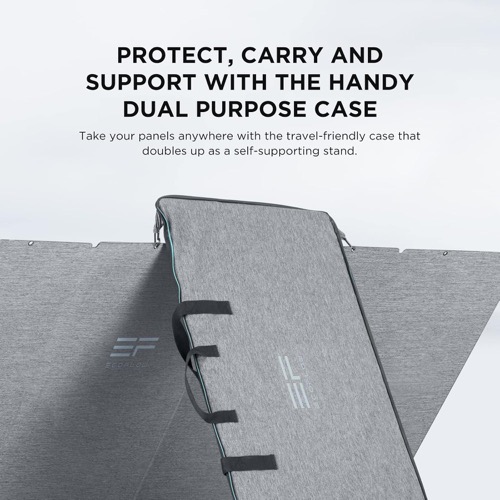
- Protective carry case doubles as the adjustable support.
- IP68 rating applies to the panel body, not every open connection.
- Best for backyard backup and vehicle-supported base camps.
PROS
- High useful output from one portable panel
- 48V-class design reduces current for 400W
- Folds for storage
- Strong fit with compatible EcoFlow stations
- Large and heavy to reposition
- Case stand is awkward
- Outer sections can sag
- Connector and long-term output incidents appear
CONS
- Large and heavy to reposition
- Case stand is awkward
- Outer sections can sag
- Connector and long-term output incidents appear
High-Power Base-Camp Pick
Based on exact documentation, retained exact-ASIN evidence, and the expanded qualitative Amazon owner-text review; no hands-on test claimed
Can 400 watts of folding solar ever justify $599 — roughly four times what a no-name panel with the identical rating asks? That money question hangs over EcoFlow’s premium foldable, and the honest answer turns less on the panel itself than on what already sits in your garage. Spec for spec it’s a genuinely good panel with a couple of stubborn flaws, so the premium lives or dies on whether you own the gear it was built to feed.
Plenty of cheaper 400W foldables quote the same wattage, the same monocrystalline cells, and often half the price. On paper, EcoFlow’s version doesn’t read four times better. So the real test isn’t “is 400W good?” — it’s whether build quality, weatherproofing, and a tidy fit with a Delta 2 or Delta Pro earn the markup.
Here’s the honest framing: a premium panel that mostly lives up to the label, though not flawlessly. Cells are well made and the main body carries an IP68 rating, yet the stand is flimsy, the weight is real, and hot afternoons cost measurable output. For an EcoFlow owner, that trade can pay off. For a bargain hunter chasing watts, it’s a harder sell.
Cross-shopping? See how it ranks in our best 400W solar panels roundup.
- Documented EcoFlow station path
- High nameplate power in one folding unit
- Station display helps refine angle
- Known cable family
- Large, heavy folded package
- Case-based stand takes practice
- Broad surface catches wind
- Vehicle-supported carry is more realistic than backpack portability
The expanded owner pool contains many successful Delta and Delta Pro charging setups, but the displayed inputs span a wide range. Those readings reflect season, latitude, haze, angle, cell heat, partial shade, extension loss, station limits, battery state, and sometimes cable or product faults. They are useful examples only when those conditions remain attached. They do not establish a single “real-world wattage” that every owner should expect.
Critical observations focus on difficult setup, missing or misunderstood adapter cables, input below expectations, case/stand frustration, weather ambiguity, and support experiences. Some owners praise construction and fast charging; others returned the panel. The appropriate response is an arrival test with the intended station—not a claim that the sample predicts an individual unit.
The premium is easiest to justify when the panel travels in a vehicle, charges a compatible EcoFlow station, and can be deployed on a broad controlled surface. Buyers carrying equipment far from the vehicle or working alone in frequent wind may get more usable energy from smaller modules they are willing to reposition.
The EcoFlow Pairing — and What Else Fits
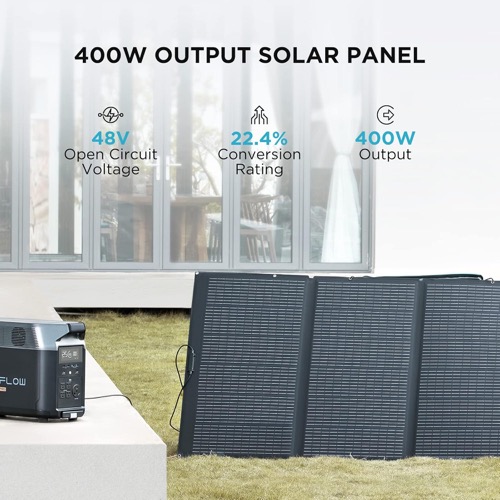
A fair first question for a panel like this is “will it play nicely with the gear I own?” If that gear is an EcoFlow station, the answer is a clear yes. It uses an MC4 connector and leans on the station’s built-in MPPT algorithm to track output, and owners report smooth results with the Delta 2 and Delta Pro in particular.
Here’s the thing, though: MC4 is a universal solar connector, so this panel isn’t locked to EcoFlow. You can wire it into other MC4-input power stations, or run it into a 12V battery bank through a separate charge controller. A few owners build exactly those custom setups. Worth knowing — the panel itself has no controller, so charging a bare 12V battery means supplying your own MPPT or PWM unit.
| Power Station / Battery | Typical Use | Compatible? | Notes |
|---|---|---|---|
| EcoFlow Delta 2 | Home backup, camping | Compatible | Owners run a fridge all day and top the station by mid-morning |
| EcoFlow Delta Pro | Off-grid, home backup | Compatible | Charges well most days; slower on very hot days |
| EcoFlow River series | Camping, small backup | Compatible | Standard MC4 input works |
| Other MC4-input stations | Camping, backup | Compatible | Universal MC4 output plugs right in |
| 12V battery (AGM / lead-acid / LiFePO4) | RV, boat, off-grid | Needs adapter | Requires a separate MPPT or PWM controller |
| USB devices (phone, power bank) | Everyday charging | Not compatible | No onboard USB — needs a station in the line |
Adapter Check — The MC4 output is the universal part, but the cable that ships in the box runs short for a lot of setups. If your sunny spot sits more than a few feet from the station, plan on an MC4 extension in a matching gauge so you don’t lose the placement flexibility a foldable panel is supposed to give you.
Chasing 400 Watts in Real Sun
Rated at 400W, the EcoFlow panel translates in good sun to roughly 320W of real output, or about 1,280 Wh on a typical day with four solid peak sun hours. In practice, owners regularly do better than that estimate when conditions line up: one buyer in south Florida caught 350W laying it flat and 375W at the right angle, and another saw 365W feeding a Delta Pro.
What does that mean day to day? Plenty to keep an EcoFlow station alive. One owner runs a home refrigerator all day off a Delta 2 and still has charge left for the night, and another watched a Delta 2 climb from 70% to full by 10:30am after powering a small fridge overnight. In real use, that’s the panel doing exactly what it’s built for.
Heat is the surprise limiter. A recurring observation is that the cells get hot — one owner started at 360W and dropped to 250-260W at a festival, later learning from EcoFlow support that the panel can reach around 140°F and lose roughly 13% efficiency once hot. Hazy days behave better than you’d fear; owners report it still charging a Delta Pro decently on overcast skies, just not as much.
| Condition | Estimated Output | What That Means |
|---|---|---|
| Full sun, ideal angle | ~320-375 W | Recharges a Delta 2 in a strong day; big daily gain |
| Partly cloudy sky | ~160-200 W | Still meaningful charging; just slower to fill the station |
| Overcast / heavy clouds | ~80-120 W | Keeps trickling; won’t fully charge but holds ground |
| Panel angle 45° off optimal | ~210-240 W | Noticeable hit; reposition for the best return |
| Winter / weak sun | ~200-240 W | Still usable; expect fewer peak sun hours overall |
| Hot, still day (140°F cells) | Drops to ~250-260 W | Cells heat up and throttle; shade the airflow if you can |
Real-World Math — Using a 0.80 real-world factor, this 400W panel delivers roughly 320W in good sun. Stretch that across four peak sun hours and you bank about 1,280 Wh in a day — enough to refill a Delta 2’s 1,024 Wh on a single strong day, with headroom to run a fridge alongside.
Treat these as planning examples: the displayed input still changes with orientation, sky, shade, cell heat, receiver behavior, and extension loss.
The Foldable Build, Case and All
First thing owners notice is that these are heftier and better made than they expected — and for once, that’s a compliment. Buyers describe the panels as sturdy and well constructed, built from flexible EVA layers over tough fiberglass rather than a flimsy laminate. One owner expects years of use out of them.
Folded up, the panel tucks into a padded, water-resistant carry case with handles, and that case is where the design gets clever and frustrating at the same time. It protects the panel in storage and doubles as the angle stand when you open it up. Buyers like that it stores neatly and shields the cells from scratches in transit.
That same case-stand is the weak spot. Owners say it doesn’t hold firmly — the weight of the panels makes the whole thing want to slide, and the side sections can sag inward “more like a tent” than a flat array. To be fair, plenty of buyers just work around it, cutting PVC pipe for support or leaning the panel against a wall. It’s the one build complaint that comes up again and again.
Setting It Up on the Kickstand Case
Setup is about as easy as folding solar gets, at least in principle. Unfold the panel, open the carry case into its kickstand shape, aim it at the sun, and plug the MC4 cable into your EcoFlow station. First-time buyers who pair it with a Delta 2 describe it as intuitive — set it in the sun and it charges.
Two things will trip you up: the stand and the weight. The case-stand doesn’t hold firmly, so on uneven ground the panel wants to slide or sag, and owners routinely prop it with PVC or lean it on a wall instead. Then there’s the heft — at a rated 35.3 lb (and heavier-feeling to many), muscling it into position isn’t nothing, especially solo.
Cold and cable length round out the friction. One owner couldn’t fold the panel on a 55°F morning until the stiff hinges warmed in the sun for a few hours, which is a real hassle when you’re breaking camp. And because the included cable runs short, buyers who want the panel in full sun while the station sits in shade end up buying a longer one.
Practical Tip — Buy a longer MC4 cable at the same time as the panel and pack a compact support — a length of PVC or a small folding stand. Owners almost universally end up improvising around the wobbly case, and sorting it before a trip beats discovering it at a windy campsite.
Is the Premium 400W Right for You? — Use-Case Fit Matrix
| Use Case | Fit | Why |
|---|---|---|
| Charging an EcoFlow Delta 2 / Delta Pro | Strong fit | Built for it; real 300-375W in sun and clean MPPT pairing |
| Home emergency / power-outage backup | Strong fit | Owners ran fridges and electronics off a station after a hurricane |
| RV or van supplemental solar | Solid fit | Foldable and repositionable; just plan for the weight |
| Off-grid camping with a power station | Solid fit | Keeps a station charged; heat and stand are the caveats |
| Custom 12V battery setup (with controller) | With caveats | MC4 output works, but you supply the MPPT/PWM controller |
| Hot-climate midday charging | Borderline | Output throttles as cells hit ~140°F |
| Backpacking or grab-and-go trips | Borderline | At 35+ lb it’s heavy and bulky to carry far |
| Leaving connections out in heavy rain | Skip | Only the body is IP68 — the plugs aren’t waterproof |
| Bargain hunters who just want watts | Skip | Cheaper 400W panels deliver similar good-sun output for less |
| Direct phone / USB device charging | Not recommended | No onboard USB — needs a station or controller |
| Buyer who wants a rock-steady stand | With caveats | The case-stand is wobbly; expect to improvise support |
| High-draw loads without a battery | Not recommended | It’s a charging panel, not a generator |
Worth it if you want:
- A well-built folding panel that pairs cleanly with an EcoFlow Delta 2 or Delta Pro
- Real 400W-class output in good sun to keep a station charged for backup or off-grid use
- An IP68 main body that shrugs off rain and dust on the panel surface
- The EcoFlow fit and finish, and you don’t mind paying up for it
Not for you if you need:
- The cheapest path to 400W of good-sun output
- A lightweight panel you can carry far or store in a small car
- Weatherproof connections you can leave out in a downpour
- A rock-solid stand and a long warranty at this price point
This is a premium tool aimed at EcoFlow owners — not a bad panel, just one priced for people who value the match.
IP68, Wind, and the Heat Problem
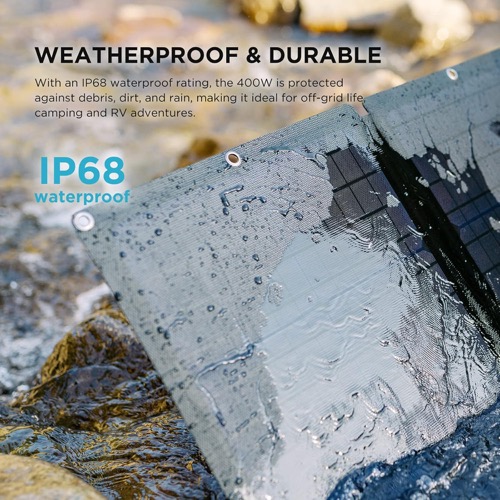
Its main body carries an IP68 rating, which is about as high as portable panels go — dust-tight and able to handle water well beyond a passing shower. One owner even reported it riding out an ice storm outside. For the panel surface itself, weather is genuinely not a worry.
Here’s the catch, and it’s an important one: that IP68 rating covers only the main body. EcoFlow is explicit that the junction box and connection points shouldn’t be immersed, and there are owner reports of solar plugs burning. So the vulnerable spot isn’t the cells — it’s exactly where the cables meet the panel. Keep those connections dry and shaded.
Heat is the other durability story. Beyond the output drop, one owner described the structure between the cells softening and seeming to melt just enough to make the panels droop apart when folding. In real use, that’s rare, but it lines up with the ~140°F cell temperatures owners and support both mention.
| Feature | This Panel | What It Means Outdoors |
|---|---|---|
| IP rating | IP68 (main body) | Dust-tight and handles rain well — top-tier for the body |
| Junction box / ports | Not waterproof | Keep connections dry; burn reports exist at the plugs |
| Panel surface | EVA over fiberglass | Flexible and tough; no glass to crack |
| Frame | None (foldable) | No rigid frame to warp; relies on the case for support |
| Heat behavior | Cells reach ~140°F | Output throttles; one owner saw cells soften in extreme sun |
| Cold behavior | Stiff hinges near 55°F | Folding gets stubborn until the panel warms up |
| Long-term owner reports | Mostly positive, some fade | Solid for most; one measured 50% output at 18 months |
Worth Knowing — IP68 sounds bulletproof, but it only describes the panel body here. The plugs and junction box are the real weak link, so mount the panel where the connections stay dry and out of standing water. A great rating on the wrong part gives false confidence.
The 12-Month Warranty and Heat Realities
There aren’t published safety certifications to lean on here beyond EcoFlow’s own claims, so the real-world track record matters more. For charging an EcoFlow station — which has its own protection circuitry — that’s lower stakes. Wiring it into a bare 12V battery is on you and whatever controller you add, so pick a reputable one.
Warranty is where the premium pinches. Owners cite a 12-month term, and one measured output down to 50% after 18 months — just past coverage. Others received panels with scratches deep enough to feel or a slightly damaged cell out of the box, which stings more at $599 than it would on a budget panel. Buy from a seller with a clear return window and test output the day it arrives.
On safety, the notable issue is heat, not fire. The cells run hot enough to throttle output and, in one case, to soften the structure between panels — and a couple of owners reported burning their fingertips keeping the panel aimed, or solar plugs burning at the connection. None of that is common, but it’s worth handling the panel with the heat in mind.
Long-Term Ownership — Monocrystalline cells usually degrade slowly, so the panel body should last for years. On this one, the parts to watch are the connection plugs, the hinges, and the case zipper — the spots owners flag first. Test output on arrival, keep the connections dry, and store it folded and cool.
EcoFlow 400W Solar Panel Review: Is the Premium Price Justified?
If you own an EcoFlow station and want a well-built folding panel that just works, the EcoFlow 400W solar panel does what you’d hope. It’s sturdy, the main body is IP68-rated, and in good sun it pulls a real 300-375W to keep a Delta 2 or Delta Pro topped up. Just know going in: it’s heavy, the kickstand case is wobbly, it throttles output when it bakes in hot sun, and at around $599 with a 12-month warranty, you’re paying a premium that cheaper 400W panels undercut. Worth it if you value the fit and finish — skippable if you only want watts.
EcoFlow 400W portable panel: Decision Snapshot
| Spec | Value |
|---|---|
| Max Power Output | 400 W (monocrystalline) |
| Output Voltage | 23 V DC |
| Connector | MC4 (no USB) |
| Cell Efficiency | Up to 23% claimed (22.4% cited) |
| Weatherproof Rating | IP68 main body — connections are NOT waterproof |
| Charge Controller | None on panel — MPPT runs in the EcoFlow station |
| Cable Length | Not specified (runs short — extension often added) |
| Mount Type | Adjustable kickstand carry case |
| Best For | Charging an EcoFlow Delta 2 / Delta Pro for backup and off-grid |
Premium Panel, Premium Price — Worth It?
Justified for the committed EcoFlow owner, overkill for the budget watt-chaser — that’s where this EcoFlow 400W solar panel review settles for most buyers. It’s a genuinely well-made foldable that pairs seamlessly with EcoFlow stations and, in good sun, delivers the real 300-375W that keeps a Delta 2 or Delta Pro charged through an outage or a camping trip. Add an IP68 body and sturdy cells, and owners who bought it for backup power tend to be glad they did.
Those trade-offs are just as real. Weight is high, the kickstand case is wobbly, the cells throttle in hot sun, the connections aren’t waterproof, and $599 with a 12-month warranty is a lot next to cheaper 400W foldables. So here’s the if/then: run EcoFlow gear and value the clean fit and build, and the premium is justified. Want watts on a budget and don’t mind a no-name panel? Save the money and put it toward a second panel instead.
Pros & Cons Analysis
Based on documented specifications and owner feedback
Pros
- Strong output when the sun cooperates — owners report drawing over 300W in late-afternoon sun and one buyer in south Florida caught 350W laying the panel flat and 375W at the right angle. Paired in twos, another owner saw a peak of 695W at midday. For a folding panel, that's a real chunk of the 400W rating.
- Genuinely well-made panels — buyers repeatedly call these sturdy and well constructed, with a padded carry case that protects the panel and stores neatly. Several describe them as tougher and heavier than lighter, flimsier competitors, and one expects years of use.
- Pairs seamlessly with EcoFlow stations — set in sunshine and plugged into a Delta 2, one owner runs a home refrigerator all day and keeps the generator charged for night use. Another watched a Delta 2 climb from 70% to full by 10:30am after powering a small fridge overnight.
- IP68-rated main body — the panel itself is built from flexible EVA and tough fiberglass and carries an IP68 waterproof rating, so a passing shower or dusty campsite won't hurt it. One owner reported it shrugging off an ice storm outside.
- Monocrystalline cells with high claimed efficiency — EcoFlow rates the cells at up to 23%, and owners who tested them still pulled meaningful power on hazy days rather than nothing. In good sun, the real-world numbers back up the marketing better than most budget panels.
- Foldable with a carry case and handles — it folds down into a zippered case with handles, so you can pack it up and move it between the yard, the RV, and storage. Buyers who want portability over a fixed roof array appreciate that flexibility.
- Charges even on hazy and low-light days — owners report it does a good job charging a Delta Pro on most days and even trickles a bit on hazy skies, just not as much. It kept a small fridge running 24/7 through a week outdoors in New Mexico.
- Case protects and doubles as an angle stand — the water-resistant padded case is designed to prop the panels at an angle, and owners who don't trust it improvise with PVC or lean the panels against a wall for an even simpler setup.
Cons
- Heat quietly steals output — a recurring theme is that the panel bakes in direct sun and throttles back. One owner started at 360W input and dropped to 250-260W at a festival, later learning from support the cells can hit ~140°F and lose roughly 13% efficiency once hot.
- The kickstand case feels flimsy — the most common design gripe. The case doubles as the stand, and owners say it doesn't hold firmly, the weight of the panels makes the whole thing want to slide, and the side panels can collapse "more like a tent" than a flat array.
- Charging can crawl in the wrong conditions — not everyone gets the fast numbers. One buyer needed six hours to add just 33% to a Delta Pro on a hot, sunny day, and a few report the panel simply didn't keep up with expectations.
- The connections aren't waterproof — the IP68 rating covers only the main body. The junction box and connection points shouldn't be immersed, and there are owner reports of solar plugs burning, so the weak link is exactly where the cables meet.
- Output can fade over time — one owner measured output at 50% after 18 months, past the 12-month warranty window. Others received panels with scratches deep enough to feel or slight cell damage out of the box, which stings at this price.
- It's heavy and cumbersome — the single most common complaint. At a rated 35.3 lb it's more than many expect, some owners swear it feels closer to 40-50 lb, and one senior buyer found it a real lift. Car camping storage is tight.
- Cold makes the hinges stubborn — one owner couldn't fold the panels at 55°F because the hinges were too stiff and had to leave them in the sun for three hours to warm up. That's a real hassle when you're breaking camp on a cool morning.
- Premium price and short warranty — at around $599 for a single panel, expectations are high, and the 12-month coverage feels light for the money. The included short cable also pushes some buyers to purchase a longer one to reach the sun.
Bottom Line: High Output for a Stationary Base Camp
The original EcoFlow 400W can deliver substantial power through one compatible 48V-class panel, but its 35.3-pound body and case stand demand a repeatable setup routine. It is a good backyard, RV-base-camp, and emergency panel. Frequent solo movers should compare lighter 200W pairs or the newer lightweight model without mixing their specifications.
Frequently Asked Questions
How heavy is the EcoFlow 400W portable panel?
The original EF-Flex-400 is 35.3 pounds for the panel and about 41.9 pounds with its case. It is transportable between vehicle and campsite, not backpack equipment.
How much output did owners report?
Individual reports include roughly 348W in clear July Texas sun and 365W into a Delta Pro in another setup. Other owners reported much lower input or declining output. Conditions differ and the sample does not define a typical range.
Will it work with any power station?
No. Check the station's operating voltage range, absolute voltage ceiling, current and watt limits, connector and polarity. The original panel publishes about 41V Vmp and 48V Voc.
Is the carrying case a good stand?
It works, but handling complaints recur. Owners describe awkward hooks, unsupported outer sections, and building alternate frames or leaning the panel against a stable surface.
Can it stay outside permanently?
It is designed as a deployable folding panel. The panel body has an IP68 rating, but fabric, folds, case, connectors, wind exposure and repeated handling still matter. A rigid mounted array is usually the better unattended format.
Technical Specifications
| Brand | EF ECOFLOW |
|---|---|
| Model / SKU | EF-Flex-400 (ASIN B09TKKYW7G) |
| Panel format | Four-section folding portable |
| Rated output (Pmax) | 400W |
| Cell technology | P-type PERC monocrystalline |
| Module efficiency | 22.6% |
| Voltage at maximum power (Vmp) | 41V |
| Current at maximum power (Imp) | 9.8A |
| Open-circuit voltage (Voc) | 48V |
| Short-circuit current (Isc) | 11A |
| Power tolerance | ±10W |
| Maximum system voltage | — |
| Maximum series fuse | — |
| Output connector | Solar connectors / MC4-compatible path |
| Output cable | Solar charging cable included |
| Deployed dimensions | 93.1 × 41.7 × 1.0 in |
| Folded dimensions | 24.4 × 41.7 × 1.0 in |
| Weight | 35.3 lb; 41.9 lb with case |
| Surface and frame | ETFE-faced EVA/fiberglass laminate |
| Positioning / mounting | Protective carry case doubles as stand |
| Environmental protection | Panel body IP68; connections not for immersion |
| Wind / snow load | — |
| Operating temperature | — |
| Included accessories | Panel, protective kickstand case, solar charging cable |
| Product warranty | 12 months (US original model) |