Topunive 100W Flexible Solar Panel Review: Lightweight, but Revision-Sensitive
At a Glance
KEY FEATURES
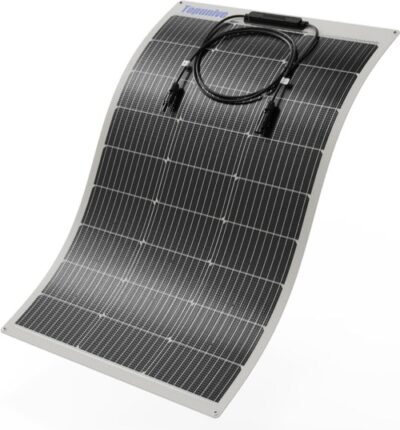
- Identity: Topunive SFSP-100, ASIN B0BQ1Y8JMH; keep the delivered label because revisions have changed.
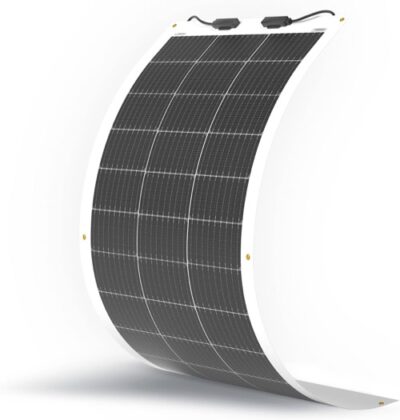
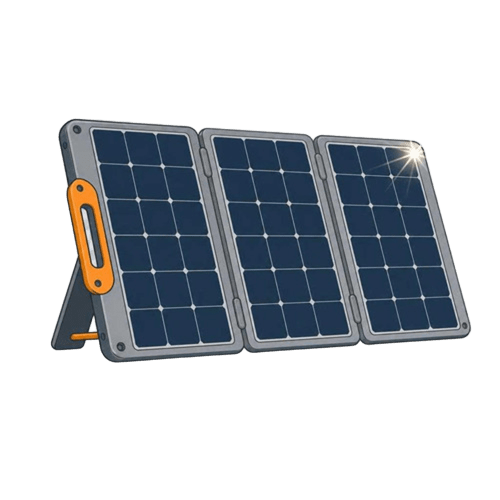
- Format: 100W semi-flexible monocrystalline laminate, approximately 4.4 lb.
- Connection: MC4 solar connectors; no battery charge controller is included.
- Mounting: Six reinforced eyelets; design for support, airflow, drainage, wind, and future removal.
- Best fit: Curved or weight-sensitive van, RV, boat, and temporary array surfaces where a rigid panel is impractical.
PROS
- Several exact-100W owner accounts document useful clear-sun input
- Bends to curved decks, van roofs, and uneven surfaces
- Light 4.4 lb body with MC4 leads and grommets
- Array-friendly current only after the delivered label and receiver limits are checked
- IP67 junction box and strong value versus brands
CONS
- Output sags when the back gets hot or partly shaded
- Flexible but fragile — needs careful handling
- No charge controller — you add your own for 12V batteries
- Design and voltage changed between batches
- No-name QC variance and unverified warranty
Editor's Choice
Based on exact documentation and qualitative exact-ASIN Amazon owner evidence; no hands-on test or population-rate claim
Buy this Topunive 100W flexible panel if you want cheap, bendable solar for a boat deck or van roof and you’re willing to add your own controller and test it the day it lands — otherwise pay up for a brand. That’s the bottom line, and everything below explains why it holds.
Why so blunt? Because the listing tells only half the story. A 100W semi-flexible panel, 9-busbar monocrystalline cells, an IP67 junction box, and a sticker price often half what a name brand charges — on paper it matches gear that costs twice as much, then adds the party trick of bending to fit a roof a rigid panel would never lie flat on. What the spec sheet hides is whether that low price bites once you’re relying on it off-grid.
The practical framing is straightforward. Hardware quality is often genuinely decent, yet quality control wanders from batch to batch, the warranty is whatever a rotating seller decides that week, and support and revision consistency remain less predictable than with an established dealer network. As a cheap way to add solar to a curved surface, that’s a fair trade. For a permanent setup you’ll trust for years, the math changes.
This one made our best flexible solar panels shortlist — see exactly where it landed.
The historical URL stays intact, but this is no longer treated as an anonymous panel.
Dimensions, cell layout, voltage, and warranty language have changed across owner timelines.
The expanded owner record changes the most important part of this review: the risk is not simply “unbranded versus branded.” The Amazon product page identifies Topunive, while longer owner updates describe more than one physical revision under the same shopping history. Buyers mention different cell counts, footprints, voltage behavior, and warranty wording. That makes the label on the panel you receive more authoritative than an old photo, an old review, or even a second panel bought years later.
Exact-configuration reports show why both enthusiasm and caution appear. Owners describe lightweight van, trawler, trailer, yard-rack, and backup-power installations; several recorded useful output through Victron or other controllers, and some kept arrays working through a year or longer. Other owners describe output materially below the nameplate, pronounced loss under partial shade, mismatched replacement revisions, surface discoloration, or decline after extended roof exposure. Those observations identify conditions to investigate but cannot quantify how often any outcome occurs.
The installation lesson is equally specific. Flexible cells can follow a gentle curve, but repeated flexing, local pressure, unsupported edges, and trapped heat are separate stresses. Owners used adhesive, perimeter roofing tape, mechanical fasteners, and custom racks with different results. No single attachment method is automatically correct for every membrane, metal roof, boat deck, or vehicle. The substrate manufacturer, wind loading, drainage, cable protection, thermal path, and eventual removal plan all belong in the design.
For electrical planning, treat the product as a bare module. It needs a compatible solar controller before a battery, or a power station whose PV voltage, current, wattage, connector, and polarity all fit. Never infer an array limit from “12V” in the product name. Read the delivered label, calculate the whole string, and retest after the panel reaches operating temperature.
Support, Warranty Language, and Revision Control
Warranty language needs to be captured at purchase. One long owner update says earlier five-year wording later became difficult to locate and describes unsuccessful attempts to obtain help; other accounts describe responsive replacement handling for an underperforming unit. Those individual experiences point in both directions. They do not establish a typical support outcome, and current terms should be verified on the product page and order record rather than inferred from an old review.
Save before installation:
- The complete order page and seller identity
- The warranty text and return-window dates
- Photos of the box, module face, back, junction box, connectors, and label
- Cold and warm commissioning readings with equipment and conditions noted
- Any communication and case numbers if performance changes
Revision control is the related issue. An owner who tried to add a newer module to an older installation described a changed cell layout, footprint, and voltage. Series and parallel arrays depend on electrical matching, so “same ASIN” is not enough. Compare delivered Vmp, Imp, Voc, Isc, dimensions, connector polarity, and cell layout before combining purchases from different dates.
No exact safety-certification record was retained for this revision. That does not prove absence, but it means the installation should not invent one. Use a listed controller and protection hardware appropriate to the system, size conductors for the actual circuit, provide a disconnect where required, secure cables against abrasion, and follow applicable marine, vehicle, or building rules.
What the Topunive Output Reports Actually Establish
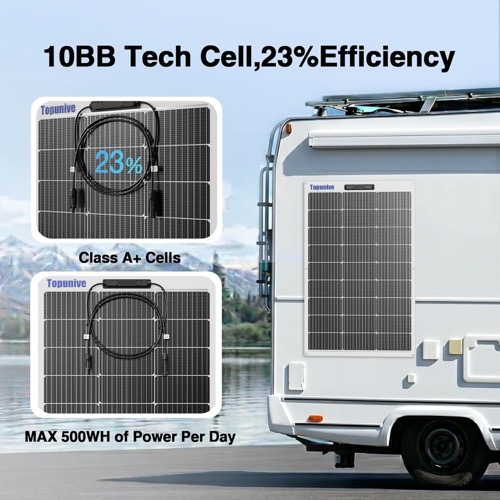
The owner evidence supports a range of individual outcomes, not a standardized power curve. Several exact-100W accounts describe controller readings in roughly the useful midrange of the nameplate, including multi-panel arrays whose combined output made sense for the number of modules. Other owners recorded much lower input, especially with partial shade, a hot roof, an imperfect angle, a receiver limit, or after extended exposure. A few saw unusually strong peaks. None of those isolated readings can be promised to another buyer.
| Observation | What it may indicate | What to record next |
|---|---|---|
| Healthy Voc but low loaded power | Heat, shade, controller behavior, battery taper, or cell damage | Vmp/Imp at the controller, cell temperature, sky, angle, battery state |
| One module differs from matching neighbors | Panel, connector, cable, or revision mismatch | Swap positions and test each module independently |
| Output falls after warming | Normal thermal derating or a temperature-sensitive fault | Cold and hot readings under otherwise similar conditions |
| Array disappears in series | Receiver ceiling, connector fault, shading, or mixed labels | Cold-corrected string Voc and each panel’s delivered label |
The safest baseline is a repeatable commissioning record. Start with the unmounted panel in clear sun, use a compatible MPPT controller or station, and let the receiving battery sit low enough to accept charge. Record open-circuit voltage, stable loaded voltage, current, power, sky, angle, and time. Repeat when the panel is warm. The goal is not to prove that a 100W label must appear on a display; it is to establish how the delivered unit behaves before installation adds heat, cable length, shade, and mechanical stress.
Daily energy is the more useful planning measure. A van refrigerator, communications kit, or overnight medical device consumes watt-hours, while a panel display shows a momentary value. Build the load budget first, apply the site’s seasonal solar resource and system losses, then decide whether one Topunive module leaves enough margin. If the application is critical, redundancy and alternative charging matter more than an optimistic clear-sky peak.
Wiring It Into Your 12V Setup
Biggest question for a panel like this is “what do I actually connect it to?” On its own, not much — it’s a bare 12V panel with MC4 leads. To charge a battery you add an MPPT or PWM controller between the panel and the battery, and several owners run it happily through a Victron MPPT.
Here’s the thing that makes it easy to expand: the current is low, around 6.6A short-circuit. That lets owners wire several in parallel and stay under a typical 15A power-station limit, or chain a couple in series while staying under a 60V cap. One long-time owner does warn that the cell layout changed between batches, which shifted the voltage — so match specs carefully before pairing a new panel with an old one.
| Setup | Typical Use | Compatible? | Notes |
|---|---|---|---|
| 12V flooded lead-acid | Car, truck, tractor | Compatible | Add a PWM or MPPT controller |
| AGM (sealed) | RV, boat, van | Compatible | Add controller; great for sealed bays |
| Gel cell | Marine, mobility | Needs adapter | Set the controller to a gel profile |
| LiFePO4 (12V) | Van, RV, off-grid | Needs adapter | Controller must have an LFP charge profile |
| Portable power station (MC4 in) | Camping, backup | Verify first | Check the station accepts ~12-25V solar input |
| 24V battery bank | Large RV / boat bank | Not compatible | Wire two panels in series for 24V |
| Connection | What You Get | What You Need to Add |
|---|---|---|
| MC4 leads | Standard solar plugs | MC4-to-XT60 or Anderson for many stations |
| To a 12V battery | Direct panel output | An MPPT or PWM charge controller |
| Two panels in series | Higher voltage, same amps | Stay under your controller/station voltage cap |
| Two panels in parallel | 12V, doubled amps | Y-branch MC4 connectors and a fuse |
Buyer Heads-Up — Not every controller supports LiFePO4 out of the box. If you run a lithium house battery, confirm your MPPT or PWM controller has an LFP charge profile before you connect this panel — a lead-acid profile can shorten a lithium battery’s life.
Where a Flexible 100W Panel Earns Its Keep — Use-Case Fit Matrix
| Use Case | Fit | Why |
|---|---|---|
| Boat / sailboat 12V charging | Strong fit | Bends to the deck; IP67 box handles spray |
| Camper van or RV curved roof | Strong fit | Low-profile, light, and conforms to the curve |
| Truck cab / roof-top tent | Strong fit | Thin and light; owners power inverters and batteries |
| Supplementing a fixed roof array | Solid fit | Low current wires in parallel; good for cloudy-day boost |
| Off-grid cabin or shed 12V loads | Solid fit | Add a controller and it maintains a house battery |
| 12V battery maintenance (with controller) | With caveats | Works well, but you supply the MPPT/PWM controller |
| Charging a power station directly | Verify first | Needs an MC4 adapter and a compatible input range |
| Flush-mounting flat on a hot roof | Borderline | Back overheats and throttles without an air gap |
| Any shaded mounting spot | Skip | Very shade-sensitive; output collapses |
| Set-and-forget permanent install | Borderline | No-name QC and unclear warranty raise the risk |
| Buyer who wants certified, exact specs | With caveats | Voc, Isc, and efficiency aren’t officially published |
| High-draw loads without a battery | Not recommended | It’s a 100W charging panel, not a generator |
This one earns its keep for the sailor, van-lifer, or RV owner who needs a bendable, low-profile panel that hugs a curved deck or roof, delivers real 100W-class output for roughly half a name brand’s price, and can be hung, glued, or bolted down and later expanded in series or parallel. Anyone topping up a fixed roof array who wants a light supplement that keeps trickling on cloudy days will get along with it too.
The buyer it’s wrong for is easy to spot. If your mounting spot sits in shade or partial obstruction, if you expect a ready-to-charge kit rather than a bare panel that needs its own controller, or if certified specs, a strong brand warranty, and batch-to-batch consistency are non-negotiable, this panel will let you down — spend more on a known brand instead. A different tool for a different job — not a bad panel, just one with clear edges.
Topunive 100W flexible panel: Decision Snapshot
| Spec | Value |
|---|---|
| Max Power Output | 100 W (9BB monocrystalline) |
| Output Voltage | 12 V DC nominal (~18 V Vmp) |
| Connector | MC4 (no USB, no controller) |
| Cell Efficiency | — (no exact revision value retained) |
| Weatherproof Rating | IP67 junction box; flexible body, no whole-panel cert |
| Charge Controller | None — direct output, add your own |
| Cable Length | Not specified (leads exit opposite sides) |
| Mount Type | Pre-drilled grommets; adhesive or zip-tie friendly |
| Best For | 12V charging on boats, RVs, vans, and curved roofs |
100W Flexible Solar Panel Review: The Short Take
If you want a bendable panel to charge a 12V battery or supplement a roof array on a boat, RV, or van, this 100W flexible solar panel does the job for a lot less than the name brands. In good sun it pulls a real 75-89W per panel, it weighs just 4.4 pounds, and its low current makes it easy to wire two or three together. Just know going in: it needs full, clean sun to shine, the back gets hot when it lies flush, it’s flexible but still fragile, and there’s no controller in the box — so plan on adding your own and testing the panel the day it arrives.
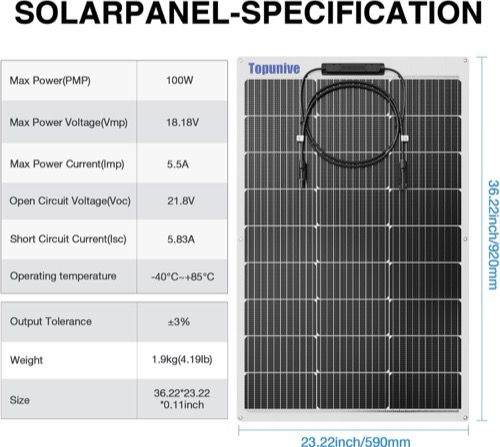
A Bendable Panel Built Around ETFE
First impression for most buyers is that it feels sturdier than a bargain flexible panel has any right to. Owners describe it as heavier and better made than expected, with a smooth ETFE face over the cells and a TPT back sheet that helps shed heat and wipe clean. Buttoned up, it reads like real gear, not a throwaway.
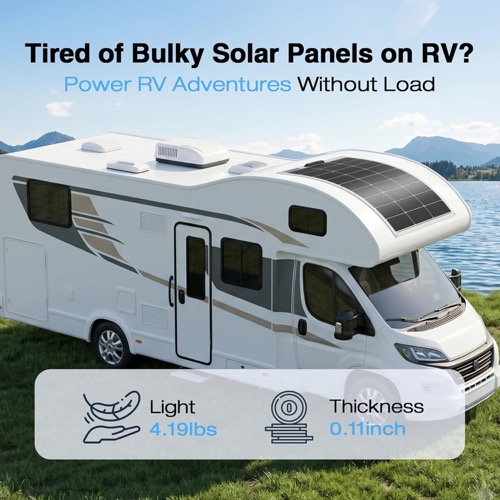
That body is the whole selling point. It’s about 0.12 inches thick, follows a gentle supported curve, and lays across a curved van roof or boat deck where a rigid glass panel would rock on its corners. Pre-drilled metal grommets — six of them on the current version — let you screw, bolt, or zip-tie it down, and one owner even trimmed the outer margin a touch to fit a tight spot without hurting output.
The mechanical caveat is important: flexible does not mean indestructible. Owners are blunt that the panel is still fragile and should be handled with care, so no leaning on it or creasing it past that bend radius. A couple also notice cell clusters that look lighter or darker at an angle, which raises quiet questions about UV fading down the road.
IP67 Junction Box vs. a Flexible Body
Weatherproofing here is a split story. That junction box carries an IP67 rating and routes output through its junction box, so the electrical heart of the panel handles splashes, dust, and marine spray better than a lot of budget flexible panels bother with. That’s genuinely reassuring on a boat deck.
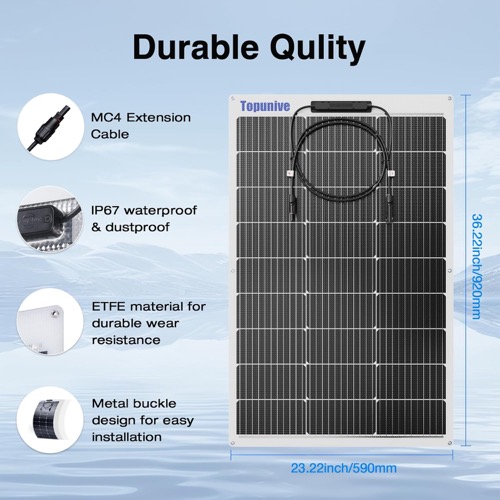
Its body is a different matter. This is an ETFE-over-TPT laminate — good for shedding heat and wiping clean — but there’s no whole-panel IP rating quoted, and the flexible sheet is fragile by design. Owners who treat it like a delicate laminate, not a rigid panel you can stand on, tend to get long trouble-free use out of it.
Long-term durability is mostly a bright spot, with the honest asterisk of revision and quality-control variation. Plenty of owners report a year or more of regular marine and RV use without drama, but a few note faded-looking cell clusters or output that slipped over time, including one panel down to 26W after a year. That variance is the real risk, not the sealing.
| Feature | This Panel | What It Means Outdoors |
|---|---|---|
| IP rating | IP67 junction box only | Wiring box handles spray and dust; whole-panel not certified |
| Frame / backing | Frameless flexible laminate | Conforms to curves; no rigid frame to corrode |
| Panel surface | ETFE over monocrystalline cells | Wipes clean; decent UV and abrasion resistance |
| Back sheet | TPT | Helps shed heat; still gets hot flush-mounted |
| Bypass diodes | Two built in | Reduce loss from partial shading across the panel |
| Handling | Flexible but fragile | Careful handling required; don’t crease or lean on it |
| Long-term owner reports | Mostly positive, some fade / drop-off | Solid for most; QC variance is the real risk |
Worth Knowing — An IP67 junction box protects the wiring, not the whole panel. Route the MC4 leads so water drains away from the connectors, avoid ponding water on a flat-laid panel, and you’ll dodge most moisture headaches this design can throw at you.
Gluing, Screwing, or Zip-Tying It Down
Getting it mounted is where the flexible form really pays off. At 4.4 pounds and paper-thin, you can lay it on a curved roof, hang it from the grommets on an RV or tent, or bond it down with adhesive for a permanent low-profile install. First-time solar buyers consistently describe the setup as a no-brainer.
Two small things trip people up. First, the two MC4 leads exit the junction box in opposite directions, so one owner had to loop a wire under the panel to route both cables together — worth planning before you glue anything down. Second, the grommet holes are on the small side, and one buyer removed them to fit their preferred fasteners.
Airflow is the other tip. Bonding the panel flat against a hot roof is the one setup that reliably hurts output, so owners who care about summer performance leave an air gap or add a thin spacer underneath. It’s a five-minute decision at install time that pays back every hot afternoon.
Practical Tip — Before you commit to a mounting spot, plan your cable route and buy an MC4 extension in the right length. The panel’s leads are short and exit awkwardly, and you’ll usually want the controller or power station out of the sun — so an extra 10-20 ft of MC4 cable saves a reinstall later.
Final Decision: Buy It for a Constraint, Not Just a Discount
The Topunive earns consideration when a conventional framed module will not fit: the surface is gently curved, mass is tightly limited, profile matters, and the owner can support, cool, test, and periodically inspect a laminate. It is less persuasive on a flat rack where glass offers airflow, structural framing, easier replacement, and a longer-established durability model.
The deal is conditional even for the right site. Confirm the current revision before purchase, verify the delivered label, commission the unit before bonding, and retain removal access. Treat partial shade as a design problem, not a weather inconvenience. Do not combine it with an older unit until the electrical values match, and do not build a critical energy budget around one best-case watt reading.
Bottom line: buy the Topunive because its 4.4-pound flexible format solves a real mounting constraint and the delivered unit passes your tests. If the main attraction is only its price, a rigid framed panel is usually the more defensible long-term purchase.
Pros & Cons Analysis
Based on documented specifications and owner feedback
Pros
- Solid real-world output in good sun — owners regularly pull 75-89W per panel on clear days, with one buyer catching 97W in full Texas sun. For a bendable budget panel, that's a respectable chunk of the rated 100W.
- Genuinely light and thin — at 4.4 lb and roughly 0.12 inches thick, it's easy to carry, hang, or lay across a curved roof. Buyers describe it as light enough to reposition by hand throughout the day to chase the sun.
- Bends to curved and uneven surfaces — the semi-flexible body sits on boat decks, van roofs, truck cabs, and roof-top tents where a rigid panel simply won't lie flat. This is the whole reason to pick a flexible panel over a cheaper glass one.
- Low current is great for parallel wiring — with a roughly 6.6A short-circuit current, owners run several in parallel and stay under a 15A power-station limit, or chain a few in series while staying under a 60V cap. That flexibility makes it an easy building block.
- Nicely built for the money — buyers describe it as heavier and better made than expected, with an ETFE face, a TPT back sheet, and pre-drilled metal grommets. One owner even trimmed the edges a smidge to fit a tight spot without hurting output.
- Keeps trickling on cloudy and rainy days — the 9-busbar monocrystalline cells and a prismatic-looking surface help it grab low-angle light, and owners report meaningful output across a full day rather than a hard midday-only spike.
- IP67 junction box — the wiring box carries an IP67 rating with two built-in bypass diodes, which helps it shrug off splashes and dust on a deck or roof. That's better sealing than a lot of budget flexible panels bother with.
- Strong value versus name brands — at around $72 (and cheaper on sale), owners feel it matches Renogy-class panels at the same percentage of rated power for roughly half the money. Several bought more after the first one worked out.
Cons
- Heat and shade knock it back hard — a recurring complaint is that the back bakes when the panel sits flush on a roof, and output sags. Several owners also call it very susceptible to shading, dropping toward single digits when part of the cell area is covered.
- Flexible does not mean tough — owners warn that although it follows a gentle supported curve, it's still fragile and needs careful handling. Treat it like a laminate sheet, not a rigid glass panel you can lean on.
- Design changed between batches — one long-time owner found the new version has 3 cells across and 9 down instead of the older 11-down layout, which shifts the voltage and size. That broke a planned series hookup and means old reviews may not match the panel you receive.
- No charge controller included — you get MC4 leads and nothing else, so charging a 12V battery means buying your own MPPT or PWM controller. First-time buyers sometimes miss that the panel can't safely charge a battery on its own.
- Spotty batch-to-batch quality — separate from normal wear, some units simply underperform, with one owner reporting only 26W a year after purchase. This is the classic budget-priced lottery — the seller is your only recourse.
- Needs full sun to hit its numbers — one disappointed buyer maxed out at 60W and found it did little in shade. The 100W figure is a lab rating, and weak or partial light pulls real output well below it.
- Leads exit awkwardly — the two wires leave the junction box in opposite directions, so one owner had to loop a lead under the panel to route both cables together. Minor, but it complicates a clean install.
- Uncertain longevity and warranty — a few owners note cell clusters that look lighter or darker at an angle and worry about UV fading over time, and warranty terms vary by listing with no brand-level accountability behind them.
Final Decision: Buy It for a Constraint, Not Just a Discount
The Topunive is worth considering when its flexible 4.4 lb format solves a genuine curved-surface or weight constraint and the delivered revision passes a documented cool-and-warm commissioning test. On a flat rack with room for glass, a rigid module remains the more defensible long-term choice. Verify the current label, support the laminate, manage heat and shade, and preserve removal access.
Frequently Asked Questions
Who makes the 100W flexible panel on this page?
Amazon currently identifies ASIN B0BQ1Y8JMH as a Topunive 100W flexible solar panel. The indexed URL remains unchanged, but the product is no longer described as unbranded.
Can I combine a new Topunive panel with an older one?
Only after comparing the delivered Vmp, Imp, Voc, Isc, dimensions, polarity, and cell layout. Owner histories describe revision differences, so the same ASIN or watt label does not prove two purchases are electrically identical.
Does the Topunive panel connect directly to a 12V battery?
No. Use a solar charge controller whose PV limits and battery profile match the panel and battery. For a portable power station, verify the complete PV voltage, current, wattage, connector, and polarity requirements.
Should I glue this flexible panel flat to a roof?
Permanent bonding is conditional. The design needs substrate-compatible adhesive, thermal management, drainage, strain relief, wind resistance, and a way to inspect or remove the panel. Commission it before permanent attachment.
How much power should the 100W panel produce?
There is no single guaranteed display value. Sun, angle, shade, cell temperature, cable loss, controller behavior, and battery state all affect input. Record a cool and warm baseline for the delivered unit under known conditions.
Technical Specifications
| Brand | Topunive |
|---|---|
| Model / SKU | SFSP-100 (ASIN B0BQ1Y8JMH) |
| Panel format | Semi-flexible laminate |
| Rated output (Pmax) | 100W |
| Cell technology | 9BB monocrystalline |
| Module efficiency | — |
| Voltage at maximum power (Vmp) | — |
| Current at maximum power (Imp) | 5.24A |
| Open-circuit voltage (Voc) | — |
| Short-circuit current (Isc) | — |
| Power tolerance | — |
| Maximum system voltage | — |
| Maximum series fuse | — |
| Output connector | MC4 solar connectors |
| Output cable | — |
| Deployed dimensions | 36.22 × 23.22 × 0.12 in |
| Folded dimensions | — |
| Weight | 4.4 lb |
| Surface and frame | ETFE/TPT frameless laminate |
| Positioning / mounting | Six reinforced mounting eyelets |
| Environmental protection | IP67 junction box |
| Wind / snow load | — |
| Operating temperature | — |
| Included accessories | One 100W flexible panel |
| Product warranty | — |