ECO-WORTHY 260W Flexible Solar Panel Kit Review: Two Panels, Two Wiring Paths
At a Glance
KEY FEATURES
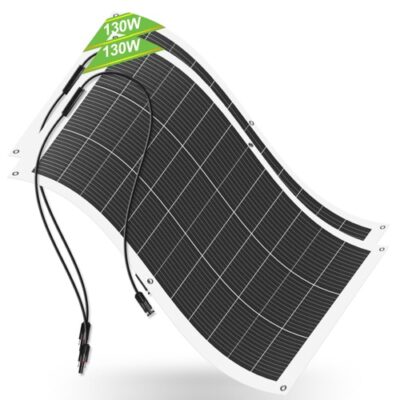
- Two current-revision 18BB flexible panels rated at 130W each.
- Per-panel values are 21.10V Vmp, 6.16A Imp, 24.50V Voc, and 6.50A Isc.
- Series and parallel wiring create very different controller requirements.
- Approximately 12.6 pounds total before mounting hardware and wiring.
- Best for weight-sensitive roofs with a deliberate cooling and service plan.
PROS
- 260W total nameplate at low weight
- Two panels allow layout flexibility
- Exact per-panel electrical limits published
- Current 18BB revision
- No single wiring method fits every controller
- Individual panel imbalance reports
- Flexible-roof thermal tradeoffs
- Arrival and surface-condition incidents appear
CONS
- No single wiring method fits every controller
- Individual panel imbalance reports
- Flexible-roof thermal tradeoffs
- Arrival and surface-condition incidents appear
Lightweight Two-Panel Design Option
Based on exact documentation, retained exact-ASIN evidence, and the expanded qualitative Amazon owner-text review; no hands-on test claimed
Kneeling on a cabin top that curves away toward the gunwales, a boat owner peels the backing off a strip of VHB tape and presses the first of two wafer-thin panels down along the camber — the exact spot where a rigid glass panel would sit proud and refuse to sit flush. That job is what the ECO-WORTHY 260W flexible twin-pack is built for: skinning a curved roof with solar, minus the weight, the drilling, and the glass. What follows is what two of these 130W panels actually do once they’re wired up, and where the trade-offs hide.
You’ve seen the pitch. Two ultra-thin panels, 260 watts on paper, monocrystalline cells, a 270-degree bend claim, and a price that undercuts most rigid kits per watt. For a van, a boat deck, or a cabin roof that isn’t flat, that’s a tempting package. Whether the flexibility and the wattage both hold up once you leave the product page is the real question.
Here’s the honest framing up front: the hardware is legitimately useful for weight-sensitive builds, but real-world output swings a lot, the “flexible” part is really semi-flexible, and durability depends on the batch and how you mount it. For scaling lightweight solar on a curved roof with an MPPT controller, the pair earns its place. Anyone expecting a guaranteed 260 watts out of the box needs a closer look at the reality.
Still deciding? We stack it against every rival in the best flexible solar panels roundup.
The two-panel bundle is not simply the single-panel review multiplied by two. It introduces panel-to-panel consistency, branch connections, topology, twice the roof attachment area, and two thermal interfaces. Amazon exposes the same variation-family review pool for this ASIN and the single 130W ASIN, so it is treated as one qualitative source. Pair-specific claims are retained only where an owner clearly describes multiple panels; other observations remain family-level context.
| Pair arrangement | What approximately adds | Design pressure |
|---|---|---|
| Series | Vmp and Voc | Cold-voltage ceiling and partial-shade behavior |
| Parallel | Imp and Isc | Branch connectors, conductor current, and protection |
| Separate inputs | Receiver-dependent | Only when the device explicitly supports independent trackers/inputs |
Owner evidence includes arrays used on vans, trailers, boats, cabins, and lightweight structures. It also raises cracked surfaces, delamination, connector or diode problems, varying output, wind exposure, support outcomes, and the danger of incorrect series/parallel diagrams. None of that yields a defensible failure percentage. It does justify testing each panel alone, verifying polarity, and checking the combined circuit under supervision.
Mounting principle: an adhesive bond that is difficult to remove can hide heat damage and make one failed panel expensive to service. Plan inspection and replacement before choosing the attachment method.
Wiring the Pair: Series, Parallel, and What It Feeds
Here the key compatibility question isn’t “which device” — it’s “how do I wire two panels, and into what?” The pair ships with 2.9 ft MC4 cables for either series or parallel, so you’ve got both options out of the box without adapters.
Series raises the array voltage, which suits a 24V bank and helps an MPPT controller run efficiently with lower resistance losses — several owners credit series wiring for their better output. Parallel keeps you near 18V for a straightforward 12V system. Feeding a portable power station? Use its own controller and an MC4-to-station adapter for your model.
| System / Battery | Typical Use | Compatible? | Notes |
|---|---|---|---|
| MPPT charge controller (e.g., Victron) | Off-grid 12V/24V | Compatible | Best pairing; series wiring recommended |
| PWM charge controller | Budget 12V | Compatible | Works, but loses efficiency vs MPPT |
| 12V bank (AGM / lead-acid) | RV, boat, cabin | Compatible | Wire parallel; controller required |
| LiFePO4 (12V) | Van life, backup | Needs LFP profile | Set controller to lithium mode |
| 24V battery bank | Larger rig | Compatible | Wire the two panels in series |
| Portable power station | Camping | Needs adapter | MC4 to your station’s input port |
Buyer Heads-Up — These panels are unusually setup-sensitive. A PWM controller, a single panel feeding a controller, or a battery voltage too close to the array voltage will each quietly cost you watts. If you want the rated numbers, plan on MPPT and series wiring from the start — it’s the single biggest lever you control.
Sticking 260 Watts to a Curved Roof
Mounting is where flexible panels earn their keep, and these give you options. Six metal-reinforced holes let you bolt or cable-tie them down, or you can go adhesive with silicone, VHB tape, cable ties, or Velcro for a non-permanent install. Owners tie them to railings, stick them to car roof boxes, and glue them to curved RV caps.
Reality check: the gluing itself. Because the panels resist conforming to a surface, some owners spend over an hour per panel pressing high-strength tape, and a few report the adhesive lifting where the panel won’t lie flat. If your roof has a real curve, work in sections and give the adhesive time to grab.
Then there’s the cable. The included MC4 leads are just 2.9 ft each — fine for linking the two panels or reaching a nearby combiner, but short for any real roof-to-controller run. Budget for MC4 extensions so you can place the panels for sun and keep the controller near the battery.
Practical Tip — Buy a pair of MC4 extension cables at the same time as the panels. The 2.9 ft leads won’t reach from a roof down to your controller, and staying in standard MC4 the whole way keeps voltage drop low and avoids flaky adapters. Sort your run length before install day, not at the campsite.
260 Watts on Paper: What the Pair Actually Makes
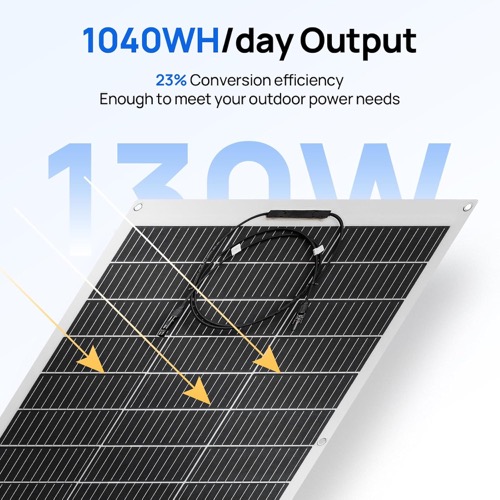
Rated at 130W each, the pair promises 260W — which in good sun realistically translates to around 160W of combined output, or roughly 645 Wh on a solid four-peak-sun-hour day. That’s the honest middle. Real numbers scatter widely around it depending on your gear.
Here’s the pattern in owner feedback. Buyers running a quality MPPT controller with series wiring and a good angle tend to hit or approach rated numbers — one saw 110-121W per panel in cold, clear winter sun with a near-vertical mount. Others, in full direct summer sun, only pull 51-75W per panel, with one pair capping at 116W combined. Same panels, very different results.
Why the spread? Controller type matters more than almost anything — MPPT pulls noticeably more than PWM. Series wiring lowers resistance losses, cool cells outperform hot ones, and a battery voltage sitting too close to the array voltage robs you of watts. Owners who chase down these details are the ones posting the good numbers.
| Condition | Estimated Output (pair) | What That Means |
|---|---|---|
| Full sun, ideal angle, MPPT + series | ~160-220 W | Strong daily gain; good-batch panels land here |
| Cold, clear winter sun, steep angle | ~180-240 W | A few owners see their best numbers here |
| Partly cloudy sky | ~80-110 W | Still meaningful; slower to fill the bank |
| Overcast / heavy clouds | ~30-55 W | Trickles along; won’t fully charge |
| PWM controller or single-panel feed | ~100-140 W | Setup losses cap output below potential |
| Flat, hot, airless mount | Drops sharply | Cells heat up and throttle output |
Real-World Math — Using a 0.62 real-world factor, the 260W pair delivers roughly 160W in good sun. Stack four peak sun hours onto that 160W and you’ve banked around 645 Wh for the day — enough to put a real daily dent in a mid-size RV or van battery bank. Push it with MPPT and series wiring and you can beat that; run PWM and you’ll fall short.
These are estimates. Your actual numbers ride on controller type, angle, sky, cell temperature, and how your battery voltage relates to the array.
Bending, Cracking, and the IP68 Question
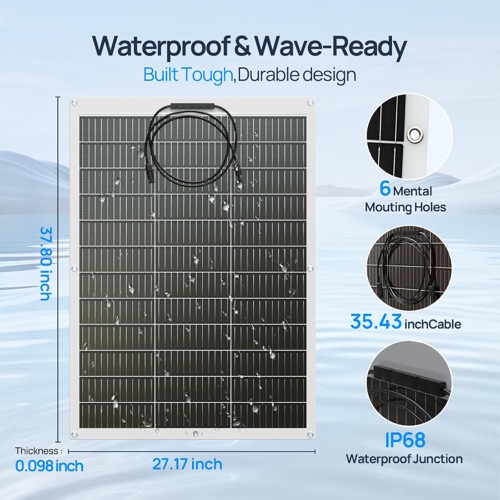
On weather, the news is good. The pre-installed junction box carries an IP68 rating and is fully sealed with built-in diodes, and owners back that up — one reported steady 17V output in the middle of a rainstorm after a year of flat-mounted use on a truck topper. Rain isn’t the thing to worry about here.
Flex durability is. The panels are semi-flexible, and pushing them past a gentle curve is where trouble starts — some owners hear audible cracking during mild bending, a sign of internal cell stress. Others find the panels hold up fine for a year of real use. It’s a genuine coin flip that tracks with batch quality and how carefully you handle and mount them.
Honest read: treat these as panels that follow a gentle curve, not ones you can roll up. Mount them where they won’t be constantly flexed by wind or vibration, and the IP68 sealing takes care of the rest.
| Feature | This Panel | What It Means Outdoors |
|---|---|---|
| IP rating | IP68 (junction box) | Sealed against dust and immersion at the box |
| Frame / backing | Frameless flexible laminate | Ultra-light; more exposed to flex damage |
| Panel surface | Weatherproof laminate (no glass) | Wipes clean; can’t shatter, but can crease |
| Junction box seal | Sealed, with built-in diodes | Keeps moisture out of the wiring |
| Connector weatherproofing | MC4 (standard weather-rated) | Solid outdoors when fully seated |
| Operating temperature | Up to 185°F (85°C) rated | Covers most climates; throttles when baked flat |
| Long-term owner reports | Mixed — some a year-plus, some early flex damage | Handling and batch quality drive the outcome |
Worth Knowing — IP68 covers the junction box, not the whole flex laminate against years of bending. The cells stay dry, but repeated flex is what ages a flexible panel. Mount on a gentle, stable curve with the back able to breathe, and you sidestep both the heat throttling and the cracking risk.
Two Ultra-Thin Panels, Up Close
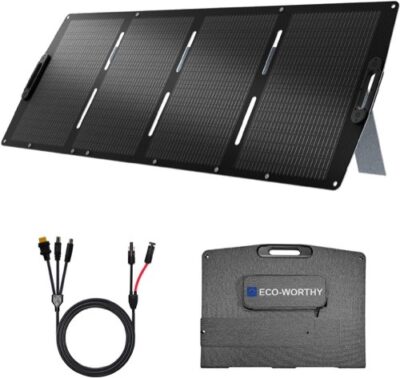
First impression for most owners is the weight — or the lack of it. Each panel is about 0.1 inch thick and roughly 4.4 pounds, so the pair adds 260 watts of potential without the heft of glass panels. Lift one and it feels more like a stiff placemat than a solar panel.
That thinness is the whole point, and it’s why builders on Airstreams, skoolies, and boats keep choosing them. The panels slip into a protective portfolio bag, travel easily between campsites, and follow a gentle roof curve that a rigid panel simply can’t. Six metal-reinforced holes run along the edges for grommet or cable-tie mounting.
A trade-off is baked into the build, though. That same thin laminate that saves weight leaves the cells more exposed, and the “270-degree” flex claim oversells things — these are semi-flexible at best. A few owners report audible cracking during mild bending, and one panel arrived bent in three places. Handle them gently, and don’t force a bend the panel resists.
What About Grounding, Heat, and the Warranty?
There are no listed safety certifications beyond the manufacturer’s claims, which is worth knowing for a permanent, high-panel-count build. One detailed owner review flagged static charge buildup and a mild shock on contact during operation, tied to the lack of a proper grounding point — so if you’re wiring several of these into a larger array, plan your grounding.
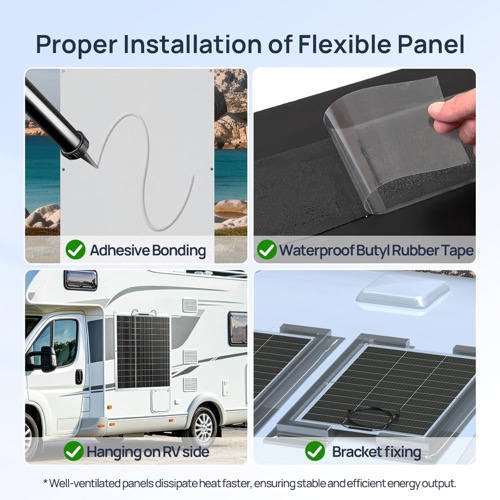
Heat is the other practical factor. Glued tight to an insulating roof with no airflow, the cells warm up and throttle back, and the panels carry an upper rating of 185°F. Leave a small air gap where you can, and your midday numbers hold up better.
On the warranty, terms aren’t clearly stated, but there’s a real bright spot: owners who contacted ECO-WORTHY about weak panels describe getting replacement panels shipped out, which nudged more than one review upward. The flip side is that buyers who only spot-checked output and fully tested a month later found themselves past the return window.
Long-Term Ownership — Monocrystalline cells themselves degrade slowly, but on a flexible panel the weak points are flex fatigue and the batch you happen to get. Test real output the week the panels arrive, mount them where they won’t be constantly stressed, and contact the seller early if the numbers look off — replacements do happen, but the return clock is short.
Is a Flexible Twin-Pack Right for Your Rig? — Use-Case Fit Matrix
| Use Case | Fit | Why |
|---|---|---|
| Curved RV or camper-van roof solar | Strong fit | Light, thin, follows gentle curves rigid panels can’t |
| Boat deck / marine install | Strong fit | Low profile and IP68 box suit a wet, curved deck |
| Skoolie or trailer roof build | Strong fit | Adds real wattage without glass-panel weight |
| Scaling to a bigger array (4-8 panels) | Solid fit | Clean 130W blocks scale well on an MPPT controller |
| Off-grid cabin or shed 12V/24V power | Solid fit | Good with the right controller and wiring |
| Portable “throw it in the sun” charging | With caveats | Semi-flexible and short cables make casual use fiddly |
| Feeding a 12V bank on a PWM controller | Borderline | Works, but PWM caps output well below potential |
| Flat, glued-down, airless mount in hot sun | Borderline | Heat throttling drops midday output |
| Buyer expecting a guaranteed 260W out of the box | With caveats | Real output varies and often runs under rated |
| Tight-radius bends or rolling the panel | Not recommended | Semi-flexible only; sharp bends can crack cells |
| High-draw loads without a battery/controller | Not recommended | These are charging panels, not a generator |
| A permanent install with no grounding plan | With caveats | No ground point; static buildup was reported |
Right for you if you want:
- Lightweight solar for a curved RV, van, boat, or cabin roof where glass panels won’t fit or weigh too much
- A clean 130W building block you can scale to a bigger array over time
- Standard MC4 wiring that drops into an existing MPPT setup without adapters
- Strong price per watt on a thin, low-profile panel
Wrong for you if you need:
- Guaranteed rated output straight out of the box with no tuning
- A panel you can roll up or bend around tight corners
- A plug-and-play kit with a controller and long cables included
- Certified specs, a clear grounding path, and a spelled-out warranty
Different tool for a different job — this is a lightweight-roof panel, not a rugged grab-and-go kit.
ECO-WORTHY 2×130W bundle: Decision Snapshot
| Spec | Value |
|---|---|
| Max Power Output | 260 W total (2x 130 W, monocrystalline) |
| Output Voltage | ~18 V DC per panel (24.5 V max) |
| Connector | MC4 (2.9 ft series/parallel cables, no USB) |
| Cell Efficiency | Up to 23.5% claimed (not verified) |
| Weatherproof Rating | IP68 sealed junction box |
| Charge Controller | None — direct MC4 output |
| Cable Length | 2.9 ft per cable (short — extension usually needed) |
| Mount Type | Six reinforced holes + adhesive / tape / Velcro |
| Best For | Lightweight solar on curved RV, van, boat, and cabin roofs |
Quick Verdict on the ECO-WORTHY 260W Flexible Solar Panel Review
If you want to add lightweight solar to a curved or weight-sensitive roof, this ECO-WORTHY 260W flexible solar panel review lands on a clear “yes, with eyes open.” The panels are genuinely thin and light, the IP68 junction box handles rain, and standard MC4 wiring drops them into any solar setup. Just know going in: real output often runs under the 130W-per-panel rating, the panels are semi-flexible rather than truly bendable, and you’ll want a good MPPT controller and series wiring to get the most out of them. Test your numbers the week they arrive, because return windows are short.
Is the Flexible Twin-Pack Worth It?
The right buyer here is building lightweight solar onto a curved or weight-sensitive roof, wiring the pair in series into a quality MPPT controller, and checking real output the week the panels land. For that person, two 130W panels are an easy call — a light, thin way to solar-skin a roof that rigid glass can’t handle, an IP68 junction box that shrugs off rain, and standard MC4 wiring that drops into a larger setup. Owners who run them in series into a good controller genuinely get their money’s worth.
The wrong buyer wants guaranteed rated watts out of a bendable, warranty-backed panel with a controller and long cables already in the box. Real output often runs under the 130W-per-panel rating, these bend only to a gentle curve rather than rolling up, durability swings by batch, and the short cables plus missing controller keep them from being plug-and-play. If that describes your needs, spend more on a kit built around certainty. Match the panel to the job, though, and this ECO-WORTHY 260W flexible twin-pack earns its recommendation.
Pros & Cons Analysis
Based on documented specifications and owner feedback
Pros
- Genuinely light for the coverage — each panel is about 0.1 inch thick and roughly 4.4 pounds, so the pair adds real wattage to a roof without the weight of glass panels. Owners building on vans, Airstreams, and skoolies keep coming back to how easy the panels are to lift and place.
- Scales cleanly to bigger setups — the clean 130W building block makes it easy to grow. One owner runs eight of these into an MPPT controller and pulls 800W on a good day; another chains three in series and hits 330-364W total. Two panels are just the starting point.
- IP68 sealed junction box with built-in diodes — the pre-installed box is fully sealed and rated IP68, and owners report the panels shrugging off rain. One buyer mentioned steady 17V output in the middle of a rainstorm after a year of use.
- Standard MC4 connectors and series/parallel cables — the pair ships with 2.9 ft MC4 cables for series or parallel wiring, so it drops straight into any MC4 solar setup or MPPT controller without adapters or soldering.
- Strong value per watt — buyers routinely call these some of the least expensive 100W-plus panels they could find, often under a dollar per watt. For a lightweight flexible pair, that pricing is hard to match.
- Quick, flexible mounting options — six metal-reinforced holes plus adhesive, silicone, VHB tape, cable ties, or Velcro give you non-permanent options. Owners tie them to railings, stick them to roof boxes, and glue them to curved caps.
- Better performance in cold, clear winter sun — a couple of owners report their best numbers in winter with a near-vertical mount, briefly touching 121W per panel. Cool cells and a steep low-sun angle play to the panel's strengths.
- Responsive seller support in some cases — owners who contacted ECO-WORTHY about weak panels describe getting replacement panels shipped out, which nudged more than one review up a star or two.
Cons
- Real output often lands well below 130W each — the loudest complaint. Several owners test their panels in full, direct sun and see 51-75W per panel, with one pair only making 116W combined. A few even had to get replacements before the numbers looked reasonable.
- Less flexible than "270°" suggests — the panels are better described as semi-flexible. Owners report audible cracking during even mild bending, and one found a panel bent in three places out of the box. Great for gentle curves, risky for tight bends.
- Durability is a coin flip — some panels hold up for a year of truck-topper duty, while others develop microfractures under light stress or arrive scratched. The open-back, thin-laminate design that saves weight also leaves the cells more exposed to flex damage.
- Output is very setup-sensitive — a PWM controller, a single panel feeding a controller, or a battery voltage too close to the array voltage all sap output. Owners who see rated numbers tend to run series wiring into a quality MPPT unit.
- Heat throttles a flat, glued-down install — mounted tight to an insulating surface with no airflow, the cells heat up and lose output. The upper temperature rating is 185°F, and owners note better numbers when there's a gap for the back to breathe.
- Adhesive mounting can be a fight — because the panels resist conforming to a surface, some owners spend over an hour per panel pressing high-strength tape, and a few report the adhesive lifting where the panel won't lie flat.
- No grounding point raises a static flag — one detailed owner review notes static charge buildup and a mild shock on contact during operation, tied to the lack of a proper ground path on the panels.
- Short return window catches slow testers — buyers who only spot-checked output and fully tested a month later found themselves past the return date. With a flexible panel, verify real numbers the week it lands.
Bottom Line: Design the Pair Before You Mount It
The ECO-WORTHY 2×130W kit offers 260W of nameplate power at roughly 12.6 pounds, but it is not one electrically indivisible panel. Test each module, choose series or parallel from the controller limits, and build cooling and removal into the roof plan.
Frequently Asked Questions
Should I wire the two ECO-WORTHY 130W panels in series or parallel?
It depends on the controller. Series is approximately 42.2V Vmp and 49V Voc at 6.16A Imp; parallel is approximately 21.1V Vmp and 24.5V Voc at 12.32A Imp. Apply cold-voltage and current safety rules from the exact controller manual.
Are these the new 18BB panels?
This review covers the current exact-ASIN two-panel 18BB offer. Check the delivered model labels because older product copy may describe a different busbar revision.
How much output did owners report?
Individual combined observations include roughly 130W, 190W in winter conditions, and pairs where one panel produced about 50W while the other produced about 75W. Different setups and conditions prevent a meaningful average.
Can I connect the pair directly to a battery?
No. Use a compatible solar charge controller, suitable wiring, overcurrent protection, disconnects, and a battery charging profile appropriate to the battery.
How should I test the pair before mounting?
Inspect both panels, record each label, measure each panel separately under the same sun and angle, then test the intended series or parallel configuration before permanent mounting.
Technical Specifications
| Brand | ECO-WORTHY |
|---|---|
| Model / SKU | US-L02AM130W18V-2 / two current 18BB panels (ASIN B0CNTJCQLW) |
| Panel format | Two semi-flexible panels |
| Rated output (Pmax) | 260W total (2 × 130W) |
| Cell technology | Monocrystalline, 18BB |
| Module efficiency | — |
| Voltage at maximum power (Vmp) | 21.10V per panel; approximately 42.2V series |
| Current at maximum power (Imp) | 6.16A per panel; approximately 12.32A parallel |
| Open-circuit voltage (Voc) | 24.50V per panel; approximately 49.0V series |
| Short-circuit current (Isc) | 6.50A per panel; approximately 13.0A parallel |
| Power tolerance | ±3% per panel |
| Maximum system voltage | — |
| Maximum series fuse | — |
| Output connector | Solar connectors; series or parallel topology chosen separately |
| Output cable | 11AWG leads, approximately 2.9 ft per panel |
| Deployed dimensions | 37.8 × 27.1 × 0.1 in per panel |
| Folded dimensions | Not foldable |
| Weight | Approximately 12.6 lb total |
| Surface and frame | Flexible laminate |
| Positioning / mounting | Six reinforced grommets per panel |
| Environmental protection | IP68 junction boxes; complete assembly rating not separately documented |
| Wind / snow load | — |
| Operating temperature | -40°C to 85°C |
| Included accessories | Two panels with attached leads and solar connectors |
| Product warranty | 1-year material warranty |