ECO-WORTHY 130W Flexible Solar Panel Review: Light, but Heat Matters
At a Glance
KEY FEATURES
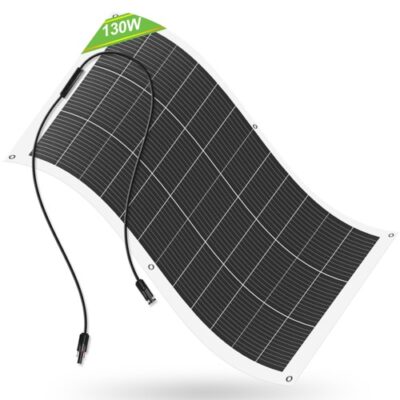
- Current 18BB revision rated at 130W, replacing older 12BB copy.
- 21.10V Vmp, 6.16A Imp, 24.50V Voc, and 6.50A Isc.
- 6.28-pound, 0.1-inch panel suits weight-sensitive surfaces.
- Six grommets and flexible laminate require a ventilated support plan.
- Best for gently curved RV, boat, trailer, and roof-box projects.
PROS
- Very low weight
- Complete current-revision electrical data
- Solar connectors included
- Fits gently curved surfaces
- Cooling depends on installation
- Not as flexible as the marketing can imply
- Individual delamination report
- Adhesive-only mounting complicates service
CONS
- Cooling depends on installation
- Not as flexible as the marketing can imply
- Individual delamination report
- Adhesive-only mounting complicates service
Lightweight Curved-Roof Option
Based on exact documentation, retained exact-ASIN evidence, and the expanded qualitative Amazon owner-text review; no hands-on test claimed
Is 130 flexible watts a real middle ground, or just an awkward compromise wedged between a 100W and a 200W panel? That’s the question worth answering before you buy a thin, light sheet to lay across a curved RV roof, a boat deck, or a van build without paying premium money. What follows tells you what this ECO-WORTHY panel actually does once it’s mounted, and where the low price and the flexible form factor quietly cost you something.
Most buyers land here because a flexible panel solves a real problem. Glass panels are heavy, they won’t sit flush on a curve, and they stick up into the wind. A 130W flexible panel at this price promises high-efficiency cells, an IP68 seal, and a form that conforms to surfaces a rigid panel can’t touch — sitting neatly between the common 100W and 200W flexibles.
Honesty first: the hardware is light and genuinely handy, but flexible panels come with known trade-offs — real output that trails the rating, cells that don’t love being bent hard, and a “flexible” label that oversells how much it actually curves. For gentle curves and easygoing 12V maintenance, that can be a fair deal. For a permanent, high-output install you’ll lean on for years, the math needs a closer look.
It also earns a spot in our best flexible solar panels comparison — worth a look if you are weighing the alternatives.
Amazon exposes the same variation-family review pool for this single panel and the two-panel bundle, so it is treated as one qualitative source rather than two independent samples. The exact 130W electrical and physical values come from the single-panel documentation. Owner observations are used for installation, heat, cracking, shipping, and support themes only when the text does not clearly concern a different bundle or array size.
Owners describe successful van, boat, trailer, shed, and lightweight portable installations, including useful controller input in varied sun. The same pool contains reports of cracked surfaces, delamination, wiring or connector faults, inconsistent arrival condition, and panels that declined or stopped working. Those contradictions make installation design central to the verdict. They do not allow a failure percentage because the sample is pooled, targeted, and missing rating metadata.
A thin panel can save roof weight and follow a shape a framed module cannot. That is a specific engineering advantage. It is not a shortcut around controller sizing, cable protection, roof sealing, safe disconnects, temperature management, or periodic inspection.
Glue, Grommets, and Getting It Mounted
Mounting is where the flexible form both helps and fights you. On the plus side, it’s light, low-profile, and ECO-WORTHY gives you options — adhesive, silicone, double-sided tape, cable ties, or Velcro, plus six pre-drilled holes if you’d rather screw it down. For a non-permanent setup, that flexibility is genuinely useful.
Here’s the reality owners report: sticking it down well is real work. One detailed buyer needed heavy 30 lb-rated 3M or Gorilla tape and over an hour of hand pressure per panel, and still fought the panel’s urge to spring back on a curve. Adhesive lifting on curved surfaces comes up more than once, so surface prep and patience matter.
Then there are the cables. It ships with a pair of 2.9 ft MC4 leads — plenty for linking panels side by side, nowhere near enough to reach a controller or battery across a rig. Plan on buying MC4 extensions, and keep the connector type consistent end to end.
Practical Tip — Buy MC4 extension cables in the length you actually need at the same time as the panel, and dry-fit the whole layout before any adhesive comes out. For a curved roof, clean and degrease the surface, warm the panel slightly so it conforms easier, and press it down in sections — rushing the glue is how owners end up with a lifting edge.
IP68 Sealing and the Cracking Question
Weatherproofing is a genuine strength on paper. The junction box carries an IP68 rating, is fully sealed, and packs built-in bypass diodes — and owners back that up, reporting the panels handle rain and even an ice storm without water reaching the wiring. There’s no glass to shatter and no metal frame to corrode, which suits salt-air marine setups.
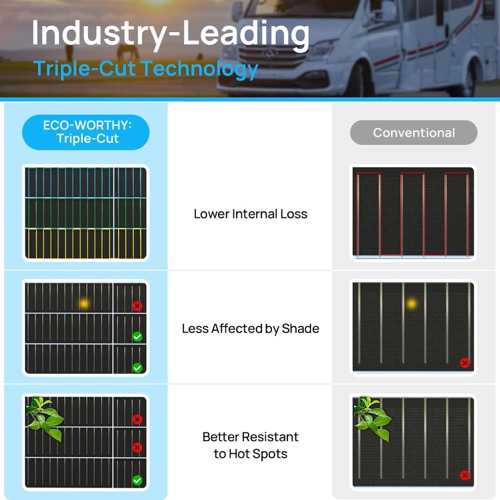
Durability tells a more mixed story once you leave the seal aside. The thin laminate is easy to over-stress: owners describe audible cracking during handling and panels bent in a few places out of the box, which points to internal cell damage. Glue one flat to a roof with no airflow behind it and it also runs hot, and heat quietly trims output.
To be fair, several owners report long, trouble-free stretches — over a year flat-mounted to a truck topper, still charging in the rain. The takeaway is that the sealing holds up well; the laminate is the part you have to respect.
| Feature | This Panel | What It Means Outdoors |
|---|---|---|
| IP rating | IP68 (junction box) | Sealed against dust and immersion — strong on paper |
| Frame / structure | Frameless laminate | No metal to corrode; also nothing to stiffen it |
| Panel surface | Polymer laminate, no glass | Light and matte; wipes clean, won’t shatter |
| Junction box seal | Sealed IP68, bypass diodes | Keeps moisture out of the wiring; diodes help with partial shade |
| Connector weatherproofing | MC4 (weather-resistant) | Standard sealed solar connector; seat it firmly |
| Operating temperature | Up to 185°F (85°C) rated | Handles hot roofs, but flat mounting runs it warm |
| Long-term owner reports | Mixed — good in rain, cracking under bending | Sealing is the strength; laminate is the weak point |
Worth Knowing — Flexible panels don’t fail from water nearly as often as they fail from heat and flex. Give the panel some airflow behind it instead of gluing it dead-flat, avoid tight bends, and you sidestep the two things that actually shorten a laminate panel’s life.
130 Watts on Paper, What You Get in Practice
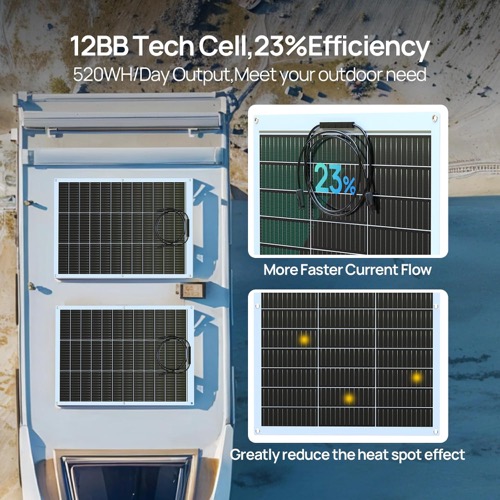
On paper the ECO-WORTHY 130W flexible panel is rated at 130W — which at a realistic 0.70 factor works out to roughly 91W in good sun, or about 364 Wh across a typical four-hour peak-sun day. That’s the number to plan around, not the 520 Wh the box implies.
In practice, output is the biggest source of mixed feelings. Plenty of owners find single panels testing at 51W, 55W, or 60W in full, direct sun, and one pair managed only 116W together. To be fair, that’s not the whole story — dialed-in owners have pulled 85W from one panel on an overcast day and 110-121W each with a good winter vertical mount, and one array of eight hit 800W into an MPPT controller.
So what makes the difference? A knowledgeable owner spells it out: MPPT beats PWM, series wiring lowers resistance losses, and a panel baking flat on an insulating surface heats up and gives back less. Cloudy days still produce — expect a meaningful trickle rather than nothing — but a single panel flat on a hot roof through a PWM controller will sit at the low end.
| Condition | Estimated Output | What That Means |
|---|---|---|
| Full sun, ideal angle | ~85-95 W | Strong daily charge; tops a 12V bank and offsets real draw |
| Partly cloudy sky | ~45-55 W | Still useful; slower to fill a battery |
| Overcast / heavy clouds | ~15-30 W | Keeps trickling; won’t fully charge but holds ground |
| Panel 45° off optimal | ~55-65 W | Noticeable hit; angle it if you can |
| Winter sun, good angle | ~60-90 W | A steep winter tilt can actually shine — some owners peak here |
| Panel in partial shade | ~10-25 W | Big drop; the front-mounted box shades cells too |
Real-World Math — Using a 0.70 real-world factor, this 130W panel makes roughly 91W in good sun. Give it a 4-hour peak-sun day and you bank close to 364 Wh. A 12V/100Ah battery holds around 1,200 Wh, so one panel meaningfully offsets daily draw and holds a stored bank at full charge — just don’t expect it to refill a deeply drained bank in a single day.
These are estimates. Your real numbers ride on angle, sky, shade, panel temperature, your controller, and how you’ve wired it.
The Ultra-Thin 130W Build, Up Close
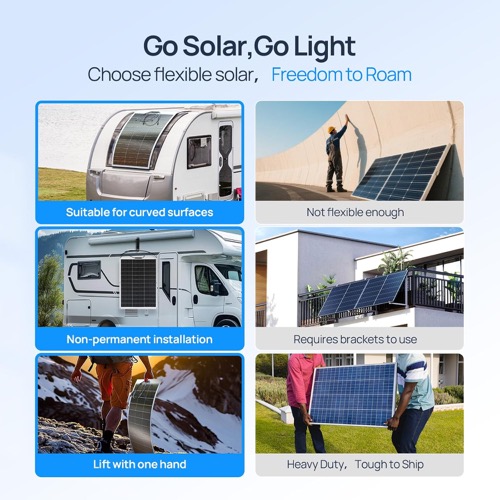
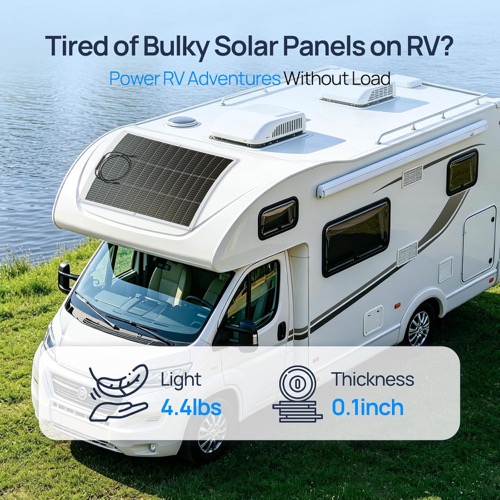
First thing owners notice is how little there is to it. At 4.4 pounds and roughly a tenth of an inch thick, it feels more like a stiff placemat than a solar panel, and buyers say it’s dramatically easier to carry and store than glass. One owner slides a pair into a 32-by-42-inch bag to shuttle between campsites.
Underneath, it’s frameless laminate over monocrystalline cells, with no glass to crack and six metal-reinforced holes along the edge for mounting. Six pre-drilled points give you screw options, but the panel is really built for adhesive, tape, or Velcro. A sealed junction box sits on the surface with a short pair of MC4 leads for linking panels.
Now the honest part. “Bendable” has limits here — most owners call it semi-flexible, and a few report panels that arrived bent in a couple of spots. The junction box mounting on the front of the panel is a design miss one buyer calls out, since it shades a strip of cells and gets in the way of a truly flush install. It’s light and low-profile, just not as forgiving as the marketing implies.
Batteries and Systems It Connects To
First question with a bare panel like this: “what do I hook it to?” It’s an 18V-nominal panel meant for 12V systems, so with a charge controller in the line it works across the common battery chemistries. Owners use it to maintain truck and RV AGM banks, run small off-grid setups, and one even recharges a converted battery-powered riding mower over a few sunny days.
Here’s the catch: nothing regulates the output on its own. You supply the controller for battery charging, or feed a solar generator that has one built in. For 24V or 48V banks, owners wire panels in series — one runs a 48V converter setup this way.
| Battery / System | Typical Use | Compatible? | Notes |
|---|---|---|---|
| Flooded lead-acid | Car, truck, tractor | Compatible | Standard 12V charging through a controller |
| AGM (sealed) | RV, boat, truck topper | Compatible | Owners keep AGM banks topped off for months |
| Gel cell | Marine, mobility | Needs correct profile | Set your controller to a gel charge profile |
| LiFePO4 (12V) | RV, van life, off-grid | Needs LFP mode | Panel is fine; the controller must support lithium |
| 24V / 48V bank | Large RV, off-grid | Needs series wiring | Chain panels in series with the MC4 leads |
| Solar generator / power station | Camping, backup | Compatible | Via an MC4-to-input adapter for your unit |
Buyer Heads-Up — Owners are near-unanimous that MPPT beats PWM with this panel. An MPPT controller tracks the panel’s best voltage point and can pull noticeably more usable watts, especially in weaker light. If you’re charging LiFePO4, confirm your controller has a lithium profile before you connect it.
The Warranty and Grounding Reality
There are no listed safety certifications beyond the manufacturer’s own claims, which is common at this price. For trickle-charging a 12V battery through a reputable controller, that’s low stakes — your controller is doing the protective work. Warranty terms aren’t clearly published either, but the encouraging news is that owners who contacted ECO-WORTHY about weak panels got replacement units shipped, and the swaps brought their arrays back to expected output.
One safety note is worth flagging honestly. A high-volume owner running many of these panels reports no easy way to ground them, which let static build up and produced a noticeable shock when touching a panel during operation. It’s not a widespread complaint, but on a larger fixed array it’s smart to plan a grounding path as you would with any solar install.
On everyday safety, the feedback is otherwise calm — no melting boxes or burning connectors in normal use. The main heat effect is on output, not danger: a panel baking flat in still air gives back fewer watts until conditions ease.
Long-Term Ownership — Monocrystalline cells themselves degrade slowly and last for years. On a flexible panel, the real weak points are the laminate, the flex hinge, and heat from flat mounting — not the cells. Test output the day it arrives, give it airflow, avoid hard bends, and you’ll know early whether you drew a good one from the batch.
Where a Flexible 130W Panel Earns Its Keep — Use-Case Fit Matrix
| Use Case | Fit | Why |
|---|---|---|
| Curved RV or camper roof | Solid fit | Light, low-profile, conforms to gentle curves |
| Boat deck / bimini / marine | Solid fit | IP68 sealing and no metal frame suit salt air |
| Van build / low-clearance roof | Strong fit | 0.1 in thick and 4.4 lb sits nearly flush |
| Topping off a stored 12V AGM bank | Strong fit | Owners hold truck and RV banks charged for months |
| Off-grid cabin or shed (light loads) | Solid fit | Add a controller; pair panels for headroom |
| Feeding a solar generator | Solid fit | MC4 output reaches most stations with an adapter |
| Buyer expecting a full 130W daily | Borderline | Single-panel output often lands under the rating |
| Tight compound curves or hard bends | With caveats | It flexes, but sharp bends can crack cells |
| Permanent glued-down flush mount | With caveats | Blocks airflow, runs hot, trims output |
| Buyer who wants certified, guaranteed watts | Borderline | Real output varies batch to batch |
| High-draw loads without a battery | Not recommended | It’s a charging panel, not a generator |
| Roof that never sees direct sun | Skip | Shade tanks output on any panel |
A good match if you want:
- A light, thin panel that conforms to a gently curved RV, van, or boat roof
- Set-and-forget maintenance for a stored 12V AGM or lead-acid bank
- A low price per watt with easy MC4 series or parallel expansion
- A frameless, glass-free panel that shrugs off rain and won’t shatter
Look elsewhere if you need:
- A guaranteed full 130W every day from a single panel
- A panel you can bend around tight curves without risking cracks
- A complete kit — this one has no charge controller in the box
- Certified specs and rock-solid, batch-to-batch consistency
Think of it as a different tool for a different job — a light, curved-surface trickle charger, not a high-output workhorse.
ECO-WORTHY 130W flexible panel: Decision Snapshot
| Spec | Value |
|---|---|
| Max Power Output | 130 W (monocrystalline) |
| Output Voltage | ~18 V DC (24.5 V open-circuit) |
| Connector | MC4 (pair of 2.9 ft cables, no USB) |
| Cell Efficiency | 23.5% claimed (not verified) |
| Weatherproof Rating | IP68 sealed junction box (frameless, no glass) |
| Charge Controller | None — bare panel |
| Cable Length | 2.9 ft leads (extension usually needed) |
| Mount Type | Adhesive / tape / Velcro + 6 pre-drilled holes |
| Best For | Topping off 12V banks on RVs, boats, and vans |
ECO-WORTHY 130W Flexible Solar Panel Review: The Quick Verdict
If you want a light, thin panel to keep a 12V battery charged on an RV, boat, or van, this ECO-WORTHY 130W flexible solar panel review lands on a clear yes with caveats. It’s easy to handle, the IP68 box shrugs off rain, and it conforms to gentle curves a glass panel never could. Just know going in: a single panel rarely makes its full 130W, the laminate can crack if you bend it hard, and there’s no controller in the box — so pair it with a good MPPT unit and plan the mount carefully before you commit adhesive.
The Verdict on a Budget Bendable 130W
This is your panel if you want something light, thin, and weather-sealed to keep a 12V bank charged on an RV, boat, or van: it does that job at a low price per watt, and it sits on curved surfaces a rigid panel can’t. An IP68 box handles rain, weight runs a fraction of glass, and responsive replacement support softens the risk. Pair it with a good MPPT unit, plan the mount before the glue comes out, and it earns its keep.
It’s the wrong panel if you’re counting on a guaranteed full 130W from a single unit, or building a permanent flush install you’ll trust for a decade. Single-panel output often lands well under the 130W rating, the laminate can crack under a hard bend, and no controller ships in the box. For that buyer, size up the controller, wire panels in series, or step up to a heavier framed panel and buy the certainty.
Pros & Cons Analysis
Based on documented specifications and owner feedback
Pros
- Genuinely light and thin — at 4.4 lb and about a tenth of an inch thick, owners describe it as far easier to handle and haul than glass panels. One buyer moves them between campsites in a 32-by-42-inch bag; another mounted one on a bicycle trailer without a second thought.
- Keeps a 12V battery topped off — mounted flat to a truck topper and run through a small controller to a couple of AGM batteries, one owner reports over a year of steady charging, still pushing a good 17 volts even in the rain. It's a set-and-forget maintenance panel for many.
- Strong value per watt — buyers repeatedly call it one of the least expensive panels over 100W they could find, with one noting it works out to less than a dollar per watt. For a light, thin panel, that's a low bar to entry.
- Good on curved RV and marine roofs — for gentle curves, owners report the panels conform well enough for RV rooftops and space-constrained van, skoolie, and boat installs where a rigid glass panel simply won't sit flat.
- IP68 sealed junction box with built-in diodes — the pre-installed box is fully sealed and carries bypass diodes, and owners report the panels shrug off rain and even an ice storm without water getting into the wiring.
- Series and parallel expansion built in — a pair of 2.9 ft cables makes it easy to chain panels. Owners run three in series for higher voltage and efficiency, and one scaled all the way to an eight-panel array pushing 800W into an MPPT controller.
- Responsive warranty support — a couple of owners who contacted ECO-WORTHY about weak panels got replacement units shipped out, and the swaps brought their arrays back up to expected output.
- Lighter per watt than fixed panels — even the owners disappointed by output concede these still beat rigid glass on weight per watt, which is the whole reason to buy flexible in the first place.
Cons
- Rated watts are hard to hit — a common complaint is that a single panel lands well under 130W. Owners report individual panels testing at 51W, 55W, and 60W in full, direct sun, with one pair reaching only 116W together — less than one panel should make on its own.
- Cracks and microfractures under light bending — several owners describe audible cracking during install and panels arriving bent in a few places. The thin laminate is easy to stress, and once a cell fractures the output suffers.
- Less flexible than the 270° marketing suggests — the panels are best described as semi-flexible. Owners say the rigidity makes them awkward to hang and hard to conform to anything past a gentle curve, so the "wraps any surface" pitch oversells it.
- Sticking them down is real work — one detailed owner needed heavy 30 lb-rated 3M or Gorilla tape and over an hour of hand pressure per panel, and still fought the panel's resistance to conforming. Adhesive lifting on curved surfaces comes up more than once.
- Junction box and connectors sit on the front — one buyer flags the poor design of mounting the MC4 box and wires on the face of the panel, which shades a strip of cells and complicates a clean flush mount.
- Short included cables — the 2.9 ft leads are fine for connecting panels side by side, but any real run to a controller or battery means buying your own MC4 extensions.
- Batch-to-batch quality is a gamble — beyond the wattage spread, one repeat buyer received a clearly returned, used set with a cat's dirty pawprints across the face. Inspect what shows up before you install it.
- Grounding and static concern — one high-volume user reports no easy way to ground the panels, leading to static buildup and a noticeable shock when touching a panel during operation. Worth planning a grounding path on larger installs.
Bottom Line: A Mounting Project, Not Just a Light Panel
The current 18BB ECO-WORTHY 130W is attractive where a framed panel is too heavy or rigid. Its success depends on a smooth support, conservative bend radius, airflow, and inspectable mounting. Buyers wanting the longest unattended roof life should still compare a rigid framed module.
Frequently Asked Questions
Is this the current 18BB ECO-WORTHY 130W panel?
Yes. This review covers the current exact-ASIN 18BB offer with model L02AM130W18V-1A. Older 12BB specifications should not be mixed into the comparison.
How much can the panel bend?
ECO-WORTHY markets up to 270 degrees of flexibility, but that does not mean it can be creased or wrapped around a tight radius. The mounting surface should be smooth and gently curved.
Does a flexible panel need airflow underneath?
Yes, a ventilation strategy is prudent. A dark panel bonded directly to an insulated roof can run hot, which reduces output and may stress materials over time.
What output did owners report?
Individual reports include roughly 97W in direct sun, about 110W on a roof box, and one owner saying the panel reached rated power. Other multi-panel reports were lower. These different systems do not define a guaranteed range.
Can I glue it directly to an RV roof?
Only after the roof maker, adhesive maker, and panel instructions all support the method. Provide drainage, avoid hard pressure points, and preserve a way to inspect or replace the panel.
Technical Specifications
| Brand | ECO-WORTHY |
|---|---|
| Model / SKU | L02AM130W18V-1A / current 18BB (ASIN B0CVX3YQNS) |
| Panel format | Single semi-flexible panel |
| Rated output (Pmax) | 130W |
| Cell technology | Monocrystalline, 18BB |
| Module efficiency | — |
| Voltage at maximum power (Vmp) | 21.10V |
| Current at maximum power (Imp) | 6.16A |
| Open-circuit voltage (Voc) | 24.50V |
| Short-circuit current (Isc) | 6.50A |
| Power tolerance | ±3% |
| Maximum system voltage | — |
| Maximum series fuse | — |
| Output connector | Solar connectors |
| Output cable | 11AWG leads, approximately 2.9 ft |
| Deployed dimensions | 37.8 × 27.1 × 0.1 in |
| Folded dimensions | Not foldable |
| Weight | 6.28 lb |
| Surface and frame | Flexible laminate |
| Positioning / mounting | Six reinforced grommets |
| Environmental protection | IP68 junction box; complete assembly rating not separately documented |
| Wind / snow load | — |
| Operating temperature | -40°C to 85°C |
| Included accessories | One panel with attached leads and solar connectors |
| Product warranty | 1-year material warranty |