Renogy Flexible Solar Panel Review: The Bendable 100W Pick for Curved RV Roofs and Boat Decks
At a Glance
KEY FEATURES
- Power output: 100 W (claimed), monocrystalline silicon (64 cells)
- Output: 12 V DC nominal (Vmp ~18.9 V); MC4 connectors, one long lead and one short lead
- Cell efficiency: 22% (high-efficiency mono; runs a bit lower than rigid once heat-soaked on a flat roof)
- Weatherproofing: Sealed polymer laminate with aluminum-alloy backing, no glass; rated to 2400 Pa wind and 5400 Pa snow; upper temperature rating 176°F. No certified IP rating listed
- Charge controller: None included — bare MC4 leads; pair with a separate MPPT or PWM controller to charge 12V batteries
- Best for: Curved RV and van roofs, boat biminis and decks, and deployable off-grid charging where a rigid glass panel can't sit flat
PROS
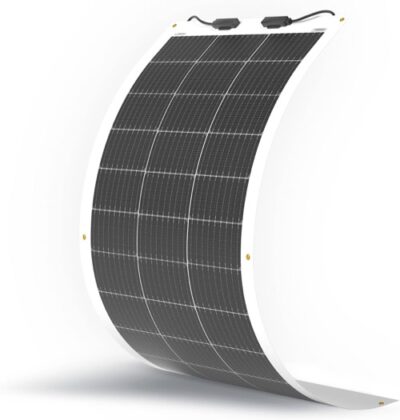
- Bends to curved RV, van, and boat roofs where rigid won't fit
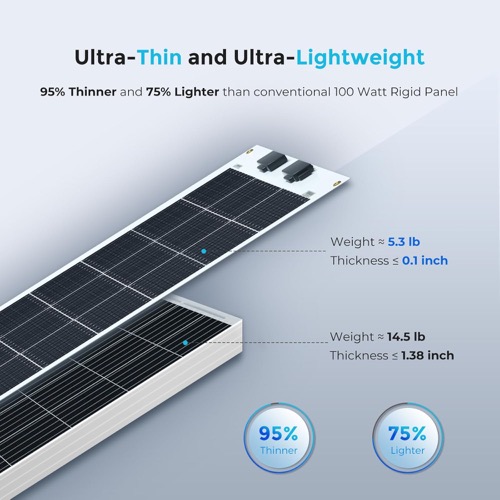
- Very thin (~1/10 in) and light (~4 lb) for clean, no-drill installs
- Real 5.9A / up to ~87W per panel when tilted in full sun
- Keeps 12V batteries and power stations topped up off-grid
- Durable for years outdoors with a 5-year warranty and good support
CONS
- Flexes to a curve only — it's not foldable and can crack if overbent
- Glued flat to a hot roof, the cells heat up and output drops
- Flat, untilted rooftop output can fall well short of 100W
- No charge controller included — you supply your own MPPT or PWM
- Some units delaminate or develop hotspots over time
Editor's Choice
Based on exact documentation and qualitative exact-ASIN Amazon owner evidence; no hands-on test or population-rate claim
Plenty of shoppers write off flexible panels as toy-grade — a floppy sheet that can’t survive a real roof or push meaningful watts. That reputation is mostly wrong. Renogy’s 100W semi-flexible panel is built for the roof that isn’t flat — the airstream curve, the van’s rounded top, the boat bimini — where a rigid glass panel just won’t sit, and owners run it outdoors for years. What follows is straightforward: what this thin, bendable panel actually does once it’s stuck down and soaking up sun, and where the flexible form factor costs you.
Picture a surface that curves while every rigid panel in the listings is a stiff rectangle that would tent up at the edges or block your view. You want something light, low-profile, and stealthy — ideally mounted without drilling holes through a roof you’d rather keep watertight. That’s the exact gap this panel is built to fill.
Where the “weak” myth holds a grain of truth is efficiency: flexible panels trade a little of it and run hotter than framed rigid ones, especially glued flat to a dark roof with no airflow underneath. In return, you get a roughly 4-pound, tenth-of-an-inch panel that hugs a curve and disappears into your build. For the right roof, that trade is worth it. For a flat, sun-baked deck where a rigid panel would fit fine, it’s worth thinking twice.
This panel is one of our picks in the best flexible solar panels guide, where it goes head-to-head with the other top options.
The expanded owner material makes revision control central. Buyers describe successful Goal Zero, RV, van, cabin, bimini, and battery-controller applications, but they also describe receiving a different size than an older panel or product-page dimensions. That matters on a tightly packed roof and in an electrical string. The current reviewed model is RNG-100DB-H-US; compare its delivered label and footprint with the current specification table before drilling or ordering a replacement.
| Commissioning stage | Check | Failure it helps isolate |
|---|---|---|
| Unboxed, cool | Visual condition, polarity, Voc | Shipping, connector, or open-circuit fault |
| Loaded in clear sun | Controller voltage/current and stable power | Mismatch, shade, battery taper, or weak connection |
| After warming | Repeat the same readings | Temperature-sensitive connection or laminate behavior |
| After mounting | Compare with the temporary baseline | New shade, cable loss, heat, or attachment stress |
This process is grounded in the owner record. Some panels produced useful power for years or worked well in hot locations; other individual accounts describe output disappearing after warming, manufacturing defects, old-version recalls, premature decline, or difficult support. There are also reports of smooth refunds or replacements. Together they show why documentation and repeatable testing matter, but they cannot yield a population reliability rate.
The product’s real advantage remains legitimate: a roughly 5.3-pound, 0.1-inch laminate can occupy a curved surface that a framed module cannot. Use that advantage only where it solves a real constraint. If the site is flat, cool, and structurally able to accept glass, a rigid 100W panel offers a simpler thermal and mechanical design.
Mounting should preserve strain relief, drainage, inspection access, and eventual removal. Adhesive selection depends on both surfaces and expected temperature; eyelets alone should not carry all wind load. On fabric or marine installations, account for movement and chafe. On a vehicle, treat road-speed uplift as a structural load rather than a camping breeze.
Life on a Hot, Curved Roof
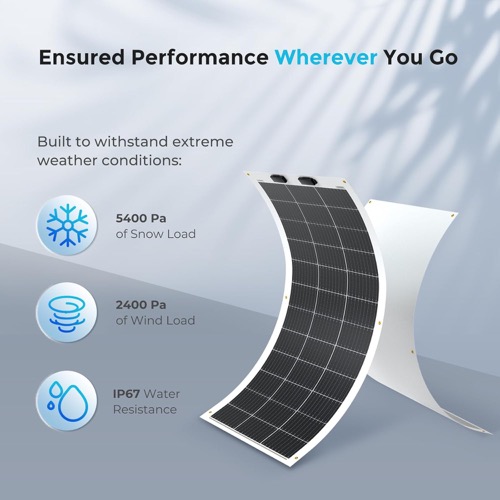
There’s no certified IP rating listed here, but the construction tells the real story — the cells are sealed inside a polymer laminate with no glass to crack, and it’s rated to 2400 Pa wind and 5400 Pa snow. That’s a panel built for a moving van roof and a wet boat deck, not a fragile one.
Long-term, most feedback is reassuring. Owners describe it as durable and robust, with one running a pair on a van for about three years and another reporting both panels still strong after RV-roof duty. One buyer knocked a panel off in high wind, had cars run over it, reinstalled it, and it still worked years later — hard to ask for a tougher field test than that.
The honest caveat is aging. A few owners report panels beginning to delaminate over time, and one developed a hotspot that melted part of the laminate. It’s not the norm, but it’s the failure mode to watch, and it’s where the 5-year warranty earns its keep.
| Feature | This Panel | What It Means Outdoors |
|---|---|---|
| IP rating | None certified | Sealed laminate, but no official ingress spec |
| Frame / backing | Frameless, aluminum-alloy backing | Light and low-profile; no frame to corrode |
| Panel surface | Polymer laminate (no glass) | Won’t shatter; textured surface can hold grime |
| Wind / snow load | 2400 Pa / 5400 Pa | Handles highway wind and winter snow loads |
| Operating temperature | Up to 176°F rated | Covers hot roofs; output softens as cells heat |
| Long-term owner reports | Mostly years of service | Solid overall; isolated delamination / hotspots |
Worth Knowing — A sealed laminate isn’t the same as a certified IP rating. This panel shrugs off rain and spray by design, but the smart move on a permanent install is to seal the wire entry points and edges with the mounting adhesive so moisture never gets a path under the laminate.
What You Can Wire It To
Bare MC4 leads are all that ship in the box, so the first question is what goes between the panel and your battery. For any 12V charging, the answer is a charge controller — you supply your own MPPT or PWM unit, and owners are clear that “a good charge controller” is what makes it shine on a boat or in a camper. Feeding a portable power station is simpler: the station’s built-in controller does the work, and you just need an MC4-to-station adapter.
With a controller in the line, it handles the usual 12V chemistries, and owners put it to work across all of them. It trickle-charges AGM banks, tops off marine batteries, and fights the slow drain that kills camper batteries over a winter. Several charge portable stations with it, including Goal Zero Yeti and Bluetti units.
| Battery / Device | Typical Use | Compatible? | Notes |
|---|---|---|---|
| Flooded lead-acid | Car, truck, tractor | Compatible | Standard 12V charging via controller |
| AGM (sealed) | RV, boat, camper | Compatible | Owners trickle-charge AGM banks nicely |
| Gel cell | Marine, mobility | Needs gel mode | Set the controller’s gel profile |
| LiFePO4 (12V) | Van life, RV | Needs LFP mode | Verify the controller supports lithium |
| 24V battery bank | Large RV, boat | Needs series wiring | Panel is 12V output; wire two in series |
| Power Station | Typical Use | Compatible? | Notes |
|---|---|---|---|
| Goal Zero Yeti | Off-grid, backup | Compatible | Owners charge Yeti units via MC4 adapter |
| Bluetti EB / AC series | Camping, backup | Compatible | Reported charging a Bluetti daily |
| Jackery / EcoFlow | Camping, home backup | Verify first | Needs an MC4-to-station input adapter |
Adapter Check — Before you buy, look at your charge controller or station input. For a 12V battery you’ll want an MPPT controller sized for ~6 amps of panel current; for a power station, confirm it accepts MC4 (or grab the right adapter). Sorting the connector chain first saves a dead-battery weekend later.
The Thin, Bendable Build
First thing owners notice is how little there is to it. At about a tenth of an inch thick and roughly 4 pounds, it lays nearly flush and adds no wind resistance on a moving vehicle. There’s no aluminum frame and no glass — just monocrystalline cells sealed in a polymer laminate over an aluminum-alloy backing.
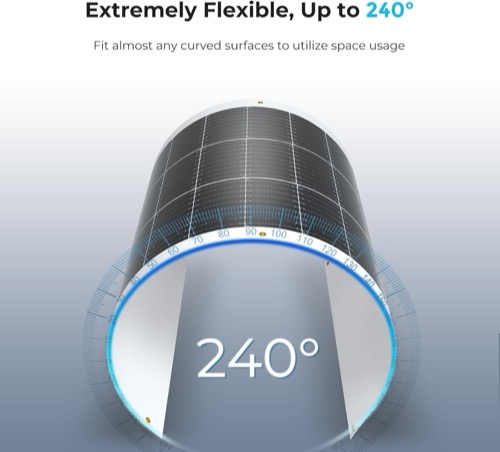
Bending is the headline feature, and it delivers. Buyers report it curving to the shape of an airstream roof, a van top, and even an ELF velomobile shell, with one noting it “bent easily to the shape” of the panel it replaced. Several re-positioned theirs a couple of times during install without any drama. The connectors get good marks too — solid and well fastened to the panel.
Two small design gripes come up. The MC4 leads are mismatched, one long and one short, and an owner points out the long one should be a touch longer so both reach the same side. And once it’s glued down, swapping cables later is called “royally challenging” — so route your wiring the way you want it the first time.
Where This Flexible Panel Belongs — Use-Case Fit Matrix
| Use Case | Fit | Why |
|---|---|---|
| Curved RV or airstream roof | Strong fit | Bends flush where rigid panels can’t sit |
| Van build (stealth, no drilling) | Strong fit | Thin, light, adhesive-mounts clean |
| Boat bimini / marine deck | Strong fit | Sealed laminate, light, hugs curves |
| Deployable off-grid charging | Strong fit | Light enough to move to the sun on a stand |
| 12V battery maintenance (with controller) | Solid fit | Trickles AGM and lead-acid well |
| Charging a power station | Solid fit | Works via an MC4 adapter |
| Flat roof where rigid fits fine | Borderline | You’d get more watts from a cheaper rigid panel |
| Hot roof, glued flat, no airflow | Borderline | Heat derates output; tilt or vent if you can |
| Roof with AC units / heavy shade | Borderline | Series wiring means partial shade craters output |
| Needs a plug-and-play controller | With caveats | None included — you buy your own |
| Wants a foldable, packable panel | Not recommended | It curves, it doesn’t fold |
| High-draw loads without a battery | Not recommended | It’s a charging panel, not a generator |
Buy it when you want:
- A panel that hugs a curved RV, van, or boat roof where rigid glass won’t fit
- A stealth, no-drill install that keeps your roof watertight and your build clean
- Feather weight you can move to the sun or haul in and out easily
- A name-brand flexible panel with a real 5-year warranty and responsive support
Look elsewhere if you need:
- Maximum watts from a flat, sun-baked roof — a rigid panel does that cheaper
- A ready-to-go kit with the charge controller in the box
- A panel that folds up small for backpacking or storage
- Rock-solid output from a shaded or AC-cluttered rooftop
This is a purpose-built tool: right roof, right job, and it’s genuinely useful in the field.
The Five-Year Warranty and Fine Print
There are no listed safety certifications beyond the manufacturer’s own specs, which matters less here than for a device with a built-in controller. Because you supply your own MPPT or PWM unit, the protection features — overcharge cutoff, reverse-current, and the rest — come down to the controller you choose, so pick a reputable one.
Warranty is a genuine strength for a flexible panel. Renogy backs it with a 5-year material warranty, and owners cite a long power-output warranty on top of that. Support gets real-world praise too — one buyer had two panels replaced at four months, one for an output issue and one for a broken connector, without a fight.
On safety incidents, the feedback is calm. The main heat story is performance, not danger — the panel softens output when it bakes on a flat roof, then recovers as conditions ease. The one thing to respect is bending: overflex it and you can crack a cell, so treat “flexible” as gentle curves only.
Long-Term Ownership — Monocrystalline cells themselves degrade slowly, but a flexible laminate’s weak points are delamination and the sealed leads. Mount it with airflow or a slight tilt if you can, seal the edges and wire entries, and don’t overbend it — do that and owners routinely get years out of it.
Should You Buy It? — Renogy 100W flexible panel
For the buyer with a curve to cover, this Renogy Flexible Solar Panel review lands in a clear place: it’s a proven, durable panel that goes where rigid ones can’t, mounts without drilling, and holds up outdoors for years with a warranty and support team behind it. Tilted in good sun it delivers real, usable power, and owners lean on it to keep RV, marine, and camper batteries alive off-grid. Those are the reasons to buy it.
The trade-offs are just as real. Glued flat to a hot roof it gives up some watts to heat, there’s no controller in the box, partial shade hits it hard, and a few units delaminate over time. So here’s the if/then: if your roof curves and you want a light, stealth, no-drill panel you can trust for years, this Renogy flexible solar panel is an easy yes. If you’ve got a flat surface a rigid panel would fit, spend less on rigid and pocket the extra watts.
Renogy 100W flexible panel: Decision Snapshot
| Spec | Value |
|---|---|
| Max Power Output | 100 W (monocrystalline, 64 cells) |
| Output Voltage | 12 V DC nominal (Vmp ~18.9 V) |
| Connector | MC4 (one long lead, one short lead) — no USB |
| Cell Efficiency | 22% (runs lower once heat-soaked flat) |
| Weatherproof Rating | No IP cert — sealed laminate, 2400 Pa wind / 5400 Pa snow |
| Charge Controller | None — bare panel, add your own MPPT/PWM |
| Cable Length | Not specified (mismatched leads — extension usually needed) |
| Mount Type | No bracket — adhesive / tape / velcro, flat or curved |
| Best For | Curved RV, van, and boat roofs where rigid won’t fit |
How Many Watts You'll Actually See
Rated at 100W, this flexible laminate in real conditions translates to roughly 70W of usable output, or about 280 Wh on a typical day with four solid peak sun hours. That’s the honest working number to plan around, not the nameplate.
In practice, output swings a lot with how you mount it. Tilted toward the sun on a stand, owners see the good stuff: one measured 5.9 amps in full sun, a pair hit 140W, and one buyer caught as high as 175W from two panels in ideal conditions. Laid dead flat on a roof with no tilt, the story changes — one owner measured only about 36W expecting closer to 100.
Heat is the quiet limiter here. Glued flush to a dark roof with no air gap, the laminate warms up, and hot cells make fewer watts — one owner pegs flexible efficiency at roughly 10% below rigid for the same rooftop job. To be fair, cloudy and low-light days behave better than you’d fear; owners report it still putting out “great power, even in lower lights.”
| Condition | Estimated Output | What That Means |
|---|---|---|
| Full sun, tilted to the sun | ~70-87 W | Best case; strong daily gain, fills a 12V bank fast |
| Full sun, flat on a hot roof | ~40-55 W | Heat and flat angle both bite; still useful, just softer |
| Partly cloudy sky | ~30-45 W | Keeps meaningful charging going; slower fill |
| Overcast / heavy clouds | ~10-20 W | Trickles rather than dies; holds ground on a 12V bank |
| Winter / weak sun | ~35-45 W avg | Still charges; fewer peak sun hours overall |
| One cell shaded | Drops sharply | Series wiring means partial shade can crater output |
Real-World Math — Apply a 0.70 real-world factor to this 100W panel and you land near 70W in good sun. Stretch that across four solid peak sun hours and the day’s harvest works out to roughly 280 Wh — enough to fight the parasitic drain in a camper and keep a pair of AGM batteries topped, which is exactly what owners use it for.
These are estimates. Your real numbers depend on tilt, sky, shade, cell temperature, and how much airflow you leave behind the panel.
Sticking It Down Without Drilling
Setup is where flexible earns its fans. There’s no bracket to bolt and no holes to drill — owners stick it down with 3M tape, heavy-duty velcro plus adhesive, or Renogy’s own mounting adhesive, and it holds to a curve beautifully. For a van build or a camper roof you’d rather keep watertight, that no-penetration install is a real win.
One catch: “glue it once, glue it right” applies literally. Because swapping cables after it’s stuck is a pain, plan your wire routing before the adhesive sets. And remember the leads are mismatched lengths, so figure out which side your controller lives on early.
Tie-downs are a mixed bag worth checking. Some units arrive with grommets for lashing it to a deck or tent, while one boat owner griped about missing tie-down holes when it got windy on deck. If you’re not gluing it flat, plan to add your own edge fasteners so a gust can’t lift it.
Practical Tip — Buy an MC4 extension cable when you buy the panel. The stock leads are short and mismatched, and once the panel is adhered you can’t easily re-route them. A 10-15 ft extension in matching MC4 lets you place the panel in the best sun and keep the controller near the battery.
Renogy Flexible Solar Panel Review: Quick Verdict
If you need to put solar on a curved roof without drilling holes, the Renogy 100W flexible panel does exactly what a rigid panel can’t. It’s genuinely thin and light, it bends to hug a van shell or boat bimini, and tilted in good sun it pushes real numbers — one owner measured 5.9 amps in full sun. Just know going in: laid dead flat on a hot roof it gives up some watts to heat, there’s no charge controller in the box, and flexible means “curves gently,” not “folds up.” Match it to the right roof and it’s an easy panel to live with for years.
Pros & Cons Analysis
Based on documented specifications and owner feedback
Pros
- Bends to fit curved surfaces — this is the whole point, and owners deliver on it. Buyers mount it flush on an airstream curve, a van roof, an ELF velomobile shell, and a boat bimini, with one noting it "bent easily to the shape" of the panel it replaced. It goes where a rigid glass panel simply can't sit.
- Genuinely thin and light — at roughly a tenth of an inch thick and about 4 pounds, it lays almost flat and adds no wind resistance. Owners repeatedly call out the light weight for van roofs and hauling in and out of the house, and one made a PVC frame to angle it because it's so easy to move.
- Strong output when tilted in good sun — deployed on a stand at a decent angle, owners report real numbers: 5.9 amps measured in full sun from one panel, 140W from a pair, and one buyer saw as high as 175W from two panels in the right conditions. It keeps producing even at less-than-perfect angles.
- No-drill, stealth installs — buyers stick it down with 3M tape, heavy-duty velcro, or Renogy's mounting adhesive and skip roof holes entirely. The frameless, low profile keeps a van or camper build looking clean, and several report panels "still going strong" years after a tape-only install.
- Holds up outdoors for years — owners describe it as durable and robust, with one running a pair for about three years on a van and another reporting both panels still strong after RV-roof duty. One even knocked a panel off in high wind, had cars run over it, reinstalled it, and it still worked years later.
- Keeps 12V batteries and stations topped up — paired with a charge controller, it trickles two AGM batteries nicely, fights parasitic camper drain, and tops off a portable station. Owners charged Goal Zero Yeti and Bluetti units with it, calling it a convenient way to keep things full off-grid.
- Responsive Renogy support and solid warranty — customer service earns praise, with one owner reporting two panels replaced at four months for an output issue and a broken connector. The 5-year material warranty and long power-output coverage give it a backstop most flexible panels lack.
- Fair price for a proven flexible panel — around $110 for a name-brand, 100W semi-flexible panel with a real warranty lands well below boutique flexible options, and owners who need the curved fit feel it earns its keep on marine and RV builds.
Cons
- Flexible does not mean foldable — a recurring reminder from owners. It flexes to a gentle curve, not a fold, and one buyer warns that bending it too far will break it. A couple mention it flexes less than they pictured, so plan for a curved roof, not a rolled-up panel.
- Mismatched lead lengths — one MC4 lead is long and one is short. An owner points out the long wire should be a couple inches longer so both reach the same side when routed together, a small design gripe that turns up more than once.
- Flat-mount output runs lower — laid flat on an RV roof with no tilt and no airflow underneath, real output drops. One owner measured only 2.5 amps (about 36W) expecting closer to 100, and another puts efficiency roughly 10% below rigid panels for the same rooftop job.
- Adhesive mounting bakes the cells — glued flat to a dark roof with no air gap, the laminate heats up, and solar cells lose efficiency as they get hot. It's the quiet trade-off behind lower rooftop output, and it's the price of that clean flush mount.
- Delamination and hotspots on some units — not every panel ages cleanly. A few owners report panels beginning to delaminate over time, and one developed a hotspot that melted part of the laminate. It's the main long-term durability worry to keep on your radar.
- No charge controller in the box — the panel ships as bare MC4 leads. To charge a 12V battery you supply your own MPPT or PWM controller, and owners are clear that "a good charge controller" is what makes it work well on a boat or in a camper.
- Shade one cell and output tanks — like most panels wired in series, shading even a single small cell can drop delivery sharply, and one owner watched power fall to zero shading one 5-inch cell. Rooftop AC units and vents that throw partial shade are the real-world culprit.
- Tie-downs and cable swaps are hit or miss — some units ship with grommets for tying down, others don't, and one boat owner missed tie-down holes when it got windy on deck. Changing cables after install is also called "royally challenging" once the panel is stuck down.
Should You Buy It?
For the buyer with a curve to cover, this Renogy Flexible Solar Panel review lands in a clear place: it's a proven, durable panel that goes where rigid ones can't, mounts without drilling, and holds up outdoors for years with a warranty and support team behind it. Tilted in good sun it delivers real, usable power, and owners lean on it to keep RV, marine, and camper batteries alive off-grid. Those are the reasons to buy it.
The trade-offs are just as real. Glued flat to a hot roof it gives up some watts to heat, there's no controller in the box, partial shade hits it hard, and a few units delaminate over time. So here's the if/then: if your roof curves and you want a light, stealth, no-drill panel you can trust for years, this Renogy flexible solar panel is an easy yes. If you've got a flat surface a rigid panel would fit, spend less on rigid and pocket the extra watts.
Frequently Asked Questions
Does the Renogy 100W flexible panel really put out 100 watts?
In good sun at a decent angle, owners get close — one measured 5.9 amps in full sun, and pairs of panels have hit 140W and even 175W in the right conditions. Laid flat on a roof with no tilt and no airflow underneath, expect less; one owner measured about 36W in that setup. The 100W figure is a lab rating under ideal light and temperature, so treat 65-85W per panel as a realistic good-sun target when it's tilted.
How much does the panel actually bend?
Enough to hug a curved RV roof, a van shell, or a boat bimini, but not enough to fold. Owners describe it bending to the shape of a curved surface during install and even re-positioning it a couple of times without trouble. The important caveat, straight from buyers: flexible does not mean foldable. Bend it too far and you risk cracking a cell, so match it to a gentle curve, not a sharp one.
Do I need a charge controller with this panel?
Yes, for charging a 12V battery. The panel ships as bare MC4 leads with no controller in the box, so you add your own MPPT or PWM unit between the panel and the battery. Owners are clear that a good charge controller is what makes it work well on a boat or in a camper. If you are feeding a portable power station like a Goal Zero Yeti or Bluetti, the station's built-in controller handles it and you just need the right MC4 adapter.
Why is my rooftop output lower than expected?
Two reasons, and both are normal for flexible panels. First, laid flat instead of tilted toward the sun, any panel loses output. Second, glued flush to a dark roof with no air gap, the laminate heats up, and hot solar cells produce less. One owner pegs flexible efficiency at roughly 10% below rigid for the same rooftop job. If you can tilt it, even a little, or leave some airflow behind it, you will claw back real watts.
Can I mount it without drilling holes in my roof?
Yes, and most owners do. Buyers stick it down with 3M tape, heavy-duty velcro plus adhesive, or Renogy's own mounting adhesive, and several report panels still going strong years later with no roof penetrations. That clean, stealth install is a big reason people choose flexible over rigid. Just know that once it is glued down, swapping cables later is described as challenging, so route your wiring the way you want it before it sets.
Does it come with tie-down grommets?
It varies by unit. Some owners report theirs arrived with six grommets for tying down, while a boat owner complained about a lack of tie-down holes when the deck got windy. If you plan to lash it to a deck or tent rather than glue it flat, check the listing or plan to add your own edge fasteners so a gust does not lift it.
What batteries and power stations does it work with?
With a charge controller in the line, it charges standard 12V chemistries — flooded lead-acid, AGM, gel, and LiFePO4. Owners use it to trickle-charge AGM banks, fight parasitic camper drain, and keep marine batteries topped up. It also feeds portable power stations and solar generators like the Goal Zero Yeti and Bluetti through an MC4-to-station adapter. Match the controller's battery-type setting to your chemistry, especially for gel and lithium.
How long does it last outdoors?
Most owners report years of reliable service — one ran a pair on a van for about three years, and another says both panels are still strong after RV-roof duty. The honest caveat is that a few units delaminate over time, and one developed a hotspot that melted part of the laminate. Renogy backs it with a 5-year material warranty and a long power-output warranty, and buyers report the support team replacing panels when issues came up.
What happens if part of the panel is shaded?
Output drops fast. Like most panels with cells wired in series, shading even one small cell can choke delivery hard — one owner saw power fall to zero after shading a single 5-inch cell. On an RV roof, the usual culprits are air conditioners, vents, and antennas throwing partial shade as the sun moves. Mount it where it stays in clear sun for as much of the day as you can.
Are the two cables the same length?
No. One MC4 lead is long and one is short. An owner points out the long lead should be a couple inches longer so both wires reach the same side when routed together. It is a minor annoyance, but plan your wiring route around it, and budget for an MC4 extension cable if your charge controller or battery sits more than a few feet from the panel.
Technical Specifications
| Brand | Renogy |
|---|---|
| Model / SKU | RNG-100DB-H-US (ASIN B07BMNGVV3) |
| Panel format | Semi-flexible laminate |
| Rated output (Pmax) | 100W |
| Cell technology | 9BB monocrystalline |
| Module efficiency | 15.7% |
| Voltage at maximum power (Vmp) | 20.7V |
| Current at maximum power (Imp) | 4.84A |
| Open-circuit voltage (Voc) | 24.4V |
| Short-circuit current (Isc) | 5.16A |
| Power tolerance | ±3% |
| Maximum system voltage | 600VDC UL |
| Maximum series fuse | 15A |
| Output connector | Solar connectors |
| Output cable | 12 AWG |
| Deployed dimensions | 43.0 × 22.9 × 0.1 in |
| Folded dimensions | — |
| Weight | 5.3 lb |
| Surface and frame | Frameless flexible laminate |
| Positioning / mounting | Curved-surface mounting; flexes up to 240° |
| Environmental protection | IP67 junction box and solar connectors |
| Wind / snow load | 2400Pa wind / 5400Pa snow |
| Operating temperature | -40°F to 176°F (-40°C to 80°C) |
| Included accessories | One 100W flexible panel |
| Product warranty | 5-year output and material/workmanship warranty |