BLUETTI Elite 200 V2 + 200W Solar Generator Review
At a Glance
KEY FEATURES
- Station: 2,073.6Wh LFP with 2,600W continuous output
- Longevity: 6,000+ cycles to at least 80% capacity
- Solar boundary: 1,000W receiver with one 200W PV200D
- Growth: No expansion-battery port
- Best fit: Compact camper or apartment backup with modest daily loads
PROS
- Strong output in a compact 2kWh chassis.
- 6,000-cycle documentation supports frequent use.
- 1,000W PV ceiling permits a much larger array.
- Fast AC charging and app control improve recovery.
CONS
- One 200W panel uses only 20% of solar capacity.
- No expansion path if 2,073.6Wh proves too small.
- No native RV high-current or 240V outlet.
- Sixteen exact owner records limit outcome confidence.
Best Compact High-Cycle 2kWh Kit
Based on exact manufacturer limits and 16 usable exact-bundle owner records; no first-party testing performed.
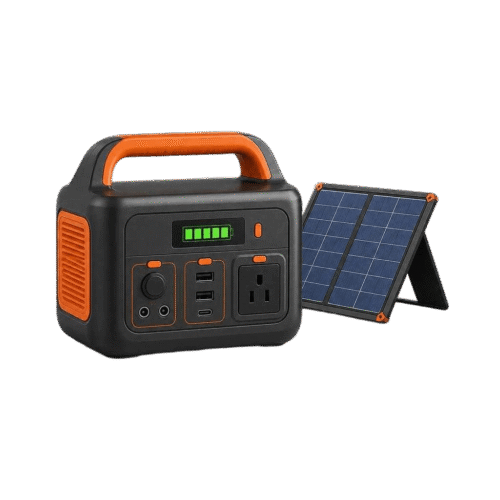
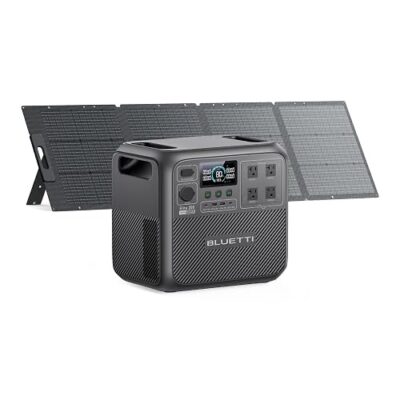
The BLUETTI Elite 200 V2 with one PV200D is a compact 2kWh solar generator whose station is sized for serious 120V loads but whose included panel is sized for portable convenience. The station stores 2,073.6Wh, supplies 2,600W continuous AC, and accepts as much as 1,000W of solar. The PV200D contributes 200W. That five-to-one receiver gap defines the bundle more clearly than any marketing label.
Sixteen usable exact-bundle owner accounts describe camper and minivan use, household appliances, hot plates, refrigeration, app behavior, solar setup, delivery, and isolated fault or remedy experiences. The sample is deliberately treated as qualitative evidence. It can identify what to inspect and which missions appear plausible; it cannot tell us how often any outcome occurs.
Read This Review Through an Evidence Confidence Lens
Three evidence layers should not be blended. Exact BLUETTI documentation establishes capacity, power, input windows, cycle life, transfer time, dimensions, and warranty. Exact-owner reports show how people actually deploy the bundle. Calculations translate those facts into planning ranges. A single fault report cannot override the manual, and a single success cannot prove typical reliability.
Sort Loads Into Duration Bands Before Using 2,600W
The inverter can run many household appliances, but the battery cannot sustain all of them for long. A 1,500W hot plate may fit the power boundary and still consume most usable energy in roughly an hour of continuous operation. A 100W refrigerator average or a modest minivan electrical budget can last far longer. Output decides whether a load starts; energy decides when it stops.
| Duration band | Illustrative load | Planning consequence |
|---|---|---|
| Minutes | Kettle, hot plate, microwave, power tool | High watts can be acceptable when tightly scheduled |
| Hours | Refrigerator, television, office equipment | Measure duty cycle and include inverter loss |
| Overnight | CPAP, fan, communications, cooler | Test a complete night with reserve before relying on it |
| Multi-day | Essentials group | Recovery energy becomes more important than inverter rating |
PV200D Geometry Matters More Than Its Folded Size
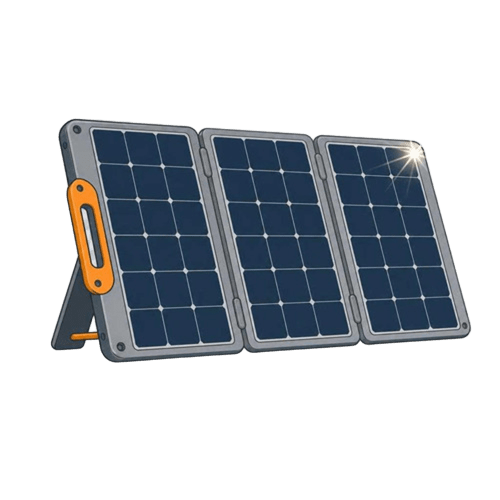
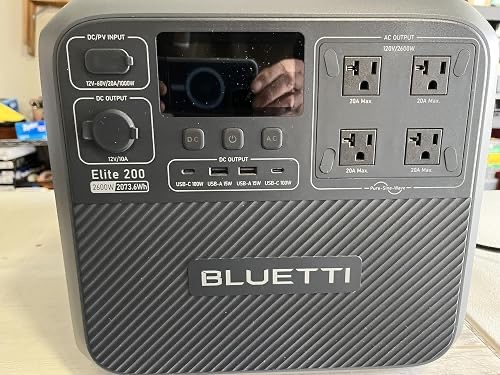
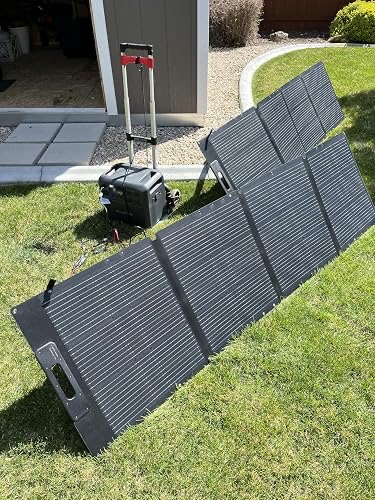
The PV200D is a 200W foldable ETFE panel with a 20.4V operating point and IP67 rating. Folded, it is easy to store; deployed, it requires a long clear strip, stable stands, and a cable route without trip or strain hazards. The best parking spot for a minivan or camper is not necessarily the best solar exposure.
Use a site plan: mark morning and afternoon shade, panel orientation, wind exposure, vehicle movement, and the path to the station. Raising the panel or changing angle can improve harvest, but only within safe support limits. Keep connector ends clean and dry during setup, and never drag the cell surface across the ground.
A 200W Panel Leaves an 800W Receiver Gap
The Elite 200 V2 accepts up to 1,000W of solar within its documented voltage and current window. One PV200D uses 20% of that wattage ceiling. Dividing 2,073.6Wh by 200W yields more than ten nameplate hours before field and charging losses. It is more realistic to view the panel as a quiet daytime extender than as a fast refill path.
Estimate net energy, not peak display watts. A favorable day might replace a moderate refrigerator-and-electronics budget, while cloud, heat, shade, or simultaneous cooking can erase the gain. If the buyer expects daily solar independence, price a compatible larger array before deciding that the one-panel bundle is the lowest-cost option.
Required daily array energy = previous-day consumption + desired recharge margin.
Then validate array Voc in cold weather, current, connector path, and the station’s 12–60V / 20A input boundary. Panel wattage alone is not a safe design.
No Expansion Port Makes the Capacity Decision Final
The Elite 200 V2 does not offer an expansion-battery path. That simplifies ownership, but it means a buyer who later needs 4kWh cannot add a matching pack. The alternatives are a second independent station or replacement with a larger platform. Measure the mission now rather than buying for the 2,600W headline.
This fixed-capacity design can be an advantage in a van or apartment where space and system complexity matter. It is a disadvantage for a home-backup plan expected to grow. Compare the cost, weight, outlets, and charging of one larger expandable system against two independent units before committing.
Commission the App and 15ms UPS as Separate Features
Wi-Fi and Bluetooth monitoring are valuable for charge limits, state, input, output, and firmware. UPS behavior is a different question. BLUETTI publishes a 15ms transfer time, which can be appropriate for many ordinary electronics but is not an online, zero-transfer topology. The exact protected device decides whether interruption is acceptable.
- Record firmware and settings. Save screenshots before changing defaults.
- Test the load on grid pass-through. Confirm temperature and power margin.
- Remove input under supervision. Watch both the station and protected device.
- Restore input. Verify output state and charging behavior.
- Repeat after any update. Treat firmware as a system change.
Use the Return Window as a Commissioning Deadline
The owner sample includes positive accounts and isolated complaints involving non-delivery, early faults, or remedy friction. None gives a population rate. Together they justify an early inspection routine. Do not store the unopened kit for hurricane season or a future trip.
- Match station, panel, serials, and cable inventory to the exact order.
- Inspect panel cells, stands, connectors, and shipping damage.
- Cycle the station through representative AC, USB, and DC loads.
- Test solar in stable sun and keep input screenshots.
- Open written support cases with photos and reproducible steps before return deadlines.
Where This Exact BLUETTI Bundle Fits Best
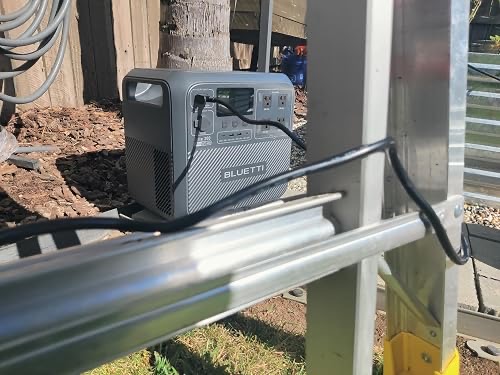
The kit is a good candidate for a camper, minivan, apartment, or short home-outage plan built around refrigeration, communications, lights, electronics, and carefully scheduled cooking. The station’s combination of output, battery documentation, app control, and manageable size is persuasive when the load budget fits 2kWh.
It is a weaker fit for daily solar-only recovery, planned capacity expansion, long high-watt heating, or a buyer who assumes the panel fills the receiver. In those cases, compare the station with a larger compatible array or choose a platform designed to expand.
Bottom Line: A Capable Fixed 2kWh Station With Token-Array Risk
The Elite 200 V2 is the reason to consider this package: 2,073.6Wh, 2,600W output, a documented 1,000W solar receiver, strong cycle-life specification, app connectivity, and a five-year station warranty. The PV200D is a useful portable panel, but one module is too small to exploit the receiver or quickly refill a deeply used battery.
Buy the exact bundle when portability and light daily recovery matter more than solar speed. Prove the load-duration bands, map panel deployment, commission app and UPS behavior, and accept the fixed capacity before the return window closes. The product can be a coherent mobile system; the one-panel configuration should never be mistaken for its maximum solar design.
Pros & Cons Analysis
Based on documented specifications and owner feedback
Pros
- Compact power density — The station combines 2kWh storage and 2,600W output at about 53.4 pounds.
- Long-cycle LFP specification — BLUETTI documents more than 6,000 cycles to 80%, a strong basis for regular use.
- Receiver supports real solar growth — A 1,000W input ceiling gives qualified buyers room to move beyond the starter panel.
- Fast grid recovery — Turbo AC charging can restore substantial energy during short utility or generator windows.
- Useful monitoring — Wi-Fi and Bluetooth app access supports energy logging, settings and firmware management.
Cons
- Starter panel is undersized — The PV200D requires more than ten ideal nameplate hours for an empty 2kWh battery before field losses.
- Capacity choice is permanent — No expansion port means a larger future mission requires another or replacement station.
- High output can hide short duration — Heating and cooking can fit the inverter yet consume the battery rapidly.
- UPS remains conditional — A 15ms transfer requires exact-load commissioning and is not an online UPS.
- Sparse exact evidence demands restraint — The current sample reveals useful camper and household scenarios but cannot establish failure frequency.
A Fixed 2kWh Station That Deserves More Panel
The Elite 200 V2 is a capable compact station with excellent cycle-life documentation. Choose the 200W bundle for portability and daytime offset; choose or build a larger compatible array when solar must perform daily recovery.
Frequently Asked Questions
Can the PV200D fully charge the Elite 200 V2 in one day?
Not usually from empty. Ideal nameplate math exceeds ten hours, before panel and charging losses or active loads.
Can the battery be expanded?
No. The Elite 200 V2 has no expansion-battery port.
What can 2,600W output run?
Many household and travel appliances fit the power rating, but startup and total watt-hours must be checked for each load.
Does it work as a UPS?
BLUETTI documents about 15ms transfer. Test the exact protected device and use dedicated protection when interruption consequences are unacceptable.
Can a larger solar array be used?
Yes, within the documented 12–60V, 20A and 1,000W receiver limits and with the correct connector topology.
Why is the owner sample described as sparse?
Sixteen usable exact-bundle records identify scenarios and inspection points but are too few to calculate outcome or failure rates.
Technical Specifications
| Brand | BLUETTI |
|---|---|
| Kit model / SKU / ASIN | Elite 200 V2 + PV200D bundle (ASIN B0DL5HVR29; US) |
| Power-station model | BLUETTI Elite 200 V2 |
| Included solar-panel model and quantity | 1 × BLUETTI PV200D 200W portable panel |
| Battery capacity | 2,073.6Wh |
| Battery chemistry | LiFePO4 (LFP) |
| Cycle-life rating | 6,000+ cycles to at least 80% capacity |
| Expandable capacity | No expansion-battery port |
| Continuous AC output | 2,600W |
| Surge / peak output | 3,900W Power Lifting for selected resistive loads |
| AC voltage, frequency, and waveform | 120V, 60Hz, pure sine wave |
| AC outlets and high-current / RV / 240V outputs | 4 × 120V AC; no high-current RV or 240V output |
| USB and DC outputs | USB-C, USB-A, 12V car socket and DC5521 outputs |
| Maximum station solar input | 1,000W |
| PV input voltage/current range and connector | 12–60V DC / 20A maximum; MC4-to-aviation solar path |
| Included panel rated power | 200W |
| Panel Voc / Vmp / Isc / Imp | Voc 24.6V / Vmp 20.4V / Isc 10.8A / Imp 9.7A |
| Panel construction and cell type | Foldable ETFE monocrystalline panel |
| Panel weather rating | IP67 panel |
| Panel dimensions and weight, folded / deployed | About 23 × 23.9 × 1.7 in folded and 23.9 × 82.8 in deployed; 17.15 lb |
| Solar recharge estimate with included panel | Idealized minimum exceeds 10 nameplate hours; field recovery normally takes longer |
| Maximum AC input and AC recharge time | Up to 2,400W AC input; 0–80% in about 50 minutes and full in about 70 minutes under specified Turbo conditions |
| Car, alternator, and other charging methods | Vehicle charging and compatible optional BLUETTI alternator charger |
| UPS / EPS support and transfer time | UPS support with about 15ms transfer |
| App and connectivity | BLUETTI app over Wi-Fi and Bluetooth |
| Station dimensions, weight, operating limits, and weather rating | About 13.8 × 9.8 × 12.7 in; 53.4 lb; station has no published outdoor IP rating |
| Station and panel warranties | Station 5 years; PV200D 12 months |
| Included in the box | Elite 200 V2, AC cable, grounding screw, solar cable and documentation; PV200D panel and attached lead |