
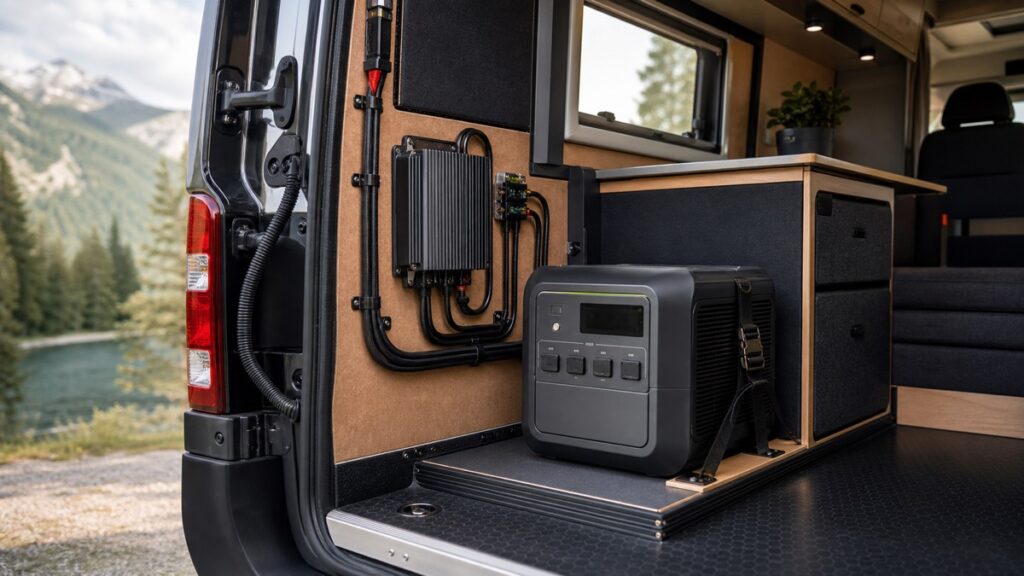
Charging a portable power station from a vehicle can mean two very different systems. A factory accessory socket is a low-power convenience path governed by the vehicle outlet and station car cable. A direct battery DC-to-DC alternator charger is a higher-power installed system governed by the vehicle electrical budget, charger, protection, cable kit, station input, software, and exact compatibility list. Choose the path first; then find its bottleneck.
Choose the Charging Path Before You Buy Hardware
Use the vehicle’s built-in accessory outlet only with the manufacturer-approved car charging cable and within the outlet’s manual-defined voltage, current, and ignition rules. This path is easy to remove and may be adequate for a small station or long drive. Its low power is often the limiting factor, which is acceptable when the goal is maintaining a refrigerator or recovering a modest amount of energy between camps.
A direct DC-to-DC alternator charger connects into the vehicle battery/electrical system using a purpose-built kit. Current official products advertise several hundred watts, but “800W charger” or “600W charger” is a maximum product rating—not a guarantee from every vehicle. Real power is the lowest verified limit across the vehicle’s surplus electrical capacity, charger input/output, cabling/protection supplied for that exact system, station input, connection adapter, temperature controls, and configured charge limit.
Start with the documented accessory-socket path.
A compatible DC-to-DC system may recover substantially more energy.
Stop at professional vehicle assessment.
Require exact vehicle and charger confirmation.
Find the Bottleneck in the Vehicle-to-Battery Chain
The tool uses only values you enter from manuals, manufacturer compatibility resources, or a qualified installer. It does not select a fuse, wire, route, connection point, or safe alternator loading. Its purpose is to expose which verified ceiling controls theoretical charging power.
For an accessory socket, the path power ceiling is voltage multiplied by the verified outlet current, before conversion losses. For a direct system, the same arithmetic is only a ceiling for the verified surplus/installed path—not a claim about total alternator rating. The smallest of that path ceiling, charger maximum, and station input maximum controls the result.
If the station needs an adapter or uses a lower input rate with that charger, enter the lower exact figure. EcoFlow, for example, documents extra adapter or custom-cable requirements for some DELTA products. Jackery publishes different approximate charge power for compatible models even when the same 600W charger is used. Compatibility is therefore a chain, not a plug shape.
An Accessory Socket and a Direct DC-to-DC Charger Are Different Systems
| Decision factor | Factory accessory socket | Direct DC-to-DC alternator charger |
|---|---|---|
| Connection | Approved portable cable into vehicle outlet | Installed path at starter/house battery or manufacturer-defined point |
| Typical purpose | Maintenance or modest recovery while driving | Higher-rate energy recovery during longer drives |
| Primary ceiling | Vehicle outlet fuse/current and station car-input limit | Verified vehicle surplus, charger, installed kit, and station port |
| Installation | Usually removable; follow both manuals | Manufacturer recommends or requires competent/professional installation |
| Main hidden risk | Overloaded socket, hot connector, ignition-dependent outlet | Incorrect protection/routing, battery management conflict, warranty implications |
Do not use the direct charger’s included protection rating as a universal recommendation. EcoFlow lists a 125A fuse for its exact 800W product and kit, alongside 11–31V, 76A maximum charging-mode input and 800W maximum output. Those values describe that product. Another charger, vehicle, cable kit, voltage, or route can require a different design.
Jackery currently lists its DC-to-DC product at 11.8–32V, 60A input and 600W maximum output, with model-specific approximate station charge rates. It recommends professional installation. These official examples confirm the need for product-specific design; they do not establish that either system fits your vehicle.
Compatibility Must Hold at Every Connection
A “12V vehicle” label is not the entire first box. Modern charging systems may regulate voltage dynamically. Hybrids, range-extended vehicles, RV house-battery systems, and special alternators can behave differently. EcoFlow says actual operating power depends on surplus alternator power and may fluctuate; older or special models may not work properly because of low voltage. Ask the vehicle manufacturer or a qualified installer rather than guessing a spare-current value.
At the last box, confirm whether the station accepts the charger through its solar/DC input, a dedicated alternator port, or an adapter. Check whether that input can be used while the station supplies loads and whether the combined heat/load scenario causes derating.
Hand the Installer a Complete Electrical Brief
A professional handoff is more useful when it contains exact questions rather than “install an 800W charger.” Bring the vehicle VIN and electrical documentation, charger model/manual, station model/manual, intended mounting location, cable kit, normal driving pattern, and energy goal.
- Vehicle budget: What load is available after the vehicle’s own worst-case electrical demand, and how is that verified?
- Start/stop behavior: How does the charger recognize engine operation without draining the starter battery?
- Protection: Does the exact manufacturer kit and vehicle installation require changes or additional approved protection?
- Routing: Can the supplied cable avoid heat, sharp edges, moving parts, friction, water exposure, and crush points?
- Mounting and cooling: Does the charger have required clearance and protection while remaining serviceable?
- Compatibility: Are every adapter, connector, polarity, input window, and software setting documented?
- Warranty: What do the vehicle and charger manufacturers say about modifications?
- Commissioning: Which voltage, current, temperature, and stop-state observations will be recorded?
EcoFlow explicitly recommends professional wiring and warns against high-temperature, sharp, and friction-prone routes. It also tells owners to verify alternator capacity and vehicle warranty implications. This is why the guide provides a brief rather than a universal wiring recipe.
Driving Time Produces a Range, Not a Guaranteed Refill
At a sustained 100W path, four driving hours might add roughly 340Wh after an 85% conversion assumption. At a sustained 600W path, the same arithmetic gives about 2,040Wh. But the higher figure is valid only when the vehicle, installed system, charger, station port, software, and temperature all sustain it.
Accessory charging may add little energy; direct-system overhead and vehicle controls matter.
A verified direct system has the best opportunity to approach its planned rate.
Surplus and charger output may fall; ventilation and routing matter.
Model energy gained as a range—perhaps 60%, 80%, and 100% of the verified bottleneck—until commissioning logs show repeatable behavior. Compare that range with the daily load budget. A van fridge drawing energy continuously can consume part of the charge while the station is refilling, so net battery gain can be lower than charger output.
Average station charge power multiplied by actual driving time.
Refrigeration, communications, or other devices powered while driving.
Energy deliberately retained for critical loads or an unplanned stop.
The energy genuinely available for the next stationary period.
Log the station’s energy before departure and after arrival, not just its peak charging display. Two trips of equal duration can produce different recovery when traffic, idle time, cabin HVAC, defrost, battery temperature, or charger derating changes. After several representative drives, use the lowest repeatable net result for itinerary planning and keep a separate method for days when the vehicle does not move.
Heat, Short Trips, and Vehicle Controls Can Reduce the Result
Direct chargers convert substantial power inside a compact enclosure. EcoFlow lists an operating range of −4°F to 140°F for its current 800W unit and warns that the product can become hot. An operating-temperature rating does not mean every mounting location is acceptable. Follow the required clearance, orientation, and route instructions.
Record engine state, charger mode, vehicle voltage, input/output power shown by approved instrumentation, station charge power, cable/connector condition, temperatures or thermal warnings, and the automatic stop after the engine turns off. Repeat with headlights, HVAC, defrost, and other normal vehicle loads under installer guidance.
Stop the plan if a connector heats abnormally, insulation is damaged, a protection device opens, the charger repeatedly faults, the starter battery declines, or the vehicle reports an electrical-system fault. Do not increase a fuse, bypass protection, or raise software current to force the desired rate.
Bottom Line: Design Around Verified Surplus Power
Use an accessory socket when simplicity and removability matter more than refill speed. Consider a direct DC-to-DC system when the energy deficit and driving time justify it, every component is compatible, a qualified assessment verifies vehicle surplus, and the exact installation can follow manufacturer instructions.
- Quantify the daily Wh deficit.
- Select socket or direct path.
- Verify every link and vehicle surplus.
- Have the installed system professionally reviewed where recommended.
- Commission at conservative settings.
- Use logged net energy—not headline power—for trip planning.
Use the runtime guide to calculate the daily deficit and the UPS/EPS guide only when automatic pass-through behavior is part of the vehicle setup. Solar charging remains a separate input-design question in the Solar Panels cluster.


Leave a Reply