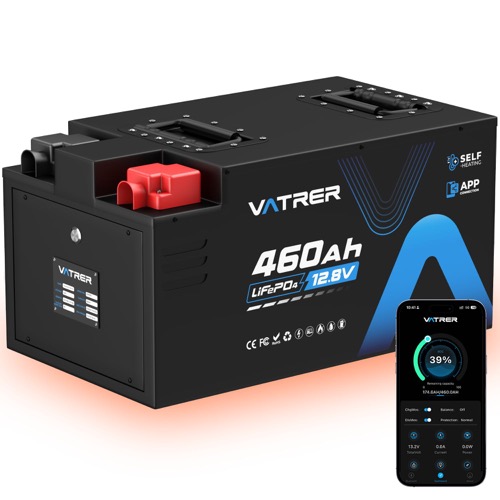
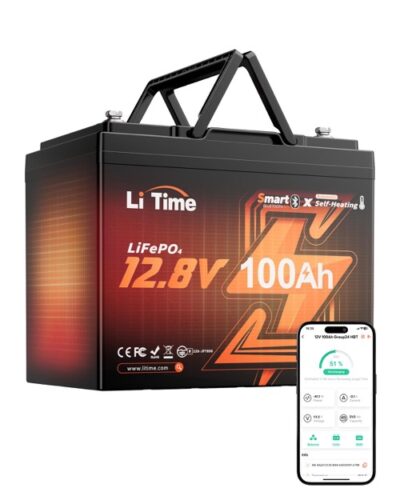
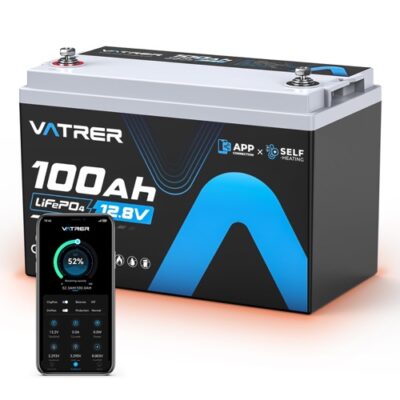
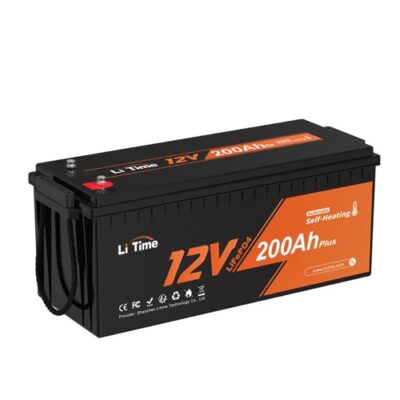
“Self-heating” is not one standardized feature. A useful comparison needs the activation temperature, stop temperature, minimum incoming current, source of heater energy, warm-up time, and what happens when winter solar cannot meet the threshold. Our five picks range from 1,280Wh to 5,888Wh because capacity changes that entire energy balance.
We Ranked Heater Conditions Before Capacity
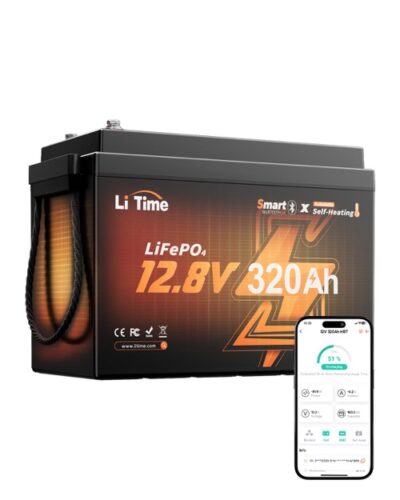
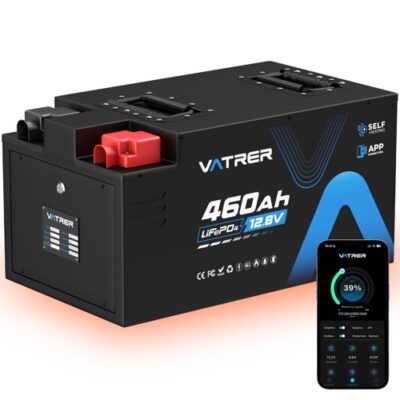
A large battery with vague heat behavior can be less useful than a smaller unit whose winter sequence is predictable. LiTime’s 100Ah needs at least 10A; Vatrer’s 100Ah needs more than 10A; LiTime’s 200Ah needs at least 20A. The larger LiTime 320Ah adds an app-selectable mode that can use stored battery energy under allowed conditions. Vatrer 460Ah documents temperature thresholds but its exact input behavior deserves confirmation for the delivered revision.
100Ah: Group 24 Precision or Group 31 Value?
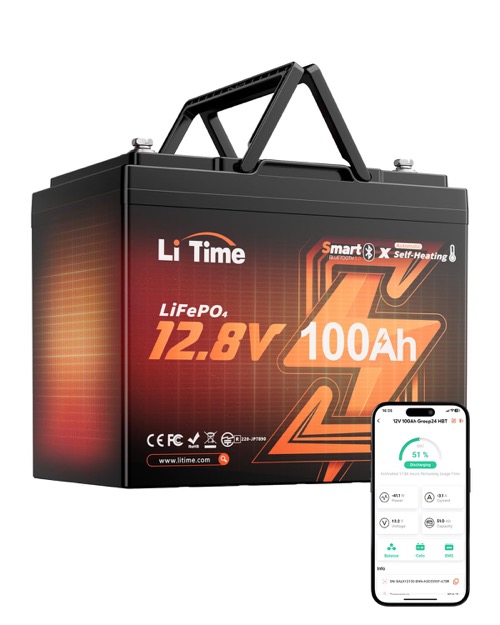
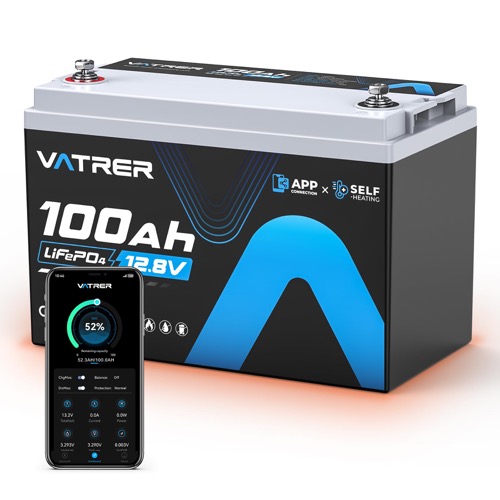
LiTime and Vatrer both store 1,280Wh and publish 100A continuous current. LiTime is the compact Group 24 model and adds a 500A one-second pulse with published warm-up timing. Vatrer uses a longer Group 31 case, lacks an exact timed surge in the reviewed source, and has conflicting 4S/parallel copy—but remains an attractive value option when that tray already exists.
LiTime 100Ah
Choose for compactness, one-second pulse documentation, and clearer heater timing.
Vatrer 100Ah
Choose for Group 31 replacement value when continuous loads remain moderate.
200Ah and 320Ah Solve Different Large-Battery Problems
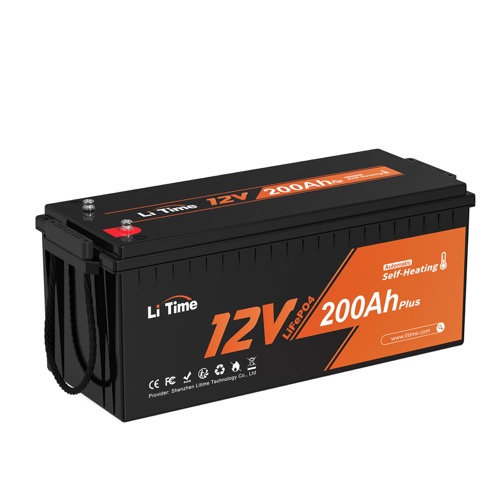
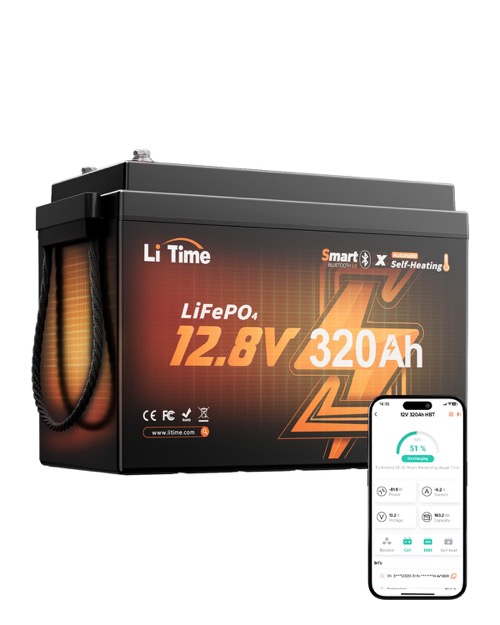
LiTime 200Ah prioritizes current: 200A continuous and 800A for one second, with no Bluetooth. It is logical in a system that already uses a bank shunt. LiTime 320Ah prioritizes energy density and control: 4,096Wh, 200A continuous, 1,000A for one second, Bluetooth, and two heater modes.
| Decision | 200Ah Plus | 320Ah Mini |
|---|---|---|
| Monitoring | External architecture required | Built-in app plus optional shunt |
| Nominal energy | 2,560Wh | 4,096Wh |
| Heater planning | At least 20A incoming | Incoming-power and app-selectable energy mode |
| Owner coverage | 9 exact reviews | 11 exact reviews |
460Ah Consolidates a Bank and a Risk
Vatrer’s 460Ah stores 5,888Wh and supports 300A continuous current in one enclosure. It removes several parallel interconnects, but weighs 104.7 pounds, carries IP54 rather than IP65, and concentrates the complete system in one BMS and case. Large capacity also needs a large recovery source; storage does not create solar energy.
- Fewer interconnects
- No parallel SOC matching for one unit
- One app view
- Heavy removal and service
- Concentrated fault energy
- No battery-level redundancy
Owner Evidence Is Uneven by Model
The 100Ah LiTime has 24 retained exact reviews; Vatrer 100Ah has 14 but is positive-skewed; LiTime 200Ah has nine; Vatrer 460Ah has 32; LiTime 320Ah has 11. We do not reward a smaller positive-only sample over a larger mixed one. Coverage determines confidence, while primary documentation determines published limits.
No population claims: captured reports can reveal failed heating, BMS cutoff, support friction, or successful winter use. They cannot calculate a brand-wide defect rate.
A Cold-Weather Buying Checklist
- Define the coldest charge condition: cell temperature, not only outdoor air.
- Prove heater input: actual winter amps at the battery after losses.
- Budget warm-up energy and time: then calculate remaining solar recovery.
- Match current and surge: include duration and low-voltage inverter draw.
- Engineer the enclosure: weight, restraint, IP rating, terminals, fuse, disconnect, and service access.
Final Picks by System
LiTime 100Ah is the compact default; Vatrer 100Ah is the Group 31 value alternative. LiTime 200Ah is best when a 200A-class path and external shunt are already planned. LiTime 320Ah wins energy density and heater control. Vatrer 460Ah is for an engineered large 12V system that values consolidation enough to accept its mass and IP54 enclosure.