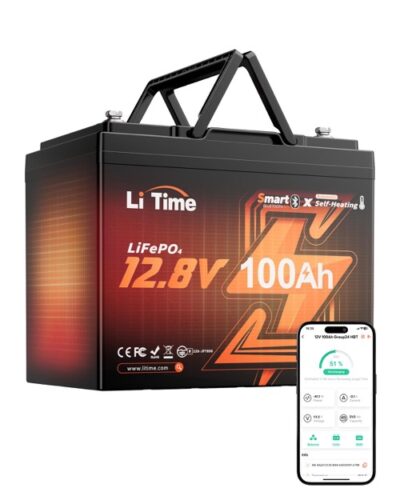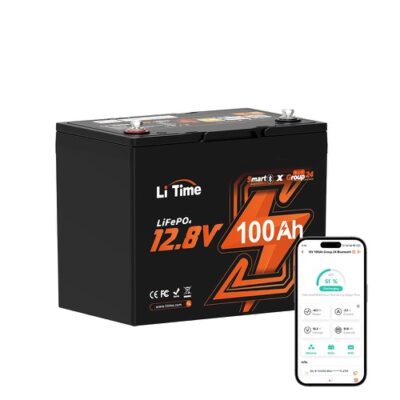
LiTime 12V 320Ah Mini Self-Heating Review: Dense, Smart Storage
At a Glance
KEY FEATURES
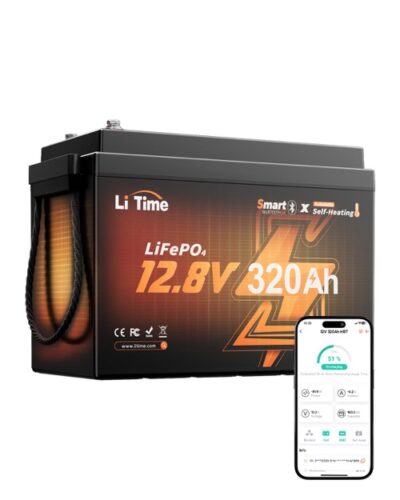
- 12.8V, 320Ah, 4,096Wh nominal energy.
- 200A continuous; 1,000A for one second.
- Bluetooth with automatic and energy-efficient heating modes.
- 57.3-pound, 14.49-inch-long IP65 case.
- Best for high energy density where one-second surge fits.
PROS
- Exceptional energy per case footprint
- 200A continuous current
- App-selectable heater behavior
- Full current/cycle/temperature documentation
CONS
- Only 11 exact reviews and one customer photo
- 1,000A pulse lasts one second
- 57.3 pounds still requires handling planning
- Large capacity can take a long time to recover from small solar
Compact High-Energy Pick
Based on exact documentation and exact-ASIN owner evidence
How Many LiTime 12V 320Ah Mini Self-Heating Batteries Do You Need?
Estimate how many LiTime 12V 320Ah Mini Self-Heating batteries your daily energy target may require.
Solar Battery Bank Size Calculator
How much solar battery storage do I need?
The word “Mini” is relative. LiTime’s 320Ah battery weighs 57.3 pounds, but placing 4,096Wh in a 14.49 × 7.44-inch base is impressive energy density for a finished 12V battery. This review therefore compares space saved with current, recharge time, heat strategy, and the thin exact-owner history.
Large single-case reserve.
Charge and discharge.
Very large, very brief.
Early, limited coverage.
Energy Density Wins Space, Not Recharge Time
A 4.096kWh battery can support longer autonomy without parallel interconnects. The same capacity also takes time to restore. At LiTime’s 64A recommended charge rate, an idealized 320Ah nameplate is roughly five hours before taper and loss; a small solar array can need several days after deep use.
320Ah ÷ 64A = 5 hours
Real recovery is longer and solar is variable. Include heater energy, loads running during charge, controller loss, and incomplete sun hours.
200A Sustained, 1,000A for One Second
The continuous envelope is 200A, about 2,560W at nominal voltage before loss and sag. The 1,000A number lasts one second. This battery can accommodate a very sharp inrush on paper; it cannot support a load that stays above 200A after the clock expires.
Two Heating Modes Create a Real Energy Choice
Automatic heating uses qualifying incoming power. The app also exposes an energy-efficient mode that may use battery energy when SOC is above the documented threshold, allowing warming when external input is limited. That can restore charging sooner but spends stored energy—the exact opposite of a free heater.
| Mode | Advantage | Tradeoff |
|---|---|---|
| Incoming-power heating | Preserves stored load energy | May wait for adequate winter source current |
| Energy-efficient/app mode | Can warm from battery under allowed SOC conditions | Consumes reserve before charging begins |
The Installation Is Compact but Not Light
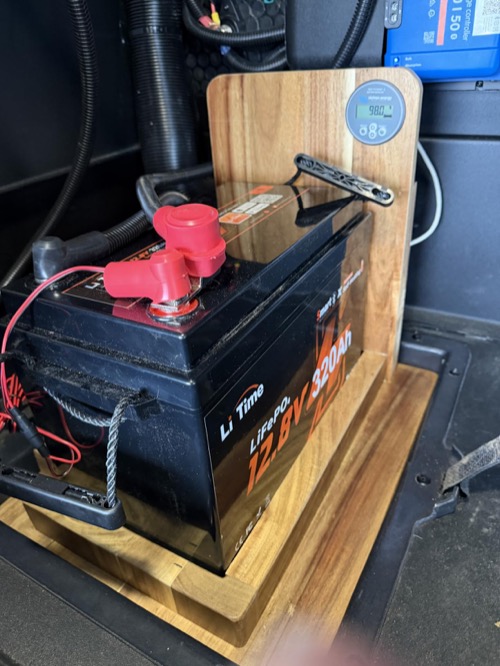
The 14.49 × 7.44 × 10.04-inch case needs only one set of M8 terminals, but the 57.3-pound mass still requires a lifting path, supported tray, restraint, service clearance, fuse, and disconnect. The IP65 enclosure is not permission for submersion.
- Model axle/floor loading and restraint under vehicle motion.
- Protect the 200A-class conductor at the source.
- Allow insulated lug and cable clearance above the 10.04-inch case.
- Keep Bluetooth accessible without sacrificing enclosure protection.
Eleven Reviews Cannot Carry a Reliability Verdict
Ten captured reports are positive and one describes a 12.2V battery that would not charge. The sample offers early app, capacity, and installation impressions but almost no diversity of failure outcomes. The high editorial score reflects documented capability; Build & Ownership is intentionally lower.
Energy, current, pulse, heat, IP, and cycle conditions are explicit.
Eleven reviews and one photo cannot establish long-term reliability.
LiTime 320Ah Mini: Final Recommendation
Choose it when energy density, app visibility, flexible cold behavior, and a 200A continuous path matter—and when the charging system can restore 4.096kWh in the available weather window. Do not let the one-second 1,000A headline or the word “Mini” obscure the real design.
Pros & Cons Analysis
Based on documented specifications and owner feedback
Pros
- Exceptional energy per case footprint
- 200A continuous current
- App-selectable heater behavior
- Full current/cycle/temperature documentation
Cons
- Only 11 exact reviews and one customer photo
- 1,000A pulse lasts one second
- 57.3 pounds still requires handling planning
- Large capacity can take a long time to recover from small solar
Bottom Line: Impressive Density, Early Evidence
LiTime's 320Ah Mini delivers 4,096Wh, 200A continuous current, Bluetooth, IP65, and unusually flexible heating in a compact-for-capacity case. The electrical proposition is strong; ownership confidence is limited by only 11 captured reviews and one customer photo. Buy for density after verifying recovery time and surge duration.
Frequently Asked Questions
How much energy does the LiTime 320Ah Mini store?
Its nominal rating is 4,096Wh. Practical usable energy is lower after reserve, BMS cutoff, temperature, wiring, and inverter losses.
What are the heating modes?
The exact model supports automatic incoming-power heating and an app-selectable energy-efficient mode that may use battery energy when SOC is above the documented threshold. Verify the current manual and understand the winter energy tradeoff before enabling it.
Can it supply 1,000A?
Only for one second. Its sustained charge and discharge ceiling is 200A. The complete DC path must support any pulse safely.
How compact is it?
The published case is 14.49 × 7.44 × 10.04 inches at 57.3 pounds. It is compact relative to 4.096kWh, not a small carry battery.
How reliable is the evidence?
Only 11 exact-ASIN reviews and one customer photo were retained. Ten positive and one critical report give useful early signals but poor failure-mode coverage.
Technical Specifications
| Brand | LiTime |
|---|---|
| Exact model | L12V320-200-HBT-4-W190 |
| Battery chemistry | LiFePO4 (LFP) |
| Nominal voltage | 12.8V |
| Rated capacity | 320Ah |
| Rated energy | 4,096Wh |
| Recommended depth of discharge | Up to 100% DoD; 80% DoD is paired with the 6,000-cycle figure |
| Recommended charge current | 64A |
| Maximum continuous charge current | 200A |
| Maximum continuous discharge current | 200A |
| Peak discharge current | 1,000A for 1 second |
| Recommended charge voltage | 14.4V ± 0.2V (CC/CV) |
| Low-temperature charge protection | Charging is blocked below 32°F (0°C) until the cells are warmed |
| Self-heating | Yes; automatic heating from -4 to 41°F (-20 to 5°C), including an app-selectable energy-efficient mode |
| Charge / discharge temperature | Charge: -4–122°F (-20–50°C) with heating; discharge: -4–140°F (-20–60°C) |
| BMS protections | Overvoltage, undervoltage, charge/discharge overcurrent, short-circuit, overload, and high/low-temperature protection |
| Monitoring | Built-in Bluetooth with LiTime app |
| Series / parallel configuration | Up to 4 in series and 4 in parallel (4S4P) |
| Terminals | M8 × 16 mm bolts |
| Dimensions | 14.49 × 7.44 × 10.04 in |
| Weight | 57.3 lb |
| Ingress rating | IP65 |
| Cycle-life specification | 4,000 cycles at 100% DoD; 6,000 at 80%; 15,000 at 60% |
| Warranty | 5 years |