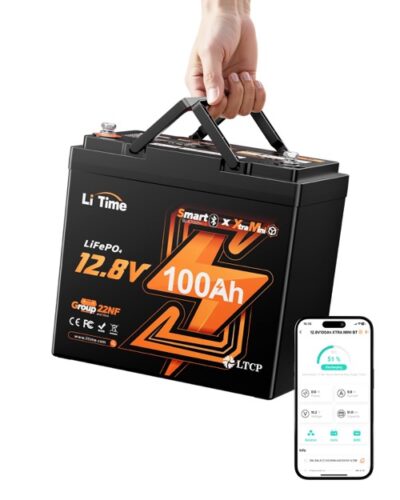
LiTime 12V 100Ah Self-Heating Review: Winter Logic Explained
At a Glance
KEY FEATURES
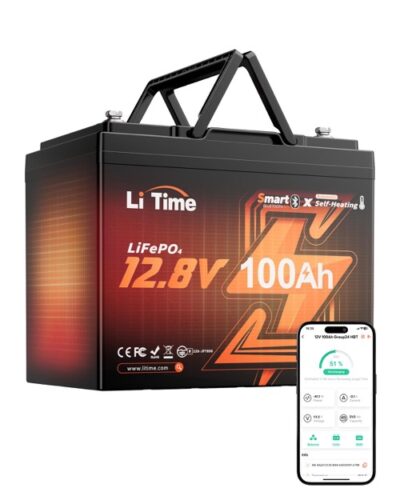
- 12.8V, 100Ah, 1,280Wh Group 24 case.
- Automatic -20 to 5°C heating with at least 10A input.
- Bluetooth app and IP65 enclosure.
- 100A continuous; 500A for one second.
- Best for cold RV/solar systems with adequate winter charge current.
PROS
- Exact heater thresholds and minimum input
- Bluetooth shows temperature and protection state
- Group 24 format
- Complete current/cycle documentation
CONS
- Heating depends on available charge current
- Warm-up can take 70–150 minutes
- One-second surge remains brief
- Owners report short terminal hardware and parallel-charge issues
Heated Group 24 Pick
Based on exact documentation and exact-ASIN owner evidence
How Many LiTime 12V 100Ah Self-Heating Batteries Do You Need?
Estimate how many LiTime 12V 100Ah Self-Heating batteries your daily energy target may require.
Solar Battery Bank Size Calculator
How much solar battery storage do I need?
LiTime’s heated Group 24 is not merely the Bluetooth model with “winter” added to the label. The heater changes the charging sequence: incoming energy can be diverted to warm cells before normal charging begins, and the source must supply at least 10A. That minimum is the central design fact.
The Heater Has an Input Gate
Heating operates from -4 to 41°F (-20 to 5°C) when qualifying charging power is present. LiTime states roughly 70–90 minutes to warm from 14°F (-10°C) and 100–150 minutes from -4°F (-20°C). A snow-covered or shaded array may produce voltage without providing the 10A minimum, leaving the battery protected but cold.
Winter Solar Must Cover Heat and Recharge
A battery that needs 100 minutes of heating before charging has fewer productive solar hours left. The energy model must cover heater demand, daily loads, conversion loss, and replacement of prior deficit. A controller’s nameplate current is irrelevant if the array cannot produce it under winter irradiance and temperature.
heater energy + load energy + battery recharge + system loss
Use location-specific winter harvest, not summer panel wattage, and preserve margin for snow, shade, and short days.
Bluetooth Makes the Heating Sequence Observable
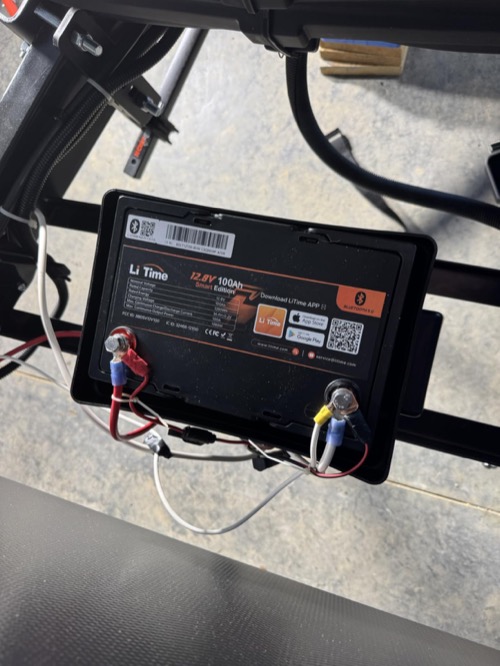
The app can show cell temperature, current, SOC, and protection states, which helps distinguish “not charging because it is cold” from a wiring or controller problem. Establish a warm baseline first, then record what the app shows during a controlled cold-start event.
| Observed state | Likely question | Next check |
|---|---|---|
| Cold, input under 10A | Why has heating not started? | Available source current, shade, wiring, controller limit |
| Heating, no SOC rise | Is energy being lost? | Expected warm-up phase and cell temperature |
| Warm, no charge | Is a different protection active? | Voltage, current, BMS state, charger profile |
The Electrical Envelope Is Familiar
Continuous charge and discharge are 100A, with 500A for one second. The recommended charge current is 20A. Heater input and battery charging share the same system, so add every source and respect the 100A maximum even when cold behavior complicates current flow.
Owner Reports Expose Two Installation Details
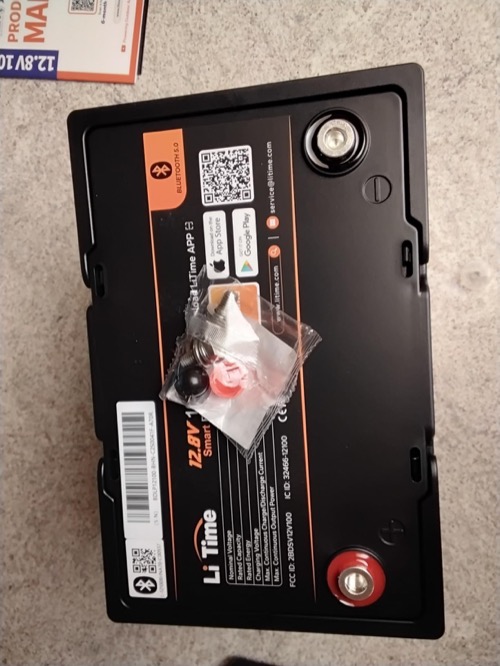
The 24-review merged sample includes positive cold-weather and app use, plus reports of terminal bolts too short for complex lug stacks and low-input solar/parallel behavior that did not match owner expectations. There are also isolated defective or non-charging reports. These observations cannot establish rates, but they map directly to commissioning checks.
- Use a busbar rather than crowding multiple large lugs onto one M8 bolt.
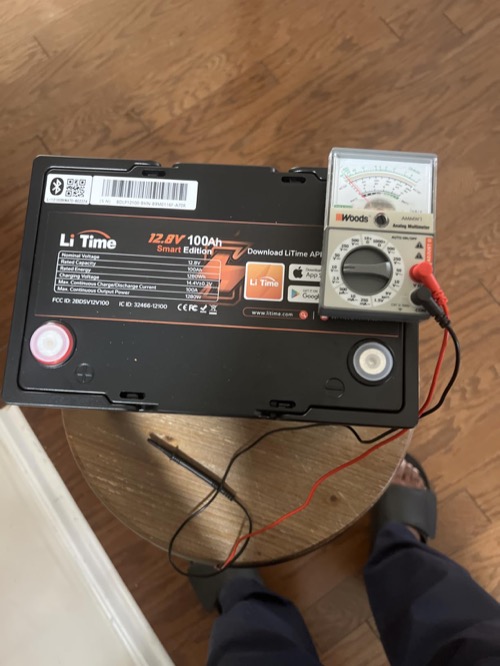
- Confirm every parallel unit sees similar cable resistance and temperature.
- Test whether the real winter source exceeds 10A at the battery.
- Keep a charger/recovery path available when a BMS opens.
LiTime Heated Group 24: Final Recommendation
Best fit
A cold RV, boat-house bank, or small solar system with direct app visibility and a verified winter source that can exceed 10A.
Poor fit
A tiny winter array, a multi-second high-surge load, or a terminal layout that requires an unsafe lug stack.
The heater is credible because its conditions are published. The buyer’s job is to prove those conditions exist in the real system.
Pros & Cons Analysis
Based on documented specifications and owner feedback
Pros
- Exact heater thresholds and minimum input
- Bluetooth shows temperature and protection state
- Group 24 format
- Complete current/cycle documentation
Cons
- Heating depends on available charge current
- Warm-up can take 70–150 minutes
- One-second surge remains brief
- Owners report short terminal hardware and parallel-charge issues
Bottom Line: Heating Works Only When the Energy Plan Works
The LiTime heated Group 24 is a strong cold-climate choice because its activation band, minimum input, warm-up time, Bluetooth, and current limits are documented. Its heater is not magic: weak winter solar may fail to deliver the required 10A, and captured owners raise terminal and parallel-charging cautions.
Frequently Asked Questions
When does the LiTime self-heater turn on?
The exact model heats automatically when charging is available and cell temperature is between -4°F and 41°F (-20°C to 5°C). It needs at least 10A of charging input.
How long does heating take?
LiTime publishes about 70–90 minutes from 14°F (-10°C) and 100–150 minutes from -4°F (-20°C). Actual time depends on temperature, available charge current, enclosure, and battery condition.
Does the heater use battery energy?
The normal automatic mode is driven by incoming charging power. Follow the exact manual and app settings; do not assume the heater will rescue a cold battery when winter solar cannot provide the minimum input.
Can it supply 500A?
Only for one second. Continuous charge and discharge are 100A, so a multi-second startup above 100A may not fit.
Can four be connected in parallel?
LiTime permits up to 4S4P with matched batteries. Low winter solar, unequal cabling, temperature differences, and BMS states can still cause uneven behavior and must be designed for.
Technical Specifications
| Brand | LiTime |
|---|---|
| Exact model | L12V100-100-GROUP24-HBT-4-A70 |
| Battery chemistry | LiFePO4 (LFP) |
| Nominal voltage | 12.8V |
| Rated capacity | 100Ah |
| Rated energy | 1,280Wh |
| Recommended depth of discharge | Up to 100% DoD; 80% DoD is paired with the 6,000-cycle figure |
| Recommended charge current | 20A |
| Maximum continuous charge current | 100A |
| Maximum continuous discharge current | 100A |
| Peak discharge current | 500A for 1 second |
| Recommended charge voltage | 14.4V ± 0.2V (CC/CV) |
| Low-temperature charge protection | Charging is blocked below 32°F (0°C) until the cells are warmed |
| Self-heating | Yes; automatic heating from -4 to 41°F (-20 to 5°C), with at least 10A charging input |
| Charge / discharge temperature | Charge: -4–122°F (-20–50°C) with heating; discharge: -4–140°F (-20–60°C) |
| BMS protections | Overvoltage, undervoltage, charge/discharge overcurrent, short-circuit, overload, and high/low-temperature protection |
| Monitoring | Built-in Bluetooth with LiTime app |
| Series / parallel configuration | Up to 4 in series and 4 in parallel (4S4P) |
| Terminals | M8 bolts |
| Dimensions | 10.24 × 6.61 × 8.27 in (Group 24) |
| Weight | 22.71 lb |
| Ingress rating | IP65 |
| Cycle-life specification | 4,000 cycles at 100% DoD; 6,000 at 80%; 15,000 at 60% |
| Warranty | 5 years |