LiTime Xtra-Mini Smart Review: Compact Battery, Useful App
At a Glance
KEY FEATURES
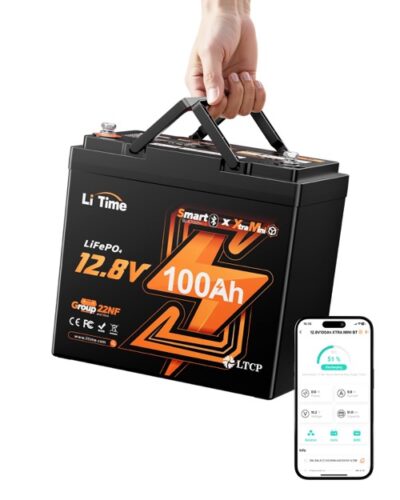
- Battery: 12.8V, 100Ah, 1,280Wh LiFePO4 in a Group 22NF-sized case.
- Current: 100A continuous charge/discharge; 500A peak for one second.
- Temperature: Charging stops below 32°F and resumes at 41°F; no self-heating.
- Bank setup: Up to 4S4P with matched batteries.
- Best fit: Tight RV, boat, radio, or small off-grid builds that benefit from Bluetooth.
PROS
- Group 22NF-sized case saves compartment space.
- Built-in Bluetooth shows status without a separate shunt.
- 100A continuous charge and discharge ratings suit many 12V house loads.
- Documented low-temperature cutoff protects charging below freezing.
- Exact manual publishes 4S4P and terminal-torque limits.
CONS
- The smaller case does not reduce the need for cable and terminal clearance.
- App readings are monitoring data, not an independent capacity test.
- The 500A headline is limited to a one-second pulse.
- No integrated heater is included.
- The exact owner sample is small, recent, and almost entirely positive.
Editor's Pick
Based on documentation and exact-model owner evidence
How Many LiTime Xtra-Mini Smart Batteries Do You Need?
Estimate how many LiTime Xtra-Mini Smart batteries your daily energy target may require.
Solar Battery Bank Size Calculator
How much solar battery storage do I need?
This LiTime Xtra-Mini Smart review is really a fit-and-visibility decision: do you need a full 100Ah battery in a much smaller case, and do you want to see its status without adding a separate shunt? The exact battery here is the 12.8V 100Ah Xtra-Mini Smart, Amazon ASIN B0DNQ5VS8G — not a heated sibling, a multi-pack, or another LiTime Mini carrying similar search language.
The answer looks favorable for tight RV, boat, radio, and small off-grid compartments. Its manual documents 1,280Wh, 100A continuous charging and discharging, direct Bluetooth, and cold-charge cutoff. The caution is evidence depth: the ten retained exact-variant owner reviews are recent and overwhelmingly positive, so they illuminate use cases but cannot settle long-term reliability.
The Small-Box Question: What Fits in 9 × 5.4 Inches?
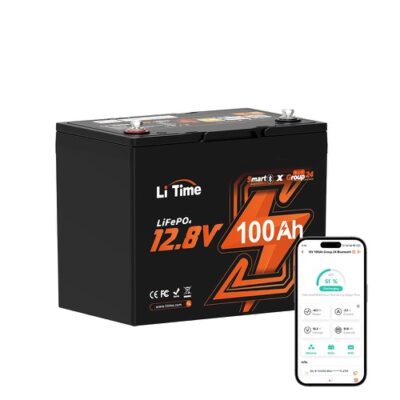
The case measures 9.02 × 5.43 × 8.19 inches and weighs 19.13 pounds. That footprint is associated with Group 22NF sizing, which is substantially easier to place than the full Group 31 batteries often used in older RV or marine-house installations. The smaller base can release space for a disconnect, fuse, busbar, or cable routing instead of forcing the battery to occupy the entire compartment.
Small does not mean clearance-free. Measure the usable compartment in three dimensions, then allow space above the M8 terminals for lugs, insulated covers, and cable bends. A battery that physically drops into a tray can still be a poor installation if a stiff conductor pulls sideways on a post or the cover cannot close without touching energized hardware.
The lower weight matters most when access is awkward. At a little over 19 pounds, one unit is manageable for seasonal removal or service, and sampled owners repeatedly contrasted the compact, light case with the lead-acid batteries they replaced. That is handling evidence, not permission to mount it without restraint; movement, abrasion, and terminal stress still need to be controlled.
Form factor can also change the rest of the system. Saving several inches may let a builder shorten high-current cable runs or place protection closer to the positive terminal, but only if access and thermal conditions remain suitable. Do not spend the gained space by crowding uninsulated busbars or forcing the battery against a compartment wall.
Fit check before checkout
- Measure height with the complete lug stack and terminal cover.
- Allow the specified conductor bend radius without side-loading a post.
- Reserve service space for the fuse, disconnect, and a physical battery hold-down.
Bluetooth That Answers the Useful Questions
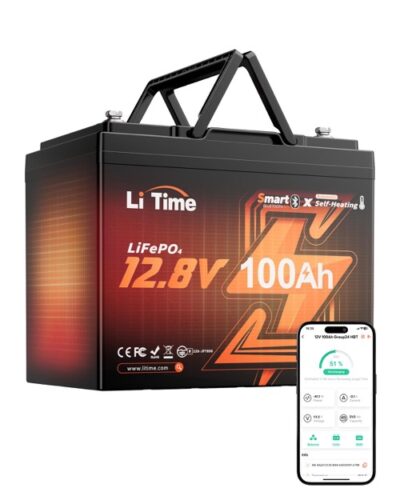
Bluetooth is built into this exact Xtra-Mini Smart, so basic battery visibility does not require an external shunt or communication dongle. The LiTime app is intended to show status such as state of charge and operating data. Multiple sampled owners called the app useful, and one specifically reported checking it without creating an account in that installation.
That convenience changes everyday ownership. A battery hidden under a seat or inside a boat compartment can be checked before an outing without opening the enclosure or estimating state of charge from a flat LiFePO4 voltage curve. It also provides a quicker clue when a BMS protection has opened the circuit.
The app should not be promoted as laboratory instrumentation. State-of-charge algorithms can drift, and a displayed percentage does not independently prove that the battery delivered 100Ah under a controlled load. Use the telemetry for operation and troubleshooting; use an attributable load test with documented conditions if actual capacity is the question.
Telemetry is most useful when the owner establishes a normal baseline. Note the displayed current with known loads, observe charge completion under the configured controller, and investigate a sudden deviation instead of trusting one percentage in isolation. A separate bank shunt may still be preferable when several batteries feed one common load.
What should I record on the first full charge?
Save the displayed voltage, current, temperature, state of charge, and protection state after the charger completes its documented profile. That baseline makes a later change easier to investigate.
When is the internal app enough?
It is the simpler option for one battery when the goal is direct visibility and fault clues. It becomes less complete when several batteries share one bus and the owner needs net bank energy accounting.
When would I still install a shunt?
Use a correctly placed shunt when every charger and load must be included in one bank-level total. Keep a separate way to inspect the individual LiTime if one parallel unit enters protection.
What the app cannot prove: A convenient state-of-charge screen is operating evidence, not an independent 100Ah capacity test. Establish a normal baseline and investigate changes rather than trusting one percentage in isolation.
The 100A Envelope—and the One-Second Surge
LiTime publishes 100A as both the maximum continuous charge current and maximum continuous discharge current. At the nominal 12.8V rating, multiplying 12.8V by 100A gives about 1,280W of preliminary DC power. That calculation is a boundary check, not a promise that a 1,280W AC appliance will run continuously: inverter efficiency, voltage sag, cable loss, ambient temperature, surge, and the other protection devices all reduce the usable design envelope.
The 500A peak figure is more dramatic and easier to misuse. It lasts for one second. That may help with a brief inrush, but it does not turn the battery into a 6.4kW continuous source, and it should not be used to excuse an undersized continuous-current design.
Charging deserves the same separation. The recommended charge current is 20A, while 100A is the published continuous maximum. A solar controller sized to the larger number would need suitable array power, conductors, protection, temperature conditions, and a charge profile matching the 14.4V ±0.2V CC/CV guidance. “Maximum” is a ceiling, not automatically the best everyday setting.
| Electrical number | Use it for | Do not infer |
|---|---|---|
| 100A continuous discharge | Sustained DC-load boundary | That every 1,280W AC appliance is suitable |
| 500A for 1 second | Checking a very brief inrush | Multi-second motor-start capability |
| 20A recommended charge | Everyday charging plan | That the 100A maximum is automatically preferable |
| 14.4V ±0.2V CC/CV | Charger-profile verification | Correct temperature protection by itself |
What Happens When the Battery Is Below Freezing?
The BMS is documented to stop charging below 32°F (0°C) and to resume at 41°F (5°C). That recovery gap is useful: it prevents rapid on-off cycling around the freezing point. The discharge range extends lower, to -4°F (-20°C), which is why a cold battery may still power loads while refusing incoming solar current.
This model is not self-heating. If it sits in an unconditioned compartment through a cold morning, the cutoff can protect the cells but cannot make them warm enough to accept charge. Insulation, placement in conditioned space, or a separately designed heating strategy may be required where winter solar production matters.
Do not bypass that protection by treating a charger setting as the only temperature control. A complete system considers the battery BMS, charge controller, sensor placement, heater demand, and the possibility that solar input arrives before the compartment warms.
Owner Use Cases: Radio, Refrigeration, Trolling, and Heat
The exact-variant review sample covers a useful range of modest 12V systems. Owners describe ham radio service, boat and kayak trolling motors, boat electronics, a diesel heater, and an inverter-powered refrigerator during an outage. Those reports show why the combination of compact size, 100A current, and app visibility has practical appeal.
Compact footprint and phone visibility address space and access; moisture protection and terminal safety remain installation jobs.
One owner reported no noticeable interference, but the result is specific to that equipment and cable layout.
The 100A continuous boundary may suit modest loads after startup, inverter loss, and low-voltage current are checked.
Owner use demonstrates the application, not automatic approval for every motor, voltage, or peak-current demand.
One radio owner reported no noticeable interference in that installation. That is a helpful anecdote, not an electromagnetic-compatibility test, and a different radio, cable layout, charger, or inverter can behave differently. Another owner mentioned roughly 200 cycles; that personal milestone does not validate LiTime’s published multi-thousand-cycle figures.
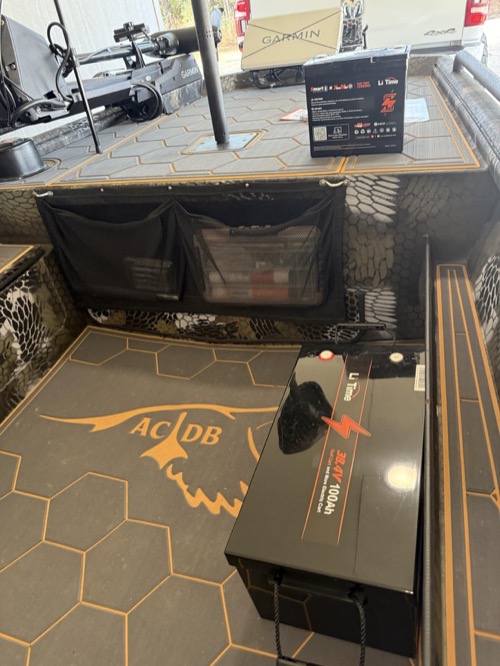
The customer photo is particularly relevant to the physical argument. It shows the exact battery inside a finished boat compartment with real surrounding constraints, rather than isolated on a white background. Buyers should still measure their own tray and cable route; a photograph cannot confirm ventilation, fuse placement, or terminal torque.
What Ten Positive Reviews Cannot Establish
The retained sample includes ten exact-variant verified-purchase reviews dated from January 10, 2025, through March 19, 2026. Nine carry five stars and one carries four. That consistency supports the conclusion that the sampled owners generally liked the size, app, and early performance.
It does not support a population-wide reliability claim. A small positive-skewed sample can miss rare failures, later degradation, support disputes, or lower-star reports not captured by the collection method. The responsible reading is “useful early owner evidence with low coverage of failure modes,” not “proven defect-free.”
Cycle-life statements require the same restraint. LiTime publishes different cycle counts at 100%, 80%, and 60% depth of discharge, but those are manufacturer specifications. Without a controlled long-duration test of this exact model, the review should present them as planning context rather than an expected service-life guarantee.
Installation Boundaries Before You Buy
The exact manual allows up to four batteries in series and four in parallel. A 4S4P limit describes the outer configuration boundary; it does not say that batteries of different ages, charge states, capacities, or revisions can be mixed safely. Plan a bank from matched units and follow the manual’s pre-connection state-of-charge and wiring requirements.
LiTime specifies 12–14 N·m for the M8 terminal hardware. Use a torque tool rather than guessing by hand, and make sure the bolt length suits the actual lug stack. Loose connections create resistance and heat; overtightening can damage the terminal. Fuse, disconnect, conductor, busbar, and enclosure choices must be based on the system’s available current and applicable requirements.
The IP65 rating means the enclosure is dust-tight and protected against water jets under the rating conditions. It does not mean the battery is submersible or suitable for an exposed bilge. Mount it securely, keep the terminals protected, and preserve access for inspection.
Storage and seasonal shutdown need app-independent checks as well. Remove unintended parasitic loads, follow LiTime’s state-of-charge and temperature guidance, and verify the battery before a long idle period. Bluetooth convenience should not replace a physical disconnect or a maintenance plan for equipment that continues drawing power when the vehicle or boat appears off.
A practical commissioning sequence
- Verify identity: match the Xtra-Mini Smart label and manual to the delivered battery.
- Install mechanically: restrain the case and torque the M8 hardware to 12–14 N·m.
- Configure charging: confirm voltage, current, equalization, and cold behavior across every source.
- Create a baseline: record app current and state of charge with a known load and a full charge.
LiTime Xtra-Mini Smart: Bottom Line
The LiTime Xtra-Mini Smart review lands on a clear use-case verdict. This is the pilot set’s space-and-telemetry specialist: it combines a 19.13-pound Group 22NF-sized case, direct Bluetooth, 100A continuous current, and documented cold-charge cutoff without requiring an external monitor.
Choose it when compartment size and quick battery visibility materially improve the installation. Skip it when you need integrated heating, engine-starting service, or evidence of long-term field reliability beyond a small recent sample. Before ordering, measure terminal clearance, verify the charger’s 14.4V ±0.2V profile, and confirm that the proposed inverter and bank stay inside the continuous-current and 4S4P limits.
Pros & Cons Analysis
Based on documented specifications and owner feedback
Pros
- Compact physical footprint — the 9.02 × 5.43-inch base is useful where a conventional Group 31 case will not fit.
- Direct battery telemetry — Bluetooth 5.0 works with the LiTime app and several sampled owners specifically valued the status view.
- Clear current envelope — 100A continuous charging and discharging are both documented.
- Automatic cold-charge cutoff — charging stops below 32°F (0°C) and returns at 41°F (5°C).
- Published bank and hardware limits — the manual specifies 4S4P and 12–14 N·m terminal torque.
Cons
- Fit still needs measurement — buyers must leave room for the 8.19-inch case height, M8 hardware, cable bends, and protection.
- Telemetry is not a test certificate — app-reported state of charge cannot verify usable capacity or long-term calibration by itself.
- Very short peak window — 500A applies for one second and should not be treated as a large inverter's continuous allowance.
- No self-heating — the battery may remain unable to charge until its cells warm naturally or the installation provides heat.
- Limited history for this exact variant — ten retained reviews cannot establish a broad reliability or cycle-life rate.
LiTime Xtra-Mini Verdict: Small Case, Real Visibility
Verdict: The LiTime Xtra-Mini Smart is the strongest compact-and-connected choice in this pilot. Its exact manual supports the case with 1,280Wh, 100A continuous charge/discharge, built-in Bluetooth, and cold-charge cutoff.
Buy it if: You have a tight RV, boat, radio, or small off-grid compartment and want to check battery status without installing a separate shunt. The 19.13-pound Group 22NF-sized enclosure is the practical differentiator.
Skip it if: You need self-heating, engine-starting service, or a much longer exact-model owner record. The 500A peak lasts one second and must not be treated as continuous inverter capacity.
Verify before checkout: Measure terminal and cable clearance, confirm the 14.4V ±0.2V charge profile, and keep the design within 100A continuous and 4S4P. The ten retained reviews are useful but too small and positive-skewed to establish a defect rate.
Frequently Asked Questions
Does the LiTime Xtra-Mini have built-in Bluetooth?
Yes. The exact 12.8V 100Ah Xtra-Mini Smart has Bluetooth 5.0 for the LiTime app. Sampled owners specifically mentioned checking battery status in the app, and one said an account was not required in that setup. App telemetry is useful for day-to-day visibility, but it is not an independent capacity measurement.
Can the LiTime Xtra-Mini charge below freezing?
Its BMS is documented to stop charging below 32°F (0°C) and resume at 41°F (5°C). That protects the cells from accepting charge while too cold, but the battery does not heat itself. A cold installation may need external thermal management before solar charging can resume.
How much current can this battery supply continuously?
The manual lists 100A maximum continuous discharge and 100A maximum continuous charge. At the 12.8V nominal rating, 100A is about 1,280W of preliminary DC power before voltage sag, inverter losses, surge behavior, cabling, and protection are considered. Design from every component's exact limit.
Is the 500A peak rating suitable for a large inverter?
The 500A figure lasts only one second, so it is a short pulse specification rather than a continuous inverter rating. Check the inverter's continuous DC draw and surge duration, then verify cable, fuse, disconnect, terminal, and BMS limits against the exact manuals.
How many LiTime Xtra-Mini batteries can be connected together?
LiTime documents up to four batteries in series and four in parallel, or 4S4P, using compatible matched batteries. That published maximum is not a complete bank design. State of charge, conductor balance, overcurrent protection, charging equipment, and connection sequence still require exact-manual planning.
Is the LiTime Xtra-Mini self-heating?
No. This exact Xtra-Mini Smart has low-temperature charge protection but no integrated heater. Those functions solve different problems: cutoff blocks unsafe cold charging, while a heater raises cell temperature so charging can eventually restart.
Is the LiTime Xtra-Mini a starting battery?
No. The reviewed product is a deep-cycle energy-storage battery, not an engine-starting battery. Its one-second pulse rating should not be used to reclassify it for cranking service. Follow LiTime's stated applications and use a battery designed for starting when that is the job.
How strong is the owner evidence for this exact model?
The retained exact-variant sample contains ten verified-purchase reviews from January 2025 through March 2026, with nine five-star and one four-star review. That offers useful installation and app observations, but it is too small, recent, and positive-skewed to establish a defect rate or long-term cycle life.
Technical Specifications
| Brand | LiTime |
|---|---|
| Exact model | 12.8V 100Ah Xtra-Mini Smart |
| Battery chemistry | LiFePO4 (LFP) |
| Nominal voltage | 12.8V |
| Rated capacity | 100Ah |
| Rated energy | 1,280Wh |
| Recommended depth of discharge | Up to 100% DoD; 80% DoD is paired with the 6,000-cycle figure |
| Recommended charge current | 20A |
| Maximum continuous charge current | 100A |
| Maximum continuous discharge current | 100A |
| Peak discharge current | 500A for 1 second |
| Recommended charge voltage | 14.4V ± 0.2V (CC/CV) |
| Low-temperature charge protection | Charging stops below 32°F (0°C) and resumes at 41°F (5°C) |
| Self-heating | No |
| Charge / discharge temperature | Charge: 32–122°F (0–50°C); discharge: -4–140°F (-20–60°C) |
| BMS protections | Overvoltage, undervoltage, charge/discharge overcurrent, short circuit, overload, high temperature, and low temperature |
| Monitoring | Built-in Bluetooth 5.0 with LiTime app |
| Series / parallel configuration | Up to 4 in series and 4 in parallel (4S4P) |
| Terminals | M8 bolts; 12–14 N·m specified torque |
| Dimensions | 9.02 × 5.43 × 8.19 in (Group 22NF) |
| Weight | 19.13 lb (8.68 kg) |
| Ingress rating | IP65 |
| Cycle-life specification | 4,000 cycles at 100% DoD; 6,000 at 80%; 15,000 at 60% |
| Warranty | 5 years |