Redodo 12V 100Ah Review: Long History, Basic BMS
At a Glance
KEY FEATURES
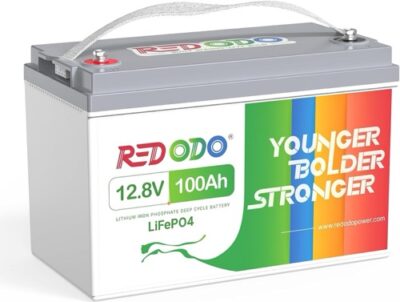
- Battery: 12.8V, 100Ah, 1,280Wh LiFePO4 in a Group 31-sized case.
- Current: 100A continuous charge/discharge; manual lists 400A for one second.
- Temperature: No low-temperature charge cutoff, heater, or Bluetooth on the Basic model.
- Bank setup: Up to 4S4P with matched compatible batteries.
- Best fit: Warm, conventional Group 31 systems valuing a longer exact-ASIN history.
PROS
- Exact ASIN includes several three-to-four-year owner reports.
- 1,280Wh and 100A continuous charge/discharge are documented.
- Conventional Group 31 size suits existing larger compartments.
- Five customer photos show varied real installations.
- Owner evidence includes favorable multi-year replacements.
CONS
- Older Zooms reports cannot prove today's internal hardware is unchanged.
- Manual and product page disagree on surge current and charge voltage.
- The case is less compact than Mini or Group 24 alternatives.
- No cold-charge cutoff, self-heating, or direct monitoring.
- Another owner strongly disputes the prorated warranty remedy.
History-First Pick
Based on documentation and exact-model owner evidence
How Many Redodo 12V 100Ah Batteries Do You Need?
Estimate how many Redodo 12V 100Ah batteries your daily energy target may require.
Solar Battery Bank Size Calculator
How much solar battery storage do I need?
This Redodo 12V 100Ah review has something the newer Mini batteries cannot offer: an exact Amazon ASIN with owner reports stretching from 2021 into 2026. That history includes the product’s earlier Zooms branding, several multi-year use accounts, five genuine customer-photo records, and sharply different warranty experiences.
It remains a basic battery. The Group 31-sized case provides 1,280Wh and 100A continuous current, but it has no Bluetooth, heater, or low-temperature charge cutoff. A direct manual/web disagreement over the one-second peak and charge voltage also prevents a simple “the specs say” conclusion.
An Older ASIN With a Newer Brand Name
Redodo publicly confirms that the company used the Zooms name previously. Two older retained reviews explicitly identify their batteries as Zooms while remaining tied to ASIN B094NN5KWY. That makes them legitimate historical owner evidence for the listing, provided the article labels the brand era instead of implying perfect hardware continuity.
The distinction matters because a retail identifier can outlive internal revisions. Cells, BMS components, case construction, firmware, suppliers, and warranty terms may change while Amazon preserves the same review pool. Older observations can show that real buyers used the product for years; they cannot prove that a battery purchased today is physically identical.
This review therefore uses the current exact manual and current product page for specifications, then uses Zooms-era reports only as dated ownership context. It never lets an old review override a current electrical limit.
That separation also affects warranty analysis. A favorable remedy under an earlier name and policy can show that one owner received help, but the current buyer is governed by today’s seller, documentation, serial record, and terms. Preserve purchase-date context whenever an old report is used to discuss support.
Revision warning: A long-running ASIN creates useful ownership history, but ASIN continuity is not proof of unchanged cells, BMS hardware, warranty terms, or documentation.
- Zooms era: Older exact-ASIN reports identify the previous brand and provide dated ownership context.
- Brand transition: Redodo publicly connects the present company with the former Zooms name.
- Current specification point: Today’s exact manual and product page govern the electrical boundaries used in this review.
- Current purchase: The delivered label, serial, manual revision, seller, and warranty—not ASIN age alone—define the buyer’s product.
What Fits in the Group 31 Case
At 13 × 6.77 × 8.43 inches, the Basic occupies a conventional Group 31-sized envelope. It can suit an existing large battery compartment, but it is longer than the Group 24 and Mini alternatives. Measure the hold-down, lid height, top-terminal clearance, conductor bends, and space for a fuse or disconnect before assuming a group label guarantees fit.
Weight is 22.05 pounds, light relative to many lead-acid Group 31 batteries and close to the smaller Power Queen case. The IP65 rating supports a dust-tight, water-jet-resistant enclosure under its test conditions; it does not make the battery submersible or remove the need to protect terminals.
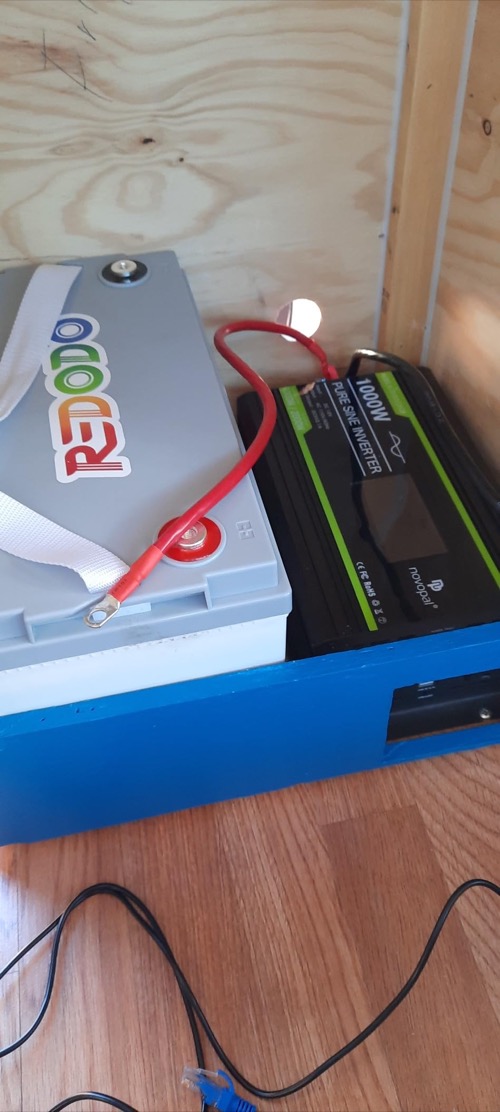
M8 hardware is listed, but an exact terminal-torque value was not found. Do not copy torque from another brand with similar bolts. Obtain the correct value for the current revision and ensure the bolt length properly accommodates the installed lug stack.
Measure the Group 31 installation, not just the case
- Confirm hold-down and lid clearance around the 13-inch-long enclosure.
- Protect the top terminals and leave a serviceable cable bend.
- Place the fuse or disconnect close enough to protect the conductor.
- Obtain the current revision’s terminal torque before tightening.
Four Years of Owner Reports—Not Four Years of Controlled Testing
Several retained owners describe approximately three to four years of use. Their applications and updates add more longitudinal context than a page filled only with unboxing reviews. They also show that aging evidence can contain both continued service and eventual failures.
No captured owner followed a controlled cycle-life protocol with documented current, temperature, depth of discharge, calibration, and end-of-life threshold. Redodo publishes 4,000 cycles at 100% DoD, 0.2C, and 77°F (25°C), but the owner timeline cannot be converted into validation of that number.
The evidence is strongest when kept concrete: a battery reportedly remained in service for a stated period, powered a stated application, or received a stated remedy. It becomes weak when rewritten as “proven four-year durability” for every current unit.
Longitudinal anecdotes can also be distorted by survivor bias. Owners whose systems continue to work may return with positive updates, while others disappear; failed units may prompt reviews more often than routine service. The sample helps identify questions to ask but cannot describe the probability of either outcome.
| Evidence layer | What it contributes | What it cannot establish |
|---|---|---|
| Current Redodo manual and page | Present-day electrical boundaries | That older units used identical internals |
| Zooms-era owner reports | Dated applications and multi-year narratives | A failure rate for today’s revision |
| Customer installation photos | Visible proportions, terminals, and real system context | Capacity, BMS thresholds, or wiring approval |
| Warranty accounts | Examples of both favorable and disputed remedies | The outcome of a future claim |
Cold Charging Is the Installer’s Responsibility
The manual starts charging at 32°F (0°C), but the Basic model does not stop cold charging itself. It also has no heater. This is the central system-design limitation and a repeated owner warning in the retained evidence.
An external charger or solar controller can help only when it has dependable battery-temperature input and settings appropriate to the installation. A sensor measuring warm controller air while the battery cells remain frozen is not adequate. Conditioned mounting or engineered heat may be necessary when charging must continue in winter.
The battery may discharge down to -4°F (-20°C), so a cold morning can produce the misleading situation where loads still work but accepting solar current would be outside the published charge range. Design the block before the first freeze instead of relying on someone to disconnect panels manually.
Sensor location is part of that design. A controller mounted in a warm electrical cabinet may not know that a battery against an exterior wall remains frozen. Temperature control should represent the cells closely enough to block every charging source, including an alternator or shore converter that may operate when solar is absent.
Who must stop charging
- Sense the battery: measure temperature where it represents the cells, not warm controller air.
- Block every source: include solar, alternator, converter, and inverter/charger paths.
- Define recovery: decide when charging may resume after the battery warms.
- Test the control: verify the protection before the first unattended freeze.
Solar Vans, Trailers, Mowers, and Trolling Motors
Owner reports cover a full-time solar van, teardrop-trailer solar, trolling motors, portable work equipment, RV replacement service, and a four-unit 48V mower conversion. That breadth supports the conclusion that the basic 100A architecture is useful across mobile and small off-grid storage.
The conventional Group 31 case and 100A ceiling can fit a modest house system after cold charging and inverter current are addressed.
Owner reports establish use, but motor voltage, continuous demand, startup, protection, and manufacturer approval remain model-specific.
Lower weight than lead acid helps handling; transport restraint and terminal protection still belong in the design.
The report illustrates series use, not a universal propulsion guide or approval of regenerative loads.
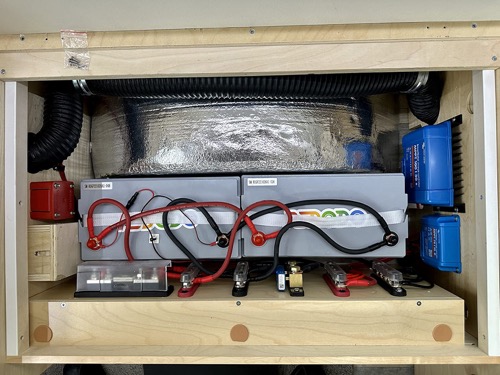
The battery’s 100A continuous discharge represents about 1,280W at 12.8V nominal before voltage sag and conversion loss. A 1,000W inverter may look compatible on paper, but actual DC draw, startup, cable length, conductor size, protection, and low-voltage behavior still decide the result.
Charging has a matching 100A maximum but a 20A recommended rate. An RV might combine solar, alternator, and shore-power charging, so current must be checked at the bank rather than one device at a time. A 14.4V ±0.2V target in the exact manual should be coordinated across all sources, with lead-acid equalization behavior disabled where the current battery instructions require it.
Redodo permits up to 4S4P using matched compatible units. The four-series mower report illustrates one use, not a universal conversion guide. Propulsion systems can have demanding startup and regenerative behavior, so exact equipment approval remains essential.
Two Very Different Warranty Outcomes
Two owners describe replacements following problems after multi-year use and speak positively about support. Another owner characterizes a prorated refund or purchase discount as a warranty scam. These accounts cannot be reconciled into one universal support verdict, but excluding either side would distort the evidence.
The practical lesson is to read the current warranty remedy rather than only the five-year term. Keep the invoice, serial details, charger settings, photos, voltage records, and load behavior. Determine whether a later-year failure leads to replacement, prorated credit, discount, return shipping, or another remedy under the current policy.
A product with a longer owner timeline naturally has more opportunity to accumulate both praise and complaints than a newly listed battery. Comparison scoring should reward the evidence depth without penalizing the battery as though each older complaint represented a known population rate.
Practical ownership also includes documentation before trouble appears. Photograph the installation, record serial and resting voltage, retain charger settings, and note current under a known load. If the BMS disconnects or capacity seems reduced, those records give support a clearer starting point than an unsupported statement that the battery is dead.
What favorable reports add
They show that some owners received replacements after multi-year problems and found the support process useful.
What the disputed report adds
It shows why a five-year headline must be read together with prorating, shipping, proof, and the actual remedy.
What should I save before a problem occurs?
Keep the invoice, exact seller, serial, label photos, manual revision, charger settings, terminal information, and commissioning voltage/current records.
What does a five-year headline leave unanswered?
It does not state whether a later claim receives a replacement, prorated credit, discount, repair, or return requirement. The current policy and failure date determine the practical remedy.
Can the captured reports predict my claim?
No. They show that both favorable and disputed outcomes occurred. They help identify documentation questions but cannot forecast a future support decision.
Manual Versus Web Page: The 400A Question
The exact manual lists a 400A peak for one second and 14.4V ±0.2V CC/CV charging. The current product page lists 300A for one second and 14.6V. Because the exact manual is the normalized primary source, its values appear in the shared specification table; the article retains the disagreement instead of silently choosing the larger current.
The continuous limit is consistently 100A, making it the safer design anchor. A startup that truly needs between 300A and 400A for a full second should not be approved from conflicting public text. Ask Redodo which specification belongs to the exact current revision and obtain a response that can be retained with the system documentation.
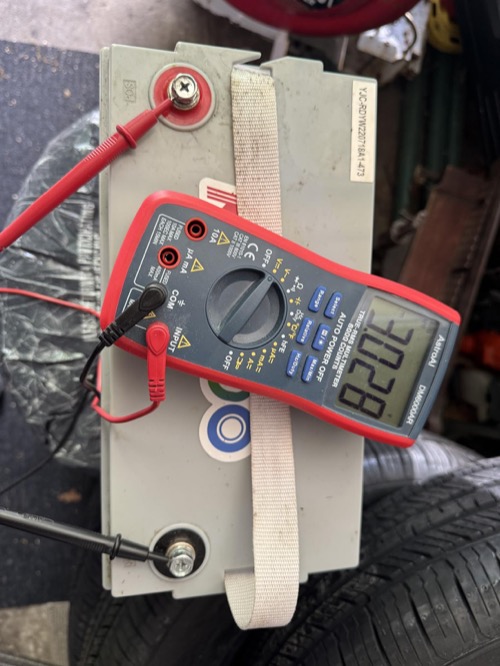
The same restraint applies to voltage photos. A resting reading can help identify arrival state or a protection condition, but it cannot reveal delivered amp-hours by itself. LiFePO4’s flat voltage curve makes state-of-charge estimates from one reading particularly imprecise.
A repeatable capacity check would require a known full-charge endpoint, calibrated current and energy measurement, a stated load rate, controlled temperature, and a documented cutoff. None of those conditions should be invented from a photograph of a multimeter.
Redodo 12V 100Ah Basic: Bottom Line
The Redodo 12V 100Ah review supports it as a conventional Group 31 option with a longer and more varied exact-ASIN history than the newer compact batteries. Its 1,280Wh, 100A continuous ratings, 4S4P allowance, and many real installation examples make it credible for supervised solar, RV, trailer, or trolling service.
Choose another battery when automatic cold-charge protection, integrated monitoring, or the smallest case is required. Before buying, verify the current revision’s peak and charge voltage, obtain terminal torque, plan external cold protection, and read the prorated remedy. The historical record is useful precisely because it is mixed; it is not controlled proof of four-year durability.
Pros & Cons Analysis
Based on documented specifications and owner feedback
Pros
- Long exact-ASIN window — retained reviews span December 2021 through July 2026.
- Full everyday ratings — 12.8V, 100Ah, 1,280Wh, and 100A continuous charge/discharge are published.
- Real installation evidence — customer photos and reports cover solar vans, trailers, mowing, trolling, and work equipment.
- Documented 4S4P — matched units can form up to a 20.48kWh nominal bank.
- Several extended-use accounts — owners report roughly three to four years of service.
Cons
- Brand-era uncertainty — Zooms-to-Redodo continuity does not prove identical cells, BMS hardware, or terms.
- Source disagreement — the manual lists 400A/1s and 14.4V ±0.2V; the web page lists 300A/1s and 14.6V.
- Basic BMS feature set — no cold-charge cutoff, self-heating, or Bluetooth belongs to this variant.
- No published terminal torque — M8 hardware is identified without an exact manufacturer torque value.
- Mixed warranty outcomes — replacement praise and a strongly negative prorated-remedy dispute both appear.
Redodo Basic Verdict: History Helps, Temperature Protection Doesn't
Verdict: The Redodo Basic is a credible full-size Group 31 battery with 1,280Wh, 100A continuous current, and unusually broad exact-ASIN ownership history.
Buy it if: You have a conventional larger compartment, can prevent cold charging externally, and prefer several years of real application reports over built-in app features.
Skip it if: You need automatic low-temperature cutoff, self-heating, Bluetooth, compact Mini dimensions, or a surge-dependent design that cannot tolerate the manual/web disagreement.
Verify before checkout: Confirm the current revision's 400A-versus-300A peak, charging voltage, terminal torque, and warranty remedy. Treat older Zooms reports as dated ownership context, not proof that today's internals are unchanged.
Frequently Asked Questions
Are Zooms and Redodo the same battery brand?
Redodo states that it was formerly named Zooms, and older reviews on this exact ASIN use the Zooms name. Those reports can inform ownership history, but they do not prove that current cells, BMS hardware, firmware, production, or warranty terms are identical to the earlier units.
Does the Redodo Basic stop charging below freezing?
No. The exact Basic model lists a 32°F (0°C) lower charge-temperature boundary but does not provide low-temperature charge cutoff. It also lacks self-heating. The installation must positively prevent cold charging through suitable equipment, sensor placement, or temperature-managed mounting.
Is the surge rating 300A or 400A?
The exact manual lists 400A for one second, while the current product page lists 300A for one second. The standardized table uses the manual value and the review preserves the conflict. Ask Redodo for exact-revision confirmation when a startup load depends on the difference.
What charge voltage should be used?
The exact manual specifies 14.4V ±0.2V CC/CV, while the current web page publishes 14.6V. This review uses the manual range. Configure the exact charger or solar controller according to the current battery manual and confirm settings with Redodo when source revisions differ.
Can four Redodo batteries be connected in series?
Yes. The exact documentation permits up to four in series and four in parallel, or 4S4P, using matched compatible batteries. That is an outer configuration limit, not a finished wiring design. State of charge, cable balance, protection, charging, and revision compatibility still matter.
Does the Redodo Basic have Bluetooth?
No. Built-in app monitoring is not present on the exact 12V 100Ah Basic variant. Use an appropriately installed external shunt when accurate bank-level state-of-charge tracking is required, and do not borrow smart features from another Redodo model.
What do the long-term reviews establish?
Several exact-ASIN owners report roughly three to four years of use across solar and mobile applications. That is more longitudinal evidence than the compact pilot models provide, but it is still self-reported and spans the Zooms-to-Redodo period. It does not validate 4,000 cycles or unchanged internals.
How does the Redodo warranty perform in practice?
The retained evidence is mixed. Two owners describe replacements after multi-year problems and praise support, while another strongly criticizes a prorated refund or discount remedy. These cases show possible outcomes, not a guaranteed success or dispute rate. Read the current exact terms before purchase.
Technical Specifications
| Brand | Redodo |
|---|---|
| Exact model | 12V 100Ah Basic |
| Battery chemistry | LiFePO4 (LFP), prismatic cells |
| Nominal voltage | 12.8V |
| Rated capacity | 100Ah |
| Rated energy | 1,280Wh |
| Recommended depth of discharge | 100% DoD is used in the documented cycle-life condition |
| Recommended charge current | 20A (0.2C) |
| Maximum continuous charge current | 100A |
| Maximum continuous discharge current | 100A |
| Peak discharge current | 400A for 1 second (exact manual) |
| Recommended charge voltage | 14.4V ± 0.2V (CC/CV; exact manual) |
| Low-temperature charge protection | No |
| Self-heating | No |
| Charge / discharge temperature | Charge: 32–122°F (0–50°C); discharge: -4–140°F (-20–60°C) |
| BMS protections | Overcharge, over-discharge, charge/discharge overcurrent, short circuit, and high-temperature protection |
| Monitoring | None on the Basic model |
| Series / parallel configuration | Up to 4 in series and 4 in parallel (4S4P) |
| Terminals | M8; torque not specified by manufacturer |
| Dimensions | 13 × 6.77 × 8.43 in (Group 31) |
| Weight | 22.05 lb (10.0 kg) |
| Ingress rating | IP65 |
| Cycle-life specification | 4,000 cycles at 100% DoD, 0.2C, and 77°F (25°C) |
| Warranty | 5 years |