Power Queen Group 24 Review: Good Fit, Hard Questions
At a Glance
KEY FEATURES
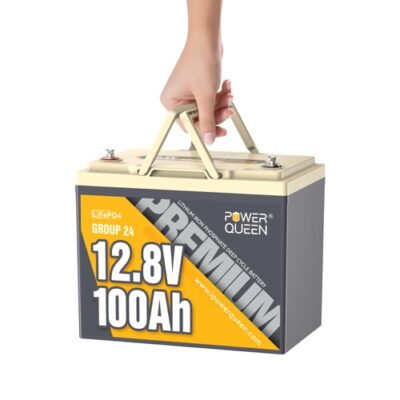
- Battery: 12.8V, 100Ah, 1,280Wh LiFePO4 in a true Group 24 case.
- Current: 100A continuous charge/discharge; manual lists 400A for 0.1 second.
- Temperature: Charge range starts at 32°F, but this Classic has no cold cutoff or heater.
- Bank setup: Up to 4S4P using compatible matched revisions.
- Best fit: Warm-location single-battery systems where Group 24 fit and price lead.
PROS
- 10.24 × 6.61-inch footprint fits standard Group 24 boxes.
- 100A continuous charge/discharge and 1,280Wh are documented.
- IP65 case weighs 22.16 pounds.
- Owner reports cover CPAP, Starlink, radio, trolling, and backup use.
- Five-year warranty and 4S4P expansion are published.
CONS
- No low-temperature charge cutoff, self-heating, or Bluetooth.
- Manual and product page publish different peak-current windows.
- Manufacturer does not publish terminal torque.
- Captured reviews include repeated early-failure and support complaints.
- One owner reports same-model units from different orders were considered incompatible.
Conditional Value
Based on documentation and exact-model owner evidence
How Many Power Queen Group 24 Batteries Do You Need?
Estimate how many Power Queen Group 24 batteries your daily energy target may require.
Solar Battery Bank Size Calculator
How much solar battery storage do I need?
This Power Queen Group 24 review is not a simple value verdict. The exact Classic battery combines a standard Group 24 footprint, 1,280Wh, and 100A continuous current with a price-oriented design, but the evidence raises three questions that matter more than the headline capacity: cold charging, peak-current documentation, and whether later same-name units can safely expand an older bank.
The owner record is also deliberately uncomfortable. Seventeen exact-variant reviews were retained across high and low ratings to expose failure modes, so their distribution must not be mistaken for Amazon’s overall star mix. The result is a conditional single-battery recommendation, not a blanket endorsement for an unattended or expandable system.
Good Numbers, Harder Ownership Questions
The basic electrical case is easy to understand. Power Queen publishes 12.8V, 100Ah, and 1,280Wh, with 100A maximum continuous charge and discharge. The battery weighs 22.16 pounds and carries an IP65 enclosure rating, giving it a substantial weight advantage over a comparable lead-acid house battery without promising submersion protection.
Those numbers describe a capable storage unit, not its whole ownership story. The Classic lacks Bluetooth, self-heating, and low-temperature charge cutoff. Its M8 hardware is identified, but an exact manufacturer torque value was not found. More importantly, the captured reviews include early failures, difficult contact or returns, and one bank-expansion compatibility warning.
The five-year warranty and cycle-life table should therefore be read as terms and manufacturer specifications, not a forecast. Power Queen publishes 4,000 cycles at 100% depth of discharge, 6,000 at 80%, and 15,000 at 60%. Without an exact controlled long-term test, those figures help compare stated conditions but cannot predict the calendar life of a hot boat locker or stored RV.
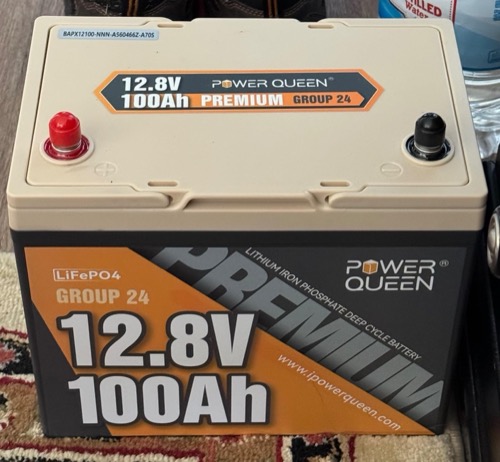
That does not make every unit unreliable. It means price and specifications cannot be evaluated without a plan for temperature control, revision matching, and warranty friction. The battery is easiest to defend where one unit performs a bounded job and the owner can observe its behavior.
The defensible job
One Group 24 battery in a warm, supervised system with external monitoring and a moderate load.
The poorly bounded job
An unattended freezing installation, surge-dependent inverter, or future bank that assumes later revisions will match.
Group 24 Fit and the 100A Operating Box
The case measures 10.24 × 6.61 × 8.27 inches, so it targets a standard Group 24 box instead of only using “Group 24” as a marketing comparison. Measure the actual hold-down, lid, terminal caps, and cable route; a standardized footprint does not guarantee that every top-terminal arrangement fits an existing enclosure.
Both continuous-current ceilings are 100A. Multiplying the 12.8V nominal rating by 100A gives about 1,280W of preliminary DC power. An inverter’s AC rating cannot be matched directly to that figure because efficiency, low-voltage current, surge, cable loss, fuse size, temperature, and BMS response all affect the design.
Power Queen recommends 20A charging even though the maximum continuous charge current is 100A. For a solar system, the everyday controller setting should follow the battery, array, conductor, and temperature plan rather than automatically using the largest permitted number. The published charge target is 14.4V ±0.2V CC/CV.
Group 24 does not finish the fit check
- Measure the hold-down, lid, terminal cover, and cable route in the actual box.
- Request the exact M8 torque because it was not present in the reviewed material.
- Check continuous inverter current at low battery voltage, not only nominal AC watts.
No Cold-Charge Cutoff Means the System Must Provide It
The documented charging range begins at 32°F (0°C), but this exact Classic battery does not block cold charging. That distinction is critical. A temperature range tells the designer what is allowed; a BMS cutoff determines whether the battery itself intervenes when the charger ignores the boundary.
There is no integrated heater either. A cold-weather installation needs a dependable external strategy, such as a charger or controller with a correctly placed battery-temperature sensor, conditioned mounting, or an engineered heating system. A generic “lithium” charging profile does not prove that the controller will stop current based on the battery’s cell temperature.
This limitation matters less in a genuinely warm, supervised location and much more in an unattended RV, shed, or cabin that receives morning solar after a freezing night. If the system cannot positively prevent cold charging, choose a battery with exact-model low-temperature cutoff or redesign the environment.
The published temperature range is not a protection feature: This battery says charging starts at 32°F (0°C), but the exact Classic does not document a BMS cutoff that enforces that boundary.
The Peak-Current Documents Do Not Tell One Story
The exact manual publishes a 400A peak lasting 0.1 second. The current product page instead lists 280A for five seconds. These are not two versions of the same measurement: magnitude and duration both change, and neither source explains a direct equivalence.
The standardized specification table therefore retains the exact-manual 400A/100ms value while the review preserves the web-page conflict. Do not join them into a fictional 400A-for-five-seconds rating, average the currents, or select whichever number makes an inverter recommendation easier.
For real load planning, the 100A continuous ceiling remains the stable anchor. Ask Power Queen for the current exact-revision surge curve if a motor, compressor, or inverter startup depends on more than 100A. A system should not rest on an unresolved marketing/manual difference at its most demanding moment.
| Uncertainty | Conflicting evidence | Safe editorial treatment |
|---|---|---|
| Startup magnitude | 400A in the manual; 280A on the product page | Do not select the larger number without revision confirmation |
| Startup duration | 0.1 second in the manual; 5 seconds on the page | Never combine them into a fictional 400A-for-5-seconds rating |
| Design anchor | 100A continuous is consistent | Keep normal loads inside the stable published ceiling |
Why “Same Model” May Not Mean Bank-Compatible
One owner bought a second unit described as the same model, rating, and size, then reports being told by Power Queen that the two purchases were unsafe to use together. The review says different orders could contain incompatible revisions. That is a single account, but the consequence is serious enough to change expansion advice.
The manual allows up to 4S4P for compatible matched batteries. That limit cannot answer whether a 2024 unit and a visually identical later unit share cells, BMS thresholds, internal resistance, or firmware. Before expanding, provide both serial and revision identifiers to the manufacturer and get written compatibility confirmation.
This makes the Classic easier to recommend as a new single-battery system or a bank purchased as a matched set than as an assumed drop-in addition years later. Buyers planning staged expansion should treat revision continuity as a purchasing criterion, not an afterthought.
Even a same-order bank should be commissioned as a set. Record each serial and resting voltage, bring units to the manufacturer-required state of charge, use balanced conductor paths, and confirm that current divides reasonably under a known load. Visual case matching alone cannot reveal a connection error or one BMS entering protection earlier than its neighbors.
- First purchase: Save the exact label, serial, revision, resting voltage, receipt, and current manual.
- Initial commissioning: Establish the charge profile, external-monitor baseline, and current under a known load.
- Later purchase: Compare both identity records and send them to Power Queen before connecting the units.
- Compatibility decision: Expand only with written exact-revision approval; otherwise keep the batteries in separate systems.
Failures, Replacements, and the Limits of a Balanced Sample
The retained reviews include successful trolling-motor, ham-radio, CPAP, Starlink, hurricane backup, and power-station-extension use. One owner describes two batteries in series feeding a Bluetti input, while another reports a BMS issue after roughly three years followed by a prompt warranty replacement. Those are useful examples of actual applications and one favorable remedy.
The negative side is material. Captured owners report batteries arriving deeply discharged, failures around eight to twelve months, inability to hold useful output, difficult contact, return restrictions, and unexpected shipping charges. One backup battery reportedly fell to a very low voltage without having completed a normal cycle.
These observations do not add up to a failure percentage. The research intentionally sampled different ratings, and some reviews do not provide diagnostic measurements. They do show the kinds of problems a buyer should plan to document: arrival voltage, charger behavior, load performance, serial/revision identity, storage routine, and every support interaction.
Owners report trolling, radio, CPAP, Starlink, backup, and series-connected use, which supports plausible scenarios rather than runtime guarantees.
One prompt replacement and several difficult remedy reports show why the procedure matters as much as the five-year headline.
The rating-balanced sample and incomplete diagnostics do not represent a population failure rate.
Arrival records, revision identity, charger behavior, and a moderate commissioning load directly improve diagnosis.
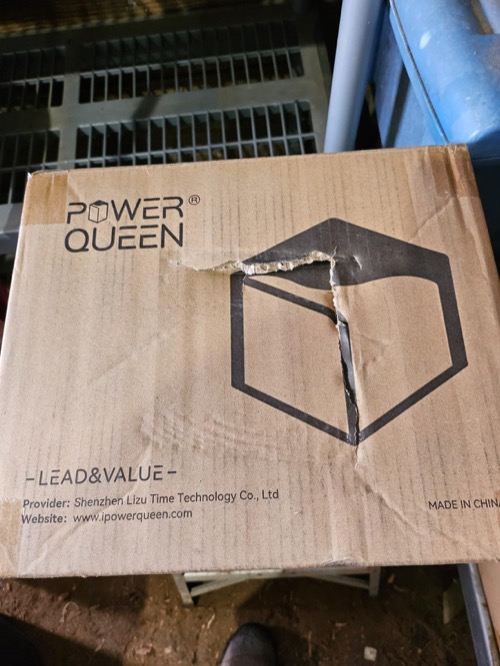
The damaged-box photo illustrates why arrival inspection matters without proving battery damage. The associated owner says the unit appeared intact, charged, and powered test loads. Photograph the package before opening, inspect the case and terminals, record resting voltage, and contact the seller before energizing anything questionable.
Arrival inspection while the return record is fresh
- Photograph every side of the shipping carton before opening it.
- Inspect the case, terminals, and hardware without energizing a questionable unit.
- Record the exact label, serial, resting voltage, and package condition.
- Charge with the documented profile and apply a known moderate commissioning load.
- Contact the seller immediately if voltage, protection behavior, or physical condition is abnormal.
Where a Single Battery Still Makes Sense
A warm-location, single-battery system avoids the two largest architectural concerns: it does not need to mix revisions, and it can use system-level temperature control without coordinating several cases. The Group 24 footprint suits replacement boxes, and 100A continuous discharge covers many moderate 12V house loads when the inverter and wiring are sized accordingly.
Commission the unit before relying on it. Record the case and serial information, inspect the terminals, confirm resting voltage, charge with the documented profile, and run a known moderate load while watching an external meter or shunt. That process is not a laboratory capacity test, but it can expose shipping damage, a protection state, or an obvious mismatch while the purchase record and packaging are still available.
The owner applications suggest plausible roles in trolling, field radio, medical-device backup, communications, and small outage systems. They do not establish runtime. Calculate energy demand from actual watt-hours, allowed depth of discharge, conversion efficiency, and reserve, then use the battery-bank calculator as a preliminary count rather than a guarantee.
Buyers who want direct telemetry can add an external shunt, but that changes installed cost. Those who expect freezing temperatures should price an exact temperature-control solution or choose a battery with integrated cutoff. Value is the finished safe system, not the battery’s checkout price alone.
Power Queen Group 24 Classic: Bottom Line
The Power Queen Group 24 review ends with a narrow recommendation. Its documented Group 24 fit, 1,280Wh, 100A continuous current, and moderate weight make sense for a price-conscious, single-battery system in a controlled temperature environment.
Skip it for blind expansion of an older bank, unattended freezing conditions, or a project whose startup load depends on the unresolved peak-current documents. Before buying, confirm the exact revision, current warranty and return path, terminal torque, and whether your controller can prevent cold charging. The specifications are competitive; the ownership evidence requires more caution than a simple value badge would suggest.
Pros & Cons Analysis
Based on documented specifications and owner feedback
Pros
- Actual Group 24 dimensions — the 10.24 × 6.61 × 8.27-inch case targets standard battery boxes.
- Complete everyday current ratings — 100A continuous charge and discharge are both documented.
- Useful energy-to-weight package — 1,280Wh is published at 22.16 pounds.
- Broad application reports — sampled use includes backup, CPAP, Starlink, ham radio, and trolling motors.
- 4S4P is documented — matched compatible units can form larger banks within the manual limit.
Cons
- Fit does not prove bank compatibility — one owner says a later same-model purchase could not safely join an older unit.
- Peak evidence conflicts — the manual lists 400A/0.1s while the current page lists 280A/5s.
- No automatic cold-charge block — the installation must prevent charging below 32°F.
- Meaningful negative evidence — several retained owners report dead units, failures around a year, or difficult support/returns.
- Torque remains unpublished — M8 × 16mm hardware is listed without a manufacturer torque value.
Power Queen Group 24 Verdict: Best Kept to a Bounded Job
Verdict: The Group 24 Classic offers credible 1,280Wh and 100A specifications in a standard-size, 22.16-pound case, but cold protection, source conflicts, and mixed ownership evidence narrow the recommendation.
Buy it if: You need one affordable Group 24 battery for a warm, observable RV, radio, trolling, or backup system and can provide external monitoring and temperature control where required.
Skip it if: You intend to add a later purchase to an older bank, charge unattended below freezing, or depend on a large startup surge. One owner reports same-name revision incompatibility, and the manual/web peak figures conflict.
Verify before checkout: Confirm exact revision compatibility, terminal torque, the current warranty/return process, and a positive cold-charge prevention method. Treat the rating-balanced owner sample as failure-mode evidence, not an Amazon-wide failure rate.
Frequently Asked Questions
Does the Power Queen Group 24 have low-temperature charge protection?
No. The exact 12V 100Ah Group 24 Classic specifies a 32°F (0°C) lower charge-temperature boundary but does not automatically block cold charging. The charger or installation must provide dependable temperature control. This model also has no integrated heater.
What is the correct peak-current rating?
The exact manual lists 400A for 100 milliseconds, while the current product page lists 280A for five seconds. This review retains the manual value in the standardized table and discloses the longer web-page pulse separately. Do not combine them or assume either is a continuous inverter rating.
Can two Power Queen batteries from different orders be connected?
Do not assume so from the shared retail name. One exact-variant owner reports that Power Queen considered units from separate orders incompatible despite matching visible model, rating, and dimensions. Before expanding a bank, provide serial/revision details to the manufacturer and obtain written confirmation.
How much continuous current can the battery supply?
The manual lists 100A maximum continuous discharge and 100A maximum continuous charge. At 12.8V nominal, that is roughly a 1,280W preliminary DC boundary before voltage sag, inverter loss, cabling, terminals, fuses, and ambient temperature are considered.
Does the Power Queen Group 24 have Bluetooth?
No. The reviewed Classic variant has no built-in monitoring. State-of-charge tracking therefore needs an appropriately installed external shunt or another compatible system monitor. Do not borrow Bluetooth features from a different Power Queen variant grouped near this listing.
Is this battery suitable for a multi-battery bank?
The manual allows up to four in series and four in parallel, but only with mutually compatible matched units. Equal visible specifications are not enough if internal revisions differ. Match model and revision, bring units to the required state of charge, and follow the exact protection and balanced-wiring guidance.
What do owners report about reliability?
The 17-review research set was deliberately balanced across ratings to expose both strengths and failure modes, so its star mix is not Amazon's overall distribution. It includes successful backup and trolling use as well as dead-on-arrival, roughly one-year failure, return, and support complaints. No population failure rate can be calculated.
What terminal torque should be used?
Power Queen identifies M8 × 16mm hardware but the reviewed exact documentation does not publish a torque value. Do not guess or copy a value from another battery. Ask Power Queen for the exact revision's specification and use hardware and lug thickness that permit proper thread engagement.
Technical Specifications
| Brand | Power Queen |
|---|---|
| Exact model | 12V 100Ah Group 24 Classic |
| Battery chemistry | LiFePO4 (LFP) |
| Nominal voltage | 12.8V |
| Rated capacity | 100Ah |
| Rated energy | 1,280Wh |
| Recommended depth of discharge | Up to 100% DoD; 80% DoD is paired with the 6,000-cycle figure |
| Recommended charge current | 20A (0.2C) |
| Maximum continuous charge current | 100A |
| Maximum continuous discharge current | 100A |
| Peak discharge current | 400A for 0.1 second (exact manual) |
| Recommended charge voltage | 14.4V ± 0.2V (CC/CV) |
| Low-temperature charge protection | No |
| Self-heating | No |
| Charge / discharge temperature | Charge: 32–122°F (0–50°C); discharge: -4–140°F (-20–60°C) |
| BMS protections | Overcharge, over-discharge, charge/discharge overcurrent, short circuit, and high-temperature protection |
| Monitoring | None on the Classic model |
| Series / parallel configuration | Up to 4 in series and 4 in parallel (4S4P) |
| Terminals | M8 × 16 mm; torque not specified by manufacturer |
| Dimensions | 10.24 × 6.61 × 8.27 in (Group 24) |
| Weight | 22.16 lb (10.05 kg) |
| Ingress rating | IP65 |
| Cycle-life specification | 4,000 cycles at 100% DoD; 6,000 at 80%; 15,000 at 60% |
| Warranty | 5 years |