Battle Born BB10012 Review: Premium Support or Overpriced?
At a Glance
KEY FEATURES
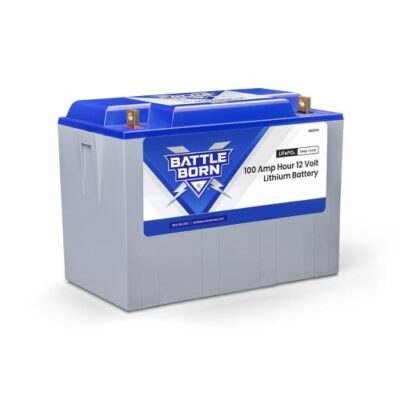
- Battery: 12V, 100Ah, calculated 1,200Wh LiFePO4 with cylindrical cells.
- Current: 100A continuous discharge; 200A surge for 30 seconds; 50A max charge.
- Temperature: Cold-charge cutoff is documented, but the manual conflicts on its threshold.
- Bank setup: Up to four in series; manufacturer states no parallel-unit limit.
- Best fit: Premium RV or off-grid builds prioritizing documentation, support, and certifications.
PROS
- 200A surge is sustained for a documented 30 seconds.
- Detailed manual covers hardware, BMS behavior, bank wiring, and installation.
- IP65 and multiple third-party compliance references are published.
- Ten-year limited warranty and documented support path.
- Exact owner reports include long-term solar use and a warranty replacement.
CONS
- Maximum continuous charge is only 50A.
- The same manual conflicts on the cold-charge threshold.
- The standard BB10012 has no heater or Bluetooth.
- Premium price and 31-pound weight weaken the value case.
- The manually retained exact-ASIN sample is too small for reliability conclusions.
Premium Choice
Based on documentation and exact-model owner evidence
How Many Battle Born BB10012 Batteries Do You Need?
Estimate how many Battle Born BB10012 batteries your daily energy target may require.
Solar Battery Bank Size Calculator
How much solar battery storage do I need?
This Battle Born BB10012 review asks whether better documentation, a 30-second surge specification, published certifications, and a ten-year limited warranty justify a heavier, usually more expensive 100Ah battery. It reviews the standard BB10012 under Amazon ASIN B06XX197GJ — not the heated BB10012H and not a newer smart model mentioned beside it in shared documents.
The premium case is real but narrow. Battle Born publishes installation hardware, torque, BMS behavior, series/parallel guidance, and compliance references in unusual detail. The standard model still lacks an app and heater, weighs 31 pounds, limits charging to 50A, and has internally inconsistent cold-charge wording that requires a conservative interpretation.
Why This Is the Expensive Battery in the Room
Nothing in the 12V and 100Ah headline explains a premium by itself. Battle Born publishes those ratings as 1,200Wh when multiplied, while most 12.8V pilot batteries work out to 1,280Wh. The reason to pay more would need to come from current behavior, documentation, certification, support, and the likelihood that those things reduce uncertainty in the intended installation.
The manual supplies uncommon detail: terminal dimensions, two bolt lengths, washers and locking nuts, 9–11 ft-lb torque, BMS reset behavior, charging profiles, bank diagrams, and explicit safety instructions. It also references IP65 and several UL, ETL, UN38.3, Class I Division 2, and CE compliance items. These are stronger buying evidence than an unqualified marketplace “premium cells” bullet.
Certification references should still be matched to the exact application. The manual notes, for example, that the Class I Division 2 listing does not apply to the heated version. A label can help an engineer document a system, but it does not replace enclosure, conductor, disconnect, fault, environmental, and local-code decisions for the installed battery.
Documentation does not eliminate tradeoffs. The battery weighs 31 pounds, roughly ten to twelve pounds more than the compact choices in this pilot. Its 50A maximum charge limit may constrain a high-solar-input design, and the standard model needs a separate monitor if state of charge matters.
The published 3,000–5,000 deep-discharge-cycle range also lacks a detailed condition in the sources reviewed for the shared table. It should not be converted into years by assuming one full cycle per day or compared directly with a rival tested at a stated depth, rate, temperature, and end-of-life threshold. Warranty length and cycle specification answer different questions.
What the premium actually buys
- An exact terminal-hardware list and a published 9–11 ft-lb torque range.
- A timed 200A surge window that lasts 30 seconds, not just a split-second peak.
- Detailed reset, charge-profile, and bank-configuration instructions.
- A 10-year limited warranty whose remedy still depends on the current terms.
Hardware, torque, reset, charging, and bank instructions are unusually specific.
A useful duration for loads that do not settle instantly.
Plan a separate shunt when state-of-charge visibility matters.
The heated sibling’s features do not transfer to this ASIN.
BB10012 Means Standard: No Heat, No App
The BB10012 and heated BB10012H share a manual. Product-family documents also mention optional smart communication. That makes identity discipline essential: the exact standard battery reviewed here does not receive the heat-enable terminal, 28W heater behavior, or wireless telemetry described for other versions.
This is not automatically a poor feature set. A system-level shunt can monitor an entire parallel bank more coherently than five separate app screens, and a battery installed in conditioned space may not need internal heat. The problem arises only when a buyer pays for the standard ASIN while assuming family-level features are inside it.
The case is 12.76 × 6.86 × 8.95 inches, described for Group 27/31 replacement, with brass flag terminals rather than simple threaded inserts on the case top. Measure the actual tray and cable path and verify that the supplied bolt option fully engages the locking nut through the complete lug stack.
Can I use the heated model’s temperature behavior?
No. The BB10012H heater, heat-enable terminal, and related current behavior belong to the heated version. This review and its recommendation cover the standard BB10012.
Does product-family smart communication mean this battery has an app?
No direct app or wireless telemetry is documented for this exact standard battery. Add a suitable system monitor instead of assuming a shared manual places communications hardware inside every model.
Which physical detail deserves attention?
The brass flag terminals use a supplied bolt, washers, and locking nut. Check bolt choice, full thread engagement, lug stack, insulation, and the published 9–11 ft-lb torque.
A 30-Second Surge Is the Real Differentiator
The maximum continuous discharge current is 100A, matching the main operating ceiling across much of the pilot. Battle Born then documents 200A for 30 seconds and larger loads for no more than half a second. The duration makes the 200A value more useful than a larger but nearly instantaneous peak when evaluating a compressor or motor startup.
That does not mean every 2.4kW nominal-DC startup is acceptable. The inverter’s low-voltage input current and surge duration must align with the BMS, while the conductors, fuse, disconnect, busbars, and terminals handle the event. Battle Born also says a current surge limiter is required with inverters rated at 3,500W or higher.
Charging is less aggressive. The manual lists 50A as recommended and maximum continuous current, with 14.2–14.6V bulk/absorption and 13.4–13.8V float. Multiple charging sources need a combined limit; a 50A solar controller plus another active charger can exceed the battery ceiling even when each device looks acceptable alone.
Absorption guidance is also bank-dependent: the manual gives 30 minutes per 100Ah. Equalization and temperature compensation should be disabled under its profile. Those settings need to be checked in every active charging source, because correcting a solar controller does not reprogram an older converter or alternator charger connected to the same bank.
| Current event | Published boundary | Design question |
|---|---|---|
| Normal discharge | 100A continuous | Does the inverter remain inside this limit at low battery voltage? |
| Extended startup | 200A for 30 seconds | Does the motor settle before the timed window closes? |
| Large inverter | Surge limiter required at 3,500W or higher | Is the required limiter included in the complete design? |
| Combined charging | 50A maximum continuous | Can solar, alternator, and shore charging overlap? |
Cold-Charge Documentation Needs a Conservative Reading
The exact current manual gives three related statements that do not align cleanly. Its technical table lists a 25°F (-3.9°C) lower charging temperature. The charging guidance begins at 32°F (0°C), and the BMS section says charging under 32°F is blocked even though its subheading contains 25°F.
This review therefore uses 32°F as the operating boundary. It is the conservative instruction and the explicit BMS behavior stated in the prose. The standardized table preserves the conflict so a reader can see why the recommendation does not promise charging between 25°F and 32°F.
Conservative cold-weather rule: Use 32°F (0°C) as the charge boundary until Battle Born confirms the conflicting wording for this exact BB10012 revision.
The standard BB10012 cannot warm itself. Install it in a temperature-managed space or provide a proper external strategy if solar charging must resume during freezing weather. Do not disable temperature protection or assume that a lithium charger profile can change cell temperature.
What Long-Term Owners Actually Add
One verified van owner describes the BB10012 in a 300W solar system with inverter loads. The same review later reports a BMS issue associated, according to the owner, with a production batch and says Battle Born replaced the battery under warranty. That is a valuable longitudinal service anecdote, not proof of a universal defect or guaranteed remedy.
Another verified RV owner discusses secure packaging, included bolts, terminal fit, solar use, and lower handling weight than the prior battery. “Lower” is contextual: 31 pounds can be much lighter than lead acid while still being the heaviest battery in this five-product LiFePO4 pilot.
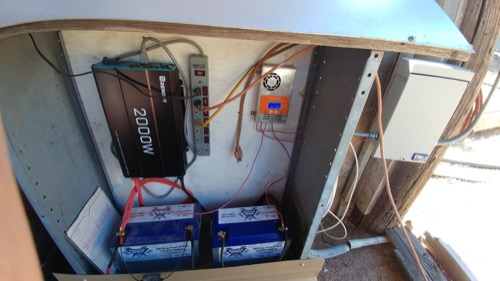
A third off-grid owner describes parallel-bank use and a practical wake-up issue after BMS low-voltage cutoff. The manual confirms that some chargers need to see more than 10V and may not recognize a disconnected battery without an appropriate recovery procedure. Follow the current manual promptly rather than improvising around a protected battery.
- Installed use: The reports place the battery in van, RV, solar, inverter, and parallel-bank contexts.
- Protection event: One owner describes a low-voltage wake-up problem that aligns with the manual’s charger-recognition warning.
- Hardware problem: Another owner reports a later BMS issue associated, in that account, with a production batch.
- Remedy: The same owner says the battery was replaced, demonstrating one useful warranty outcome rather than a guaranteed result.
The Warranty Story Is Mixed, Not Magical
The ten-year limited warranty is longer than the five-year terms in the other pilot products. The captured replacement report shows one case where the remedy mattered. Amazon’s topic snapshot also leans positive on quality and weight while showing more divided sentiment on value and non-uniform sentiment on reliability, charging capacity, and battery life.
Neither source makes coverage unconditional. The current policy governs qualifying defects, documentation, exclusions, remedies, and claim procedure. Return shipping, inspection, product use, and the difference between a return window and a warranty claim can affect the practical outcome.
Evidence coverage is the larger limitation here. The final Apify replacement run was blocked by the account’s monthly hard limit, so this pack retains three detailed exact-ASIN reports, Amazon’s dated topics, and two genuine installation photos. It is enough for specific observations, not failure percentages or a declaration that support always succeeds.
The exact manual and data sheet support detailed electrical and installation boundaries.
One captured replacement account proves a possible remedy, not universal claim performance.
Three detailed exact-ASIN reports cannot support failure-rate or long-term reliability claims.
Dated topic sentiment helps locate questions but cannot replace individual review evidence.
Where the Premium Can Still Make Sense
An installer planning a 12V, 24V, or 48V bank can benefit from the exact series instructions, terminal torque, flag hardware, documented surge duration, and protection detail. Battle Born allows up to four batteries in series and states no parallel-unit limit, which provides flexibility without erasing the engineering limits imposed by fault current and a growing bank.
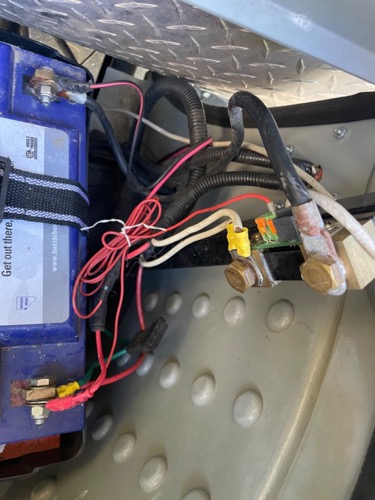
The premium is easier to justify where downtime, support access, or certification documentation has real cost. It is harder to justify for a small price-first system that can use a lighter battery with direct monitoring and equally adequate continuous current. Compare the finished system, including any shunt, heating, charger, and installation hardware — not only the battery label.
Parallel flexibility deserves the same total-system view. “No limit” in the manual is a product statement, not permission to ignore rising available fault current or unbalanced conductors. As a bank grows, busbars, branch fuses, disconnect ratings, charger capacity, physical access, and a method for detecting one disconnected battery become increasingly important.
Before treating “no parallel limit” as a design
- Calculate fault current: confirm branch fuses, busbars, and disconnects can interrupt the enlarged bank.
- Balance the paths: use a documented layout so one battery does not carry disproportionate current.
- Plan monitoring: add a bank shunt and a way to identify one battery entering protection.
- Save the evidence: record serials, torque, charger settings, and commissioning values.
Battle Born BB10012: Bottom Line
The Battle Born BB10012 review supports it as the premium documentation-and-surge choice, not the automatic best value. Its 200A-for-30-second window, flag-terminal detail, certifications, and ten-year limited warranty create a credible reason to buy for demanding, professionally planned RV or off-grid systems.
Choose something else if low weight, built-in Bluetooth, integrated heat, or the highest charge current matters more. Before checkout, confirm the standard BB10012 identity, design around the 50A charge ceiling, treat 32°F as the cold-charge boundary, and read the current warranty. The evidence is useful but too limited to turn premium positioning into a quantified reliability advantage.
Pros & Cons Analysis
Based on documented specifications and owner feedback
Pros
- Long surge window — 200A for 30 seconds is unusually useful for evaluating startup loads.
- Installation detail — flag terminals, supplied hardware, 9–11 ft-lb torque, bank connections, and BMS reset behavior are documented.
- Published protection and certifications — IP65 plus multiple UL/ETL/UN/CE references improve evidence quality.
- Ten-year limited warranty — the term is longer than the other pilot batteries.
- Useful historical anecdotes — captured owners describe van/RV solar, off-grid banks, and one completed replacement.
Cons
- Lower charge ceiling — 50A maximum continuous charge is half the 100A ceiling of several pilot batteries.
- Heavy enclosure — 31 pounds is materially heavier than the compact and Group 24 alternatives.
- Standard model is feature-light — no self-heating or wireless monitoring belongs to this ASIN.
- Not unconditional coverage — current warranty, return, proof, shipping, and remedy terms still govern each claim.
- Thin fallback sample — Apify's hard limit left only three detailed exact-ASIN reports plus Amazon topic counts.
Battle Born BB10012 Verdict: Paying for Certainty, Not Features
Verdict: The standard BB10012 is the pilot's premium documentation, certification, and long-surge choice. Its clearest advantage is 200A for 30 seconds, supported by unusually detailed installation guidance.
Buy it if: Support access, published compliance references, flag-terminal hardware, a ten-year limited warranty, and a predictable 12V–48V system matter more than weight or app features.
Skip it if: You need built-in Bluetooth, integrated heat, 100A charging, or the lowest cost per watt-hour. This exact model is non-smart, non-heated, limited to 50A charge, and weighs 31 pounds.
Verify before checkout: Confirm the BB10012 identity, use 32°F as the conservative cold-charge boundary, check the current warranty, and design the whole surge path. Three detailed owner reports cannot quantify reliability or support success.
Frequently Asked Questions
Is the standard Battle Born BB10012 heated?
No. The Amazon ASIN reviewed here is the standard non-heated, non-smart BB10012. The shared manual also covers the heated BB10012H and mentions smart variants, but those features must not be assigned to this battery. Choose the exact heated model if integrated warming is required.
What cold-charge temperature should I use?
Use 32°F (0°C) as the conservative boundary. The current manual's technical table starts charging at 25°F (-3.9°C), while its charging guidance starts at 32°F and its BMS section says charging below 32°F is blocked. Do not promise below-freezing charging from this internally conflicting text.
How much surge current can the BB10012 deliver?
Battle Born documents 200A for 30 seconds and larger loads for no more than 0.5 second. The 30-second duration is useful for startup analysis, but the continuous discharge limit remains 100A. Verify the complete inverter, conductor, fuse, disconnect, terminal, and temperature design.
What is the maximum charge current?
The BB10012 manual lists 50A as both recommended and maximum continuous charge current. That is lower than the 100A maximum published for several other 100Ah batteries. Configure every charger and solar controller so their combined current stays inside this battery and bank limit.
Does the BB10012 include Bluetooth monitoring?
No. The standard BB10012 has no integrated wireless monitoring. A separate compatible shunt or system monitor is needed for state-of-charge tracking. Do not transfer smart-battery communication features from a different Battle Born product into this model's specifications.
How many BB10012 batteries can be connected?
Battle Born allows up to four BB10012 batteries in series for a 48V nominal bank and states no numerical limit for parallel connection. That statement is not a complete unlimited-bank design. Available fault current, balanced cabling, protection, charger capacity, matched state of charge, and applicable requirements still constrain the system.
Is the 10-year warranty unconditional?
No. It is a ten-year limited warranty for qualifying defects and remains subject to current terms, proof, exclusions, remedy, and claim procedures. Read the active policy rather than treating the term length as a guaranteed full refund or replacement under every failure scenario.
How strong is the Amazon owner evidence used here?
Three detailed exact-ASIN reports and two installation photos were retained manually, along with Amazon's dated topic counts. The final Apify run could not start because the account reached its monthly hard limit. This evidence supports specific anecdotes, not a population-wide failure, value, or warranty-success rate.
Technical Specifications
| Brand | Battle Born Batteries |
|---|---|
| Exact model | BB10012 (standard, non-heated, non-smart) |
| Battery chemistry | LiFePO4 (LFP), cylindrical cells |
| Nominal voltage | 12V |
| Rated capacity | 100Ah |
| Rated energy | 1,200Wh (calculated from the published 12V × 100Ah ratings) |
| Recommended depth of discharge | Up to 100% usable depth of discharge |
| Recommended charge current | 50A (0.5C) |
| Maximum continuous charge current | 50A |
| Maximum continuous discharge current | 100A |
| Peak discharge current | 200A for 30 seconds; larger loads for no more than 0.5 second |
| Recommended charge voltage | 14.2–14.6V bulk/absorption; 13.4–13.8V float |
| Low-temperature charge protection | Yes; BMS section identifies a 25°F (-3.9°C) cutoff while charging guidance starts at 32°F (0°C) |
| Self-heating | No on BB10012; heating is limited to the separate BB10012H model |
| Charge / discharge temperature | Specification table: charge 25–135°F (-3.9–57.2°C); discharge -4–135°F (-20–57.2°C) |
| BMS protections | High/low voltage, charge/discharge overcurrent, short circuit, high/low temperature, and top-of-charge cell balancing |
| Monitoring | None on the standard BB10012; wireless monitoring is limited to separate smart models |
| Series / parallel configuration | Up to 4 in series (48V); manufacturer states no limit in parallel |
| Terminals | 0.25-inch brass flag terminals with 3/8-inch holes; 3/8- or 5/16-inch hardware; 9–11 ft-lb torque |
| Dimensions | 12.76 × 6.86 × 8.95 in (Group 27 / Group 31 replacement) |
| Weight | 31 lb (14.06 kg) |
| Ingress rating | IP65; sealed and water-resistant, not submersible |
| Cycle-life specification | 3,000–5,000 deep-discharge cycles; detailed test condition not published |
| Warranty | 10-year limited warranty |