
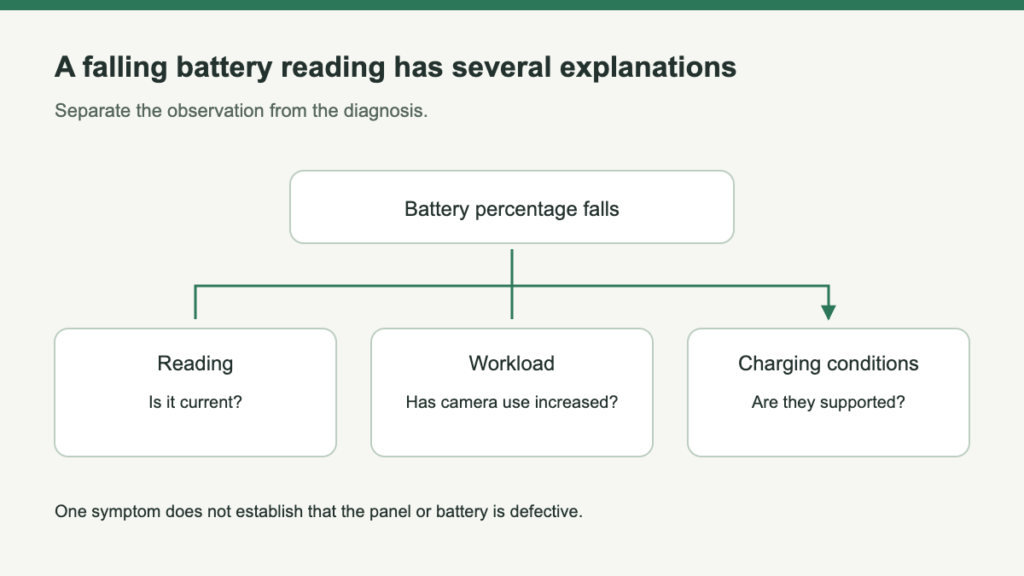
A falling battery percentage does not, by itself, prove the solar panel has failed. The camera might be receiving some energy while using more than it receives. It might also be outside its charging conditions, poorly connected or showing an old reading. Start by describing the symptom precisely before buying another panel.
Which problem are you actually observing?
| Observation | First question |
|---|---|
| No charging indication | Is the reading current, and are conditions suitable? |
| Charging indication but falling percentage | Has the camera's activity increased or sunlight decreased? |
| Device offline | Can you establish its present power state rather than relying on an old app reading? |
Record when the change began. A moved camera, new recording mode, seasonal shade or cable disturbance is useful context. None proves the cause, but a short timeline is more helpful than repeatedly changing unrelated settings.
Inspect only what you can reach safely
Follow exact cleaning, connector and weather-seal instructions. TP-Link’s charging guidance compares solar with supported adapter charging, not an arbitrary higher-powered supply.
Charging behavior can differ near the top of the range. Check the documented procedure; deliberately forcing discharge is not a diagnostic substitute.
Separate the camera path from the solar path
Only perform an adapter comparison if the manufacturer permits it for this camera.
This narrows attention toward solar conditions or the solar arrangement. It does not prove the panel is broken.
This still does not identify an internal component. Preserve the observations for the manufacturer’s next check.
Give support observations, not a guessed failed part
A supported adapter-charge comparison can narrow the investigation, but it does not diagnose a broken panel or battery by itself. Record what happened with the exact equipment and conditions.
- Identify the setup: camera version, approved panel or charger and accessible connections.
- Describe the trend: approximate battery readings, sunlight, temperature conditions and comparable camera activity.
- List completed checks: distinguish a permitted charging test from resets or parts you have not tried.
Do not bypass temperature protection, improvise leads or open a sealed battery. Preserve needed recordings and follow the exact manufacturer’s support sequence.
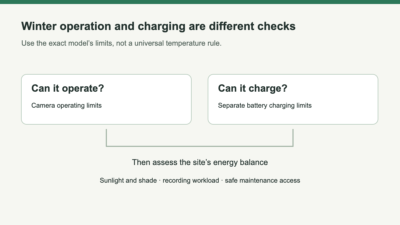
If the shortfall follows shade or a seasonal change, revisit panel placement and winter charging constraints before assuming that replacing the camera solves it.
Leave a Reply