
Solar Power Picks logo with sun, solar panel, and green energy icon

  • Home
  • Reviews
  • Best
    • Best portable power stations
    • Best Solar Panels
    • Best Solar Generators
    • Best Solar Charge Controllers
    • Best Solar Batteries
  • Guides
    • Portable Power Stations Guides
    • Solar Panels Guides
    • Solar Generators Guides
    • Solar Charge Controllers Guides
    • Solar Batteries Guides
  • Comparisons
    • Portable Power Stations Comparisons
    • Solar Panels Comparisons
    • Solar Generators Comparisons
    • Solar Charge Controllers Comparisons
    • Solar Batteries Comparisons
  • Calculator

Anker SOLIX C1000 Gen2 vs Jackery 1000 v2 at a Glance

COMPARED PRODUCTS

Anker SOLIX C1000 Gen2 Review: A 1024Wh Kit That Wall-Charges in 49 Minutes and Ships With Its Own Panel

The Anker Pick

Anker SOLIX C1000 Gen2 Review: A 1024Wh Kit That Wall-Charges in 49 Minutes and Ships With Its Own Panel

Check price at Amazon Jump to details
Jackery Solar Generator 1000 v2 Review: A 1070Wh Kit That Charges in an Hour and Comes With Its Own Panel

The Jackery Pick

Jackery Solar Generator 1000 v2 Review: A 1070Wh Kit That Charges in an Hour and Comes With Its Own Panel

Check price at Amazon Jump to details

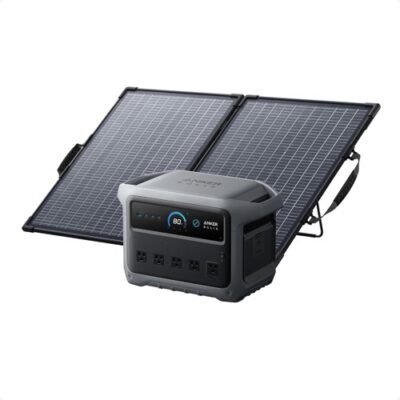
The Anker SOLIX C1000 Gen 2 and Jackery Explorer 1000 v2 are close in battery size but not in bundle behavior. Anker puts more of the budget into the station: 2,000W output, five AC outlets, a sub-10ms UPS specification, and a compact 100W panel. Jackery pairs a 1,500W station with a 200W panel, giving up some appliance headroom to recover energy faster from the equipment already in the box.

Fast answerAnker for heavier simultaneous loads and a lighter complete kit; Jackery for a more balanced station-to-panel pairing.

This is not a generic brand contest. It compares the exact US bundles attached to the product cards above: Anker C1000 Gen 2 with the PS100 Compact and Jackery Explorer 1000 v2 with one SolarSaga 200W bifacial panel. The template supplies the common 28-row specification table at the end, so the job here is to turn those figures into an ownership decision.

Read the Two Boxes Before the Two Logos

Anker’s box

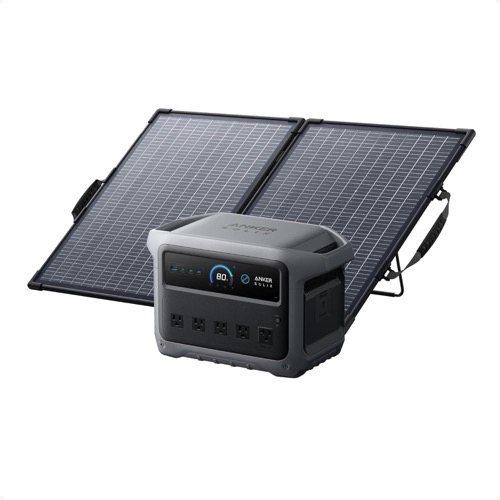
1,024Wh LFP station, 2,000W continuous output, five AC receptacles, three USB-C ports, a car socket, app control, and one compact 100W bifacial panel.

Jackery’s box

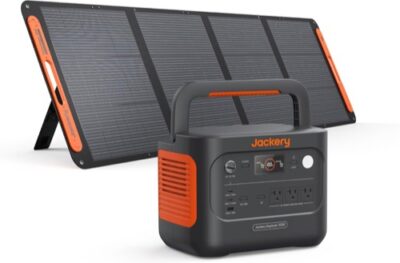
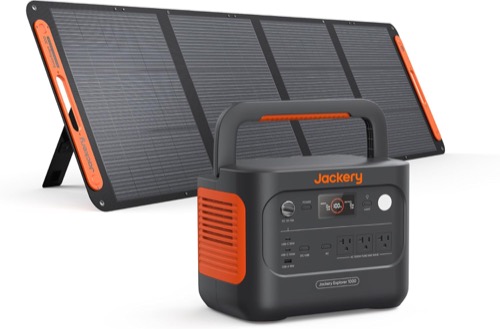
1,070Wh LFP station, 1,500W continuous output, three AC receptacles, two USB-C ports, a car socket, app control, and one 200W bifacial panel.

The 46Wh capacity difference is too small to lead the decision. After conversion losses and a reserve, both belong to the same practical energy class. The meaningful asymmetry is that Anker has the stronger inverter while Jackery supplies twice the panel nameplate. If you compare station pages without checking the bundle, you miss the trade that shapes every off-grid day.

The Appliance Gate Favors Anker

Anker publishes 2,000W continuous output and 3,000W surge. Jackery publishes 1,500W continuous and the same 3,000W surge. That extra 500W of continuous ceiling matters when several ordinary loads overlap or when a single cooking or workshop load sits between the two ratings. It does not turn Anker into a universal appliance pass. Compressor startup, electronically controlled equipment, grounding behavior, and manufacturer restrictions still decide whether a particular device belongs on either station.

Below 1,500W documented running loadBoth remain candidates; compare startup demand and the total simultaneous load.
1,500–2,000W running loadAnker remains within its published continuous rating; Jackery does not.
Above 2,000W or requires 240VNeither exact kit is the right platform.

Outlet count is also operational, not cosmetic. Five Anker AC receptacles reduce the temptation to add a power strip, while Jackery offers three. More receptacles do not raise the total 2,000W or 1,500W ceiling; they only change how conveniently the available power can be divided.

The Included-Panel Ledger Favors Jackery

The bundle comparison reverses outdoors. Jackery’s 200W panel is paired with an estimated full solar recharge of roughly 7.5 hours under the manufacturer’s ideal conditions. Anker’s 100W panel implies about 12–14 peak-sun hours from empty. A normal day rarely delivers its nameplate wattage continuously, so the Anker bundle is better understood as a 100W maintenance and partial-recovery kit unless you add compatible array capacity.

Ownership question Anker C1000 Gen 2 kit Jackery 1000 v2 kit
Panel supplied 100W PS100 Compact 200W SolarSaga
Station solar ceiling 600W 400W across two inputs
Approximate full recovery with included panel 12–14 peak-sun hours, calculated About 7.5 hours in stated ideal conditions
Growth path More unused solar-input headroom Better initial bundle balance

Anker can accept the larger future array, but that is future hardware, not a benefit already in the carton. Credit the 600W ceiling only if you have priced a compatible array, checked cold-corrected voltage and current, and accepted the extra storage and setup. Otherwise Jackery wins the first-day recovery test.

Carry the Whole Kit, Not Just the Station

The Jackery station is slightly lighter: 23.8 lb versus Anker’s 24.9 lb. Add the supplied panel, however, and the result flips. Jackery’s panel weighs 14.33 lb; Anker’s compact panel is 7.7 lb. The published station-plus-panel totals are therefore about 38.1 lb for Jackery and 32.6 lb for Anker before cables and bags.

  1. Count carry events. A station that moves twice a year can prioritize capacity; a kit moved twice a day should prioritize separate-piece weight and folded dimensions.
  2. Measure the panel storage space. The lighter Anker panel is also much smaller when folded, while the Jackery brings more solar area.
  3. Pack the cable path. Do not assume a connector name means every panel, extension, or polarity is interchangeable.

Wall Charging, UPS Behavior, and Controls

Both stations are fast from AC. Anker specifies 0–100% in 49 minutes with HyperFlash enabled in its app. Jackery quotes about one hour in emergency mode and about 1.58 hours in standard mode. The fastest setting can bring extra fan noise, heat, or battery-management conditions, so compare the mode you will actually use rather than only the shortest advertised number.

Both also publish automatic backup behavior. Anker states under 10ms; Jackery states under 20ms. Those figures are a screening gate, not proof for a computer, network appliance, medical device, or other interruption-sensitive load. Check the load manufacturer’s power requirements and run a controlled outage, restoration, overload, and low-battery test. If interruption has serious consequences, use a system designed and commissioned for that consequence.

No expansion escape hatch: neither exact station has a published expansion-battery port. If one kilowatt-hour is already marginal on paper, a different platform is safer than planning to fix capacity later.

What Owner Evidence Adds—and Cannot Prove

The retained Amazon samples for both bundles contain useful descriptions of panel setup, charging, real loads, mobility, noise, apps, and support. They also contain failures and difficult support experiences. These are qualitative records, not controlled tests or population failure rates. Their best use is to reveal what to inspect during the return window: correct bundle contents, solar input under several conditions, fan behavior, app pairing, every outlet, and support response if something arrives wrong.

  • Photograph model labels and serial numbers when the boxes arrive.
  • Confirm the exact panel, solar lead, vehicle lead, and AC cable in the bundle.
  • Run the intended highest continuous load and the most difficult startup load separately.
  • Record panel watts in clear sun at more than one angle; do not treat one reading as a rating.
  • Test app, UPS, AC restoration, and low-battery behavior while returns remain easy.

Choose by the Day You Need to Operate

Choose Anker for a busy powered workspace

The 2,000W ceiling, five AC outlets, multiple USB-C ports, and lighter complete carry suit overlapping devices and short setup cycles.

Choose Jackery for a solar-recovery weekend

The included 200W panel creates a more realistic day-to-day refill plan without immediately buying more solar hardware.

Choose neither for planned growth

If you expect added batteries, native 240V, or multi-day household coverage, start with a documented expandable system rather than forcing either 1kWh box upward.

For the larger Anker platform, read our F3800 + PS400 exact-kit review; it separates the 6,000W station capability from the one-panel bundle’s much smaller day-one solar recovery.

Price the Five-Year Ownership Ledger

The checkout total is only the first line. Add the hardware each operating plan actually needs. Anker’s 100W panel may prompt an immediate second-array purchase, while Jackery’s larger panel may require more carrying or storage equipment. Include compatible extension cables, protective cases, vehicle charging hardware, alternate panels, registration tasks, and the cost of a platform change if one kilowatt-hour later proves inadequate.

Ledger line Anker question Jackery question
Day-one solar Is 100W enough, or is the real purchase a larger compatible array? Can the 200W panel be carried and deployed where you need it?
Warranty Station is five years; confirm the exact panel term at purchase Station and panel reach five years after registration under stated terms
Capacity growth No published battery expansion No published battery expansion
Cable inventory Verify both supplied solar adapter paths and extensions Verify DC8020 leads and any second-input plan
Exit cost If 1kWh is too small, replacement—not an add-on battery—is the likely path

Warranty length should not be used as a reliability score. Read coverage, exclusions, shipping obligations, registration, and whether the retailer or manufacturer handles the claim. Owner records include both smooth and difficult outcomes; neither establishes a future claim result. Test early, preserve the invoice and serial number, and make any bundle-identity dispute while the return channel is still simple.

Also value unused capability at zero. Anker’s 600W solar ceiling has no economic benefit if the system will always use the supplied 100W panel. Jackery’s extra panel power has little value if every trip begins and ends near an AC outlet. A good ledger credits only capabilities connected to a documented use.

The Constraint Is the Verdict

Buy the Anker when the appliance and outlet gate is hardest to clear and you are willing to expand the solar array later. Buy the Jackery when the included panel has to restore a meaningful share of the battery during the trip and 1,500W covers the load list. If both pass, compare the exact delivered price, warranty registration steps, panel storage, and cable bill. The winner is the kit with the smaller unfunded gap—not the logo with the larger headline.
The Anker Pick

Anker SOLIX C1000 Gen2 Review: A 1024Wh Kit That Wall-Charges in 49 Minutes and Ships With Its Own Panel

Anker SOLIX C1000 Gen2 Review: A 1024Wh Kit That Wall-Charges in 49 Minutes and Ships With Its Own Panel

Get it now:

Check latest price

What to know

  • 49-minute full wall charge at 1,600W, but only with HyperFlash enabled in the Anker app.
  • The kit's 100W bifacial panel is light (about 7 lb with the stand) but half the wattage of Jackery's — plan on adding panels for fast solar.
  • Accepts up to 600W of solar input (60V max); the "1.8-hour" solar figure assumes the full 600W, not the bundled 100W.
  • Pairs with a SOLIX expansion battery to roughly double capacity to about 2048Wh, and fits Anker's wider home-energy ecosystem.

Best if

  • You want a 2000W inverter with headroom for stacked loads
  • You value the fastest wall charge and high-power USB-C
  • You may expand capacity or build a bigger solar array later

Skip if

  • You want the biggest bundled solar panel in the box
  • You want the longest track record and most owner reviews
  • You want a fixed, self-contained unit and nothing to add
This is the pick for buyers who want more machine for nearly the same money. In the same 1kWh class as the Jackery, the C1000 Gen2 brings a stronger 2000W inverter, the fastest wall charge in this pair (a full refill in about 49 minutes), and a station that swallows up to 600W of solar so your off-grid setup can grow. The catch is the bundle: it ships with a lighter 100W bifacial panel rather than a 200W one, so out-of-the-box solar is slower than the spec sheet's headline suggests.
  • Capacity: 1024Wh LiFePO4 (expandable to ~2048Wh)
  • Output: 2000W continuous / 3000W peak; 10 ports
  • Solar input: 100W bifacial panel included; up to 600W max input
  • Charging: 0-100% wall in 49 min (1,600W HyperFlash); IP68 panel
  • Price: $669.99
The Jackery Pick

Jackery Solar Generator 1000 v2 Review: A 1070Wh Kit That Charges in an Hour and Comes With Its Own Panel

Jackery Solar Generator 1000 v2 Review: A 1070Wh Kit That Charges in an Hour and Comes With Its Own Panel

Get it now:

Check latest price

What to know

  • One-hour full wall charge, but only with emergency mode enabled in the app — it defaults to 1.7 hours to protect the battery.
  • The bundled 200W panel realistically nets 100-135W in good sun; still, it out-charges Anker's 100W panel out of the box.
  • Two DC solar inputs let you add a second 200W panel to speed up solar recharge.
  • Fixed 1070Wh — no expansion path — but a 5-year warranty and a long reliability record behind it.

Best if

  • You want the bigger 200W panel and faster solar out of the box
  • You value a 5-year warranty and a long owner track record
  • You want a simple, well-rounded do-everything kit

Skip if

  • You need more than 1500W of continuous output
  • You want to expand capacity beyond the base unit later
  • You want the fastest wall charge or the most USB ports
This is the pick for buyers who want the complete solar experience and a long, proven track record. It bundles a genuine 200W SolarSaga panel — double the Anker's — so it refills faster from the hardware you actually paid for, and it edges ahead on capacity at 1070Wh. Add a 5-year warranty, a 4,000-cycle LFP battery, and thousands of owner reviews averaging around 4.5 stars, and it is the safer, more complete all-rounder — you just give up some inverter muscle and expansion room to get there.
  • Capacity: 1070Wh LiFePO4 (4,000 cycles to 70%)
  • Output: 1500W continuous / 3000W surge
  • Solar input: 200W SolarSaga panel included (dual DC inputs)
  • Charging: 0-100% wall in 1 hr (emergency mode); 5-year warranty
  • Price: $699

Product Comparison

Feature Anker SOLIX C1000 Gen2 Review: A 1024Wh Kit That Wall-Charges in 49 Minutes and Ships With Its Own Panel Jackery Solar Generator 1000 v2 Review: A 1070Wh Kit That Charges in an Hour and Comes With Its Own Panel
Product Image
Anker SOLIX C1000 Gen2 Review: A 1024Wh Kit That Wall-Charges in 49 Minutes and Ships With Its Own Panel
Jackery Solar Generator 1000 v2 Review: A 1070Wh Kit That Charges in an Hour and Comes With Its Own Panel
Price $669.99 $699
Rating
3.8 / 5
4.1 / 5
Category Solar Generators Solar Generators
Brand Anker Jackery
Kit model / SKU / ASIN SOLIX C1000 Gen 2 + PS100 Compact bundle (ASIN B0GYDL6PHP; US) Solar Generator 1000 v2 + SolarSaga 200W bundle (ASIN B0D2L1G66J; US)
Power-station model Anker SOLIX C1000 Gen 2 Jackery Explorer 1000 v2
Included solar-panel model and quantity 1 × Anker SOLIX PS100 Compact 100W bifacial portable panel 1 × Jackery SolarSaga 200W bifacial portable panel
Battery capacity 1,024Wh 1,070Wh
Battery chemistry LiFePO4 (LFP) LiFePO4 (LFP)
Cycle-life rating 4,000 cycles to at least 80% capacity 4,000 cycles to at least 70% capacity
Expandable capacity No expansion-battery port published for C1000 Gen 2 No expansion-battery port
Continuous AC output 2,000W 1,500W
Surge / peak output 3,000W 3,000W
AC voltage, frequency, and waveform 120V, 60Hz, pure sine wave 120V, 60Hz, pure sine wave
AC outlets and high-current / RV / 240V outputs 5 × 120V AC; no 30A RV or 240V output 3 × 120V AC; no high-current RV or 240V output
USB and DC outputs 3 × USB-C (2 × 100W, 1 × 15W), 1 × USB-A, 1 × 12V car socket 1 × USB-C 100W, 1 × USB-C 30W, 1 × USB-A 18W, 1 × 12V/10A car socket
Maximum station solar input 600W 400W across two DC inputs
PV input voltage/current range and connector 11–28V DC / 8.2A; 28–60V DC / 14.5A; XT60i 12–16V DC / 8A or 16–60V DC / 10.5A per input; 21A total maximum; DC8020
Included panel rated power 100W 200W
Panel Voc / Vmp / Isc / Imp Published operating point: 16.8V / 5.95A; Voc and Isc are not published for the exact PS100 Compact Voc 22V / Vmp 18V / Isc 12.5A / Imp 11.5A
Panel construction and cell type Foldable bifacial monocrystalline panel with integrated stand Foldable bifacial monocrystalline panel
Panel weather rating IP68 panel IP68 panel
Panel dimensions and weight, folded / deployed Folded 14.0 × 10.9 × 2.6 in; deployed 46.5 × 28.0 × 0.9 in; 7.7 lb Folded 23.62 × 23.50 × 1.57 in; deployed 89.76 × 23.50 × 0.98 in; 14.33 lb
Solar recharge estimate with included panel Calculated about 12–14 peak-sun hours from empty with 100W; Anker's 1.8-hour figure requires a 600W array About 6 hours to 80% in the manufacturer's stated ideal conditions; roughly 7.5 hours to full
Maximum AC input and AC recharge time 1,600W; 0–100% in 49 minutes with HyperFlash enabled in the Anker app Emergency mode about 1 hour; standard mode about 1.58 hours
Car, alternator, and other charging methods 12V vehicle charging through the included car cable 12V vehicle charge about 12 hours; optional 600W Jackery alternator charger supported
UPS / EPS support and transfer time UPS supported; under 10ms transfer UPS supported; under 20ms transfer
App and connectivity Anker app over Wi-Fi and Bluetooth Jackery app over Wi-Fi and Bluetooth
Station dimensions, weight, operating limits, and weather rating 15.1 × 8.2 × 9.6 in; 24.9 lb; charge 32–104°F, discharge -4–104°F; station has no published IP rating 12.87 × 8.82 × 9.72 in; 23.8 lb; charge 32–113°F, discharge 14–113°F; station has no published IP rating
Station and panel warranties Station 5 years; panel term is not published on the exact US bundle page Station and panel each 3 years plus 2 years with registration
Included in the box C1000 Gen 2, AC cable, car cable, guides; PS100 Compact, two MC4 extensions, MC4-to-XT60i and XT60-to-DC7909 cables Explorer 1000 v2, SolarSaga 200W panel, AC cable, solar charging lead, documentation
Buy Now View Deal View Deal

Bottom Line: Choose the Constraint You Can Live With

Choose the Anker SOLIX C1000 Gen 2 kit when 2,000W output, five AC outlets, faster specified UPS transfer, and a smaller panel package matter more than quick recovery from the panel in the carton. Choose the Jackery Explorer 1000 v2 kit when the included 200W panel, slightly greater capacity, lower station weight, and longer documented panel warranty make the complete bundle easier to own.

Neither kit is expandable, and neither should be bought from the station headline alone. Price the exact box contents, model the energy you can restore on a normal solar day, and confirm every load and connector against the current manuals before the return window closes.

Frequently Asked Questions

Which is better, the Anker C1000 Gen 2 or Jackery 1000 v2?

The Anker is the stronger high-output and outlet-count choice; the Jackery is the better out-of-box solar-recovery choice because its bundle includes a 200W panel rather than 100W. The better kit depends on which constraint affects your use.

Which kit can run the larger appliance?

Anker publishes 2,000W continuous output versus 1,500W for the Jackery. That does not guarantee compatibility: verify the appliance's running and startup demand and test the exact load.

Which one recharges faster from its included solar panel?

Under the manufacturers' ideal estimates, the Jackery's 200W bundle needs roughly 7.5 hours for a full charge, while the Anker's included 100W panel implies roughly 12–14 peak-sun hours. Weather, angle, temperature, shading, and conversion losses extend both.

Do both work as a UPS?

Both publish UPS/EPS support. Anker specifies under 10ms transfer and Jackery under 20ms. Confirm the protected device's tolerance and run a controlled loss-and-restoration test; neither label is a substitute for compatibility testing.

Can either battery be expanded later?

No expansion-battery port is published for either exact station. Choose enough capacity now or move to a documented expandable platform.

Which kit is easier to carry?

The Jackery station is about 1.1 lb lighter, but its 200W panel is heavier. Using published figures, the station-plus-panel total is roughly 38.1 lb for Jackery and 32.6 lb for Anker before cables and cases.

×

About Solar Power Picks

Portable Solar Power, Backup Power, and Off-Grid Gear Guides

Your trusted source for honest, in-depth product reviews and comparisons.

Quick Links

  • Best Picks
  • Reviews
  • Guides
  • Comparisons
  • Calculator
  • Privacy policy
  • Favorites

Categories

  • Portable Power Stations
  • Solar Batteries
  • Solar Charge Controllers
  • Solar Generators
  • Solar Panels

© 2026 Solar Power Picks. All Rights Reserved.

We may earn a commission when you purchase through links on our site. Learn more