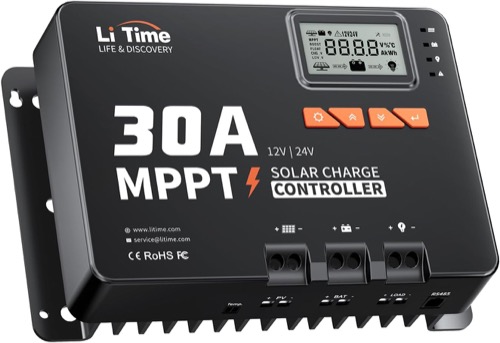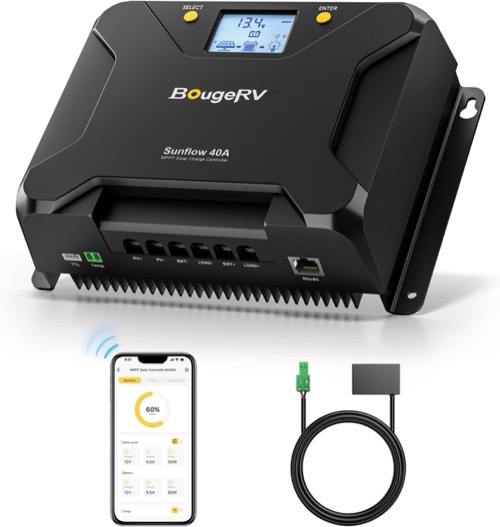
A 30A vs 40A solar charge controller decision starts with the charging job your battery will actually accept. The extra 10A can help a growing array, but it adds no harvest when the panel is small, the battery is full, or another system limit already constrains charging.
The featured examples are the LiTime 30A MPPT and the BougeRV Sunflow 40A 12V/24V model in our reviews. They make the current tradeoff concrete, but they are different products with different controls and input rules. Do not transfer one model’s allowable array to every controller with the same amperage.
The calculations below are planning estimates. We compare published product information and identify the measurements needed for a final design; we do not claim a controlled head-to-head output test.
30A vs 40A Solar Charge Controller: Begin at the Battery
A controller’s 30A or 40A label usually describes battery-side charge current. For an MPPT unit, PV-input current can be quite different because the controller converts voltage and current. A higher-voltage string may feed relatively low current into a controller that delivers much higher current to the battery.
Start with battery voltage, permitted charge current, and any other simultaneous chargers. A solar controller, alternator charger and shore charger can each be individually acceptable while their combined output exceeds the battery’s limit. Apply the battery manufacturer’s requirements and coordinate charge settings before selecting controller capacity.
Then decide whether the array belongs on a 12V or 24V bank. At a higher battery voltage, the same watts require less battery-side current. Changing bank voltage affects the inverter, loads, chargers and wiring, so it is a system decision rather than a free way to shrink one component.
Planning current ≈ available PV watts × assumed conversion factor ÷ actual charging voltage. Use an explicitly stated factor for an estimate; manufacturer input limits remain separate pass/fail checks.
Put Three Array Sizes Through the Same Assumptions
For an illustrative comparison, assume 95% conversion and a 14.4V charging point. A 300W input gives about 19.8A, 400W gives 26.4A, and 500W gives 33.0A before the output limit intervenes. These are arithmetic scenarios, not promised panel production or measured efficiencies of the featured controllers.
At 28.8V, those current estimates halve. That shows why an array that challenges a 30A controller on 12V can fit comfortably within its output envelope on 24V. It does not establish compatibility with the input voltage, Isc, manufacturer wattage allowance, or battery profile.
For the featured LiTime, published array input is 450W at 12V and 900W at 24V. The reviewed Sunflow lists 600W and 1,200W respectively. Therefore the 500W/12V example is not a LiTime approval: it exceeds that model’s published input-power figure even before discussing clipping.
| PV power used in calculation | At 14.4V and 95% | At 28.8V and 95% |
|---|---|---|
| 300W | 19.8A | 9.9A |
| 400W | 26.4A | 13.2A |
| 500W | 33.0A | 16.5A |
Separate a Brief Peak From a Useful Daily Gain
A controller touching 30A briefly does not establish the value of moving to 40A. Record when it reaches its limit, whether the battery still wants charge, and how long the limitation persists. If the battery reaches its absorption target soon afterward, the larger unit may save little useful time.
Suppose an upgrade could deliver an additional 4A for two hours at 14.4V. That is an estimated 115.2Wh delivered during that interval. Compare the extra energy with your actual deficit: refrigerator overnight use, communications equipment, or a battery recovery target. Avoid treating a percentage increase in controller rating as the same percentage increase in daily energy.
Clipping permission is manufacturer-specific. Some designs allow PV-power oversizing within voltage and current limits; other published input restrictions are stricter. The absolute cold-Voc limit remains binding regardless of any output-current limiting. Use the exact manual rather than a generic oversizing percentage from a forum or sales page.
Falling current near the charge-voltage target may indicate normal charge regulation. Check battery state and charge stage before interpreting low output as controller clipping.
The Featured Pair Has Different Boundaries Beyond Amps
Both featured controllers are MPPT models intended here for 12V/24V systems with local controls and Bluetooth. LiTime publishes an MPPT operating window from battery voltage plus 3V up to 76V, alongside a 100V maximum solar-input voltage. The operating window and the absolute voltage ceiling answer different questions.
For the reviewed Sunflow ISE218 family, BougeRV lists 100V maximum input with 95V protection and 90V recovery. A string regularly approaching its protection threshold can interrupt charging even if someone argues it remains below the absolute figure. Design comfortable operating headroom using the actual panel temperature range.
BougeRV now advertises cold-protection and sensor features on some Sunflow pages, while similarly named 40A listings also cover different bank voltages. Confirm the delivered revision, sensor, manual and restart behavior before depending on those claims. Our preserved specification record does not establish a lithium low-temperature cutoff for the exact reviewed unit.
Neither a missing published Isc value nor a large nominal output rating proves an unlimited PV input. Obtain the correct array-current rule from the manufacturer when finalizing parallel strings. If that boundary cannot be documented, the array design is still unresolved.
- Match the exact 12V/24V Sunflow version rather than a different 40A family.
- Check cold Voc, total Isc, operating voltage and voltage-specific array watts individually.
- Confirm the battery’s combined charging limit and temperature protection.
- Test the app and local menus from the installed location.
Price the Cable Route and Heat Along With the Controller
Forty amps can increase the demands on the battery-side cable, terminals, protection and compartment airflow. The correct conductor depends on allowable current, insulation rating, installation conditions, length and voltage drop. Use the controller’s documented terminal limits and torque; do not remove strands to force an oversized cable into a terminal.
For the same cable resistance, resistive heating scales with current squared. Moving from 30A to 40A would produce about 1.78 times the heating at that resistance. This is an electrical relationship, not a prediction that either featured unit overheats. It explains why a larger controller warrants a fresh cable and termination assessment.
Total cost includes modules, sensors, disconnects, fuses, cable, suitable lugs, mounting and time spent configuring the system. LiTime and the reviewed Sunflow include Bluetooth, so app access alone does not justify the extra 10A. Check whether essential setup and troubleshooting remain available when the phone has no internet connection.
Pay attention to access after installation. A controller that fits an empty cabinet may become difficult to inspect once heavy cables and nearby equipment are installed. Make room to read labels, inspect terminals and remove covers without disturbing another energized circuit.
Choose 30A for a Settled Array and 40A for a Supported Expansion
Choose 30A when the complete present array passes the exact unit’s input limits, expected battery charging comfortably fits, and growth is vague. Within the featured pair, LiTime is a candidate for that smaller defined job, subject to its battery settings and 450W/900W input figures.
Choose 40A when the planned array can use the added output, the battery permits it, and the wiring and thermal design accommodate it. The reviewed Sunflow is a candidate for a larger 12V/24V array, but its published limits and delivered revision still decide suitability.
For a final 30A vs 40A solar charge controller decision, write two lines: the current array and the specifically planned next array. If both fit 30A and no operating feature changes the decision, capacity alone is a weak reason to spend more. If the next design fails voltage or another input boundary on both units, look beyond this pair.
Use the LiTime 30A review and Sunflow 40A review with the LiTime product limits and BougeRV ISE218 specifications. The controller-sizing guide covers the complete sizing process.