The best waterproof solar charge controllers protect the electronics without encouraging buyers to ignore every connector, fuse, splice, and battery terminal around them. A formal enclosure rating matters, but outdoor reliability is a system property: corrosion, cable strain, condensation, UV, insects, and nighttime battery drain can defeat a sealed-looking installation.
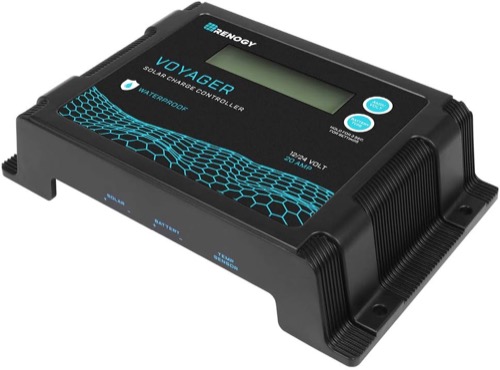
This category is also electrically uneven. The Renogy Voyager publishes voltage and watt limits plus a screen; SOLPERK and HUINE prioritize fixed leads and simple LEDs; TOPENS is a purpose-built 24V gate component rather than a universal charger.
We compared exact model specifications with captured owner reports from boats, gates, trailers, generators, sheds, and seasonal vehicles. Solar Power Picks did not repeat the manufacturers’ ingress tests, so an IP code is treated as documented enclosure evidence—not proof that an entire installed system is waterproof.
Outdoor rule — The installation is only as weather-resistant as its least protected energized connection. A rated controller body does not transfer its IP code to a user-added SAE plug or battery box.
Compare the Five Outdoor Approaches
The IP codes and weather wording are not interchangeable. Voyager and both SOLPERK units are documented as IP67; HUINE is described as IP68; the TOPENS profile says weather-resistant but does not publish a formal IP code.
| Product | Outdoor Badge | Type / Output | Published Environmental Rating | Battery System | Best Fit |
|---|---|---|---|---|---|
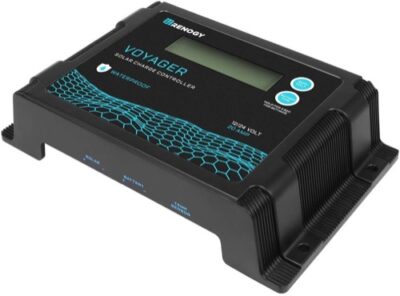
| Renogy Voyager 20A | Best Overall Waterproof Controller | PWM / 20A | IP67 | 12V / 24V | Portable panels, fences, boats, and trailers needing an LCD |
| SOLPERK 8A | Best Compact IP67 Maintainer | PWM / 8A | IP67 | 12V | Small vehicle or shed battery with independent monitoring |
| HUINE 20A | Best Fully Potted Lead-Acid Pick | PWM / 20A | IP68 | 12V / 24V | Fixed-lead outdoor lead-acid maintenance |
| TOPENS TCS3 | Best 24V Gate-System Replacement | PWM / current not published | Weather-resistant; no formal IP code published | 24V | Compatible TOPENS gate openers |
| SOLPERK 10A | Best SAE-Connected Outdoor Value | PWM / 10A | IP67 | 12V / 24V | Lead-acid gates, UTVs, and trailers |
Voyager is the only model here with both a numeric screen and a comparatively complete PV power/voltage table. Sealing increases as we move toward simpler potted hardware, but diagnostic and battery flexibility generally decrease.
How We Chose the Best Waterproof Solar Charge Controllers
Documented ingress protection received priority over visual appearance and marketplace use of “outdoor.” We then separated the controller enclosure from the installation around it and checked PV boundaries, battery chemistry, fixed-lead limitations, status information, and owner-reported field behavior.
Owner anecdotes were especially useful in this category. The sample includes controllers that survived wet fishing seasons, several years at a fuel station, and ordinary gate weather. It also includes reverse-drain reports, a sailboat panel failure that LEDs did not diagnose, ants occupying a gate enclosure, and controllers that failed after six to 24 months.
| Criterion | Outdoor Significance | Weight |
|---|---|---|
| Formal enclosure rating | Establishes a defined level of controller-body protection | High |
| Electrical documentation | Weather resistance cannot excuse unknown Voc/Isc/watts | High |
| Connection system | Fixed leads, SAE polarity, splices, and fuse holders are likely failure points | High |
| Diagnostics | Remote sites need evidence of useful charging, not only an LED | Medium |
| Battery/environment fit | Chemistry, freezing behavior, venting, and corrosion change suitability | Medium |
| Duration evidence | Multi-season reports identify maintenance expectations | Medium |
Evidence note — Customer reports can show that a unit worked outdoors in one installation. They cannot reproduce the standardized ingress test or establish a fleet-wide service life.
Best Overall Waterproof Controller: Renogy Voyager 20A
Voyager earns the lead because its weather protection does not require abandoning design data. Renogy publishes IP67, 20A output, 260W at 12V with a 25V PV ceiling, and 520W at 24V with a 55V ceiling. The LCD and local controls support lithium and lead-acid selection without an app.
Its topology is PWM, so panel voltage still needs to suit the battery. There are no programmable load terminals or communications. Captured owners repeatedly value the screen and outdoor use, and several describe months-to-years of service; the sample also includes setup frustration and one failure at about 11 months.
Choose Voyager for a portable suitcase, fence, trailer, or protected marine installation where readable local data matters. It is not the answer for a high-voltage series array or a remote system that requires historical telemetry.
Best Compact IP67 Maintainer: SOLPERK 8A
The 8A SOLPERK is the smallest and simplest option: an IP67 body, fixed leads, and two LEDs for a 12V maintenance system. Owners report useful service on vehicles, sheds, fishing equipment, and small panels. One measured a charge cycle reaching about 14.2V before the battery settled lower.
Its weakness is false reassurance. During an expedition-style sailboat race, one owner lost power after the panel failed while the controller continued flashing as if charging. Another measured 136mV on the PV side during a leakage investigation after an RV battery discharged unusually quickly; voltage alone did not quantify leakage current, but the account justifies an overnight test.
Battery-chemistry evidence also conflicts: one support response repeated by an owner mentioned automatic LiFePO4 recognition, while the normalized profile does not establish a complete lithium strategy. Choose it only when the exact revision is confirmed and an independent meter or monitor will verify real current.
Best Fully Potted Lead-Acid Pick: HUINE 20A
HUINE’s IP68 potted body and fixed leads make it the strongest sealed-electronics concept here. Captured uses include generator-start batteries with a 160W panel, a 20W boat panel, an outdoor shower battery, and several years at a 12V fueling station.
The use case is narrow. The reviewed manual excludes lithium; maximum PV Voc, Isc, watts, lead gauge, and terminal extension rules were not published. Status comes from LEDs rather than numeric readings. One owner also reported failure after about two years even though the controller was in an unheated garage rather than direct weather.
HUINE is a plausible lead-acid maintainer when potting and fixed cables solve a real exposure problem. Do not design near the nominal 20A rating without the missing PV envelope, and do not assume sealed electronics eliminate voltage-drop or splice heat.
Best 24V Gate-System Replacement: TOPENS TCS3
TOPENS TCS3 belongs in this roundup for ecosystem fit, not a formal IP claim. It is a weather-resistant PWM controller for compatible 24V gate systems and publishes up to 240W at 24V. Owners describe support-confirmed replacement, two deep-cycle 12V batteries in series, and three 10W panels keeping a gate bank charged.
Rated current, PV Voc, PV Isc, and a formal IP code were not available. Two buyers also reported short service: roughly six months for one unit and about 18 months for each of two units in another installation. A separate owner discovered ants around the equipment before replacement restored the gate.
Choose TCS3 only after TOPENS confirms the exact opener/control-board compatibility. A general-purpose MPPT with better specifications may suit a custom gate, but changing ecosystems requires a complete wiring, battery, and control review.
Best SAE-Connected Outdoor Value: SOLPERK 10A
The 10A SOLPERK adds automatic 12V/24V operation and published allowances of 150W at 12V or 300W at 24V. IP67 construction and quick SAE leads work for UTVs, trailers, gates, and other lead-acid maintenance roles.
SAE convenience creates a polarity trap because mechanically compatible accessories do not always preserve the same positive/negative arrangement. One buyer initially reported a dead unit, then corrected the review after finding reversed polarity. The sample also includes a battery-drain account, one genuine dead-on-arrival report, and a repeat owner whose first controller began allowing nighttime discharge after about three years.
Verify every connector with a meter before connection and measure reverse current after dark. This is the better SOLPERK when 24V support and published watts matter; the 8A remains the smaller 12V-only maintainer.
Match Exposure and Diagnostics to the Site
| Product | Suitable Outdoor Context | Best For | Skip If | Limit to Verify |
|---|---|---|---|---|
| Voyager 20A | Exposed PWM system needing local numbers | Most complete general outdoor use | Series voltage or remote history is needed | 25V/55V cold Voc and array current |
| SOLPERK 8A | Tiny 12V maintainer with separate meter | Compact IP67 electronics | LEDs are the only monitoring for a critical load | Exact chemistry, PV limits, nighttime leakage |
| HUINE 20A | Potted 12V/24V lead-acid system | Maximum controller-body sealing | Lithium or detailed array expansion is planned | Voc/Isc/watts and fixed-lead drop |
| TOPENS TCS3 | Confirmed 24V gate ecosystem | Drop-in gate replacement | Universal solar-controller flexibility is expected | Opener compatibility, current/Voc/Isc, enclosure status |
| SOLPERK 10A | SAE-connected lead-acid maintainer | UTV/trailer/gate convenience | Lithium or telemetry is required | SAE polarity, reverse drain, missing Voc/Isc |
Design the Outdoor System Beyond the Controller
Read IP Codes Narrowly
An IP rating applies to the tested enclosure under defined conditions. It does not promise indefinite submersion, saltwater compatibility, UV life, or resistance after the case/cable is damaged. “Weather-resistant” without a code is still useful descriptive information but should not be silently upgraded to IP67.
Mount according to the exact manual and keep every seal and cable exit unstressed. Do not drill a potted or sealed controller to create a bracket. Opening or modifying an enclosure can destroy the protection that justified the purchase.
Engineer Every Field Connection
Place drip loops where appropriate, support cables, protect against abrasion, and use connectors/fuse holders rated for the actual exposure. A waterproof body feeding an indoor-only fuse holder is not a waterproof circuit. On boats, comply with applicable marine rules for corrosion, overcurrent protection, ignition risks, and conductor selection.
Fixed leads simplify the controller interface but force any extension into the field. Calculate round-trip voltage drop at maximum expected current and keep splices inspectable. If a connector warms, discolors, loosens, or traps water, safely de-energize and correct it.
Connection check — Inspect the dry side and the wet side. Corrosion can increase resistance before a connection fails completely, reducing charge while the status light still appears normal.
Monitor Energy, Not Just Indicator State
The SOLPERK 8A sailboat report demonstrates the limit of voltage/LED detection: a failed panel may show voltage but deliver almost no current. For a critical gate, navigation light, pump, or communication battery, measure array current under load and track battery voltage/energy over time.
At commissioning, record a healthy full-sun reading, sunset battery voltage, overnight change, and next-day recovery. Repeat after storms, transport, seasonal storage, or unexplained low voltage. A small battery monitor can be more valuable than choosing the controller with the highest ingress code.
Match Chemistry to Outdoor Temperature
HUINE and SOLPERK 10A are lead-acid choices in the reviewed profiles. Voyager supports lithium selection, but a menu does not prove low-temperature LiFePO4 cutoff. TOPENS lithium wording remains ambiguous, and SOLPERK 8A evidence conflicts.
For freezing lithium sites, require documented BMS/controller protection. For lead-acid, account for temperature compensation, venting, water level where applicable, and reduced winter capacity. The battery enclosure may have very different environmental requirements from the controller.
Plan for Insects, Condensation, and Maintenance
Outdoor electronics can fail without direct rain. Condensation forms inside surrounding boxes, ants enter cable gaps, vegetation shades panels, and thermal cycling loosens or hardens materials. Create an inspection schedule rather than waiting for the gate or engine not to start.
Keep baseline readings, controller model/revision, connector polarity, and battery age in a small service record. For sealed units that cannot be repaired, confirm a replacement can be installed without cutting undocumented wiring.
Preliminary Outdoor Sizing Examples
These estimates divide array watts by representative charging voltage. They do not resolve missing PV limits or cold-corrected Voc.
| Hypothetical Site | Array Watts | Series Voc at STC | Battery | Approx. Output Demand | Still Must Verify |
|---|---|---|---|---|---|
| Seasonal vehicle | 20W | 22V | 12V lead-acid | 20 ÷ 14.4 = 1.4A | Parasitic load, nighttime current, connector polarity |
| Portable suitcase | 200W | 24V | 12V LiFePO4 | 200 ÷ 14.2 = 14.1A | Voyager cold Voc, chemistry/cold cutoff, cable loss |
| Remote 24V fence | 400W | 44V | 24V lead-acid | 400 ÷ 28.8 = 13.9A | Winter 55V ceiling, PV current, daily gate/fence load |
| Gate maintenance | 60W | 44V | 24V lead-acid | 60 ÷ 28.8 = 2.1A | TCS3 compatibility, panel arrangement, standby energy |
Outdoor Buying Mistakes
- Calling a product waterproof when only weather-resistant wording is documented.
- Assuming the controller’s IP rating covers connectors, fuses, and the battery.
- Choosing from rated output amps while PV Voc/Isc/watts are missing.
- Trusting LEDs without measuring useful current under load.
- Treating all SAE connectors as the same polarity.
- Installing LiFePO4 outdoors without verified cold-charge protection.
- Copying a gate or boat wiring diagram from a different product revision.
- Ignoring insects, condensation, UV, strain relief, and seasonal inspection.
Bottom Line — Best Waterproof Solar Charge Controllers
The Renogy Voyager 20A is the most complete general-purpose winner because it pairs IP67 protection with a numeric display and published 12V/24V voltage-and-watt limits. HUINE is the stronger potted lead-acid choice when sealing matters more than data, while SOLPERK 10A offers useful SAE convenience after polarity and reverse-drain checks. SOLPERK 8A belongs only in smaller independently monitored systems, and TOPENS TCS3 is a compatibility-led gate replacement.
Before choosing among these best waterproof solar charge controllers, verify the exact enclosure rating, PV Voc/Isc/watts, battery chemistry and temperature behavior, cable drop, connector polarity, fuse/disconnect exposure, and monitoring plan. Outdoor hardware becomes trustworthy through documented limits plus scheduled measurements—not through a sealed case alone.